Ciksaulī
चिकसौली Hindi name proposed
Also called Chiksoli
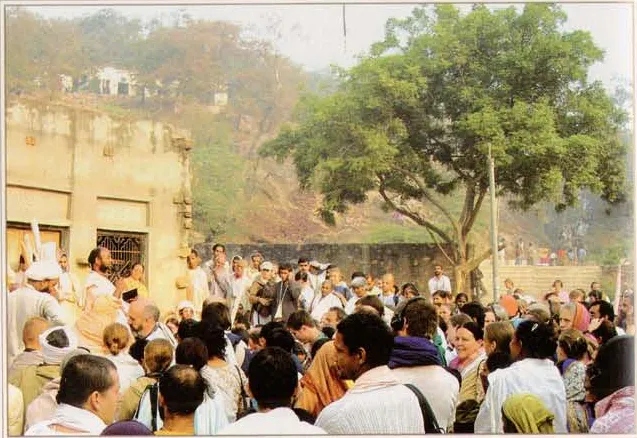
- What it is
- Ciksaulī is a village at the foot of the hill of Varṣāṇā, between Sāṅkarī-khor and Gahvaravana, as the guidebook Śrī Vraja-maṇḍala Parikramā (2007) places it.
- Visiting
- Śrī Vraja-maṇḍala Parikramā (2007) places Ciksaulī below the hill it calls Brahmācala-parvata (Brahma-parvata), with Sāṅkarī-khor to the north and Dohanī-kuṇḍa to the south-west.
In short
Ciksaulī is a village at the foot of the hill of Varṣāṇā, between Sāṅkarī-khor and Gahvaravana, as the guidebook Śrī Vraja-maṇḍala Parikramā (2007) places it.[1 +2] The Bhakti-ratnākara says that its old name was Citraśālī, the picture hall, and that the sakhī expert in dressing Śrī Rādhā lived here.[4] Śrī Vraja-maṇḍala Parikramā and the undated parikramā notes Varṣāṇā call it the birthplace of Citrā Sakhī, one of Rādhā's eight principal companions.[2 +1] Śrī Vraja-maṇḍala Parikramā also tells here how young Rādhikā was first attracted to Kṛṣṇa, in a pastime that Śrīla Rūpa Gosvāmī describes without naming a place.[2 +2]
Key facts
| Kind | village |
|---|---|
| Region · area | Varṣāṇā |
| Ācāryas | Śrīla Narahari Cakravartī Ṭhākura, Śrīla Śrīnivāsa Ācārya, Śrīla Rūpa Gosvāmī, Śrīla Rāghava Paṇḍita Gosvāmī of Govardhana |
Divine pastimes
Rādhā's first attraction
The Bhāgavatam (10.21) tells how, in autumn, Kṛṣṇa entered the forest with Balarāma and the cowherd boys, herding the cows and playing His flute, and how the young women of Vraja heard the flute-song and some of them spoke of Him privately to their close friends. Śrīla Jīva Gosvāmī calls this the gopīs' pūrvānurāga, their first attraction before meeting Him. The Bhāgavatam does not name Ciksaulī, Rādhā or Citrā.[7 +3]
tad vraja-striya āśrutya veṇu-gītaṃ smarodayam / kāścit parokṣaṃ kṛṣṇasya sva-sakhībhyo 'nvavarṇayan
When the young ladies in the cowherd village of Vraja heard the song of Kṛṣṇa’s flute, which arouses the influence of Cupid, some of them privately began describing Kṛṣṇa’s qualities to their intimate friends.
Translation: Śrīla Prabhupāda's disciples (BBT)Śrīla Rūpa Gosvāmī's drama Vidagdha-mādhava (2.9) tells how Rādhā felt drawn to three persons at once: the one named Kṛṣṇa, the flute player and the one in the picture that Viśākhā had brought. Her friends tell Her that all three are one. Śrīla Prabhupāda translates the verse in the Caitanya-caritāmṛta (Antya 1.142); it names no place.[5 +2]
ekasya śrutam eva lumpati matiṁ kṛṣṇeti nāmākṣaraṁ sāndronmāda-paramparām upanayaty anyasya vaṁśī-kalaḥ
eṣa snigdha-ghana-dyutir manasi me lagnaḥ paṭe vīkṣaṇāt kaṣṭaṁ dhik puruṣa-traye ratir abhūn manye mṛtiḥ śreyasī ||9||
“[Experiencing previous attachment to Kṛṣṇa (pūrva-rāga), Śrīmatī Rādhārāṇī thought:] ‘Since I have heard the name of a person called Kṛṣṇa, I have practically lost My good sense. Then, there is another person who plays His flute in such a way that after I hear the vibration, intense madness arises in My heart. And again there is still another person to whom My mind becomes attached when I see His beautiful lightninglike effulgence in His picture. Therefore I think that I am greatly condemned, for I have become simultaneously attached to three persons. It would be better for Me to die because of this.’
Translation: Śrīla A.C. Bhaktivedanta Swami PrabhupādaAbout this place: Śrī Rādhā's first attraction (pūrva-rāga) to 'three persons': the one named Kṛṣṇa, the flute-player and the one in the picture. In the play both Her friends, Lalitā and Viśākhā, answer that these three are the one Kṛṣṇa, and the picture is the one Viśākhā brought in the first act.
According to Śrī Vraja-maṇḍala Parikramā, this happened at Ciksaulī: Rādhikā heard the flute, saw a painting of Kṛṣṇa that Citrā Sakhī had made, and saw the cowherd youth going out with the cows. She told Lalitā that She was attached to three men, and Lalitā laughed that all three were Nanda-nandana, the son of Nanda.[2] No older text sets this pastime here, and the tellings differ in details.[2]
Accounts differ The pastime of Rādhā's attraction to 'three persons' that Śrī Vraja-maṇḍala Parikramā (2007) tells at Ciksaulī.
- Śrīmad-Bhāgavatam 10.21.2–3 (translations by Śrīla Prabhupāda's disciples), with Śrīla Jīva Gosvāmī's Krama-sandarbha on 10.22.1–2In autumn, as Kṛṣṇa entered the forest herding the cows and playing His flute, the young women of Vraja heard it and some of them described Him privately to their intimate friends; Śrīla Jīva Gosvāmī calls this the gopīs' pūrvānurāga. No Rādhā, painting or 'three persons'; no place.
- Śrīla Prabhupāda, Kṛṣṇa book ch. 21The gopīs heard the flute as Kṛṣṇa entered the forest with the cows, remembered Him and talked among themselves about His flute; they also remembered their pastimes with Him.
- Śrī Vraja-maṇḍala Parikramā (2007)At Ciksaulī Rādhikā hears the flute, sees a painting of Kṛṣṇa that Citrā Sakhī had made and sees the cowherd youth going to graze; She tells Lalitā She is attached to three men; Lalitā laughs: all three are Nanda-nandana.
- Śrīla Rūpa Gosvāmī, Vidagdha-mādhava 1.36, 2.9–10The three are the one whose name Kṛṣṇa She heard, the flute-player and the one in the picture that Viśākhā brought; both friends (Lalitā and Viśākhā) answer that this great lover Kṛṣṇa is only one; no place is named.
The wording of these accounts is our summary of the sources, not a published translation.
Śrīla Prabhupāda teaches, as a general point, that pūrva-rāga (attraction before meeting) is one of the kinds of separation celebrated in Śrīmatī Rādhārāṇī and the gopīs.[12]
Traditional accounts
In the Fifth Wave of the Bhakti-ratnākara, Śrīla Rāghava Paṇḍita Gosvāmī of Govardhana shows Śrīla Śrīnivāsa Ācārya the village …
The village of Citrā Sakhī
In the Fifth Wave of the Bhakti-ratnākara, Śrīla Rāghava Paṇḍita Gosvāmī of Govardhana shows Śrīla Śrīnivāsa Ācārya the village Cikasaulī and says (summarised here, not translated) that it was formerly Citraśālī, the home of the sakhī who was expert in dressing Rāi (Rādhā) in wonderful clothes. The verse does not name the sakhī.[4]
চিকসৌলী গ্রাম পূর্ব্বে এই চিত্রশালী। এথা রাই বিচিত্র বেশেতে দক্ষ আলি ॥
cikasaulī grāma pūrbbe ei citraśālī| ethā rāi bicitra beśete dakṣa āli ||
Śrī Vraja-maṇḍala Parikramā and the undated parikramā notes Varṣāṇā call Ciksaulī the birthplace of Citrā Sakhī. The guidebook names her parents Catura Gopa and Carcitā Gopī and her husband Pīṭhara Gopa of Jāvaṭa.[2 +1] Śrīla Rūpa Gosvāmī's Rādhā-Kṛṣṇa-gaṇoddeśa-dīpikā gives the same parents and husband and calls Citrā the fourth of Rādhā's chief sakhīs, but does not name her village.[11]
The toll path
The parikramā notes set the dāna-keli, Kṛṣṇa's toll pastime, at Sāṅkarī-khor, the narrow gorge between the hills "between village Chiksauli and Varsana". The guidebook Vṛndāvana-Dhāma Ki Jaya! (c. 1986) likewise puts the narrow passage where Kṛṣṇa taxed the gopīs on the path between Varṣāṇā and "the village of Citra". Neither sets the pastime in the village itself.[14 +1]
Visiting today
Śrī Vraja-maṇḍala Parikramā (2007) places Ciksaulī below the hill it calls Brahmācala-parvata (Brahma-parvata), with Sāṅkarī-khor to the north and Dohanī-kuṇḍa to the south-west. The parikramā notes say that it lies next to Varṣāṇā, on the other side of Sāṅkarī-khor.[1 +2]
Location
| Where it is | below Brahmācala-parvata, between Saṅkarī-khor and Gahvaravana; Sāṅkarī-khor north of it, Gahvaravana west of it; map: inside the road loop at the bottom centre, east of 9[16] 'This village is next to Varsana, on the other side of Sankari kor'[3] |
|---|
Nearby places
Brahma-parvata · Gahvaravana (Varṣāṇā) · Varṣāṇā · Sāṅkarī-khor
References
- Śrī Vraja-maṇḍala Parikramā (2007), PDF p. 171
- Śrī Vraja-maṇḍala Parikramā (2007), PDF p. 177
- the undated parikramā notes Varṣāṇā, ¶16
- Śrīla Narahari Cakravartī, Bhakti-ratnākara, Fifth Wave, 1912 ed. p. 219; Grantha Mandira text v.908, 2nd ed., 1912
- Śrīla Rūpa Gosvāmī, Vidagdha-mādhava, Act 2 (veṇu-nāda-vilāsa) v.9
- Śrīla Prabhupāda, Śrī Caitanya-caritāmṛta, Antya-līlā 1.142, translation · vedabase.io
- Śrīmad-Bhāgavatam 10.21.2, GRETIL
- Śrīmad-Bhāgavatam 10.21.3, GRETIL
- Krama-sandarbha of Śrīla Jīva Gosvāmī on Śrīmad-Bhāgavatam 10.22.1–2: commentary on ŚB 10.22.1–2, Bhagavata Vidya Pith edition, ed. Bhagavata Rishi and Krishna Shankar Shastri, 1996
- Śrīla Prabhupāda, Kṛṣṇa, the Supreme Personality of Godhead, ch. 21 'The Gopīs Attracted by the Flute' · vedabase.io
- Śrīla Rūpa Gosvāmī, Rādhā-Kṛṣṇa-gaṇoddeśa-dīpikā, part 1 vv.86–87
- Śrīla Prabhupāda, Śrī Caitanya-caritāmṛta, Madhya-līlā 23.64, translation · vedabase.io
- Śrīla Narahari Cakravartī, Bhakti-ratnākara, Fifth Wave, 1912 ed. p. 219; Grantha Mandira text v.908, 2nd ed., 1912
- the undated parikramā notes Varṣāṇā, ¶15
- Vṛndāvana-Dhāma Ki Jaya! (c. 1986), by Dhruva Mahārāja dāsa, PDF p. 48
- Śrī Vraja-maṇḍala Parikramā (2007), p. 328-329