Dhruva-tīrtha
ध्रुव-तीर्थ Hindi name proposed
Also called Dhurav ghat
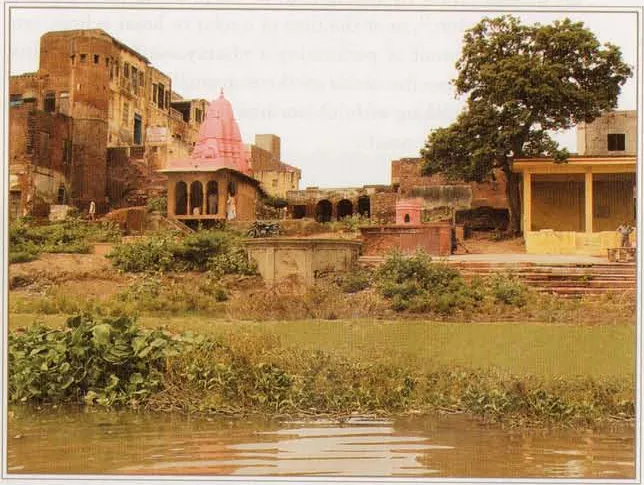
- What it is
- Dhruva-tīrtha, also called Dhruva-ghāṭa, is one of the twelve ghāṭas (bathing places) of Mathurā south of Viśrāma-ghāṭa, on the Yamunā.
- Visiting
- The guidebook Śrī Vraja-maṇḍala Parikramā (2007) counts Dhruva-tīrtha as the eighth of the twelve ghāṭas south of Viśrāma-ghāṭa; Śrīla Prabhupāda's list of the twenty-four gives it as the ninth.
In short
Dhruva-tīrtha, also called Dhruva-ghāṭa, is one of the twelve ghāṭas (bathing places) of Mathurā south of Viśrāma-ghāṭa, on the Yamunā.[1 +3] The Varāha Purāṇa calls it the place where the boy Dhruva performed the highest austerity, and says that a bath here gives honour in Dhruva's world and that śrāddha, the offering to the forefathers, made here delivers them all.[5 +6] Śrīla Prabhupāda describes the ghāṭa, with its fruit and flower trees, as the place where Dhruva Mahārāja meditated and performed severe austerities on an elevated spot.[12 +1] Here, the Caitanya-caritāmṛta says, Śrī Subuddhi Rāya met Śrīla Rūpa Gosvāmī when he came to Mathurā.[14]
Key facts
| Kind | ghāṭa |
|---|---|
| Region · area | Mathurā |
| Also part of | Yamunā |
| Ācāryas | Śrīla Rūpa Gosvāmī, Śrī Subuddhi Rāya, Śrīla Narahari Cakravartī Ṭhākura, Śrī Caitanya Mahāprabhu |
Why it is glorified
In its list of Mathurā's tīrthas the Varāha Purāṇa names the place where Dhruva of his own wish performed the highest austerity.
In its list of Mathurā's tīrthas the Varāha Purāṇa names the place where Dhruva of his own wish performed the highest austerity. By bathing there one is honoured in Dhruvaloka, Dhruva's world, and one who dies there is honoured in the Lord's world; śrāddha offered there delivers all one's forefathers, above all in their fortnight, the pitṛ-pakṣa (summarised here, not translated).[5 +6]
ध्रुवेण यत्र सन्तप्तं स्वेच्छया परमं तपः ।। तत्र वै स्नानमात्रेण ध्रुवलोके महीयते ॥ 59 ॥ तत्राथ मुञ्चते प्राणान्मम लोके महीयते ।। ध्रुवतीर्थे तु वसुधे यः श्राद्धं कुरुते नरः ॥ 152.60 ॥ पितॄंस्तारयते सर्वं पितृपक्षे विशेषतः ।। दक्षिणे ध्रुवतीर्थस्य तीर्थराजं प्रकीर्तितम् ॥ 61 ॥
dhruveṇa yatra santaptaṁ svecchayā paramaṁ tapaḥ
tatra vai snānamātreṇa dhruvaloke mahīyate tatrātha muñcate prāṇānmama loke mahīyate
dhruvatīrthe tu vasudhe yaḥ śrāddhaṁ kurute naraḥ pitṝṁstārayate sarvaṁ pitṛpakṣe viśeṣataḥ
dakṣiṇe dhruvatīrthasya tīrtharājaṁ prakīrtitam
A whole chapter of the Varāha Purāṇa (180) tells "what happened long ago at Dhruva-tīrtha", the story of King Candrasena of this city and the forefathers of his queen's maid. In it the Lord says that in the month of Āśvina the forefathers leave their worlds empty and gather at Dhruva-tīrtha, waiting for their descendants to offer them śrāddha.[5 +5]
Śrīla Rūpa Gosvāmī collected the verses on Dhruva-tīrtha in his Mathurā-māhātmya. With the Ādi-varāha verses he quotes the Saura Purāṇa, which calls it a chief tīrtha where liberation is certain (dhruva) for one who bathes. He also quotes the Mathurā-khaṇḍa of the Skanda Purāṇa: piṇḍa, the rice offering to the forefathers, given here brings a hundred times the fruit of piṇḍa at Gayā, and chanting, fire offerings, austerity, charity and worship here bring a hundred times the fruit of all tīrthas (summarised here, not translated).[9 +2]
The Bhakti-ratnākara of Śrīla Narahari Cakravartī Ṭhākura says the same in Bengali: Dhruva-tīrtha is the place of Dhruva's austerity, a bath here surely gives Dhruvaloka, śrāddha here delivers the forefathers, and chanting here gives the fruit of all tīrthas. It quotes the same verses.[6 +1]
এই ধ্রুবতীর্থ ধ্রুবতপস্যার স্থান। ধ্রুবলোকপ্রাপ্তি ধ্রুব হয় কৈলে স্নান॥ তীর্থমুখ্য এথা শ্রাদ্ধে পিতৃলোক তরে। সর্ব্বতীর্থ ফল পায় জপাদি যে করে॥ তথাহি আদিবারাহে॥ যত্র ধ্রুবেণ সন্তপ্তমিচ্ছয়া পরমং তপঃ। তত্রৈব স্নানমাত্রেণ ধ্রুবলোকে মহীয়তে॥ ধ্রুবতীর্থেতু বসুধে যঃ শ্রাদ্ধং কুরুতে নরঃ। পিতৃন্ সংতারয়েৎ সর্ব্বান্ পিতৃপক্ষে বিশেষতঃ॥
ei dhrubatīrtha dhrubatapasyāra sthāna| dhrubalokaprāpti dhruba haya kaile snāna|| tīrthamukhya ethā śrāddhe pitṛloka tare| sarbbatīrtha phala pāya japādi ye kare|| tathāhi ādibārāhe|| yatra dhrubeṇa santaptamicchayā paramaṁ tapaḥ| tatraiba snānamātreṇa dhrubaloke mahīyate|| dhrubatīrthetu basudhe yaḥ śrāddhaṁ kurute naraḥ| pitṛn saṁtārayet sarbbān pitṛpakṣe biśeṣataḥ||
Divine pastimes
Dhruva's austerity
In Śrīmad-Bhāgavatam the sage Nārada sends the boy Dhruva to Madhuvana, a holy forest on the bank of the Yamunā where the Lord is always present. He tells him to bathe in the Yamunā three times a day and to worship the Lord there, and Dhruva arrives, bathes, fasts that night and begins his worship.[17 +2]
tat tāta gaccha bhadraṃ te yamunāyās taṭaṃ śuci / puṇyaṃ madhuvanaṃ yatra sānnidhyaṃ nityadā hareḥ
My dear boy, I therefore wish all good fortune for you. You should go to the bank of the Yamunā, where there is a virtuous forest named Madhuvana, and there be purified. Just by going there, one draws nearer to the Supreme Personality of Godhead, who always lives there.
Translation: Śrīla A.C. Bhaktivedanta Swami PrabhupādaThe Viṣṇu Purāṇa also places Dhruva's austerity in Madhuvana on the Yamunā, the place where Śatrughna later built the city of Mathurā, and the Garga-saṁhitā says that Dhruva won the abode of Viṣṇu by austerity in Madhuvana.[20 +2] The Bhāgavatam does not name the ghāṭa. The Varāha Purāṇa and the Bhakti-ratnākara set the austerity here, while the modern guidebooks place it in the highlands of Madhuvana; the sources also differ on where Dhruva met his teacher.[5 +4] Read more: Madhuvana, Dhruva and the founding of Mathurā →
Accounts differ Where Dhruva performed his austerities.
- Varāha Purāṇa 152.59 and the Bhakti-ratnākara (printed p. 173)At Dhruva-tīrtha in Mathurā: where Dhruva performed the highest austerity; 'this Dhruva-tīrtha is the place of Dhruva's austerity'.
- Śrīla Prabhupāda, ŚB 4.8.42 purportAt Dhruva-ghāṭa, 'in an elevated spot'.
- Śrīmad-Bhāgavatam 4.8.42, 4.8.71; Viṣṇu Purāṇa 1.12.2-5; Garga-saṁhitā 5.25.18In Madhuvana on the Yamunā (the Viṣṇu Purāṇa adds: where Mathurā was later built).
- Śrī Vraja-maṇḍala Parikramā (2007) and the undated parikramā notes MathurāHe only bathed and received the mantra at Dhruva-tīrtha, then performed his austerities in the isolated highlands of Madhuvana, at Dhruva-ṭīlā east of Maholī.
The wording of these accounts is our summary of the sources, not a published translation.
Traditional accounts
According to the local tradition recorded in the guidebook Śrī Vraja-maṇḍala Parikramā (2007), after killing Kaṁsa, Kṛṣṇa had …
According to the local tradition recorded in the guidebook Śrī Vraja-maṇḍala Parikramā (2007), after killing Kaṁsa, Kṛṣṇa had Kaṁsa's funeral rites performed at Dhruva-ghāṭa and then rested at Viśrāma-ghāṭa; the book gives no source, so this is not certain.[23 +2] Śrīmad-Bhāgavatam tells that Kṛṣṇa consoled the royal ladies and had the funeral rites performed, but it does not name the place.[24 +1]
śrī-śuka uvāca rāja-yoṣita āśvāsya bhagavāṃl loka-bhāvanaḥ / yām āhur laukikīṃ saṃsthāṃ hatānāṃ samakārayat
Śukadeva Gosvāmī said: After consoling the royal ladies, Lord Kṛṣṇa, sustainer of all the worlds, arranged for the prescribed funeral rites to be performed.
Translation: Śrīla Prabhupāda's disciples (BBT)According to the same guidebook, many respected members of the Nimbārka sampradāya, another Vaiṣṇava line, have lived at Dhruva-tīrtha, and it calls the place the only one left to that line in Vraja.[7 +1]
The Gosvāmīs and ācāryas
The Caitanya-caritāmṛta (Madhya 25.186) tells that when Śrīla Rūpa Gosvāmī reached Mathurā, Śrī Subuddhi Rāya met him on the bank …
The Caitanya-caritāmṛta (Madhya 25.186) tells that when Śrīla Rūpa Gosvāmī reached Mathurā, Śrī Subuddhi Rāya met him on the bank of the Yamunā at Dhruva-ghāṭa.[14]
এথা রূপ-গোসাঞি যবে মথুরা আইলা ।
ধ্রুবঘাটে তাঁরে সুবুদ্ধিরায় মিলিলা ॥ ১৮৬ ॥
ethā rūpa-gosāñi yabe mathurā āilā
dhruva-ghāṭe tāṅre subuddhi-rāya mililā
When Rūpa Gosvāmī reached Mathurā, he met Subuddhi Rāya on the banks of the Yamunā, at a place called Dhruva-ghāṭa.
Translation: Śrīla A.C. Bhaktivedanta Swami PrabhupādaThe same book says that Śrī Caitanya Mahāprabhu bathed in the twenty-four ghāṭas of the Yamunā at Mathurā, and Śrīla Prabhupāda's purport lists Dhruva-ghāṭa as the ninth of them.[2 +1] Read more: The twenty-four ghāṭas of Mathurā →
Śrīla Prabhupāda
In his purport to Śrīmad-Bhāgavatam 4.8.42, where Nārada sends Dhruva to Madhuvana, Śrīla Prabhupāda lists the bathing places of …
In his purport to Śrīmad-Bhāgavatam 4.8.42, where Nārada sends Dhruva to Madhuvana, Śrīla Prabhupāda lists the bathing places of the area and describes this one:[12 +1]
Names this place“(9) Dhruva-ghāṭa (Dhruva-ghāṭa, where there are many nice trees of fruits and flowers, is famous because Dhruva Mahārāja meditated and underwent severe penances and austerities there in an elevated spot)”
Śrīla Prabhupāda, Śrīmad-Bhāgavatam, 4.8.42, purport · vedabase.io
Visiting today
The guidebook Śrī Vraja-maṇḍala Parikramā (2007) counts Dhruva-tīrtha as the eighth of the twelve ghāṭas south of Viśrāma-ghāṭa; Śrīla Prabhupāda's list of the twenty-four gives it as the ninth.[1 +3] Śrīla Rūpa Gosvāmī's verses and the Bhakti-ratnākara place Ṛṣi-tīrtha next to it on the south, and Śrīla Prabhupāda's list names Ṛṣi-tīrtha right after Dhruva-ghāṭa.[2 +3]
Nearby places
Ṛṣi-tīrtha
History
Two British district books, F. S. Growse's Mathurá (1883) and the district gazetteer of 1911, say that the small temple of Dhruva Jī on the hill behind the ghāṭa, the Dhruva-ṭīlā, was built in Saṁvat 1894 (A.D. 1837) beside the ruins of an older shrine. They report that priests of the Nimbārka sampradāya served it and counted it among their oldest shrines.[27 +1]
Where the sources differ
Where Dhruva met his instructor and who instructed him.
Accounts differ Where Dhruva met his instructor and who instructed him.
- Śrī Vraja-maṇḍala Parikramā (2007) and the undated parikramā notes MathurāHe met Devarṣi Nārada at this ghāṭa, was told to bathe here and received the twelve-syllable mantra here.
- Śrīmad-Bhāgavatam 4.8.25, 4.8.42-54, 4.8.71Nārada met him after he left his father's house (place not named), gave the mantra and sent him to Madhuvana, where he bathed on arrival.
- Viṣṇu Purāṇa 1.12.1, 1.12.6The sages headed by Marīci instructed him before he went to Madhuvana; Nārada is not named.
How an offering to the forefathers here compares with one at Gayā.
Accounts differ How offering piṇḍa or śrāddha at Dhruva-tīrtha compares with Gayā.
- Śrī Vraja-maṇḍala Parikramā (2007) and the undated parikramā notes MathurāThe forefathers get results equivalent to offering piṇḍa in Gayā.
- Śrī Vraja-maṇḍala Parikramā (2007)'s own endnote 27 (Ādi-varāha; Varāha 152.59-61)Śrāddha at Dhruva-tīrtha delivers all the forefathers; Gayā is not mentioned.
- Skanda 'Mathurā-khaṇḍa' as quoted by Śrīla Rūpa Gosvāmī (v.254) and the Bhakti-ratnākara (printed p. 174)Piṇḍa at Dhruva-tīrtha gives a hundred times the fruit of piṇḍa at Gayā.
- Varāha Purāṇa 180.129-130Reciting this account of Dhruva-tīrtha before brāhmaṇas satisfies the forefathers as if one had gone to Gayā-śiras.
Accounts differ Whether Dhruva-tīrtha is the only remaining place of the Nimbārka sampradāya in Vraja.
- Śrī Vraja-maṇḍala Parikramā (2007), the undated parikramā notes MathurāIt is 'the only remaining place of that ancient sampradāya in Vraja-maṇḍala'.
- Growse, Mathurá (1883; low priority)The Dhruva-hill shrine is one of the Nimbārkas' oldest; they also have a temple at Brinda-ban dedicated to Rasik Bihārī.
- Muttra gazetteer (1911; low priority)The Dhruva temple belongs to the Nimbārka Vaiṣṇavas who own the temple of Rasik Bihārī at Brindaban.
Accounts differ Which tīrtha lies immediately south of Dhruva-tīrtha.
- Śrī Vraja-maṇḍala Parikramā (2007)Ṛṣi-tīrtha ('dakṣiṇe dhruva-tīrthasya ṛṣi-tīrthaṁ prakīrtitam').
- Varāha Purāṇa 152.61-62First the 'Tīrtharāja' ('dakṣiṇe dhruvatīrthasya tīrtharājaṁ prakīrtitam'), and Ṛṣi-tīrtha south of that.
- Śrīla Rūpa Gosvāmī, Mathurā-māhātmya v.256 (Ādi-varāha), and the Bhakti-ratnākara, printed p. 174Ṛṣi-tīrtha ('dakṣiṇe dhruva-tīrthasya ṛṣi-tīrthaṁ prakīrtitam'), as Śrī Vraja-maṇḍala Parikramā (2007) says.
- Śrīla Prabhupāda, CC Madhya 17.190 purportLists Ṛṣi-tīrtha (10) right after Dhruva-ghāṭa (9), without giving directions.
More on this place
Madhuvana, Dhruva and the founding of Mathurā · The twenty-four ghāṭas of Mathurā
References
31 references
- Śrī Vraja-maṇḍala Parikramā (2007), PDF p. 37
- Śrīla Prabhupāda, Śrī Caitanya-caritāmṛta, Madhya-līlā 17.190, purport · vedabase.io
- Śrīla Rūpa Gosvāmī, Mathurā-māhātmya, v.260-262 (end of the southern tīrthas and start of the northern ones)
- Śrīla Rūpa Gosvāmī, Mathurā-māhātmya, v.274 (Rūpa Gosvāmī's note on the Mathurā-khaṇḍa's count)
- Varāha Purāṇa, adhyāya 152, verses 59-61, Sanskrit Wikisource
- Śrīla Narahari Cakravartī, Bhakti-ratnākara, Fifth Wave (pañcama taraṅga), printed p. 173 (1912 ed.), 2nd ed., 1912
- Śrī Vraja-maṇḍala Parikramā (2007), PDF p. 39
- Śrī Vraja-maṇḍala Parikramā (2007), PDF p. 58
- Śrīla Rūpa Gosvāmī, Mathurā-māhātmya, v.251-253 ('ādi-vārāhe'; v.253 'saura-purāṇe')
- Varāha Purāṇa, adhyāya 180 (colophon: Mathurā-varṇana), verses 1-2, Sanskrit Wikisource
- Varāha Purāṇa, adhyāya 180, verses 121-123, Sanskrit Wikisource
- Śrīla Prabhupāda, Śrīmad-Bhāgavatam, 4.8.42, purport · vedabase.io
- Śrīla Prabhupāda, Śrīmad-Bhāgavatam 4.8.42, purport (the list, as reprinted with numbers)
- Śrīla Kṛṣṇadāsa Kavirāja Gosvāmī, Śrī Caitanya-caritāmṛta, CC Madhya-līlā 25.186, online edition · vedabase.io
- Śrīla Rūpa Gosvāmī, Mathurā-māhātmya, v.254-256 ('skānde mathurā-khaṇḍe'; v.256 'ādi-vārāha-purāṇe')
- Śrīla Narahari Cakravartī, Bhakti-ratnākara, Fifth Wave, printed p. 174 (1912 ed.), 2nd ed., 1912
- Śrīmad-Bhāgavatam 4.8.42, GRETIL
- Śrīmad-Bhāgavatam 4.8.43, GRETIL
- Śrīmad-Bhāgavatam 4.8.71, GRETIL
- Viṣṇu Purāṇa, 1.12.4-6, GRETIL
Show all 31 references
- Garga-saṁhitā, Mathurā-khaṇḍa (5) 25.18, Sanskrit Wikisource
- Viṣṇu Purāṇa, 1.12.2-4, GRETIL
- Śrī Vraja-maṇḍala Parikramā (2007), PDF p. 36
- Śrīmad-Bhāgavatam 10.44.49, GRETIL
- Śrīla Prabhupāda, Kṛṣṇa, the Supreme Personality of Godhead, Chapter 44, 'The Killing of Kaṁsa' · vedabase.io
- the undated parikramā notes Mathurā, ¶36
- Mathurá (1883), F. S. Growse, B.C.S., M.A. Oxon., C.I.E. (as the title page gives him, p. 147
- Muttra (1911), D. L. Drake-Brockman, I.C.S. (edited and compiled)
- Śrīla Kṛṣṇadāsa Kavirāja Gosvāmī, Śrī Caitanya-caritāmṛta, Madhya-līlā 17.190, online edition · vedabase.io
- Śrī Vraja-maṇḍala Parikramā (2007), p. 52-53
- Śrī Vraja-maṇḍala Parikramā (2007), p. 33