Govardhana parikramā path
गोवर्धन परिक्रमा मार्ग Hindi name proposed
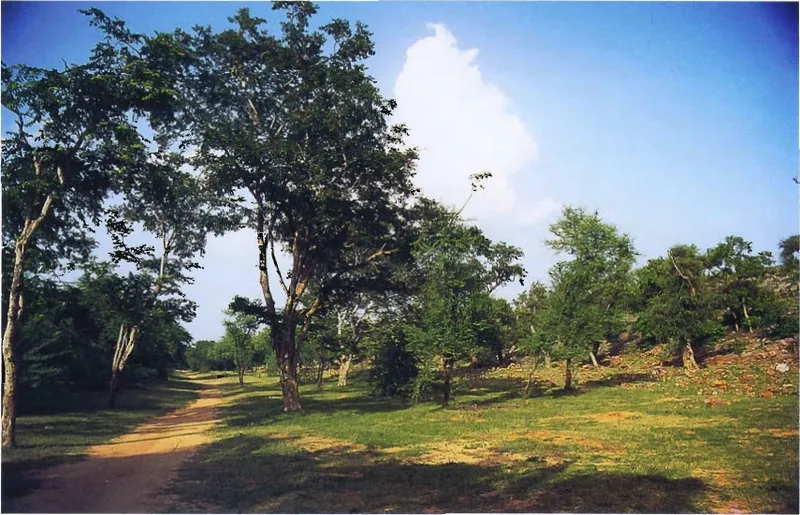
- What it is
- The Govardhana parikramā path is the circuit round Govardhana Hill that pilgrims walk; a parikramā is a walk round a holy place in worship.
- Visiting
- In 2001 the guidebook Govardhana Hill said that most ISKCON devotees began the parikramā at Rādhā-kuṇḍa village, where the Vṛndāvana road meets the path, and that the people of Vraja traditionally …
In short
The Govardhana parikramā path is the circuit round Govardhana Hill that pilgrims walk; a parikramā is a walk round a holy place in worship. It goes back to the first Govardhana-pūjā, which the Bhāgavatam tells: Kṛṣṇa told the cowherds to circumambulate the hill, and they went round it with their cows in front.[1 +4] The Varāha Purāṇa promises that one who bathes in Mānasī-gaṅgā, sees Hari at Govardhana and goes round the hill is not born again.[6 +4] Śrī Caitanya Mahāprabhu and Śrīla Mādhavendra Purī walked round it, and Śrīla Prabhupāda writes that the Gosvāmīs used to circumambulate Govardhana.[11 +6]
Key facts
| Kind | parikramā path |
|---|---|
| Region · area | Govardhana |
| Ācāryas | Śrīla Sanātana Gosvāmī, Śrīla Raghunātha dāsa Gosvāmī, Śrī Caitanya Mahāprabhu, Śrīla Mādhavendra Purī, Śrīla Narottama dāsa Ṭhākura |
Why it is glorified
The Varāha Purāṇa places Govardhana two yojanas (an old measure of distance) west of Mathurā, in a chapter whose closing line …
The Varāha Purāṇa places Govardhana two yojanas (an old measure of distance) west of Mathurā, in a chapter whose closing line names it the power of the circuit of Annakūṭa, the Purāṇa's name for the hill. It says that one who goes round Annakūṭa after bathing in Mānasī-gaṅgā and seeing Hari at Govardhana does not return to birth, and gains the result of the Rājasūya and Aśvamedha, two great Vedic sacrifices (summarised here, not translated).[6 +5] Śrīla Rūpa Gosvāmī quotes these verses in his Mathurā-māhātmya, and in the Bhakti-ratnākara Śrīla Śrīnivāsa Ācārya's guide says the same, naming the Deity Harideva where the verse says Hari.[6 +5]
The rule of the circuit
The Varāha Purāṇa also gives a rule. On the ekādaśī (eleventh day) of the bright half of the month of Bhādrapada, fasting, one bathes in Mānasī-gaṅgā at sunrise, worships Govardhana and Hari on the summit, and goes round by a series of tīrthas, holy bathing places. The circuit ends with a bath at Cakra-tīrtha in the kuṇḍa called Pañca-tīrtha, a night vigil and offerings to the ancestors on the next day.[8 +3] Śrīla Rūpa Gosvāmī quotes this rule under the heading of the Govardhana pilgrimage on that ekādaśī.[7 +2] The Vraja-bhakti-vilāsa, quoting verses that it gives as from the Ādi-varāha, names other days: the fourteenth day of the dark half of Bhādra for coming to Govardhana, and the first day of the fortnight in Kārttika for the circumambulation and the worship that replaced Indra's.[25]
Divine pastimes
The first parikramā
At the first Govardhana-pūjā Kṛṣṇa told the cowherds to circumambulate the cows, the brāhmaṇas, the sacrificial fires and the hill after their meal. They went round the hill keeping the cows in front, mounted on carts drawn by oxen, while the gopīs sang His deeds. The Bhāgavatam gives no route.[1 +4]
tathā ca vyadadhuḥ sarvaṃ yathāha madhusūdanaḥ / vācayitvā svasty-ayanaṃ tad-dravyeṇa giri-dvijān
upahṛtya balīn samyag ādṛtā yavasaṃ gavām / go-dhanāni puraskṛtya giriṃ cakruḥ pradakṣiṇam
The cowherd community then did all that Madhusūdana had suggested. They arranged for the brāhmaṇas to recite the auspicious Vedic mantras, and using the paraphernalia that had been intended for Indra’s sacrifice, they presented offerings to Govardhana Hill and the brāhmaṇas with reverential respect. They also gave grass to the cows. Then, placing the cows, bulls and calves in front of them, they circumambulated Govardhana.
Translation: Śrīla Prabhupāda's disciples (BBT)Śrīla Jīva Gosvāmī says that this was the first day of the bright half of Kārttika.[26] The commentators add that the hill was circumambulated on its own, after the great meal; that the gopas and gopīs went round on ox-carts and some cowherds on bulls; and that the brāhmaṇas went with them with their wives (summarised here, not translated).[27 +1] Śrīla Sanātana Gosvāmī and Śrīla Jīva Gosvāmī quote the Harivaṁśa, in which the herds of cattle go round the hill for the nīrājana, the ārati festival of the cows.[28 +1]
In the Garga-saṁhitā, Kṛṣṇa's own rule for worshipping Govardhana ends with going round the hill, bowing down and praying to it, and at the first Govardhana-pūjā Kṛṣṇa Himself goes round it with Nanda, Upananda, the Vṛṣabhānus and the gopas and gopīs.[2 +4] Śrīla Jīva Gosvāmī's Gopāla-campū describes the same circuit: the cows go ahead, and Kṛṣṇa walks round the hill with Balarāma and His friends, playing the flute, while the gopīs sing a song of questions and answers.[33 +2] Read more: Govardhana parikramā →
Śrī Caitanya Mahāprabhu and the ācāryas
Śrīla Mādhavendra Purī circumambulated the hill and then bathed in Govinda-kuṇḍa, on the evening when the cowherd boy brought him milk.[15 +1] Śrī Caitanya Mahāprabhu, arriving at the village of Govardhana, saw the Deity Harideva and spent the night in His temple; the next morning He set out round the hill, and afterwards He bathed in Govinda-kuṇḍa:[11 +3]
prātaḥ-kāle prabhu ‘mānasa-gaṅgā’ya kari’ snāna
govardhana-parikramāya karilā prayāṇa
In the morning, Śrī Caitanya Mahāprabhu took His bath in a lake called Mānasa-gaṅgā. He then circumambulated Govardhana Hill.
Translation: Śrīla A.C. Bhaktivedanta Swami PrabhupādaAccording to the Bhakti-ratnākara, Śrīla Sanātana Gosvāmī, living at Cakra-tīrtha, walked a parikramā of twelve krośas round Govardhana every day, and in his old age Gopīnātha, seeing his great labour, appeared to him as a cowherd boy.[16 +4] The Bengali Vṛndāvana-kathā (1920) tells that when he could no longer walk the seven-krośa circuit, a charming child gave him a stone marked with Śrī Kṛṣṇa's footprint and told him to go round it instead, and that he did so for the rest of his life. The guides give other lengths for his circuit (see below).[40]
Śrīla Prabhupāda writes that the Gosvāmīs used to circumambulate Govardhana:[17]
Names this place“(In every temple there is an arrangement to go around the temple at least three times. … The Gosvāmīs used to circumambulate Govardhana Hill.) One should also circumambulate the whole Vṛndāvana area.”
Śrīla Prabhupāda, The Nectar of Devotion, Chapter 6, item (9) · vedabase.io
The guidebook Govardhana Hill (2001) says that the Six Gosvāmīs regularly went round the hill, Śrīla Sanātana Gosvāmī and Śrīla Raghunātha dāsa Gosvāmī every day while they stayed near Govardhana. It also names Śrī Advaita Ācārya, Śrī Nityānanda Prabhu, Śrī Vallabhācārya, Śrīla Narottama dāsa Ṭhākura, Śrīla Śrīnivāsa Ācārya, Śrīla Rāghava Gosvāmī of Govardhana and Śrīla Viśvanātha Cakravartī Ṭhākura among those who walked round it.[13 +7] In the Bhakti-ratnākara, Śrīla Śrīnivāsa Ācārya's guide takes him round the many places of Kṛṣṇa's pastimes all around Govardhana.[16 +1]
Śrīla Prabhupāda
In his Kṛṣṇa book Śrīla Prabhupāda writes that since the first Govardhana-pūjā the people of Vṛndāvana still gather at the hill …
In his Kṛṣṇa book Śrīla Prabhupāda writes that since the first Govardhana-pūjā the people of Vṛndāvana still gather at the hill for the festival and go round it with their cows:[5 +1]
Names this place“They performed Govardhana worship and circumambulation of the hill. (Following the inauguration of Govardhana-pūjā, people in Vṛndāvana still dress nicely and assemble near Govardhana Hill to offer worship and circumambulate the hill, leading their cows all around.)”
Śrīla Prabhupāda, Kṛṣṇa, the Supreme Personality of Godhead (Kṛṣṇa book), Chapter 24, Worshiping Govardhana Hill · vedabase.io
In his last illness, on 26 October 1977, he agreed when his disciples asked whether they could take him round Vṛndāvana and to Govardhana. On 10 November he himself proposed going to Govardhana by bullock cart for the Govardhana-pūjā the next day; after his disciples' appeals about his health he said that the other devotees could go and he could not.[44 +2]
Names this place“If I can continue this parikramā, that is spiritual cure. … Tamāla Kṛṣṇa: What about to Govardhana? Prabhupāda: Yes.”
Śrīla Prabhupāda, Room Conversation, Vṛndāvana, 26 October 1977 · vedabase.io
Songs
Śrīla Jīva Gosvāmī's Gopāla-campū tells that the gopīs sang this song while the people of Vraja went round the hill after the …
Śrīla Jīva Gosvāmī's Gopāla-campū tells that the gopīs sang this song while the people of Vraja went round the hill after the first Govardhana-pūjā: one asks who ordained the worship of the hill, and the others answer with Kṛṣṇa's deeds.[33 +2]
Śrīla Raghunātha dāsa Gosvāmī's Prārthanāśraya-caturdaśaka describes the procession round the hill at Dīpāvalī, the festival of lamps: the cows and the chief men in front, the queen of Vraja and the women behind, and Kṛṣṇa with His friends, glancing at Rādhā.[42]
puro gobhiḥ sārdhaṁ vraja-nṛpati-mukhyā vraja-janā
vrajanty eṣām paścān nikhila-mahilābhir vraja-nṛpā
tato mitra-vrātaiḥ kṛta-vividha-narmā vraja-śaśī
chalaiḥ pasyan rādhāṁ sahacari parikrāmati girim
Visiting today
In 2001 the guidebook Govardhana Hill said that most ISKCON devotees began the parikramā at Rādhā-kuṇḍa village, where the Vṛndāvana road meets the path, and that the people of Vraja traditionally ended it with darśana, seeing the Deity, at the Mukhāravinda temple and a dip in Mānasī-gaṅgā.[16 +1]
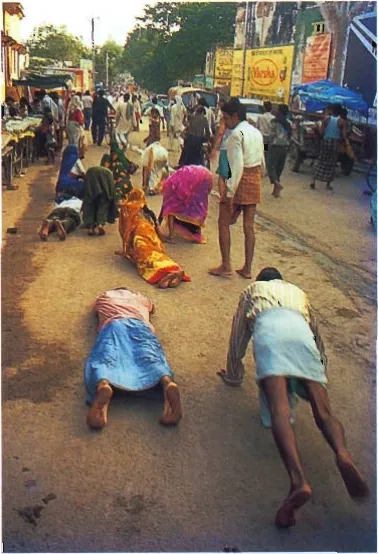
The same book describes the daṇḍavat parikramā, in which the pilgrim lies down full length in obeisance, marks the place of the fingertips with a stone and steps up to it, and the 108-daṇḍavat parikramā of some sādhus (holy men), with 108 obeisances at each spot, which can take months.[9 +1] It says that over half a million people may go round the hill on Guru Pūrṇimā, in Puruṣottama-māsa or at Govardhana-pūjā, while its back cover speaks of tens of thousands on auspicious days; neither figure is a count.[9 +2]
It also gives ten rules for the parikramā, which it takes from the Vraja-bhakti-vilāsa: respect for the Deities, cows, brāhmaṇas, trees, rocks and kuṇḍas; no shoes or leather; no parikramā at night; and not leaving it unfinished, among others. The Vraja-bhakti-vilāsa gives these rules for the pilgrimage of the forests of Vraja as a whole, not for Govardhana alone; they are given here as the guidebook's guidance for pilgrims.[50]
Location
| Where it is | Round the hill; most ISKCON devotees start where the Vṛndāvana road meets it at Rādhā-kuṇḍa village[51] passes Dāna Ghāṭi[52] |
|---|
Pictures
2 pictures
Where the sources differ
Accounts differ Length of the Govardhana circuit and of Śrīla Sanātana Gosvāmī's daily parikramā
- Govardhana Hill: India's Most Sacred Mountain (2001), p. 20the parikramā is 'about fourteen miles (23 km.)', five to six hours at a brisk pace
- Govardhana Hill: India's Most Sacred Mountain (2001), pp. 21, 24, 50Śrīla Sanātana Gosvāmī performed parikramā every day and 'used to perform a much longer parikramā' of twenty-four miles via Candra-sarovara, Śyāma Dhak, Gānthuli-grāma, Sūrya-kuṇḍa, Mukharai and Kilola-kuṇḍa
- Vṛndāvana-Dhāma Ki Jaya! (c. 1986), pp. 19, 49Sanātana circumambulated the hill daily, 'a total of twenty-one kilometers'
- Śrī Vraja-maṇḍala Parikramā (2007), pp. 624-625'the fourteen-mile long parikramā'; Sanātana sometimes walked sixteen miles from Vṛndāvana first
Accounts differ How the parikramā begins: bath in Mānasī-gaṅgā and darśana of Harideva, in which order
- Govardhana Hill: India's Most Sacred Mountain (2001), p. 24, citing Śrīla Rūpa Gosvāmī's Mathurā-māhātmyafirst bathe in Mānasī-gaṅgā, then have darśana of Harideva, 'as Lord Caitanya Mahāprabhu did'
- Caitanya-caritāmṛta Madhya 18.17, 18.22, 18.32Mahāprabhu saw Harideva on arriving, spent the night in his temple, and next morning bathed in Mānasa-gaṅgā and set out round the hill
- Varāha Purāṇa 164.11, 164.18bathe in Mānasa-gaṅgā, see Hari at Govardhana (on the summit), then go round
- Śrīla Rūpa Gosvāmī, Mathurā-māhātmya vv.399–401 (quoting the Ādi-vārāha = Varāha Purāṇa 164.1, 164.10b–12a)having bathed in Mānasa-gaṅgā and seen Hari at Govardhana, having gone round Annakūṭa, why should one grieve? (bath, sight of Hari, circumambulation; no name Harideva, no mention of Mahāprabhu)
Accounts differ Year of Mahāprabhu's visit to Vṛndāvana (and so of His Govardhana parikramā)
- Govardhana Hill: India's Most Sacred Mountain (2001), p. 24'when visiting Vṛndāvana in 1515'
- the undated parikramā notes Govardhana'In the year 1515, Lord Chaitanya Mahaprabhu also came here during His Parikrama of Vraja' (at Kusuma-sarovara)
- Śrīla Prabhupāda, CC Madhya 18.47 purportMahāprabhu went to Vṛndāvana before the birth of Viṭhṭhaleśvara, who was born in AD 1515
- Śrīla Prabhupāda, CC Madhya 19.108 purportMahāprabhu visited Prayāga (after leaving Vṛndāvana) in AD 1512 or 1513
More on this place
Govardhana parikramā
References
52 references
- Śrīmad-Bhāgavatam 10.24.29, GRETIL
- Śrīmad-Bhāgavatam 10.24.32-33, GRETIL
- Śrīmad-Bhāgavatam 10.24.34, GRETIL
- Śrīla Prabhupāda, Kṛṣṇa, the Supreme Personality of Godhead (Kṛṣṇa book), Chapter 24, 'Worshiping Govardhana Hill' · vedabase.io
- Śrīla Prabhupāda, Kṛṣṇa, the Supreme Personality of Godhead (Kṛṣṇa book), Chapter 24, Worshiping Govardhana Hill · vedabase.io
- Varāha Purāṇa, adhyāya 164, verses 10-12, Sanskrit Wikisource
- Varāha Purāṇa, adhyāya 164, verses 14-15, Sanskrit Wikisource
- Varāha Purāṇa, adhyāya 164, verses 23-26, Sanskrit Wikisource
- Govardhana Hill: India's Most Sacred Mountain (2001), Rajasekhara dasa Brahmacari, PDF p. 34
- the undated parikramā notes Govardhana, ¶4
- Śrīla Kṛṣṇadāsa Kavirāja Gosvāmī, Śrī Caitanya-caritāmṛta, CC Madhya-līlā 18.17, online edition · vedabase.io
- Śrīla Kṛṣṇadāsa Kavirāja Gosvāmī, Śrī Caitanya-caritāmṛta, CC Madhya-līlā 18.22, online edition · vedabase.io
- Śrīla Kṛṣṇadāsa Kavirāja Gosvāmī, Śrī Caitanya-caritāmṛta, CC Madhya-līlā 18.32, online edition · vedabase.io
- Śrīla Prabhupāda, Śrī Caitanya-caritāmṛta, Madhya-līlā 18.32, translation · vedabase.io
- Śrīla Kṛṣṇadāsa Kavirāja Gosvāmī, Śrī Caitanya-caritāmṛta, CC Madhya-līlā 4.23, online edition · vedabase.io
- Govardhana Hill: India's Most Sacred Mountain (2001), Rajasekhara dasa Brahmacari, PDF p. 38
- Śrīla Prabhupāda, The Nectar of Devotion, Chapter 6, item (9) · vedabase.io
- Varāha Purāṇa, adhyāya 164, verse 1, Sanskrit Wikisource
- Śrīla Rūpa Gosvāmī, Mathurā-māhātmya part 1 vv.399–401, heading 'atha śrī-govardhanasya, tatraiva' (tatraiva = the Ādi-vārāha named before v.397)
- Śrīla Rūpa Gosvāmī, Mathurā-māhātmya part 1 vv.410–411, heading 'bhādre pārśva-parivartinyām ekādaśyāṁ govardhana-yātrā'
Show all 52 references
- Śrīla Narahari Cakravartī, Bhakti-ratnākara, Fifth Wave, 1912 ed. p. 205; text Bhakti-ratnākara, taraṅgas 1–8 vv. 678-683, 2nd ed., 1912
- Varāha Purāṇa, adhyāya 164, verses 16-18, Sanskrit Wikisource
- Varāha Purāṇa, adhyāya 164, verses 39-40, Sanskrit Wikisource
- Varāha Purāṇa, adhyāya 164, verses 41-44 and 49, Sanskrit Wikisource
- Śrīla Nārāyaṇa Bhaṭṭa, Vraja-bhakti-vilāsa, Chapter 5 opening (Govardhana-utpatti-māhātmya), 'ādivārāhe', printed p. 111, 1st ed., publ. Bābā Kṛṣṇadāsa, Kusuma-sarovara, Saṁvat 2008
- Śrīla Jīva Gosvāmī: commentary on ŚB 10.24.1, Bhagavata Vidya Pith edition, ed. Bhagavata Rishi and Krishna Shankar Shastri, 1996
- Śrīla Jīva Gosvāmī: commentary on ŚB 10.24.29, Bhagavata Vidya Pith edition, ed. Bhagavata Rishi and Krishna Shankar Shastri, 1996
- Śrīla Sanātana Gosvāmī, Śrīla Jīva Gosvāmī: commentary on ŚB 10.24.34, Bhagavata Vidya Pith edition, ed. Bhagavata Rishi and Krishna Shankar Shastri, 1996
- Harivaṁśa, HV 60.29, 60.31, 60.33 (critical edition), GRETIL
- Garga-saṁhitā, Girirāja-khaṇḍa (3), adhyāya 1, verse 17, Sanskrit Wikisource
- Garga-saṁhitā, Girirāja-khaṇḍa (3), adhyāya 1, verse 19, Sanskrit Wikisource
- Garga-saṁhitā, Girirāja-khaṇḍa (3), adhyāya 2, verse 19, Sanskrit Wikisource
- Śrīla Jīva Gosvāmī, Gopāla-campū, Pūrva-campū 18, prose §§ 42-43, GRETIL
- Śrīla Jīva Gosvāmī, Gopāla-campū, Pūrva-campū 18.67-68, GRETIL
- Śrīla Jīva Gosvāmī, Gopāla-campū, Pūrva-campū 18, prose § 45 and verse 18.65 (first line), GRETIL
- Śrīla Narahari Cakravartī, Bhakti-ratnākara, Fifth Wave, 1912 ed. p. 208, 2nd ed., 1912
- Govardhana Hill: India's Most Sacred Mountain (2001), Rajasekhara dasa Brahmacari, PDF p. 35
- Vṛndāvana-Dhāma Ki Jaya! (c. 1986), by Dhruva Mahārāja dāsa, PDF p. 37
- Śrī Vraja-maṇḍala Parikramā (2007), PDF p. 325
- Vṛndāvana-kathā, 1920 ed. p. 66, on Sanātana Gosvāmī
- Śrīla Narahari Cakravartī, Bhakti-ratnākara, Fifth Wave, 1912 ed. p. 199, 2nd ed., 1912
- Śrīla Raghunātha dāsa Gosvāmī, Prārthanāśraya-caturdaśaka, verses 1-2
- Govardhana Hill: India's Most Sacred Mountain (2001), Rajasekhara dasa Brahmacari, PDF p. 127
- Śrīla Prabhupāda, Room Conversation, Vṛndāvana, 26 October 1977 · vedabase.io
- Śrīla Prabhupāda, Room Conversation, Vṛndāvana, 10 November 1977 · vedabase.io
- Govardhana Hill: India's Most Sacred Mountain (2001), Rajasekhara dasa Brahmacari, PDF p. 7
- Govardhana Hill: India's Most Sacred Mountain (2001), Rajasekhara dasa Brahmacari, PDF p. 80
- Govardhana Hill: India's Most Sacred Mountain (2001), Rajasekhara dasa Brahmacari, PDF p. 36
- Govardhana Hill: India's Most Sacred Mountain (2001), Rajasekhara dasa Brahmacari, PDF p. 170
- Govardhana Hill: India's Most Sacred Mountain (2001), Rajasekhara dasa Brahmacari, PDF p. 39
- Govardhana Hill: India's Most Sacred Mountain (2001), Rajasekhara dasa Brahmacari, p. 20
- Govardhana Hill: India's Most Sacred Mountain (2001), Rajasekhara dasa Brahmacari, p. 71