Mukhāravinda Mandira
मुखारविन्द मन्दिर Hindi name proposed
Also called Mukharvinda temple, Mukharvinda
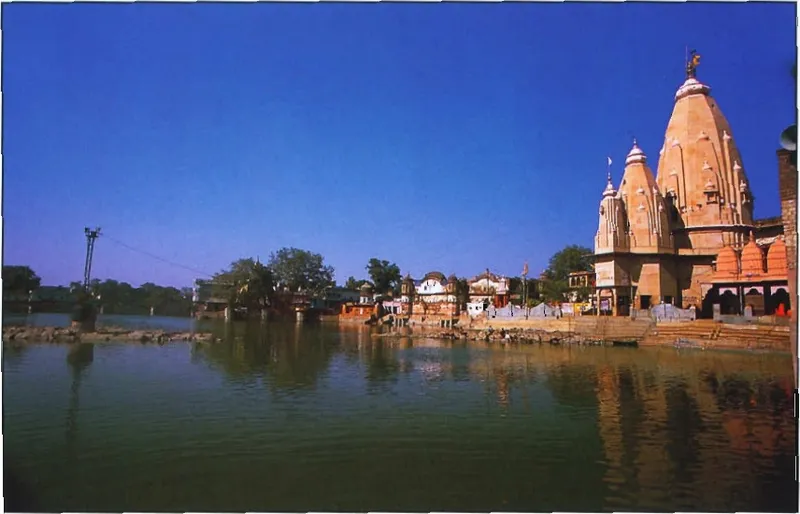
- What it is
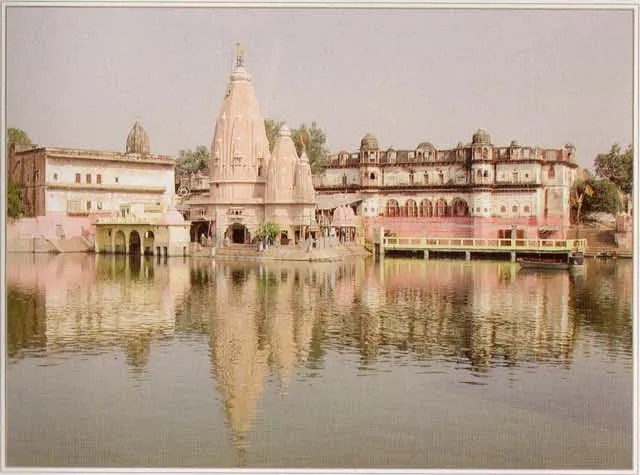
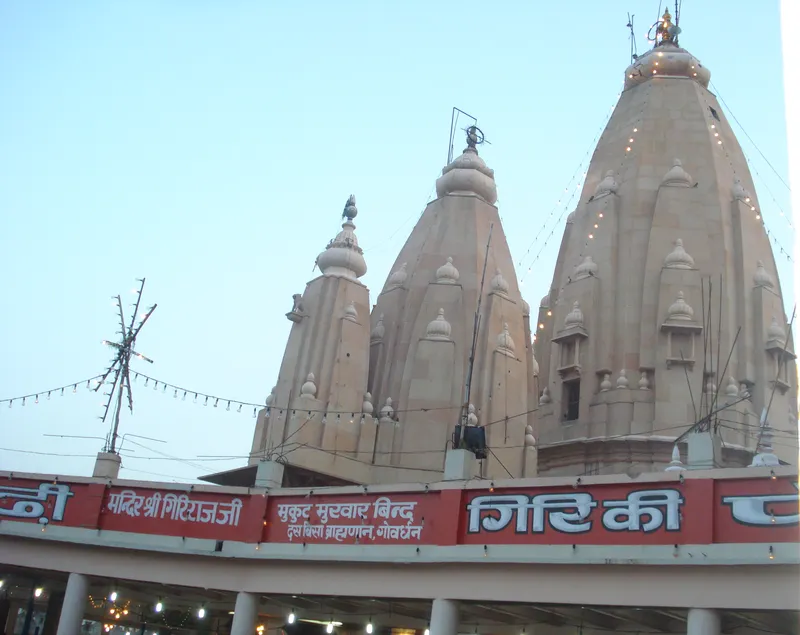
- The Mukhāravinda Mandira is a sandstone temple on Mānasī-gaṅgā in Govardhana town.
- Visiting
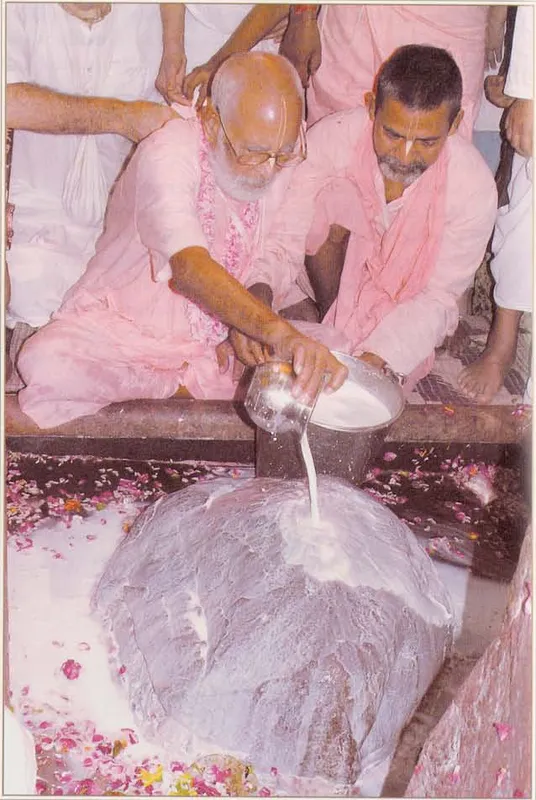
- Govardhana Hill (2001) describes pilgrims feeding the Mukhāravinda-śilā with milk and sweets and says that much milk is poured over it every day.
- Parikramā
- Govardhana parikramā, station 18
- Places here
- Mukhāravinda-śilā (Mānasī-gaṅgā), Mukut-śilā (Mukhāravinda Mandira)
In short
The Mukhāravinda Mandira is a sandstone temple on Mānasī-gaṅgā in Govardhana town. It houses the Mukhāravinda-śilā, a stone worshipped as the lotus mouth (mukhāravinda) of Govardhana Hill, which pilgrims feed with milk and sweets, as the guidebook Govardhana Hill (2001) describes.[1 +3] According to the local tradition recorded in two guidebooks, Śrīla Bhaktisiddhānta Sarasvatī Ṭhākura confirmed this stone as the real Mukhāravinda; neither says where or when, so this is not certain.[1 +2] Śrīmad-Bhāgavatam tells how Kṛṣṇa, as the hill, ate the offerings of the first Govardhana-pūjā, but it names no spot on the hill and no mouth; the texts that picture the hill as a body place its mouth in different ways.[7 +6]
Key facts
| Kind | temple |
|---|---|
| Region · area | Govardhana · Govardhana (town) |
| Also part of | Mānasī-gaṅgā |
| On the parikramā | Govardhana parikramā, station 18 · the route |
| Ācāryas | Śrīla Bhaktisiddhānta Sarasvatī Ṭhākura |
Divine pastimes
The hill eats the offerings
At the first Govardhana-pūjā, as Kṛṣṇa had advised, the cowherds presented their offerings to Govardhana Hill and to the brāhmaṇas and walked around the hill with their cows in front. Kṛṣṇa then took another, huge form, declared that He was the hill and ate the offerings, and with the people of Vraja He bowed down to that form. The Bhāgavatam names no spot on the hill and no mouth.[7 +3]
kṛṣṇas tv anyatamaṃ rūpaṃ gopa-viśrambhaṇaṃ gataḥ / śailo 'smīti bruvan bhūri balim ādad bṛhad-vapuḥ
Kṛṣṇa then assumed an unprecedented, huge form to instill faith in the cowherd men. Declaring “I am Govardhana Mountain!” He ate the abundant offerings.
Translation: Śrīla Prabhupāda's disciples (BBT)The guidebook Govardhana Hill (2001) quotes these verses on the page where it calls the Mukhāravinda the hill's mouth.[8 +3]
The commentators place the form that ate on or above the summit of the hill (summarised here, not translated). Śrīla Sanātana Gosvāmī and Śrīla Jīva Gosvāmī, quoting the Harivaṁśa, put it on the summit; Śrīla Viśvanātha Cakravartī Ṭhākura has it stand on top of the hill like a second mountain and take, with very long hands, the offerings of the people of Vraja near and far; Śrīla Baladeva Vidyābhūṣaṇa gives it a thousand arms. None of them speaks of a mouth of the hill.[16] Śrīla Sanātana Gosvāmī also says, on an earlier verse, that Kṛṣṇa's order to offer oblations into the fire shows that Govardhana, like the other deities, has fire for its mouth.[17] Read more: The first Govardhana-pūjā and the Annakūṭa →
Traditional accounts
Several texts picture Govardhana as a body, and they do not agree where its mouth is.
The mouth of the hill
Several texts picture Govardhana as a body, and they do not agree where its mouth is. In the Garga-saṁhitā's list of the hill's limbs, the mouth lies below Śṛṅgāra-maṇḍala, where the Lord and the people of Vraja made the hill of food, and Mānasī-gaṅgā is the hill's eyes; no source connects the verse with the stone in this temple.[18 +1]
Śrīla Viśvanātha Cakravartī Ṭhākura's Vraja-rīti-cintāmaṇi pictures the hill as a peacock whose throat is Mānasī-gaṅgā, whose face is Kusuma-sarovara and whose eyes are Rādhā-kuṇḍa and Śyāma-kuṇḍa; it names no mouth, and it sets the great Annakūṭa festival in the hill's chest, at Dāna-nivartana-kuṇḍa and a Saṅkarṣaṇa-kuṇḍa for which it names no village (summarised here, not translated).[11 +3] The guidebooks draw the body in other ways again. Read more: The body of Govardhana: mouth, eyes, neck and the peacock →
Accounts differ Where Govardhana's mouth (Mukharavinda) is, and the shape of the hill
- Garga-saṁhitā, Girirāja-khaṇḍa 3.8.4-5The mouth is below Śṛṅgāra-maṇḍala, where the Annakūṭa was made; Mānasī-gaṅgā is the hill's eyes.
- Govardhana Hill: India's Most Sacred Mountain (2001), p. 66The lotus mouth is in the temple on the banks of Mānasī-gaṅgā; local people claim other śilās; Śrīla Bhaktisiddhānta Sarasvatī confirmed this one.
- Govardhana Hill: India's Most Sacred Mountain (2001), p. 128The Vallabha sampradāya, who manage the Gopālajī temple, accept another Mukharāvinda śilā at Jetipurā (photographed beside the samādhi of Viṭṭhalanātha); the Gauḍīya one is at Mānasī-gaṅgā.
- Govardhana Hill: India's Most Sacred Mountain (2001), p. 12A peacock: face Kusuma-sarovara, neck Mānasī-gaṅgā, mouth Mukharavinda, eyes Rādhā-kuṇḍa and Śyāma-kuṇḍa.
According to the local tradition recorded in Govardhana Hill (2001) and the undated parikramā notes Govardhana, Śrīla Bhaktisiddhānta Sarasvatī Ṭhākura confirmed that the stone in this temple is the real Mukhāravinda, although local people point to other stones. Neither book says where or when he did so, so this is not certain.[1 +2]
Śrīla Prabhupāda
Śrīla Prabhupāda does not speak of this temple by name.
Śrīla Prabhupāda does not speak of this temple by name. Of the hill's accepting the food offered to it, he writes in a general purport on Śrīla Mādhavendra Purī's Annakūṭa for Gopāla:[14]
General teaching (does not name the place)At that time Kṛṣṇa expanded Himself and declared, “I am Govardhana Hill.” In this way He accepted all the paraphernalia and food offered to Govardhana Hill.
Śrīla Prabhupāda, Śrī Caitanya-caritāmṛta, Madhya-līlā 4.86, purport · vedabase.io
Visiting today
Govardhana Hill (2001) describes pilgrims feeding the Mukhāravinda-śilā with milk and sweets and says that much milk is poured over it every day. Śrī Vraja-maṇḍala Parikramā (2007), which puts the temple on the northern bank of the lake, describes daily abhiṣeka (a ceremonial bath), worship and bhoga (offerings of food), with festivals on Annakūṭa and Dīpāvalī.[1 +3] According to Govardhana Hill, the people of Vraja traditionally end their walk around the hill with darśana at this temple and a last dip in Mānasī-gaṅgā.[1]
The crown stone
Just behind the Mukhāravinda-śilā stands the Mukut-śilā, an upright stone marked with the outline of Kṛṣṇa's crown, according to Govardhana Hill (2001) and the undated parikramā notes Govardhana.[1 +1] The Garga-saṁhitā speaks of a stone on Govardhana that was marked with a crown by the touch of Kṛṣṇa's crown, and calls it the hill's forehead, but it does not say where that stone is; no source read connects it with this one.[21 +1]
Location
| Where it is | 'on the banks of Mānasī-gaṅgā'[23] northern bank of Mānasī-gaṅgā[24] |
|---|---|
| On the numbered Govardhana chart | 18 (printed as “Mukharavinda Temple”)[25] |
Places at Mukhāravinda Mandira
2 places
Pictures
3 pictures
Where the sources differ
Accounts differ Where Govardhana took the offerings at the first Govardhana-pūjā, and what its 'mouth' is: the Tenth Canto and its commentators
- Śrīmad-Bhāgavatam 10.24.35-36a huge form, saying 'I am the hill', ate the abundant offerings; the hill 'appeared in person'; no spot or mouth named
- Śrīla Sanātana Gosvāmī and Śrīla Jīva Gosvāmī (on ŚB 10.24.35, quoting the Harivaṁśa)the form appeared on the summit of the hill
- Śrīla Viśvanātha Cakravartī (on ŚB 10.24.35)on top of the hill like a second mountain; it took with very long outstretched hands the offerings of the people of Vraja near and far, even in Nandagrāma
- Śrīla Baladeva Vidyābhūṣaṇa (on ŚB 10.24.35)a form risen above the hill, with a thousand arms
More on this place
The first Govardhana-pūjā and the Annakūṭa · The body of Govardhana: mouth, eyes, neck and the peacock
References
25 references
- Govardhana Hill: India's Most Sacred Mountain (2001), Rajasekhara dasa Brahmacari, PDF p. 80
- Śrī Vraja-maṇḍala Parikramā (2007), PDF p. 121
- Śrī Vraja-maṇḍala Parikramā (2007), PDF p. 122
- the key of the numbered Govardhana chart, ¶20
- Govardhana Hill: India's Most Sacred Mountain (2001), Rajasekhara dasa Brahmacari, PDF p. 142
- the undated parikramā notes Govardhana, ¶59
- Śrīmad-Bhāgavatam 10.24.32-33, GRETIL
- Śrīmad-Bhāgavatam 10.24.35, GRETIL
- Śrīmad-Bhāgavatam 10.24.36, GRETIL
- Śrīla Prabhupāda, Kṛṣṇa, the Supreme Personality of Godhead (Kṛṣṇa book), Chapter 24, Worshiping Govardhana Hill · vedabase.io
- Śrīla Viśvanātha Cakravartī Ṭhākura, Vraja-rīti-cintāmaṇi, third sarga, verse 23
- Śrīla Viśvanātha Cakravartī Ṭhākura, Vraja-rīti-cintāmaṇi, third sarga (tṛtīyaḥ sargaḥ), verse 26
- Śrīla Viśvanātha Cakravartī Ṭhākura, Vraja-rīti-cintāmaṇi 3.29
- Śrīla Prabhupāda, Śrī Caitanya-caritāmṛta, Madhya-līlā 4.86, purport · vedabase.io
- Govardhana Hill: India's Most Sacred Mountain (2001), Rajasekhara dasa Brahmacari, PDF p. 26
- Śrīla Sanātana Gosvāmī, Śrīla Jīva Gosvāmī: commentary on ŚB 10.24.35, Bhagavata Vidya Pith edition, ed. Bhagavata Rishi and Krishna Shankar Shastri, 1996
- Śrīla Sanātana Gosvāmī: commentary on ŚB 10.24.27, Bhagavata Vidya Pith edition, ed. Bhagavata Rishi and Krishna Shankar Shastri, 1996
- Garga-saṁhitā, Girirāja-khaṇḍa (3), adhyāya 8, verse 4, Sanskrit Wikisource
- Garga-saṁhitā, Girirāja-khaṇḍa (3), adhyāya 8, verse 5, Sanskrit Wikisource
- Śrīla Viśvanātha Cakravartī Ṭhākura, Vraja-rīti-cintāmaṇi 3.20
Show all 25 references
- Garga-saṁhitā, Girirāja-khaṇḍa (3), adhyāya 7, verse 9, Sanskrit Wikisource
- Garga-saṁhitā, Girirāja-khaṇḍa (3), adhyāya 8, verse 7, Sanskrit Wikisource
- Govardhana Hill: India's Most Sacred Mountain (2001), Rajasekhara dasa Brahmacari, p. 66
- Śrī Vraja-maṇḍala Parikramā (2007), p. 216-217
- Numbered list of the Govardhana sites (key of the Govardhana chart)