Govinda-kuṇḍa (Vṛndāvana)
गोविन्द-कुण्ड (वृन्दावन) Hindi name proposed
Also called Govinda Kuṇḍa
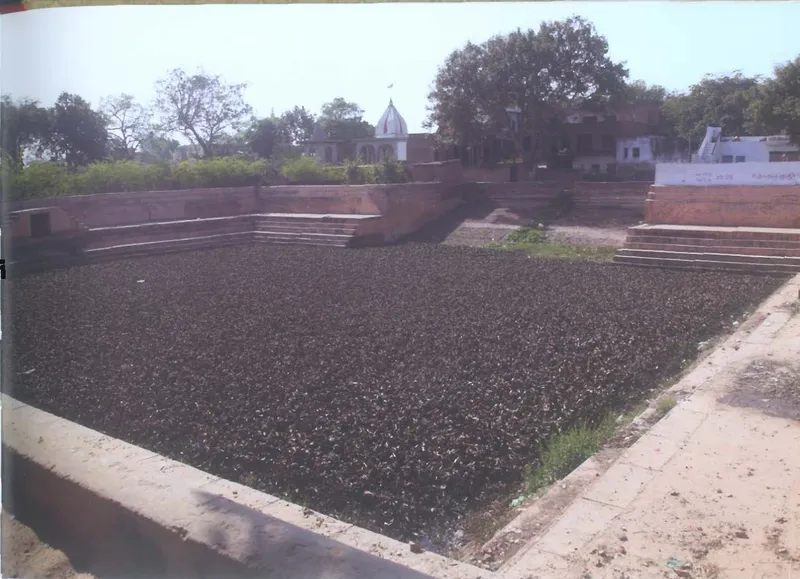
- What it is
- Govinda-kuṇḍa is a large stepped tank in the eastern part of Vṛndāvana, near the Raṅgajī temple.
- Visiting
- Śrī Vraja-maṇḍala Parikramā (2007) places the kuṇḍa near the Raṅgajī temple in the eastern part of Vṛndāvana.
In short
Govinda-kuṇḍa is a large stepped tank in the eastern part of Vṛndāvana, near the Raṅgajī temple. Two guidebooks call it the largest kuṇḍa (sacred pond) in Vṛndāvana.[1 +2] The Saura Purāṇa, quoted by Śrīla Rūpa Gosvāmī, and the Bhakti-ratnākara praise a tīrtha of Govinda in Vṛndāvana, listed next to Brahma-kuṇḍa; none of these texts says where it lies, and no source identifies it with this tank.[1 +4] The 1911 gazetteer of the Mathurā district records that a natural pond here was faced with masonry walls and steps about 1875.[2 +3]
Key facts
| Kind | kuṇḍa |
|---|---|
| Region · area | Vṛndāvana |
| Ācāryas | Śrīla Rūpa Gosvāmī, Śrīla Sanātana Gosvāmī, Śrīla Viśvanātha Cakravartī Ṭhākura, Śrīla Śrīnivāsa Ācārya, Śrīla Rāghava Paṇḍita Gosvāmī of Govardhana |
Why it is glorified
Śrīla Rūpa Gosvāmī's Mathurā-māhātmya quotes the Saura Purāṇa on a tīrtha called Govinda-svāmi-tīrtha, where the Lord lives in …
Śrīla Rūpa Gosvāmī's Mathurā-māhātmya quotes the Saura Purāṇa on a tīrtha called Govinda-svāmi-tīrtha, where the Lord lives in His Deity form named Govinda-svāmī and where sādhus bathe and worship Him (summarised here, not translated). Śrīla Rūpa Gosvāmī puts it after the section on Śrī Govinda and before Brahma-kuṇḍa. The text does not say where the tīrtha lies, and no source identifies it with this tank.[1 +4]
The Nārada Purāṇa's praise of Vṛndāvana also names a Govinda-kuṇḍa right after Brahma-kuṇḍa: the kuṇḍa where Indra, having come to know the truth, meditated on Govinda, and where a bath grants a glimpse of the Lord's eternal pastimes (summarised here, not translated). It does not say where it lies; Indra's meditation recalls the Govinda-kuṇḍa at Govardhana, and whether the Purāṇa means this tank is not settled.[1 +4]
Śrīla Viśvanātha Cakravartī Ṭhākura's Vraja-rīti-cintāmaṇi (2.72) describes a lake "at the place of Śrī Govinda" some way to the south of the Govinda-bhūmi, the meeting place of Rādhā and Kṛṣṇa, with groves all round full of humming bees. The verse does not use the name Govinda-kuṇḍa; the guidebook Vṛndāvana, the Playground of God (2010) quotes it for this kuṇḍa and takes it to mean south of the Govindajī temple.[1 +1]
Divine pastimes
Śrīmad-Bhāgavatam (10.15) tells how Kṛṣṇa and Balarāma rested in the forest with the cowherd boys. When Balarāma, tired from play, lay with His head on a boy's lap, Kṛṣṇa Himself massaged His feet; and when Kṛṣṇa, tired from wrestling, lay under a tree on a bed of soft twigs, some boys massaged His feet and others fanned Him. The Bhāgavatam names no kuṇḍa and no time of day.[11 +3]
kvacit pallava-talpeṣu niyuddha-śrama-karśitaḥ / vṛkṣa-mūlāśrayaḥ śete gopotsaṅgopabarhaṇaḥ
Sometimes Lord Kṛṣṇa grew tired from fighting and lay down at the base of a tree, resting upon a bed made of soft twigs and buds and using the lap of a cowherd friend as His pillow.
Translation: Śrīla Prabhupāda's disciples (BBT)Śrīla Sanātana Gosvāmī, explaining the verse in his Dig-darśinī (summarised here, not translated), sets this rest at some place such as the bank of the Yamunā, cooled by the breeze, under a kadamba tree, with Śrīdāmā, Śrī Rādhā's brother, as Kṛṣṇa's pillow. He names no pond.[15] The Color Guide to Vṛndāvana (2000) is the only source found that sets the brothers' midday rest at Govinda-kuṇḍa, with the cows drinking its cool water; it cites no source for this, so it is not certain.[2]
The Gosvāmīs and ācāryas
According to the Bhakti-ratnākara, Śrīla Rāghava Paṇḍita Gosvāmī of Govardhana showed Śrīla Śrīnivāsa Ācārya the …
According to the Bhakti-ratnākara, Śrīla Rāghava Paṇḍita Gosvāmī of Govardhana showed Śrīla Śrīnivāsa Ācārya the Govinda-svāmi-tīrtha during his parikramā of Vraja, after Brahma-kuṇḍa, and quoted the Saura Purāṇa verses on it. The book does not say where the tīrtha lies, and no source identifies it with this tank.[5]
According to the local tradition recorded in The Color Guide to Vṛndāvana (2000), Śrīla Rūpa Gosvāmī and Śrīla Sanātana Gosvāmī did bhajana, chanting and prayer, on the banks of this kuṇḍa. No other source was found for this, so it is not certain.[2]
Visiting today
Śrī Vraja-maṇḍala Parikramā (2007) places the kuṇḍa near the Raṅgajī temple in the eastern part of Vṛndāvana. The Color Guide to Vṛndāvana (2000) found it mostly dry, filling only in the rainy season, and Vṛndāvana, the Playground of God (2010) calls it neglected.[1 +2]
Location
| Where it is | near Śrī Raṅgajī Temple, in the eastern part of Vṛndāvana[17] 'Far to the south (of the Govindajī temple)' per Vraja-rīti-cintāmaṇi as quoted[18] |
|---|
Nearby places
Raṅgajī Mandira · Rādhā-Govinda Mandira (Vṛndāvana, old)
History
The 1911 gazetteer of the Mathurā district records that Gobind Kund, then off the main road near the Mathurā road, was a natural pond, and that about 1875 Chaudhrani Kali Sundari of Rajshahi in Bengal enclosed it on all four sides with masonry walls and flights of steps, at a cost of Rs. 30,000. The Color Guide to Vṛndāvana (2000) also names her as the builder of its ghāṭas (bathing steps).[2 +3] The Bengali Vṛndāvana-kathā (1920) names the same patron and cost and adds that the facing had broken in many places, that the kuṇḍa had no ghāṭa or domes, and that it held water only in the rainy season.[9]
Where the sources differ
Where Nārada bathed, took the form of a gopī, a cowherd girl, and saw the Lord's eternal pastimes: the Bengali Bhaktamāla of …
Where Nārada bathed, took the form of a gopī, a cowherd girl, and saw the Lord's eternal pastimes: the Bengali Bhaktamāla of Kṛṣṇadāsa Bābājī (1905) sets it at this kuṇḍa, though no older text found says so and it may be a late tradition, while the Bhakti-ratnākara tells of Nārada's wish at Brahma-kuṇḍa and the Nārada Purāṇa sets his bath at the lake of flowers near Govardhana, Kusuma-sarovara.[5 +2] Read more: How Nārada became a gopī: the accounts side by side →
Accounts differ Where Nārada bathed, received a gopī's (woman's) form and saw the Lord's eternal pastimes
- the Bengali Bhaktamāla of Kṛṣṇadāsa Bābājī (1905)At Govinda-kuṇḍa in Vṛndāvana, at Vṛndā's order
- Bhakti-ratnākara, Fifth Wave, p. 448By Brahma-kuṇḍa: 'here Vṛndā-devī disclosed her mind and fulfilled Nārada Muni's wish'; no bath or gopī form is named; the Govinda-svāmi-tīrtha follows on the same page
- Nārada Purāṇa, Uttara-bhāga 80.6–33At Vṛndā's āśrama on the bank of the Kusuma (flower) lake, in the forest where Govardhana stands: at Vṛndā's order Mādhavī had him bathe there; he came out in a woman's form, saw the Lord of the gopīs, and bathing again became a man
More on this place
How Nārada became a gopī: the accounts side by side
References
18 references
- Vṛndāvana, the Playground of God (2010), Bhakti Caitanya Svāmī, PDF p. 191
- The Color Guide to Vṛndāvana (2000), Written and Photographed by Rājaśekhara dāsa Brahmacārī, PDF p. 151
- Śrī Vraja-maṇḍala Parikramā (2007), PDF p. 345
- Śrīla Rūpa Gosvāmī, Mathurā-māhātmya, part 1 v.376-377, under the heading 'atha śrī-govinda-tīrthasya'
- Śrīla Narahari Cakravartī, Bhakti-ratnākara, Fifth Wave, quoting the Saura Purāṇa, 1912 ed. p. 448, 2nd ed., 1912
- Nārada Purāṇa, उत्तरार्धः/अध्यायः 80 v.80-59 – v.80-61 (Uttara-bhāga, chapter 80, verses 59–61)
- Śrīla Viśvanātha Cakravartī Ṭhākura, Vraja-rīti-cintāmaṇi, dvitīya sarga (chapter 2) v.72
- Muttra (1911), D. L. Drake-Brockman, I.C.S. (edited and compiled), p. 241
- Vṛndāvana-kathā, ch. 17 (saptadaśa pariccheda), section 3 'Kuṇḍa, bāpī o kūpa', printed p. 198
- Mathurá (1883), F. S. Growse, B.C.S., M.A. Oxon., C.I.E. (as the title page gives him, p. 189
- Śrīmad-Bhāgavatam 10.15.14, GRETIL
- Śrīmad-Bhāgavatam 10.15.16, GRETIL
- Śrīmad-Bhāgavatam 10.15.17, GRETIL
- Śrīla Prabhupāda, Kṛṣṇa, the Supreme Personality of Godhead (Kṛṣṇa book), Chapter 15, 'The Killing of Dhenukāsura' · vedabase.io
- Śrīla Sanātana Gosvāmī: commentary on ŚB 10.15.16'), Bhagavata Vidya Pith edition, ed. Bhagavata Rishi and Krishna Shankar Shastri, 1996
- Śrī Śrī Bhaktamāla grantha, pilgrimage list of Vṛndāvana's places, printed p. 351, left-hand column
- Śrī Vraja-maṇḍala Parikramā (2007), p. 664-665
- Vṛndāvana, the Playground of God (2010), Bhakti Caitanya Svāmī, p. 191