The great temple of Śrī Govinda
Building, damage and the journey to Jaipur
In short
The old Govind Dev temple is the large red-sandstone temple of Śrī Govinda in Vṛndāvana. It was built for the Deity that Śrīla Rūpa Gosvāmī found. The Caitanya-caritāmṛta says Śrīla Raghunātha Bhaṭṭa Gosvāmī had his disciples build it. Śrīla Prabhupāda and the temple's inscription name Mahārāja Mānsiṅgh. The Deity was later taken to Jaipur.[1–20]
On this page
At a glance
- The Deity: Śrī Govinda. According to the Bhakti-ratnākara, Śrīla Rūpa Gosvāmī found Him on Gomā-ṭīlā.[21–26]
- The earliest account of the building: Caitanya-caritāmṛta Antya 13.131. There Śrīla Raghunātha Bhaṭṭa Gosvāmī has his disciples build Govinda's temple.[1–4]
- The builder, as Śrīla Prabhupāda names him: Mahārāja Mānsiṅgh, Akbar's commander-in-chief. He built it at Śrīla Rūpa Gosvāmī's word.[5–9]
- The inscription, as historians printed and reported it: Mānasiṁhadeva, son of Bhagavantadāsa, made the temple at the Vṛndāvana yogapīṭha. It is dated "saṁvat 34", which is read as 1590, or as 1577.[10–14]
- The damage: according to Śrīla Prabhupāda, the temple had seven storeys, and Aurangzeb broke four of them.[27]
- The journey: Śrīla Prabhupāda said that the king of Jaipur took Govinda, with Gopīnātha and Madana-mohana, from Vṛndāvana to Jaipur.[15–20]
- Later: according to the guidebooks, a representative Deity of Govinda is worshipped in the new Govindajī temple behind the old building.[17 +4]
Which Deity the temple was built for
The temple stands on Gomā-ṭīlā, a mound in Vṛndāvana. The Bhakti-ratnākara tells what happened there. A Vrajavāsī (a resident of Vraja) told Śrīla Rūpa Gosvāmī that a cow gave her milk at that spot every forenoon. There he found Śrī Govinda, the Deity (the sacred form of the Lord that is worshipped), hidden in the earth.[1 +10]
The same book says that he sent word of the finding to Śrī Caitanya Mahāprabhu at Purī. So Govinda appeared during Mahāprabhu's lifetime, although no year is given.[31] The story of the finding has its own article. Read more: How Śrīla Rūpa Gosvāmī found Śrī Govinda on Gomā-ṭīlā →
The Caitanya-caritāmṛta says that Śrīla Rūpa Gosvāmī and Śrīla Sanātana Gosvāmī came to Vṛndāvana and began the service of Madana-gopāla and Govinda.[32–34] Śrīla Prabhupāda explains that the three main Deities of Vṛndāvana stand for three stages of devotion. Govinda, he says, is worshipped when one serves the Lord with strong attachment:[35–38]
Names this place“When one wishes to render service to the Lord with strong attachment, one worships Govinda on the platform of transcendental service. Govinda is the reservoir of all pleasures. … Lord Śrī Caitanya Mahāprabhu explained this mode of devotional service in three stages, and therefore these worshipable Deities were installed in Vṛndāvana by different Gosvāmīs.”
Śrīla Prabhupāda, Śrī Caitanya-caritāmṛta, Ādi-līlā 1.19, purport · vedabase.io
He also counts the Govinda temple among the seven original temples of the Gauḍīya Vaiṣṇavas (the devotees in Śrī Caitanya's line) in Vṛndāvana. All seven, he says, were set up through the efforts of the Gosvāmīs, the saintly teachers who followed Śrī Caitanya and lived in Vṛndāvana.[37]
Who ordered the Govinda temple to be built?
Of the books cited here, the oldest that speaks of the building is the Caitanya-caritāmṛta. It tells the life of Śrīla Raghunātha Bhaṭṭa Gosvāmī. He came to Vṛndāvana at Śrī Caitanya Mahāprabhu's order and lived under the guidance of Śrīla Rūpa and Śrīla Sanātana Gosvāmī. The book says:[1 +5]
নিজ শিষ্যে কহি’ গোবিন্দের মন্দির করাইলা ।
বংশী, মকর কুণ্ডলাদি ‘ভূষণ’ করি’ দিলা ॥ ১৩১ ॥
nija śiṣye kahi’ govindera mandira karāilā
vaṁśī, makara kuṇḍalādi ‘bhūṣaṇa’ kari’ dilā
Subsequently Raghunātha Bhaṭṭa ordered his disciples to construct a temple for Govinda. He prepared various ornaments for Govinda, including a flute and shark-shaped earrings.
Translation: Śrīla A.C. Bhaktivedanta Swami PrabhupādaŚrīla Prabhupāda's purport (his explanation of the verse) on Śrīla Raghunātha Bhaṭṭa Gosvāmī's life says the same in other words. One of his disciples built the temple on his order, and he gave all the ornaments of the Deity. Neither text names the disciple or gives a year.[1–4]
Śrīla Prabhupāda's account of Mahārāja Mānsiṅgh
In The Nectar of Devotion and in many classes, Śrīla Prabhupāda told the story another way. Mahārāja Mānsiṅgh was the commander-in-chief of Emperor Akbar. He offered Śrīla Rūpa Gosvāmī a service, and Śrīla Rūpa Gosvāmī told him to build a large temple for Govindajī.[5–9]
Śrīla Prabhupāda tells this story to show how ācāryas (spiritual teachers) think about temple building. They are not eager to build temples, but they engage a servant who offers his wealth.[5]
Names this place“For example, Rūpa Gosvāmī was offered a favor by Mahārāja Mānsiṅgh, the commander-in-chief of Emperor Akhbar, and Rūpa Gosvāmī instructed him to construct a large temple for Govindajī, which cost vast amounts of money.”
Śrīla Prabhupāda, The Nectar of Devotion, Chapter 7 · vedabase.io
Speaking in Vṛndāvana in October 1976, he stressed that the king was carrying out an order:[8]
Names this place“Just like first of all, Mahārāja Mansingh, he carried out the order of Rūpa Gosvāmī. He spent so much---in those days, lakhs and crores of rupees. You have seen the Govindajī's temple, broken. It is not possible to construct such a temple at the present moment. But it was done by the order of Śrī Rūpa Gosvāmī.”
Śrīla Prabhupāda, Śrīmad-Bhāgavatam 5.5.9 lecture, Vṛndāvana, 31 October 1976 · vedabase.io
On a morning walk in Chicago in 1975 he added a point about the king himself. Mānsiṅgh could have built himself a palace in Vṛndāvana, he said. But no palace of his is found there; he spent his money for Govindajī.[9]
In other purports Śrīla Prabhupāda says simply that Śrīla Rūpa Gosvāmī built, or established, the Govindajī temple. In the same way, Śrīla Sanātana Gosvāmī built the Madana-mohana temple.[33, 34]
The temple's own priest and a later commentary
The Sādhana-dīpikā was written by a priest who held the service of the Govinda temple. Its modern editor places it in the early seventeenth century. In a list of Govinda's devotees, the book praises King Māna-siṁha. It calls him devoted to Govinda's feet and to Śrī Caitanya, and says he had the great temple built. It adds that his descendants were still devoted to the Lord. It names no one who instructed him and gives no date (summarised here, not translated).[43]
Much later, in 1904, Rūpakalā wrote a Hindi prose commentary on the Bhaktamāla. He tells that the king of Āmer asked Śrīla Rūpa and Śrīla Sanātana Gosvāmī for an order. At the king's insistence they told him to build Śrī Govindadeva's temple. This is a late account, and it gives its detail of the cost only as hearsay, so the account is not certain.[44]
The sources do not agree on who instructed the builder. Their words are set side by side below, without choosing between them:
Accounts differ Under whose instruction the great temple was built, and whose disciple Mānsiṅgh was.
- Śrī Caitanya-caritāmṛta, Antya 13.131Śrīla Raghunātha Bhaṭṭa had his own disciples build Govinda's temple (no name).
- Śrīla Prabhupāda, CC Ādi 10.158 purportOn Śrīla Raghunātha Bhaṭṭa's order one of his disciples built the Govinda temple.
- Śrīla Prabhupāda, CC Ādi 7.164 and Madhya 23.104 purportsŚrīla Rūpa Gosvāmī constructed/established the Govindajī temple.
- Śrīla Prabhupāda, Nectar of Devotion ch. 7 and lectures 1972-1976Mānsiṅgh, Akbar's commander-in-chief, offered Śrīla Rūpa Gosvāmī a service and Rūpa told him to build the temple; Mānsiṅgh 'carried out the order of Rūpa Gosvāmī'.
What does the temple's inscription record?
The building carries an inscription. Its text is known from printed copies. F. S. Growse printed it in 1883, Pulinbihārī Datta copied it into his Bengali book Vṛndāvana-kathā in 1920, and A. W. Entwistle reported it in 1987.[10–14]
As they give it, the inscription says that Mahārājādhirāja Mānasiṁhadeva, son of Bhagavantadāsa, made the temple for Śrī Govindadeva. He made it at the place of the Śrī Vṛndāvana yogapīṭha (the holy seat where the Lord is present with His associates). One Kalyāṇa dāsa was in charge of the work.[10–14]
The date is written "saṁvat 34". Growse and Datta read it as the thirty-fourth year of Akbar's reign, which is 1590. The guidebooks also give 1590 for the completion. Entwistle notes that the words would normally mean Saṁvat 1634, that is, 1577.[1 +9] Entwistle describes Mān Singh as Rājā of Amber from 1589 to 1614 and the founder of the temple.[12]
Growse also reported a second Sanskrit tablet, badly broken, at the west end of the nave (the long main hall). As far as he could read it, it gave 1590 and named Śrīla Rūpa and Śrīla Sanātana Gosvāmī as directing the work. He could not copy it out, so this is not certain.[45]
Of the records cited here, the inscription is the oldest dated one that calls the temple's site the yogapīṭha.[14] The Bhakti-ratnākara gives the same name to Gomā-ṭīlā. The guidebooks show a chapel of the old temple, the Yogapīṭha, as the spot where the Deity was found.[18 +5]
A record of Śrīla Jīva Gosvāmī and Todar Mal
One more document touches the temple's early years. Entwistle (1987) writes about a document kept at a research institute in Vṛndāvana. According to him, it records that Todar Mal, Akbar's finance minister, persuaded Akbar to recognise the custodians (the keepers) of the Govinda-deva and Madana-mohana temples. Todar Mal, who died in 1589, did this on Śrīla Jīva Gosvāmī's behalf. Entwistle takes this from a later study.[48]
The temple in the time of the Gosvāmīs
Śrīla Kṛṣṇadāsa Kavirāja Gosvāmī describes Govinda's service in his own day. Thousands of servants gave the Deity majestic service in His temple. Śrī Haridāsa Paṇḍita was the chief servant, and Govinda Gosāñi, a disciple of Śrī Kāśīśvara Paṇḍita, was one of His priests.[16 +4] He writes that by Śrī Nityānanda Prabhu's mercy he himself was granted the sight of Śrī Govinda, which words cannot describe.[53]
According to the Bhakti-ratnākara, the temple also had a part in the work of the next generation. Śrīla Jīva Gosvāmī and the others gathered there. They prayed that Śrīla Śrīnivāsa Ācārya be given the power to spread the Gosvāmīs' books. Then a garland broke from Govinda's neck and fell, and the priest gave it to Śrīnivāsa.[54]
According to the same book, the cart with the books later set out for Gauḍa (Bengal) from the Govinda temple. Before it left, the mahāntas (senior holy men) of Vraja gathered there with Śrīla Śrīnivāsa Ācārya, Śrīla Narottama dāsa Ṭhākura and Śrīla Śyāmānanda Paṇḍita.[55]
How tall was the temple, and what was broken?
Śrīla Prabhupāda spoke of the building as he knew it. In Montreal in 1968 he said:[27]
Names this place“In Vṛndāvana there is a temple of Govindajī that was seven-storied. Four stories was broken by Aurangzeb on political grounds. Still, three stories are still remaining. If somebody goes there, he'll see how wonderful workmanship is there in that temple.”
Śrīla Prabhupāda, Śrīmad-Bhāgavatam 7.9.11 lecture, Montreal, 17 August 1968 · vedabase.io
He made the same point in Bombay in 1974. He told his listeners that those who had visited Vṛndāvana had seen the temple still standing in a broken state.[7] In a letter of June 1973 he wrote that the old Govindajī and Madana-mohana temples had been desecrated (dishonoured) and partly destroyed. But the Govindajī Deity had been removed, he wrote, and the old temple was no longer used for the worship.[16]
Śrīla Prabhupāda also spoke of Aurangzeb in another way. In a conversation of 1976 he remarked that Aurangzeb gave many contributions to the temples of Vṛndāvana. He did not name this temple.[56]
The guidebooks, Datta in 1920 and Entwistle give the number of storeys, and how much was broken, differently. Entwistle even doubts that the tower over the main shrine was ever finished:
Accounts differ How many storeys the temple had.
- Śrīla Prabhupāda (lectures 1968, 1972, 1974); Śrī Vraja-maṇḍala Parikramā (2007), The Color Guide to Vṛndāvana (2000), Vṛndāvana-Dhāma Ki Jaya! (c. 1986)Seven storeys; four broken by Aurangzeb, three remain.
- the undated parikramā notes Vṛndāvana'It towered into the sky five storeys high.'
- Pulinbihārī Datta, Vṛndāvana-kathā (1920), p. 34Aurangzeb completely broke the main temple and the five spires (cūḍā) above; only the jagamohana and the nāṭa-mandira remain.
- A. W. Entwistle (1987), p. 410The pilgrim guides all say the main shrine and two side chapels had tall spires that Aurangzeb had demolished; Entwistle thinks it unlikely the spire was destroyed, as it was never finished.
The wording of these accounts is our summary of the sources, not a published translation.
When and why did Śrī Govinda go to Jaipur?
Śrīla Prabhupāda told the reason in a lecture of June 1970, on the appearance day of Śrīla Baladeva Vidyābhūṣaṇa:[15–20]
Names this place“In the Jaipur there is Govinda-seva temple of Govindaji. The king of Jaipur took away, when Aurangzeb was harassing Hindus and he was breaking some of the Hindu temple, at that time from Vṛndāvana the Govinda mūrti—not only Govinda, but Govinda Gopinatha and Madana-mohana—these mūrtis were taken from Vṛndāvana to Jaipur.”
Śrīla Prabhupāda, Śrīla Baladeva Vidyābhūṣaṇa Appearance lecture, Los Angeles, 14 June 1970 · vedabase.io
In the same lecture he went on to speak of what happened later in Jaipur. It was there that Śrīla Baladeva Vidyābhūṣaṇa received Govinda's order to write his commentary, the Govinda-bhāṣya.[15] The guidebooks agree that the Deity went to Jaipur. They add that the original Govinda, now with Śrī Rādhā, is worshipped there.[15 +7] The sources tell the year of the journey differently, and also whether the Deity went straight to Jaipur; the accounts are set out below. Read more: The temples of Vṛndāvana in Mughal times →
What remained in Vṛndāvana
After the Deity had gone, a pratibhū Deity of Govindadeva was installed nearby in 1748, according to the guidebook Śrī Vraja-maṇḍala Parikramā (2007). A pratibhū is a representative form that stands in the place of the original. The same book says that the present temple was built by Nandakumāra Vasu in 1819.[17]
The other guidebooks place this new Govindajī temple behind the old one. They say that its Deities of Rādhā-Govinda are considered non-different from the original.[17 +4] The books give the builder's name and the year differently.[17 +2]
Accounts differ The builder of the new Govindajī temple (and of the new Gopīnātha temple, which Vṛndāvana, the Playground of God (2010) credits to the same man): his surname and the date.
- Śrī Vraja-maṇḍala Parikramā (2007)'in 1819 AD, Śrī Nandakumāra Vasu constructed the present temple' (Govindadeva)
- Vṛndāvana, the Playground of God (2010)'built by Nanda Kumāra Vasu from Calcutta'; the new Gopīnātha temple was built 'by the same Nanda Kumāra Vasu who had constructed the new Govindajī temple' (no date)
- 1911 Muttra gazetteer, pp. 245-246the modern temple beside the old Gopīnātha temple was 'built about the year 1821 by a Bengali Kayasth, Nand Kumar Ghose' (the Govindajī entry names no new temple)
- A. W. Entwistle (1987), p. 219 (historian)New temples of Govind Dev, Madanmohan and Gopinath were built next to the original ones by a Bengali Kāyastha named Nand Kumar Bos (no date there).
According to The Colour Guide to Rādhā-kuṇḍa (1999), another representative form of this Govinda is worshipped in the Rādhā-Govinda temple of Rādhā-kuṇḍa village. (A kuṇḍa is a sacred pond.) The representative Deities there have their own article.[57, 58] Read more: The pratibhū Deities of Rādhā-kuṇḍa →
The model for a new temple
The building kept its place in Śrīla Prabhupāda's plans. In 1972 ISKCON's temple in Vṛndāvana was being designed. Again and again he wrote that he wanted it built just like Govindajī's temple. He asked for a set of measured plans of that temple to be sent to the architect.[59–63]
Names this place“Your description of the temple sounds well. My only idea is that it should be just like Govindaji's Temple, but with further improvements.”
Śrīla Prabhupāda, Letter to Gurudasa, letter 72-05-04, 4 May 1972 · vedabase.io
His biographer says which temple he had in mind. It was the Govindajī temple near the original one, with its open courtyard of arches and its front steps.[59–63] The story of the temple he built has its own article. Read more: How Śrīla Prabhupāda built the Kṛṣṇa-Balarāma Mandira →
Where the sources differ
Of the sources cited here, four tell when, and by which road, Śrī Govinda left Vṛndāvana. Śrīla Prabhupāda gives the reason, Aurangzeb's breaking of temples, and names no year.[15–20] Datta wrote in 1920 that all the Gauḍīya Deities were probably taken to Jaipur in 1670, under the shelter of Rāmasiṁha of Amber. He gave no source for the year.[64]
According to Entwistle (1987), the ruin of the temple and the defacing of its figures are said to be the result of attacks made on Aurangzeb's orders. In his account the Deity went first to Kāmā, and then to Amber in or shortly before 1714. In 1735 it was installed in a temple facing Sawai Jai Singh's palace at Jaipur.[65, 66] Rūpakalā's footnote of 1904 differs. It says that Rājā Jaisiṁh came to Vṛndāvana in the reign of Muhammad Shāh and took the Deity at his own request, leaving an image behind.[44]
Accounts differ When and why the original Govinda Deity left Vṛndāvana for Jaipur.
- Śrīla Prabhupāda, lecture 14 June 1970 (Los Angeles)When Aurangzeb was breaking Hindu temples, the king of Jaipur took Govinda, Gopīnātha and Madana-mohana from Vṛndāvana to Jaipur (no date).
- Vṛndāvana, the Playground of God (2010)Around 1670.
- Pulinbihārī Datta, Vṛndāvana-kathā (1920), p. 218Probably in 1670, all the Gauḍīya Deities were taken to Jaipur, under the shelter of Rāmasiṁha, son of Mirzā Rājā Jayasiṁha I.
- A. W. Entwistle (1987), pp. 185, 191The Gauḍīya priests sought the protection of the rulers of Amber; the Deities were first taken to Kāmā; Govinda-deva was taken to Amber in or shortly before 1714 (A. K. …
Timeline
- 1590
Growse and Datta read it as the thirty-fourth year of Akbar's reign, which is 1590.
Read in the article: What does the temple's inscription record? → - 1714
In his account the Deity went first to Kāmā, and then to Amber in or shortly before 1714.
Read in the article: Where the sources differ → - 1735
In 1735 it was installed in a temple facing Sawai Jai Singh's palace at Jaipur.
Read in the article: Where the sources differ → - 1748
After the Deity had gone, a pratibhū Deity of Govindadeva was installed nearby in 1748, according to the guidebook Śrī Vraja-maṇḍala Parikramā (2007).
Read in the article: What remained in Vṛndāvana → - 1819
The same book says that the present temple was built by Nandakumāra Vasu in 1819.
Read in the article: What remained in Vṛndāvana → - 1972
In 1972 ISKCON's temple in Vṛndāvana was being designed.
Read in the article: What remained in Vṛndāvana → - 1973
In a letter of June 1973 he wrote that the old Govindajī and Madana-mohana temples had been desecrated (dishonoured) and partly destroyed.
Read in the article: How tall was the temple, and what was broken? →
Places in this article
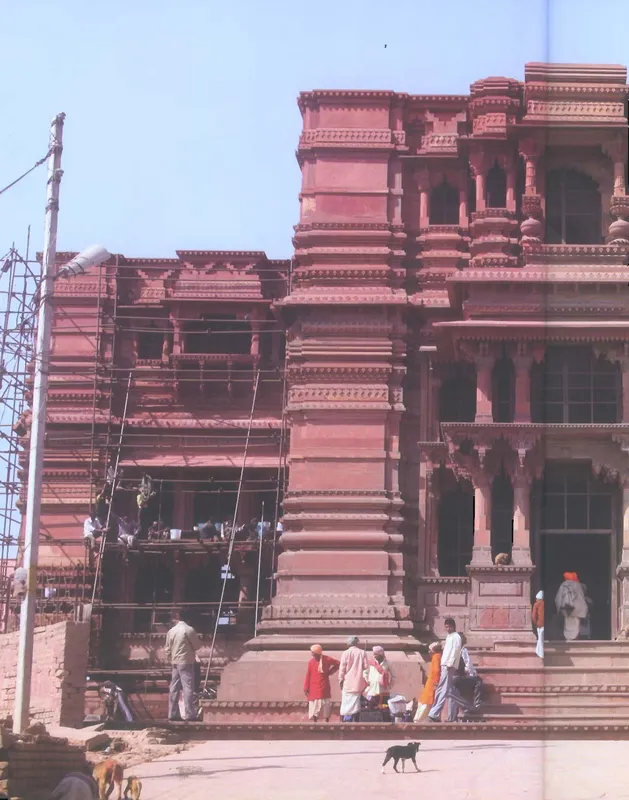
Rādhā-Govinda Mandira (Vṛndāvana, old)
राधा-गोविन्द मन्दिर (वृन्दावन, पुराना)The old Rādhā-Govinda Mandira is the great red-sandstone temple of Śrī Govindadeva in Vṛndāvana, built, as the guidebooks say, on top of Gomā-ṭīlā, a mound.
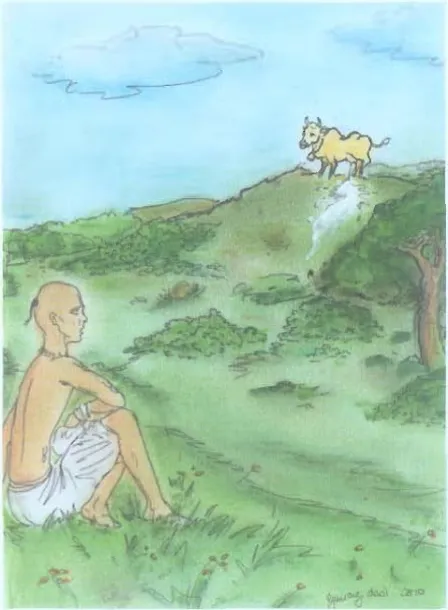
Gomā-ṭīlā
गोमा-टीलाGomā-ṭīlā is the hillock in Vṛndāvana where, according to the Bhakti-ratnākara, Śrīla Rūpa Gosvāmī found the Deity of Śrī Govinda.
Govindajī Mandira (Vṛndāvana, new)
गोविन्दजी मन्दिर (वृन्दावन, नया)The new Govindajī temple stands behind the old red-sandstone temple of Śrī Rādhā-Govinda in Vṛndāvana, the old Govindajī temple.
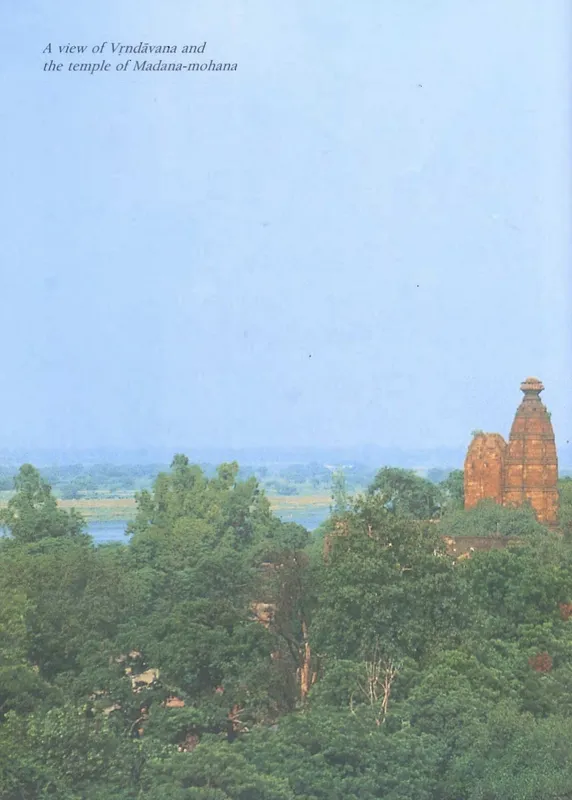
Vṛndāvana
वृन्दावनVṛndāvana is the forest on the bank of the Yamunā where Kṛṣṇa spent His childhood and youth, and the town of temples that stands in that forest today.
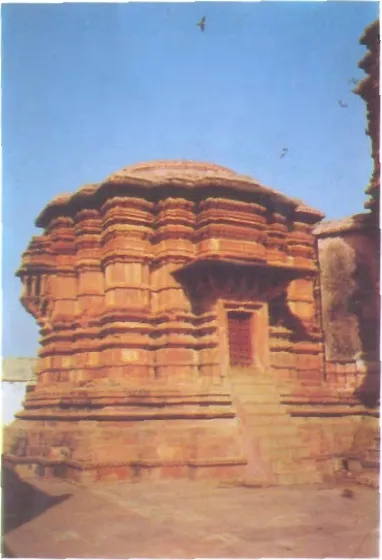
Yogapīṭha (old Govinda temple)
योगपीठ (पुराना गोविन्द मन्दिर)The Yogapīṭha is the chapel of the old Govinda temple in Vṛndāvana that the guidebooks give as the very spot where Śrīla Rūpa Gosvāmī found the Deity of Śrī Govinda.
Rādhā-kuṇḍa (village)
राधा-कुण्ड (गाँव)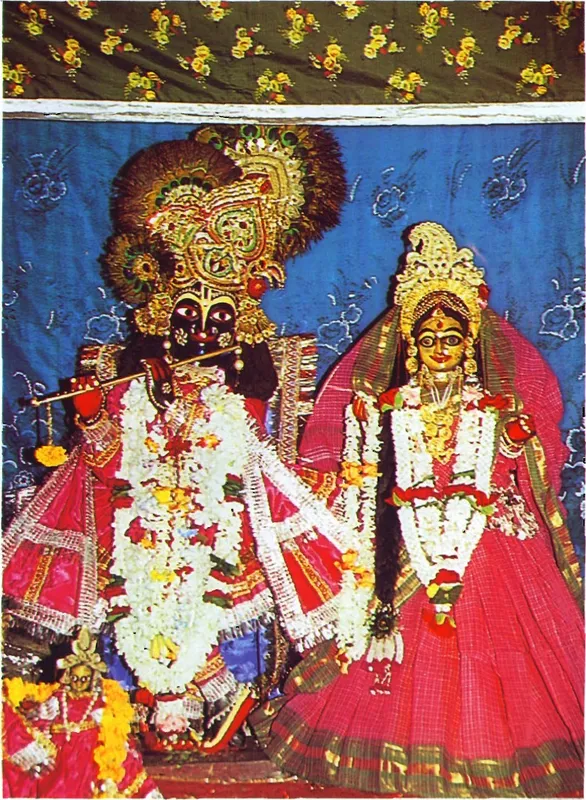
Rādhā-Govinda Mandira (Rādhā-kuṇḍa)
राधा-गोविन्द मन्दिर (राधा-कुण्ड)The Rādhā-Govinda Mandira, also called the Govindadeva temple, is a temple of Śrī Śrī Rādhā-Govinda in the village of Rādhā-kuṇḍa.
Questions and answers
The Caitanya-caritāmṛta says that Śrīla Raghunātha Bhaṭṭa Gosvāmī had his disciples build it. Śrīla Prabhupāda says that Mahārāja Mānsiṅgh, Akbar's commander-in-chief, built it at Śrīla Rūpa Gosvāmī's order. The temple's inscription, as printed by historians, names Mānasiṁhadeva, son of Bhagavantadāsa.[1–14]
The inscription is dated "saṁvat 34". Growse and Datta read this as Akbar's thirty-fourth year, 1590, and the guidebooks give 1590 for the completion. Entwistle notes that it would normally mean 1577.[1 +9]
Śrīla Prabhupāda said that the temple had seven storeys and that Aurangzeb broke four. In 1973 he wrote that it had been desecrated and partly destroyed. Other sources count the storeys or spires differently.[16, 27]
Śrīla Prabhupāda said that the king of Jaipur took Govinda, Gopīnātha and Madana-mohana from Vṛndāvana when Aurangzeb was breaking temples. The year is given differently. Datta says probably 1670; Entwistle gives Amber about 1714 and Jaipur in 1735.[15 +8]
The guidebooks say that the original Deity of Govinda, now with Śrī Rādhā, is worshipped in Jaipur. They say that the Deities in the new temple at Vṛndāvana are representative forms, considered non-different from Him.[17 +4]
He often told how Mahārāja Mānsiṅgh built it at Śrīla Rūpa Gosvāmī's word. He said that such a temple could not be built today. In 1972 he asked that ISKCON's Vṛndāvana temple be built just like Govindajī's.[5 +9]
The guidebook Vṛndāvana, the Playground of God (2010) says that a Vrajavāsī family looks after the Deities in the old temple. The Color Guide to Vṛndāvana (2000) printed its darśana hours (the times when the Deities can be seen). Both may have changed since.[18 +2]
Sources
- Śrīla Kṛṣṇadāsa Kavirāja Gosvāmī, Śrī Caitanya-caritāmṛta, CC Antya-līlā 13.131, online edition · vedabase.io
- Śrīla Prabhupāda, Śrī Caitanya-caritāmṛta, Ādi-līlā 10.158, purport · vedabase.io
- Vṛndāvana, the Playground of God (2010), Bhakti Caitanya Svāmī, PDF p. 148
- Vṛndāvana, the Playground of God (2010), Bhakti Caitanya Svāmī, PDF p. 34
- Śrīla Prabhupāda, The Nectar of Devotion, Chapter 7 · vedabase.io
- Śrīla Prabhupāda, Śrīmad-Bhāgavatam 1.2.9 lecture, Vṛndāvana, 20 October 1972 · vedabase.io
- Śrīla Prabhupāda, Śrī Rāma-navamī, Cornerstone Laying, Bombay, 1 April 1974 · vedabase.io
- Śrīla Prabhupāda, Śrīmad-Bhāgavatam 5.5.9 lecture, Vṛndāvana, 31 October 1976 · vedabase.io
- Śrīla Prabhupāda, Morning Walk, Chicago, 11 July 1975 · vedabase.io
- Vṛndāvana-kathā, chapter 2 (dvitīya pariccheda), printed p. 38
- A. W. Entwistle, ch. 8 gazetteer, §25 'Govind Dev', printed pp. 409-410, Egbert Forsten, Groningen, 1987
- A. W. Entwistle, ch. 5 §12 (Akbar's reign), printed pp. 159-160, Egbert Forsten, Groningen, 1987
- A. W. Entwistle, ch. 8 gazetteer, §25 'Govind Dev', printed p. 410, Egbert Forsten, Groningen, 1987
- Mathurá (1883), F. S. Growse, B.C.S., M.A. Oxon., C.I.E. (as the title page gives him
- Śrīla Prabhupāda, Śrīla Baladeva Vidyābhūṣaṇa Appearance lecture, Los Angeles, 14 June 1970 · vedabase.io
- Śrīla Prabhupāda, Letter to Jadurani, letter 73-06-28, 28 June 1973 · vedabase.io
- Śrī Vraja-maṇḍala Parikramā (2007), PDF p. 324
- Vṛndāvana, the Playground of God (2010), Bhakti Caitanya Svāmī, PDF p. 35
- Vṛndāvana, the Playground of God (2010), Bhakti Caitanya Svāmī, PDF p. 12
- The Color Guide to Vṛndāvana (2000), Written and Photographed by Rājaśekhara dāsa Brahmacārī, PDF p. 146
Show all 67 references
- Śrīla Narahari Cakravartī, Bhakti-ratnākara, Second Wave (dvitīya taraṅga), 1912 ed. p. 88, 2nd ed., 1912
- Śrīla Narahari Cakravartī, Bhakti-ratnākara, Second Wave (dvitīya taraṅga), 1912 ed. p. 89, 2nd ed., 1912
- Śrīla Narahari Cakravartī, Bhakti-ratnākara, Second Wave, quoting the Sādhana-dīpikā of Rādhā-kṛṣṇa Gosvāmī, 1912 ed. p. 90, 2nd ed., 1912
- Śrī Vraja-maṇḍala Parikramā (2007), PDF p. 322
- Śrī Vraja-maṇḍala Parikramā (2007), PDF p. 323
- Vṛndāvana, the Playground of God (2010), Bhakti Caitanya Svāmī, PDF p. 30
- Śrīla Prabhupāda, Śrīmad-Bhāgavatam 7.9.11 lecture, Montreal, 17 August 1968 · vedabase.io
- Vṛndāvana, the Playground of God (2010), Bhakti Caitanya Svāmī, PDF p. 40
- Śrī Vraja-maṇḍala Parikramā (2007), PDF p. 325
- the undated parikramā notes Vṛndāvana, ¶268
- Śrīla Narahari Cakravartī, Bhakti-ratnākara, Second Wave (dvitīya taraṅga), 1912 ed. p. 91, 2nd ed., 1912
- Śrīla Kṛṣṇadāsa Kavirāja Gosvāmī, Śrī Caitanya-caritāmṛta, Madhya-līlā 1.32, online edition · vedabase.io
- Śrīla Prabhupāda, Śrī Caitanya-caritāmṛta, Madhya-līlā 23.104, purport · vedabase.io
- Śrīla Prabhupāda, Śrī Caitanya-caritāmṛta, Ādi-līlā 7.164, purport · vedabase.io
- Śrīla Kṛṣṇadāsa Kavirāja Gosvāmī, Śrī Caitanya-caritāmṛta, Ādi-līlā 1.19, online edition · vedabase.io
- Śrīla Prabhupāda, Śrī Caitanya-caritāmṛta, Ādi-līlā 1.19, purport · vedabase.io
- Śrīla Prabhupāda, Śrī Caitanya-caritāmṛta, Ādi-līlā 10.90, purport · vedabase.io
- Vṛndāvana, the Playground of God (2010), Bhakti Caitanya Svāmī, PDF p. 36
- Śrīla Kṛṣṇadāsa Kavirāja Gosvāmī, Śrī Caitanya-caritāmṛta, CC Antya-līlā 13.120, online edition · vedabase.io
- Śrīla Kṛṣṇadāsa Kavirāja Gosvāmī, Śrī Caitanya-caritāmṛta, CC Antya-līlā 13.125, online edition · vedabase.io
- Śrīla Kṛṣṇadāsa Kavirāja Gosvāmī, Śrī Caitanya-caritāmṛta, CC Antya-līlā 13.128, online edition · vedabase.io
- The Color Guide to Vṛndāvana (2000), Written and Photographed by Rājaśekhara dāsa Brahmacārī, PDF p. 149
- Śrīla Rādhā-kṛṣṇa Gosvāmī, Sādhana-dīpikā, (8) aṣṭa-kakṣā, verses on the devotees of Śrī Govinda … after v.9.29', part 3/3)
- Bhaktamāla of Nābhā dāsa with Priyādāsa's kavittas and Rūpakalā's Hindi prose tilaka, part 2, entry of Rūpa and Sanātana, Rūpakalā's vārtika tilaka after kavitta 363 and its footnote, printed pp. 871-872
- Mathurá (1883), F. S. Growse, B.C.S., M.A. Oxon., C.I.E. (as the title page gives him, p. 243
- the undated parikramā notes Vṛndāvana, ¶266
- Śrīla Rādhā-kṛṣṇa Gosvāmī, Sādhana-dīpikā, (8) aṣṭa-kakṣā, the account of Śrī Rūpa and Śrī Govinda … after v.7', part 1/2)
- A. W. Entwistle, ch. 5 §12 (Akbar's reign), printed p. 160 with n. 127, Egbert Forsten, Groningen, 1987
- Śrīla Kṛṣṇadāsa Kavirāja Gosvāmī, Śrī Caitanya-caritāmṛta, CC Ādi-līlā 8.52, online edition · vedabase.io
- Śrīla Kṛṣṇadāsa Kavirāja Gosvāmī, Śrī Caitanya-caritāmṛta, CC Ādi-līlā 8.53, online edition · vedabase.io
- Śrīla Kṛṣṇadāsa Kavirāja Gosvāmī, Śrī Caitanya-caritāmṛta, CC Ādi-līlā 8.54, online edition · vedabase.io
- Śrīla Kṛṣṇadāsa Kavirāja Gosvāmī, Śrī Caitanya-caritāmṛta, Ādi-līlā 8.66, online edition · vedabase.io
- Śrīla Kṛṣṇadāsa Kavirāja Gosvāmī, Śrī Caitanya-caritāmṛta, CC Ādi-līlā 5.217, online edition · vedabase.io
- Śrīla Narahari Cakravartī, Bhakti-ratnākara, Sixth Wave (ṣaṣṭha taraṅga), 1912 ed. p. 468, 2nd ed., 1912
- Śrīla Narahari Cakravartī, Bhakti-ratnākara, Sixth Wave (ṣaṣṭha taraṅga), 1912 ed. p. 485, 2nd ed., 1912
- Śrīla Prabhupāda, Room Conversation About Māyāpur Construction, Hyderabad, 19 August 1976 · vedabase.io
- The Colour Guide to Rādhā-kuṇḍa (1999), Rājaśekhara dāsa Brahmacārī, PDF p. 95
- the undated parikramā notes Rādhā-kuṇḍa, ¶38
- Śrīla Prabhupāda, Letter to Gurudasa, letter 72-08-29, 29 August 1972 · vedabase.io
- Śrīla Prabhupāda, Letter to Gurudasa, Yamuna, letter 72-04-25, 25 April 1972 · vedabase.io
- Śrīla Prabhupāda, Letter to Gurudasa, letter 72-05-04, 4 May 1972 · vedabase.io
- Śrīla Prabhupāda, Letter to Bhavananda, letter of 1972-08-28 (page heading 'Center : Los Angeles ISKCON') · vedabase.io
- Satsvarūpa dāsa Gosvāmī, Śrīla Prabhupāda-līlāmṛta, vol. 2, ch. 43, April 1972 · vedabase.io
- Vṛndāvana-kathā, chapter 19 (ūnaviṁśa pariccheda), printed p. 218
- A. W. Entwistle, §5.25, printed p. 185 with nn. 266-268, Egbert Forsten, Groningen, 1987
- A. W. Entwistle, ch. 5 §28 'Religious activity in the time of Sawai Jai Singh', printed p. 191, Egbert Forsten, Groningen, 1987
- the undated parikramā notes Vṛndāvana, ¶271
Further sources
- Śrī Caitanya-caritāmṛta with Śrīla Prabhupāda's translation and purports (BBT); The Nectar of Devotion; Śrīla Prabhupāda's lectures, conversations and letters (vedabase.io).
- Bhakti-ratnākara of Śrīla Narahari Cakravartī Ṭhākura and the Sādhana-dīpikā (Sanskrit and Bengali), summarised, not translated.
- For dated history only, named and paraphrased: F. S. Growse, Mathurá: A District Memoir (1883); Pulinbihārī Datta, Vṛndāvana-kathā (1920); A. W. Entwistle, Braj: Centre of Krishna Pilgrimage (1987); Rūpakalā's commentary on the Bhaktamāla (1904).