The temples of Vṛndāvana in Mughal times
Akbar, Aurangzeb and the journeys of the Deities
In short
The first large temples of Vṛndāvana were founded through the Gosvāmīs, Śrī Caitanya's leading followers, in the sixteenth century, in Akbar's reign. Śrīla Prabhupāda said that Aurangzeb broke the Govinda temple and desecrated others. The historians report attacks on his orders. They date the Deities' journeys to Jaipur and Karauli between about 1714 and 1760.[1–4]
On this page
At a glance
- The beginning: the Caitanya-caritāmṛta says that Śrī Caitanya Mahāprabhu sent Śrīla Rūpa and Śrīla Sanātana Gosvāmī to Vṛndāvana. There they began the service of Madana-mohana and Govindajī.[5–10]
- The founders: each Gosvāmī established one temple, and others followed, Śrīla Prabhupāda said.[1]
- Akbar's reign: a document reported by Entwistle (1987) records Todar Mal's help for Śrīla Jīva Gosvāmī. The guidebooks' meeting of Akbar and Śrīla Jīva Gosvāmī in 1570 is not confirmed.[11, 12]
- Aurangzeb's reign: Śrīla Prabhupāda spoke of four storeys of the Govinda temple broken, and of the Madana-mohana temple desecrated. He also said Aurangzeb gave gifts to Vṛndāvana's temples.[2 +2]
- The journeys: according to Entwistle, the Deities (the sacred forms of Kṛṣṇa worshipped in the temples) went first to Kāmā. Govinda reached Amber by 1714, Madana-mohana went to Karauli in 1728, and Rādhā-Dāmodara to Jaipur in 1760.[3]
- The year 1670: given by the guidebooks, and as "probably" by the Vṛndāvana-kathā (1920). No dated document for it is known.[4 +6]
How did the temples of Vṛndāvana begin?
The Caitanya-caritāmṛta records the start of it all in two verses. Śrī Caitanya Mahāprabhu sent the two brothers to Vraja, and they went to Vṛndāvana by His order:[5–10]
তবে প্রভু ব্রজে পাঠাইল রূপ-সনাতন ।
প্রভু-আজ্ঞায় দুই ভাই আইলা বৃন্দাবন ॥ ৩১ ॥
tabe prabhu vraje pāṭhāila rūpa-sanātana
prabhu-ājñāya dui bhāi āilā vṛndāvana
Lord Śrī Caitanya Mahāprabhu then sent the two brothers Śrīla Rūpa Gosvāmī and Śrīla Sanātana Gosvāmī to Vraja. By His order, they went to Śrī Vṛndāvana-dhāma.
Translation: Śrīla A.C. Bhaktivedanta Swami PrabhupādaThere they preached, made known the places of pilgrimage and began the service of Madana-mohana and Govindajī. These are Deities, sacred forms of Kṛṣṇa that are worshipped in the temple.[5–10]
ভক্তি প্রচারিয়া সর্বতীর্থ প্রকাশিল ।
মদনগোপাল-গোবিন্দের সেবা প্রচারিল ॥ ৩২ ॥
bhakti pracāriyā sarva-tīrtha prakāśila
madana-gopāla-govindera sevā pracārila
After going to Vṛndāvana, the brothers preached devotional service and discovered many places of pilgrimage. They specifically initiated the service of Madana-mohana and Govindajī.
Translation: Śrīla A.C. Bhaktivedanta Swami PrabhupādaŚrīla Prabhupāda described the growth of the town to a visitor in Germany in 1974:[1 +4]
Names this place“In Vṛndāvana each and every Gosvāmī established one temple in the beginning. Then others followed. Rūpa Gosvāmī established Govindajī's temple, and Jīva Gosvāmī established Rādhā-Dāmodara temple.”
Śrīla Prabhupāda, Morning Walk with Professor Durckheim, Germany, 21 June 1974 · vedabase.io
He also counts seven original temples of the Gauḍīya Vaiṣṇavas, the devotees in Śrī Caitanya's line. They are Madana-mohana, Govinda, Gopīnātha, Rādhā-ramaṇa, Rādhā-Śyāmasundara, Rādhā-Dāmodara and Gokulānanda.[22]
In The Nectar of Devotion he writes that the devotees of Vṛndāvana visit the temples every morning and evening. The town, he says, has about five thousand temples. At least a dozen big and important ones, started by the Gosvāmīs, should be visited.[21] The figure of five thousand is a round number in all his statements, not a count.[1 +4]
What happened in Akbar's reign?
The large buildings of the first temples belong to the reign of Akbar. The Govinda temple carries an inscription, known through printed copies. It says that Mahārājādhirāja Mānasiṁhadeva made the temple for Śrī Govindadeva at the Vṛndāvana yogapīṭha (the holy seat where the Lord is present with His associates). It is read as 1590, or as 1577.[23–27] Read more: The great temple of Śrī Govinda →
The historians give no year for the old Madana-mohana temple. Entwistle (1987) says it was built at about the time of the work on the Govinda temple. Mītal (1966) counts it among the temples built in Akbar's reign.[25 +2] Read more: How Madana-mohana came to Śrīla Sanātana Gosvāmī →
Did Akbar meet Śrīla Jīva Gosvāmī?
The guidebooks date a meeting of Emperor Akbar with Śrīla Jīva Gosvāmī in Vṛndāvana to 1570. One of them adds that Akbar let him build temples. No farmān (royal order) or other dated document for this is known, so it is not certain.[11 +4]
The historian A. W. Entwistle (1987) notes that Hindu traditions say Akbar met leading Vaiṣṇavas of Braj, Śrīla Jīva Gosvāmī among them. But, he adds, no non-Hindu source confirms such meetings.[12]
According to Entwistle, what the record does show is a document kept at a research institute in Vṛndāvana. Todar Mal was Akbar's finance minister, and he died in 1589. The document says he persuaded Akbar, on Śrīla Jīva Gosvāmī's behalf, to give official recognition to the custodians (the keepers) of the Govinda-deva and Madana-mohana temples. Entwistle takes it from a later study and gives no date.[11]
What happened to the temples under Aurangzeb?
The sources speak of Aurangzeb in more than one way. They are given here side by side.[3 +2]
Śrīla Prabhupāda's words
In Montreal in 1968, Śrīla Prabhupāda said that the Govindajī temple had been seven storeys high, and that Aurangzeb broke four of them.[2] In San Francisco in 1967 he showed a picture of Vṛndāvana. He said that Śrīla Sanātana Gosvāmī's temple, the oldest in the town, was desecrated by Emperor Aurangzeb, and that hundreds of temples were built after the Gosvāmīs.[8] In a letter of 1973 he wrote that the old Govindajī and Madana-mohana temples had been desecrated (dishonoured) and partly destroyed. But the Govindajī Deity had been removed.[32]
In a conversation in Hyderabad in 1976 he spoke in another way:[13]
Names this place“Little bit discrepancies were there, especially during the time of Aurangzeb. He was bigot Muhammadan. … Aurangzeb gave many contributions to the Vṛndāvana temples.”
Śrīla Prabhupāda, Room Conversation About Māyāpur Construction, Hyderabad, 19 August 1976 · vedabase.io
In the same talk he mentioned a village opposite Vṛndāvana and the gift of land to a temple of the town. The transcript does not make clear which emperor he meant.[13]
The documented record
According to Entwistle (1987), none of the temples in Vṛndāvana was demolished. The original temples of Govinda-deva, Gopīnātha, Madana-mohana and Rādhāvallabha are in ruins, though, and some of their carved figures were defaced. He says this is ascribed to attacks made on Aurangzeb's orders. He gives no year for the attacks.[3, 4]
He also reports that early in his reign Aurangzeb issued decrees in favour of devotees in Braj. One of them granted villages on the east bank of the Yamunā to Gosvāmī Pūrṇānanda of Śṛṅgāravaṭa.[4] Read more: The temple of Śṛṅgāravaṭa and its gosvāmīs →
Pulinbihārī Datta wrote in 1920, and he opened his chapter on Aurangzeb in this way. For about a hundred and fifty years, he says, Vaiṣṇavas had filled the Vraja-maṇḍala with temples, and in 1670 it was shattered within a very short time. He referred his readers to Jadunath Sarkar's history. As Datta puts it, that history shows that the emperor destroyed old temples across his whole empire, in Vṛndāvana and far beyond it. Datta judged a popular local story about the Govinda temple to be untenable.[33]
The guidebooks' chronologies also give 1670, as the year of an attack on Vṛndāvana or of the desecration of its temples. No dated document for that year is known.[4 +5]
The sources' words on Aurangzeb and the temples differ, and they are set side by side here:
Accounts differ Aurangzeb's relation to the Vṛndāvana temples.
- Govardhana Hill: India's Most Sacred Mountain (2001) chronology1670: Emperor Aurangzeb attacks Vṛndāvana.
- The Color Guide to Vṛndāvana (2000) chronology1670: Aurangzeb desecrates temples.
- Śrī Vraja-maṇḍala Parikramā (2007)After the Gosvāmīs left this world 'the narrow-minded Mughal emperor Aurangzeb destroyed the famous temples'; because of his 'atrocities' the king of Jaipura took Govinda, Gopīnātha and Madana-mohana to Rājasthāna.
- Śrīla Prabhupāda, lecture 18 March 1967Śrīla Sanātana Gosvāmī's temple, the oldest in Vṛndāvana, 'was desecrated by … Emperor Aurangzeb'.
When were the Deities taken to Rājasthān, and why?
Śrīla Prabhupāda gave the reason in a lecture of June 1970. When Aurangzeb was breaking temples, the king of Jaipur took Govinda, Gopīnātha and Madana-mohana from Vṛndāvana to Jaipur.[32 +5]
According to Entwistle, the Gauḍīya priests of Govinda-deva, Gopīnātha, Rādhā-Dāmodara and Rādhā-vinoda sought the protection of the rulers of Amber. The Deities were first taken to Kāmā.[39] They did not stay there.[39]
The years he gives, from later studies, are these:[3]
- Śrī Govinda: to Amber in or shortly before 1714. In 1735 He was placed in a temple facing Sawai Jai Singh's palace at Jaipur.[3, 40]
- Śrī Madana-mohana: to Jaipur first, then in 1728 to Karauli. There Rājā Gopāla Siṁha built Him a temple opposite his palace.[39, 41]
- Śrī Rādhā-Dāmodara: to Jaipur in 1760, back to Vṛndāvana in 1796, and again to Jaipur in 1821.[39, 42]
- Śrī Gopīnātha and Śrī Rādhā-vinoda: to Jaipur. The historians (1966, 1987) and the guidebooks (1986–2010) say that the originals are there.[37 +8]
The Vṛndāvana-kathā (1920) differs. It says that all the Gauḍīya Deities were probably taken to Jaipur in 1670, under the shelter of Rāmasiṁha, son of Mirzā Rājā Jayasiṁha I. Datta gives no source for the year.[19] The guidebooks also give 1670. For each temple, the sources are set side by side on its own page, and for Śrī Govinda in His article.[4 +5]
What did each temple keep?
After the journeys, representative Deities were installed in Vṛndāvana, according to the guidebooks and the historians. These are called pratibhū forms: they stand in the place of the originals. Each temple's own story is told on its page or in its article.[37 +9]
- Govinda. The guidebooks place a pratibhū of Govinda in the new Govindajī temple behind the old one. Śrī Vraja-maṇḍala Parikramā (2007) gives 1748 for its installation and 1819 for the new temple.[35 +2]
- Madana-mohana. Mītal (1966) says that the Gauḍīya devotees installed a pratibhū in Saṁvat 1805. He says that Nandakumāra Vasu built a new temple near the old one in Saṁvat 1877.[41 +3]
- Gopīnātha. The guidebooks date the pratibhū Deities to 1748, and the new temple behind the old Rādhā-Gopīnātha Mandira to 1819.[44 +3] Read more: Gopīnātha and the banyan of Vaṁśīvaṭa →
- Rādhā-Dāmodara. According to the Vṛndāvana-kathā (1920), a pratibhū is worshipped in the Rādhā-Dāmodara temple. The sources differ on the dates, and on whether the Deity now there is the original.[19] Read more: Śrī Rādhā-Dāmodara, the Deity of Śrīla Jīva Gosvāmī →
- Rādhā-vinoda. The Vṛndāvana-kathā (1920) says that Rādhā-vinoda had gone to Jaipur, and that His pratibhū stood in the Rādhā-Gokulānanda temple.[55, 56] Read more: Śrī Rādhā-vinoda, the Deity of Śrīla Lokanātha Gosvāmī →
The old Rādhā-Vallabha temple of Śrī Hita Harivaṁśa's line is a similar case outside the Gauḍīya temples. The guidebooks give 1670 for its destruction, without evidence, and the historians give other accounts. The guidebooks of 2000 and 2010 show the present temple next to the old one.[57, 58]
Accounts differ What happened to the original Rādhā-Vallabha temple and when.
- Vṛndāvana, the Playground of God (2010)It 'was destroyed by the Muslims in 1670'; the current temple was built next door.
- The Color Guide to Vṛndāvana (2000)It was 'desicrated [sic] by the soldiers of Aurangzeb in 1670'; a new temple was built right next to it and the Deity reinstalled there.
- Growse (1883) p. 255; 1911 gazetteer p. 246The shrine (cella) was demolished by Aurangzeb and only its plinth remains, with a later room on it; the nave still stands. No year is given.
- Vṛndāvana-kathā (1920), p. 136In a Muslim disturbance the main shrine was razed to the ground; only the jagamohana and the nāṭamandira stood, half in ruins. No year.
According to The Colour Guide to Rādhā-kuṇḍa (1999), representative forms of several main Vṛndāvana Deities are also served at Rādhā-kuṇḍa, Śrī Rādhā's sacred pond. One of these temples is its Rādhā-Govinda temple. They are described in their own article.[59, 60] Read more: The pratibhū Deities of Rādhā-kuṇḍa →
Timeline
- 1570
The guidebooks date a meeting of Emperor Akbar with Śrīla Jīva Gosvāmī in Vṛndāvana to 1570.
Read in the article: What happened in Akbar's reign? → - 1670
The guidebooks' chronologies also give 1670, as the year of an attack on Vṛndāvana or of the desecration of its temples.
Read in the article: What happened to the temples under Aurangzeb? → - 1728
Śrī Madana-mohana: to Jaipur first, then in 1728 to Karauli.
Read in the article: When were the Deities taken to Rājasthān, and why? → - 1748
Śrī Vraja-maṇḍala Parikramā (2007) gives 1748 for its installation and 1819 for the new temple.
Read in the article: What did each temple keep? → - 1973
In a letter of 1973 he wrote that the old Govindajī and Madana-mohana temples had been desecrated (dishonoured) and partly destroyed.
Read in the article: What happened to the temples under Aurangzeb? →
Places in this article
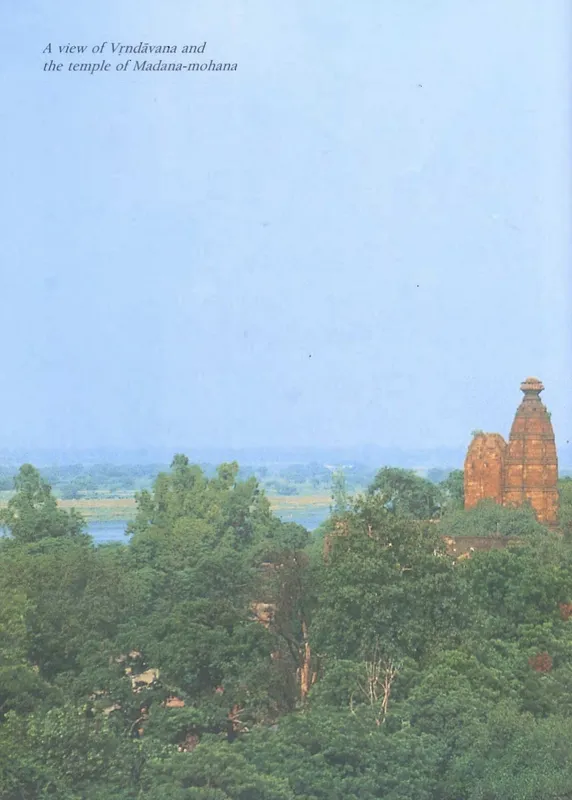
Vṛndāvana
वृन्दावनVṛndāvana is the forest on the bank of the Yamunā where Kṛṣṇa spent His childhood and youth, and the town of temples that stands in that forest today.
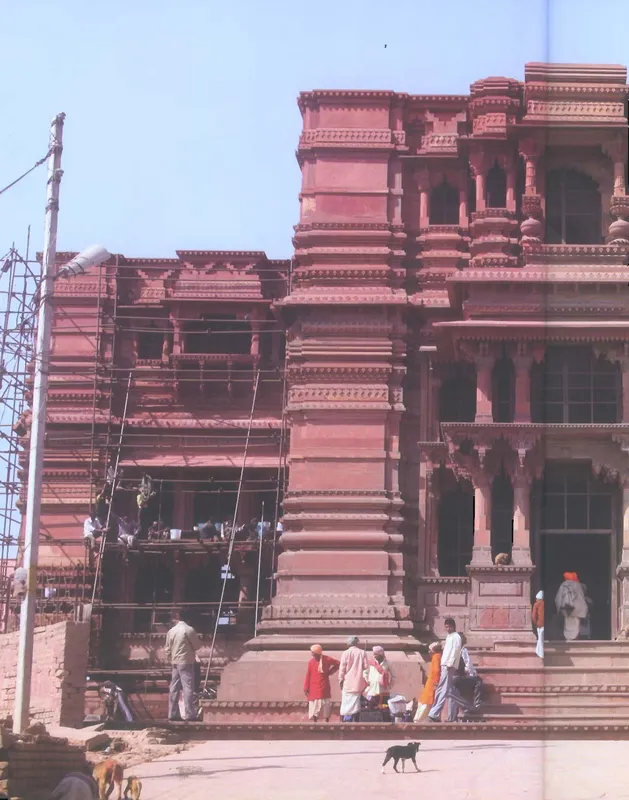
Rādhā-Govinda Mandira (Vṛndāvana, old)
राधा-गोविन्द मन्दिर (वृन्दावन, पुराना)The old Rādhā-Govinda Mandira is the great red-sandstone temple of Śrī Govindadeva in Vṛndāvana, built, as the guidebooks say, on top of Gomā-ṭīlā, a mound.
Rādhā-Madana-mohana Mandira (Vṛndāvana, old)
राधा-मदनमोहन मन्दिर (वृन्दावन, पुराना)The old Rādhā-Madana-mohana Mandira is the temple of Madana-mohana, also called Madana-gopāla, the Deity whose service Śrīla Sanātana Gosvāmī began in Vṛndāvana.
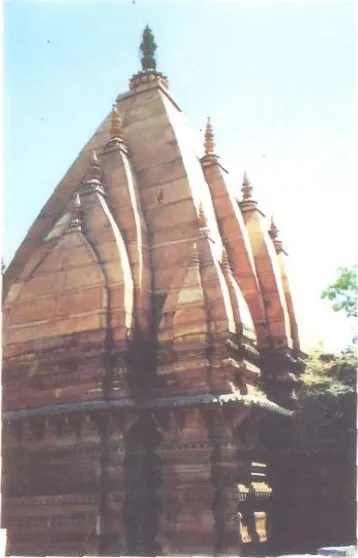
Rādhā-Gopīnātha Mandira (Vṛndāvana)
राधा-गोपीनाथ मन्दिर (वृन्दावन)The Rādhā-Gopīnātha Mandira is one of the seven original Gauḍīya Vaiṣṇava temples of Vṛndāvana.
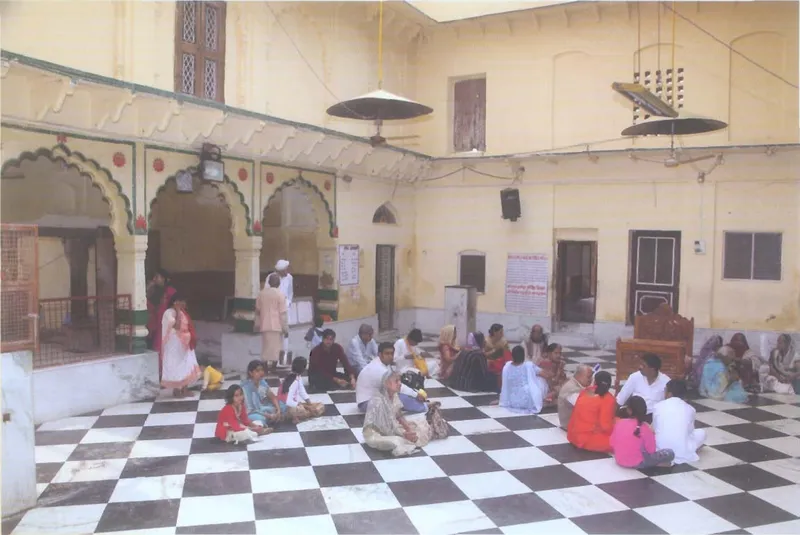
Rādhā-Dāmodara Mandira (Vṛndāvana)
राधा-दामोदर मन्दिर (वृन्दावन)The Rādhā-Dāmodara Mandira is one of the seven old temples of the Gauḍīya Vaiṣṇavas in Vṛndāvana, in the Sevā-kuñja quarter.
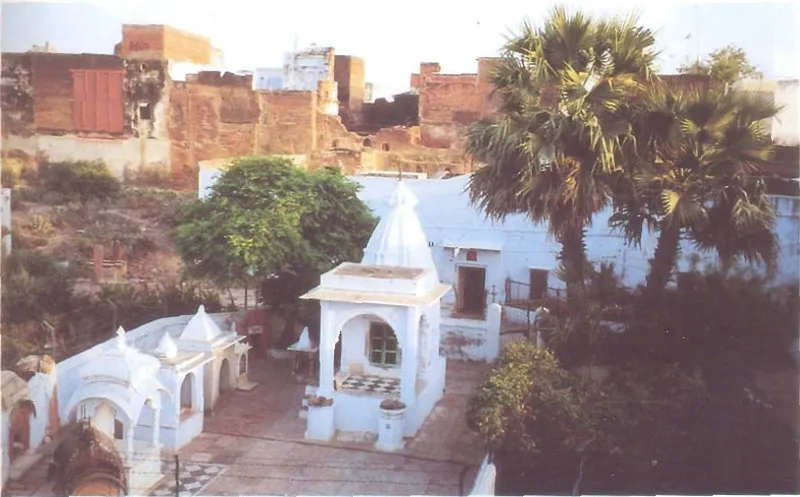
Rādhā-Gokulānanda Mandira (Vṛndāvana)
राधा-गोकुलानन्द मन्दिर (वृन्दावन)The Rādhā-Gokulānanda Mandira is a small temple in Vṛndāvana, about 200 metres from the Rādhā-Ramaṇa temple on a street that leads towards Keśī-ghāṭa.
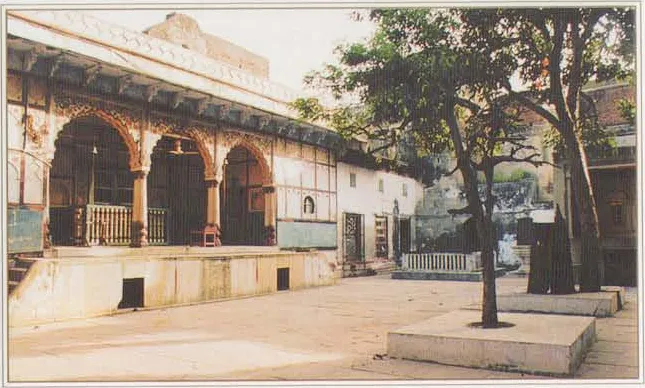
Śṛṅgāravaṭa (Vṛndāvana)
शृंगारवट (वृन्दावन)Śṛṅgāravaṭa, "the banyan of adornment", is a banyan with a temple on the bank of the Yamunā in Vṛndāvana, a little east of Imlītalā towards Keśī-ghāṭa and near the Rādhā- …
Rādhā-Vallabha Mandira (original)
राधावल्लभ मन्दिर (मूल)Govindajī Mandira (Vṛndāvana, new)
गोविन्दजी मन्दिर (वृन्दावन, नया)The new Govindajī temple stands behind the old red-sandstone temple of Śrī Rādhā-Govinda in Vṛndāvana, the old Govindajī temple.
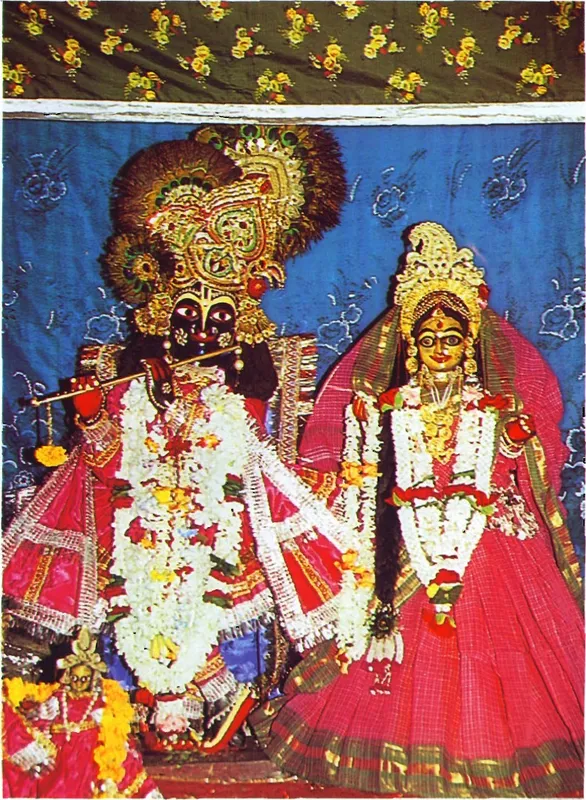
Rādhā-Govinda Mandira (Rādhā-kuṇḍa)
राधा-गोविन्द मन्दिर (राधा-कुण्ड)The Rādhā-Govinda Mandira, also called the Govindadeva temple, is a temple of Śrī Śrī Rādhā-Govinda in the village of Rādhā-kuṇḍa.
Questions and answers
The guidebooks date such a meeting to 1570, but no dated document for it is known, so it is not certain. Entwistle (1987) notes that no non-Hindu source confirms Akbar's meetings with the Vaiṣṇavas of Braj. He reports a document recording Todar Mal's help for Śrīla Jīva Gosvāmī.[11 +4]
According to Entwistle (1987), the Deities went first to Kāmā. Govinda reached Amber by 1714, Madana-mohana went to Karauli in 1728, and Rādhā-Dāmodara to Jaipur in 1760. The Vṛndāvana-kathā (1920) says probably 1670.[3, 19]
Śrīla Prabhupāda named the Govinda and Madana-mohana temples. Entwistle ascribes the ruined state of the Govinda-deva, Gopīnātha, Madana-mohana and Rādhāvallabha temples to attacks on Aurangzeb's orders, and gives no year. The guidebooks give 1670.[3 +7]
It is thin. The temples' own inscriptions are known only through printed copies. The documents that historians cite, such as the Todar Mal record and Aurangzeb's decree for Śṛṅgāravaṭa, are known only from the historians' reports.[4 +6]
Śrīla Prabhupāda said that the king of Jaipur took them when Aurangzeb was breaking temples. Entwistle says that the priests sought the protection of the rulers of Amber.[32 +6]
He said that Aurangzeb broke four storeys of the Govinda temple and desecrated the Madana-mohana temple. In 1976 he also said that Aurangzeb gave many contributions to the Vṛndāvana temples.[2 +2]
Śrīla Prabhupāda said that each Gosvāmī established one temple and that others followed. He counted seven original Gauḍīya temples of Vṛndāvana.[1, 22]
Sources
- Śrīla Prabhupāda, Morning Walk with Professor Durckheim, Germany, 21 June 1974 · vedabase.io
- Śrīla Prabhupāda, Śrīmad-Bhāgavatam 7.9.11 lecture, Montreal, 17 August 1968 · vedabase.io
- A. W. Entwistle, §5.25, printed p. 185 with nn. 266-268, Egbert Forsten, Groningen, 1987
- A. W. Entwistle, §5.25 'The exodus of deities from Braj', printed p. 183 with n. 255, Egbert Forsten, Groningen, 1987
- Śrīla Kṛṣṇadāsa Kavirāja Gosvāmī, Śrī Caitanya-caritāmṛta, Madhya-līlā 18.71, online edition · vedabase.io
- Śrīla Kṛṣṇadāsa Kavirāja Gosvāmī, Śrī Caitanya-caritāmṛta, Madhya-līlā 1.31, online edition · vedabase.io
- Śrīla Kṛṣṇadāsa Kavirāja Gosvāmī, Śrī Caitanya-caritāmṛta, Madhya-līlā 1.32, online edition · vedabase.io
- Śrīla Prabhupāda, Lecture on Śrī Caitanya-caritāmṛta, Ādi-līlā 7.149–171, San Francisco, 18 March 1967 · vedabase.io
- Śrī Vraja-maṇḍala Parikramā (2007), PDF p. 295
- Vṛndāvana-Dhāma Ki Jaya! (c. 1986), by Dhruva Mahārāja dāsa, PDF p. 15
- A. W. Entwistle, §5.12, printed p. 160 with n. 127, Egbert Forsten, Groningen, 1987
- A. W. Entwistle, §5.12 'Akbar and his Hindu associates', printed p. 158 with n. 114, Egbert Forsten, Groningen, 1987
- Śrīla Prabhupāda, Room Conversation About Māyāpur Construction, Hyderabad, 19 August 1976 · vedabase.io
- Govardhana Hill: India's Most Sacred Mountain (2001), Rajasekhara dasa Brahmacari, PDF p. 160
- Govardhana Hill: India's Most Sacred Mountain (2001), Rajasekhara dasa Brahmacari, PDF p. 161
- The Color Guide to Vṛndāvana (2000), Written and Photographed by Rājaśekhara dāsa Brahmacārī, PDF p. 25
- Śrīla Prabhupāda, Letter to Akbar Ali Khan, letter dated 24 February 1975 (vedabase 'letter-to-akbar-ali-khan') · vedabase.io
- The Color Guide to Vṛndāvana (2000), Written and Photographed by Rājaśekhara dāsa Brahmacārī, PDF p. 27
- Vṛndāvana-kathā, chapter 19 (ūnaviṁśa pariccheda), printed p. 218
- The Color Guide to Vṛndāvana (2000), Written and Photographed by Rājaśekhara dāsa Brahmacārī, PDF p. 1
Show all 60 references
- Śrīla Prabhupāda, The Nectar of Devotion, Chapter 6, 'How to Discharge Devotional Service', item (8) · vedabase.io
- Śrīla Prabhupāda, Śrī Caitanya-caritāmṛta, Ādi-līlā 10.90, purport · vedabase.io
- Vṛndāvana-kathā, chapter 2 (dvitīya pariccheda), printed p. 38
- A. W. Entwistle, ch. 8 gazetteer, §25 'Govind Dev', printed pp. 409-410, Egbert Forsten, Groningen, 1987
- A. W. Entwistle, ch. 5 §12 (Akbar's reign), printed pp. 159-160, Egbert Forsten, Groningen, 1987
- A. W. Entwistle, ch. 8 gazetteer, §25 'Govind Dev', printed p. 410, Egbert Forsten, Groningen, 1987
- Mathurá (1883), F. S. Growse, B.C.S., M.A. Oxon., C.I.E. (as the title page gives him
- A. W. Entwistle, ch. 5 §15 'Some Gaudiya devotees of the late sixteenth century', printed p. 166, Egbert Forsten, Groningen, 1987
- Prabhudayāl Mītal, part 2 ('ब्रज का इतिहास'), Mughal period, Akbar, printed p. 183
- The Colour Guide to Rādhā-kuṇḍa (1999), Rājaśekhara dāsa Brahmacārī, PDF p. 173
- Vṛndāvana, the Playground of God (2010), Bhakti Caitanya Svāmī, PDF p. 58
- Śrīla Prabhupāda, Letter to Jadurani, letter 73-06-28, 28 June 1973 · vedabase.io
- Vṛndāvana-kathā, chapter 19 (ūnaviṁśa pariccheda), printed pp. 210-212
- Śrīla Prabhupāda, Śrīla Baladeva Vidyābhūṣaṇa Appearance lecture, Los Angeles, 14 June 1970 · vedabase.io
- Śrī Vraja-maṇḍala Parikramā (2007), PDF p. 324
- Vṛndāvana, the Playground of God (2010), Bhakti Caitanya Svāmī, PDF p. 35
- Vṛndāvana, the Playground of God (2010), Bhakti Caitanya Svāmī, PDF p. 12
- The Color Guide to Vṛndāvana (2000), Written and Photographed by Rājaśekhara dāsa Brahmacārī, PDF p. 146
- A. W. Entwistle, ch. 5 §25 'The exodus of deities from Braj', printed p. 185, Egbert Forsten, Groningen, 1987
- A. W. Entwistle, ch. 5 §28 'Religious activity in the time of Sawai Jai Singh', printed p. 191, Egbert Forsten, Groningen, 1987
- A. W. Entwistle, ch. 8 §66.3 'Madanmohan', printed p. 402, Egbert Forsten, Groningen, 1987
- A. W. Entwistle, ch. 5 §36 'The Gaudiya Sampraday in modern times', note 471, printed p. 219, Egbert Forsten, Groningen, 1987
- Vṛndāvana, the Playground of God (2010), Bhakti Caitanya Svāmī, PDF p. 44
- The Color Guide to Vṛndāvana (2000), Written and Photographed by Rājaśekhara dāsa Brahmacārī, PDF p. 122
- Śrī Vraja-maṇḍala Parikramā (2007), PDF p. 330
- Vṛndāvana-Dhāma Ki Jaya! (c. 1986), by Dhruva Mahārāja dāsa, PDF p. 73
- The Colour Guide to Rādhā-kuṇḍa (1999), Rājaśekhara dāsa Brahmacārī, PDF p. 167
- A. W. Entwistle, Vrindaban temples, entry 32 'Radhavinod and Gokulanand' (citing VDA 32), printed p. 413, Egbert Forsten, Groningen, 1987
- Prabhudayāl Mītal, part 1 ('ब्रज-संस्कृति की भूमिका'), 'Braj-yātrā', Vṛndāvana: 'Śrī Rādhāvinoda-jī tathā Śrī Gokulānanda-jī', printed p. 137
- A. W. Entwistle, ch. 5 §36 'The Gaudiya Sampraday in modern times', printed p. 219, Egbert Forsten, Groningen, 1987
- Prabhudayāl Mītal, part 1 ('ब्रज-संस्कृति की भूमिका'), 'Braj-yātrā', Vṛndāvana: end of the Madanamohana entry, printed p. 136
- Prabhudayāl Mītal, part 2 ('ब्रज का इतिहास'), modern period, entry 'Nandakumāra Vasu', printed p. 277
- Vṛndāvana, the Playground of God (2010), Bhakti Caitanya Svāmī, PDF p. 42
- the undated parikramā notes Vṛndāvana, ¶232
- Vṛndāvana-kathā, chapter 7 (Rādhāvinoda and Gokulānanda), printed p. 101
- Vṛndāvana-kathā, chapter 7, section on Raghunātha dāsa Gosvāmī, printed p. 111
- Vṛndāvana, the Playground of God (2010), Bhakti Caitanya Svāmī, PDF p. 142
- The Color Guide to Vṛndāvana (2000), Written and Photographed by Rājaśekhara dāsa Brahmacārī, PDF p. 68
- The Colour Guide to Rādhā-kuṇḍa (1999), Rājaśekhara dāsa Brahmacārī, PDF p. 95
- the undated parikramā notes Rādhā-kuṇḍa, ¶38
Further sources
- Śrī Caitanya-caritāmṛta, Madhya 1.31–32, with Śrīla Prabhupāda's translation (BBT); The Nectar of Devotion; Śrīla Prabhupāda's lectures, conversations and letters (vedabase.io).
- For dated history only, named and paraphrased: Pulinbihārī Datta, Vṛndāvana-kathā (1920); Prabhudayāl Mītal (1966); A. W. Entwistle, Braj: Centre of Krishna Pilgrimage (1987), and the studies he cites.
- The guidebooks' chronologies, given as theirs: The Color Guide to Vṛndāvana (2000) and other guides.