Jatīpurā
जतीपुरा
Also called Gopālapurā
- What it is
- Jatīpurā is a village on the west side of Govardhana Hill, across the hill from Aniyora; the Gopāla temple stands on the hilltop above it.
- Visiting
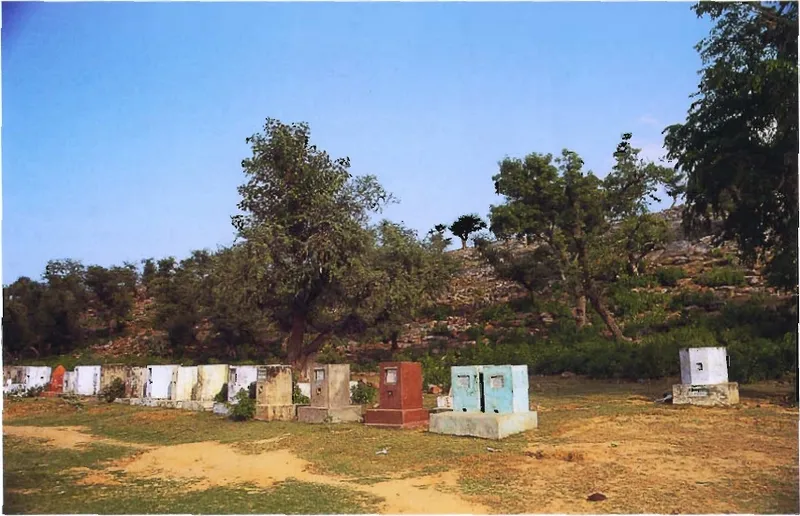
- Govardhana Hill (2001) prints a photograph of a row of small whitewashed samādhis (tombs) of different sizes at Jatīpurā; it does not say whose they are.
- Parikramā
- Govardhana parikramā, station 37
- Places here
- Annakūṭa-sthalī, Mukhāravinda-śilā (Jatīpurā), Viṭṭhalanātha Samādhi, Vallabhācārya's Baiṭhaka (Jatīpurā)
In short
Jatīpurā is a village on the west side of Govardhana Hill, across the hill from Aniyora; the Gopāla temple stands on the hilltop above it.[1 +3] The guidebooks say that the village is named after Śrīla Mādhavendra Purī, a renunciant (yati), who stayed here while he served the Gopāla Deity.[2 +2] The Caitanya-caritāmṛta tells how Gopāla asked him to install Him in a temple on top of the hill, but it names no village.[6 +2] The Deity, still worshipped at Govardhana when that book was written, is now at Nāthadvāra in Rājasthān.[8 +2]
Key facts
| Kind | village |
|---|---|
| Region · area | Govardhana |
| On the parikramā | Govardhana parikramā, station 37 · the route |
| Ācāryas | Śrīla Mādhavendra Purī, Śrīla Raghunātha dāsa Gosvāmī, Viṭṭhalanātha (Viṭhṭhaleśvara, Viṭṭhalācārya), son of Vallabhācārya, Vallabhācārya (Vallabha Bhaṭṭa) |
Traditional accounts
According to the guidebooks Govardhana Hill (2001) and Śrī Vraja-maṇḍala Parikramā (2007), the village is named after Śrīla Mādhavendra Purī: a jati or yati is a renunciant, and Govardhana Hill says that "jeti" is a corruption of yati. No scripture, Gosvāmī text or book of Śrīla Prabhupāda found so far names Jatīpurā.[2 +2]
Śrī Vraja-maṇḍala Parikramā also calls the village Gopālapurā. Śrīla Prabhupāda's purport to Caitanya-caritāmṛta Madhya 18.37 names a village Gopāla-pura near Gāṅṭhuli-grāma and Bilachu; that it is this village rests only on the guidebook's other name.[1 +5] Śrīla Nārāyaṇa Bhaṭṭa Gosvāmī's Vraja-bhakti-vilāsa, quoting the Bṛhad-gautamīya, names a Gopālapura right after Govardhana among the places of Śrī Rādhā's domain, but it does not say where it lies, and no source says that it is Jatīpurā.[1 +1]
The Gosvāmīs and ācāryas
Govardhana Hill (2001) says that Śrī Viṭṭhalanātha, the son of Śrī Vallabhācārya, stayed at Jatīpurā after he was put in charge …
Govardhana Hill (2001) says that Śrī Viṭṭhalanātha, the son of Śrī Vallabhācārya, stayed at Jatīpurā after he was put in charge of Gopāla's worship, and that his samādhi (tomb) and the baiṭhaka (sitting place) of his father are here.[2 +1] Śrīla Prabhupāda writes that Śrī Vallabhācārya established a Deity in the valley near Govardhana Hill, without naming the Deity or the village.[28]
Śrīla Prabhupāda's purport to Caitanya-caritāmṛta Madhya 18.47 calls Śrī Viṭhṭhaleśvara (Śrī Viṭṭhalanātha) the younger son of Śrī Vallabha Bhaṭṭa and gives his years as 1515 to 1585. It tells that in Śrīla Rūpa Gosvāmī's old age, when he could no longer go to Govardhana, Gopāla stayed for a month at Śrī Viṭhṭhaleśvara's house in Mathurā.[27 +2]
Visiting today
Govardhana Hill (2001) prints a photograph of a row of small whitewashed samādhis (tombs) of different sizes at Jatīpurā; it does not say whose they are.[31 +1]
The Daṇḍavata-śilā
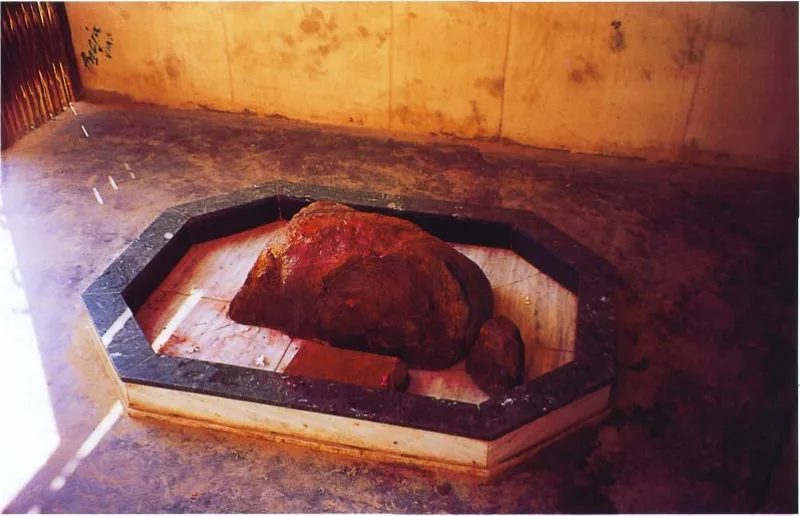
The Daṇḍavata-śilā is a Govardhana-śilā, a stone of the hill, at Jatīpurā. Its name comes from the daṇḍavat, the obeisance made by lying flat on the ground like a stick. According to the local tradition recorded in Govardhana Hill (2001), going around this stone seven times with full daṇḍavats frees one from offences made unknowingly on the walk around the hill; this is pilgrims' practice, not a rule of scripture.[27 +1] The book adds that the priests who serve in the temples on top of the hill come here to free themselves from the offence of climbing it. No scripture or Gosvāmī text found so far mentions this śilā, and the key of the numbered Govardhana chart only lists its name among the places of Jatīpurā.[27 +1]
The Caitanya-caritāmṛta tells that Śrī Caitanya Mahāprabhu resolved never to climb Govardhana Hill, and that Śrīla Rūpa Gosvāmī and Śrīla Sanātana Gosvāmī did not climb it either. The book does not mention this śilā or any atonement for climbing.[30 +2] Śrīla Prabhupāda explains why they did not climb the hill, in a general passage that does not name this śilā:[30]
Names this place“Following Śrī Caitanya Mahāprabhu’s example, they did not climb the hill because they considered it nondifferent from Kṛṣṇa, the Supreme Personality of Godhead.”
Śrīla Prabhupāda, Śrī Caitanya-caritāmṛta, Madhya-līlā 18.47, purport · vedabase.io
Location
| Where it is | west of Ānyora on the other side of Govardhana Hill; map: where the road from Gaṅṭholī and Gulāla-kuṇḍa meets the parikramā path[36] Govardhana map: '35' where the road from 'Gaṅṭholī' and 'Gulāla-kuṇḍa' meets the parikramā path[37] |
|---|---|
| On the numbered Govardhana chart | 63 (printed as “Jatipur Village”)[38] |
Places at Jatīpurā
6 places
- 1Annakūṭa-sthalīpastime site›
- 2Mukhāravinda-śilā (Jatīpurā)śilā›
- 3Viṭṭhalanātha Samādhisamādhi›
- 4Vallabhācārya's Baiṭhaka (Jatīpurā)baiṭhaka›
Also described on this page
- Daṇḍavata-śilā śilā
Also listed here
- Samādhis at Jatīpurā samādhi
Nearby places
Aniyora · Gāṅṭholī · Gopāla Rāya Mandira
Pictures
1 pictures
History
Gopāla on the hill
The Caitanya-caritāmṛta (Madhya 4) tells that Gopāla asked Śrīla Mādhavendra Purī in a dream to have the villagers take Him out of a bush and install Him in a temple on top of the hill. The book names no village.[6 +2]
grāmera loka āni’ āmā kāḍha’ kuñja haite
parvata-upari lañā rākha bhāla-mate
“Please bring the people of the village and get them to take Me out of this bush. Then have them situate Me nicely on top of the hill.
Translation: Śrīla A.C. Bhaktivedanta Swami PrabhupādaŚrīla Mādhavendra Purī made two renounced brāhmaṇas from Bengal his disciples and gave them Gopāla's daily service. After two years Gopāla asked him in a dream to bring sandalwood from Nīlācala (Jagannātha Purī), and he arranged the worship and set out.[14 +2] On the way back, at Remuṇā, Gopāla told him in a dream to smear the sandalwood on the Deity of Gopīnātha there, and at the end of the summer he returned to Nīlācala. The Caitanya-caritāmṛta does not say that he went back to Govardhana.[16 +2]
The sources differ on where Śrīla Mādhavendra Purī stayed and on which village was Gopāla's. According to the Bhakti-ratnākara, he stayed under a tree on the Govinda-kuṇḍa side of the hill, near Dāna-nivartana-kuṇḍa, and from there the guide points to Gopāla's place on the hill.[19] The Bengali Vṛndāvana-kathā (1920) says that he brought out the Deity at Annakūṭa-grāma, which it calls by its present name, Ānior (Aniyora), on the bank of Govinda-kuṇḍa; all the accounts of which village was Gopāla's are set side by side on the page of Aniyora.[20]
From Govardhana to Nāthadvāra
When the Caitanya-caritāmṛta was written, the Gopāla Deity was still worshipped at Govardhana. Śrīla Prabhupāda writes, after Śrīla Bhaktivinoda Ṭhākura, where He is now:[8 +2]
Names this place“Bhaktivinoda Ṭhākura annotates that this Gopāla Deity was originally installed by Vajra, the great-grandson of Kṛṣṇa. Mādhavendra Purī rediscovered Gopāla and established Him on top of Govardhana Hill. This Gopāla Deity is now situated at Nāthadvāra and is under the management of descendants of Vallabhācārya.”
Śrīla Prabhupāda, Śrī Caitanya-caritāmṛta, Madhya-līlā 4.1, purport · vedabase.io
Two guidebooks say that the Deity left Govardhana for Rājasthān because of the emperor Aurangzeb, and Govardhana Hill (2001) gives the year of the move as about 1670; Śrī Vraja-maṇḍala Parikramā (2007), which calls Him Śrī Nāthajī, says only that He now presides at Nāthadvāra.[5 +2] According to the historian A. W. Entwistle (1987), the top of the hill above Jatīpurā is the site of the temple that housed the Deity until He was taken to Rājasthān in Aurangzeb's reign; in 1987 the ruins of that first temple stood behind a newer one, which had later been restored.[23] Read more: The Gopāla Deity of Govardhana →
Entwistle also reports Mughal grants (farmans) of 1593 and 1633 that recorded land and buildings of the Vallabha line at Jatīpurā, held free of tax for the service of Śrīnāthjī's temple.[24 +1] He adds that in 1953 the head of the first seat of the Vallabha line brought the Deity Mathureśjī from Kota and installed Him in a temple at Jatīpurā.[26]
Where the sources differ
Whether Viṭṭhalanātha (Viṭhṭhaleśvara) was Vallabhācārya's eldest or younger son
Accounts differ Whether Viṭṭhalanātha (Viṭhṭhaleśvara) was Vallabhācārya's eldest or younger son
- Govardhana Hill: India's Most Sacred Mountain (2001), Viṭṭhalanātha Samādhi'Viṭṭhalanātha, who was the eldest son of Vallabhācārya'
- Śrīla Prabhupāda, CC Madhya 18.47 purport'Śrī Vallabha Bhaṭṭa had two sons. The elder, Gopīnātha, was born in 1432 Śakābda Era (A.D. 1510), and the younger, Viṭhṭhaleśvara, was born in 1437 (A.D. 1515)'
More on this place
The Gopāla Deity of Govardhana
References
38 references
- Śrī Vraja-maṇḍala Parikramā (2007), PDF p. 126
- Govardhana Hill: India's Most Sacred Mountain (2001), Rajasekhara dasa Brahmacari, PDF p. 140
- the undated parikramā notes Govardhana, ¶148
- Vṛndāvana-Dhāma Ki Jaya! (c. 1986), by Dhruva Mahārāja dāsa, PDF p. 98
- Śrī Vraja-maṇḍala Parikramā (2007), PDF p. 129
- Śrīla Kṛṣṇadāsa Kavirāja Gosvāmī, Śrī Caitanya-caritāmṛta, CC Madhya-līlā 4.37, online edition · vedabase.io
- Śrīla Kṛṣṇadāsa Kavirāja Gosvāmī, Śrī Caitanya-caritāmṛta, CC Madhya-līlā 4.38, online edition · vedabase.io
- Śrīla Prabhupāda, Śrī Caitanya-caritāmṛta, Madhya-līlā 4.1, purport · vedabase.io
- Śrīla Kṛṣṇadāsa Kavirāja Gosvāmī, Śrī Caitanya-caritāmṛta, CC Madhya-līlā 17.168, online edition · vedabase.io
- Śrīla Prabhupāda, Morning Walk, Māyāpur, 6 March 1974 · vedabase.io
- Śrīla Prabhupāda, Śrī Caitanya-caritāmṛta, Madhya-līlā 18.37, purport · vedabase.io
- Śrī Vraja-maṇḍala Parikramā (2007), PDF p. 134
- Śrīla Nārāyaṇa Bhaṭṭa, Vraja-bhakti-vilāsa, adhyāya 2, v.21 (the Bṛhad-gautamīya list), printed p. 36, 1st ed., publ. Bābā Kṛṣṇadāsa, Kusuma-sarovara, Saṁvat 2008
- Śrīla Kṛṣṇadāsa Kavirāja Gosvāmī, Śrī Caitanya-caritāmṛta, CC Madhya-līlā 4.104, online edition · vedabase.io
- Śrīla Kṛṣṇadāsa Kavirāja Gosvāmī, Śrī Caitanya-caritāmṛta, CC Madhya-līlā 4.107, online edition · vedabase.io
- Śrī Vraja-maṇḍala Parikramā (2007), PDF p. 133
- Śrīla Kṛṣṇadāsa Kavirāja Gosvāmī, Śrī Caitanya-caritāmṛta, CC Madhya-līlā 4.159, online edition · vedabase.io
- Śrīla Kṛṣṇadāsa Kavirāja Gosvāmī, Śrī Caitanya-caritāmṛta, CC Madhya-līlā 4.169, online edition · vedabase.io
- Śrīla Narahari Cakravartī, Bhakti-ratnākara, Fifth Wave, 1912 ed. pp. 202-203, 2nd ed., 1912
- Vṛndāvana-kathā, printed p. 122, section on Govardhana
Show all 38 references
- Govardhana Hill: India's Most Sacred Mountain (2001), Rajasekhara dasa Brahmacari, PDF p. 99
- the undated parikramā notes Govardhana, ¶103
- A. W. Entwistle, ch. 8 §22.7 'Shrinathji ka Mandir', printed p. 356, Egbert Forsten, Groningen, 1987
- A. W. Entwistle, ch. 5, the paragraph on Vitthalnath's firmans, printed p. 161, Egbert Forsten, Groningen, 1987
- A. W. Entwistle, ch. 5 §22 'The Pushtimarg in the first half of the seventeenth century', printed p. 177, Egbert Forsten, Groningen, 1987
- A. W. Entwistle, ch. 5, the paragraphs before §39 'New arrivals', printed p. 223, Egbert Forsten, Groningen, 1987
- Govardhana Hill: India's Most Sacred Mountain (2001), Rajasekhara dasa Brahmacari, PDF p. 143
- Śrīla Prabhupāda, Śrī Caitanya-caritāmṛta, Madhya-līlā 19.61, purport · vedabase.io
- Śrīla Kṛṣṇadāsa Kavirāja Gosvāmī, Śrī Caitanya-caritāmṛta, CC Madhya-līlā 18.47, online edition · vedabase.io
- Śrīla Prabhupāda, Śrī Caitanya-caritāmṛta, Madhya-līlā 18.47, purport · vedabase.io
- Govardhana Hill: India's Most Sacred Mountain (2001), Rajasekhara dasa Brahmacari, PDF p. 141
- the key of the numbered Govardhana chart, ¶63
- the key of the numbered Govardhana chart, ¶65
- Śrīla Kṛṣṇadāsa Kavirāja Gosvāmī, Śrī Caitanya-caritāmṛta, CC Madhya-līlā 18.23, online edition · vedabase.io
- Śrīla Kṛṣṇadāsa Kavirāja Gosvāmī, Śrī Caitanya-caritāmṛta, CC Madhya-līlā 18.45, online edition · vedabase.io
- Śrī Vraja-maṇḍala Parikramā (2007), p. 240-241
- Śrī Vraja-maṇḍala Parikramā (2007), p. 194-195
- Numbered list of the Govardhana sites (key of the Govardhana chart)