Pūñcharī
पूँछरी Hindi name proposed
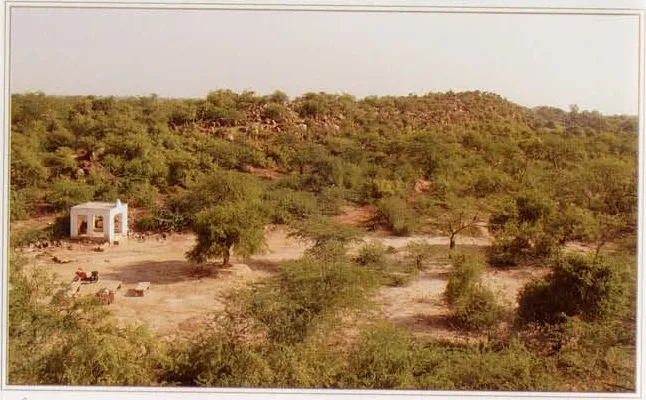
- What it is
- Pūñcharī is the village at the southern end of Govardhana Hill, at the opposite end of the hill from Rādhā-kuṇḍa.
- Visiting
- Śrī Vraja-maṇḍala Parikramā (2007) says that pilgrims on the Govardhana parikramā, the walk around the hill, complete the hill's eastern side here and begin its western side.
- Parikramā
- Govardhana parikramā, station 30
- Places here
- Apsarā-kuṇḍa, Navala-kuṇḍa, Punchari-ka-loṭhā Bābā Mandira, Rāghava Paṇḍita's cave
In short
Pūñcharī is the village at the southern end of Govardhana Hill, at the opposite end of the hill from Rādhā-kuṇḍa.[1 +4] The guidebooks explain the name as the hill's tail (pūñcha).[1 +2] Apsarā-kuṇḍa and Navala-kuṇḍa lie here, with the temple of Loṭhā Bābā, and Śrīla Rāghava Paṇḍita's cave is close by.[1 +3] According to the guidebooks, Loṭhā is a cowherd friend of Kṛṣṇa who is still waiting here for Him to come back from Mathurā.[3 +5]
Key facts
| Kind | village |
|---|---|
| Region · area | Govardhana |
| On the parikramā | Govardhana parikramā, station 30 · the route |
| Ācāryas | Śrīla Viśvanātha Cakravartī Ṭhākura |
Divine pastimes
The bathing of Kṛṣṇa
Śrīmad-Bhāgavatam (10.27.22–24) tells that after the lifting of Govardhana, Surabhi bathed Kṛṣṇa with her milk and Indra with heavenly Gaṅgā water from the trunk of his elephant Airāvata, and named Him Govinda. Tumburu, Nārada, the Gandharvas, Vidyādharas, Siddhas and Cāraṇas came there and sang, and the wives of the demigods danced. The Bhāgavatam names no place or kuṇḍa for the ceremony and does not call the dancers Apsarās.[11 +2]
tatrāgatās tumburu-nāradādayo gandharva-vidyādhara-siddha-cāraṇāḥ / jagur yaśo loka-malāpahaṃ hareḥ surāṅganāḥ sannanṛtur mudānvitāḥ
Tumburu, Nārada and other Gandharvas, along with the Vidyādharas, Siddhas and Cāraṇas, came there to sing the glories of Lord Hari, which purify the entire world. And the wives of the demigods, filled with joy, danced together in the Lord’s honor.
Translation: Śrīla Prabhupāda's disciples (BBT)The commentators on this verse, Vaṁśīdhara, Śrīla Sanātana Gosvāmī and Śrīla Jīva Gosvāmī, place the singing and dancing at the place of the ceremony in the Govardhana region, known as Śakra-kuṇḍa from the Varāha Purāṇa and as Govinda-kuṇḍa from the Skanda Purāṇa (summarised here, not translated). None of them names Pūñcharī or its kuṇḍas.[14] The guidebook Vṛndāvana-Dhāma Ki Jaya! (c. 1986) says instead that when Indra bathed Kṛṣṇa, many Gandharvas and Apsarās danced to glorify the occasion and bathed in the two kuṇḍas here.[3 +3]
Accounts differ Where the heavenly singers and dancers came at Kṛṣṇa's bathing ceremony after the lifting of Govardhana
- Śrīmad-Bhāgavatam 10.27.22-24Surabhi and Indra bathe Kṛṣṇa; the Gandharvas and others 'came there' (tatra) and sang, and the wives of the demigods danced; no place or kuṇḍa is named and the dancers are not called Apsarās
- Vaṁśīdhara, Śrīla Sanātana Gosvāmī and Śrīla Jīva Gosvāmī on ŚB 10.27.24; Jīva and Viśvanātha on 10.27.2'there' is the place of the bathing in the Govardhana region, known as Śakra-kuṇḍa (Varāha) and Govinda-kuṇḍa (Skanda); Indra met Kṛṣṇa seated on a rock of Govardhana (Harivaṁśa)
- Śrī Vraja-maṇḍala Parikramā (2007) (Surabhi-kuṇḍa entry) and the undated parikramā notes Govardhana'Surabhī bathed Śrī Govinda at Govinda-kuṇḍa with the milk from her udder'
- Vṛndāvana-Dhāma Ki Jaya! (c. 1986), Puñcari entry'When King Indra bathed Kṛṣṇa, many Gandharvas and Apsarās danced to glorify the occasion and bathed in the two kuṇḍas here'
Kṛṣṇa's promise to return
Śrīmad-Bhāgavatam tells how Kṛṣṇa left Vraja for Mathurā. At sunrise Akrūra started the chariot while the gopīs were crying; Kṛṣṇa consoled them through messengers with the promise that He would return, and they stood still as long as they could see the chariot's flag and its dust. The Bhāgavatam names no place on the way and does not mention a cowherd friend who stayed behind.[17 +4] In Mathurā Kṛṣṇa promised Nanda and the cowherds that He would come to see them, and He told Uddhava that the gopīs keep their lives only by His promises to return.[22 +5]
dhārayanty ati-kṛcchreṇa prāyaḥ prāṇān kathañcana / pratyāgamana-sandeśair ballavyo me mad-ātmikāḥ
Simply because I have promised to return to them, My fully devoted cowherd girlfriends struggle to maintain their lives somehow or other.
Translation: Śrīla Prabhupāda's disciples (BBT)Śrīmad-Bhāgavatam (10.65) also tells how Balarāma later came back to Vraja without Kṛṣṇa to see His well-wishers, and how the cowherds, long anxious in separation, embraced Him.[28 +2]
Śrīla Prabhupāda explains in the Kṛṣṇa book (chapter 46), giving the expert opinion of advanced devotees, that Kṛṣṇa never goes even a step out of Vṛndāvana. In His original identity He returned with Nanda Mahārāja and stayed with the gopīs and Mother Yaśodā in His bhāva expansion; only externally was He absent from Vṛndāvana.[27 +2]
General teaching (does not name the place)“But when He failed to come back with Nanda Mahārāja, it appeared that He either cheated them or could not keep His promise. Expert devotees, however, have decided that Kṛṣṇa was neither a cheater nor a breaker of promises. Kṛṣṇa, in His original identity, returned with Nanda Mahārāja and stayed with the gopīs and Mother Yaśodā in His bhāva expansion.”
Śrīla Prabhupāda, Kṛṣṇa, the Supreme Personality of Godhead (Kṛṣṇa book), Chapter 46, 'Uddhava Visits Vṛndāvana' · vedabase.io
The ācāryas' commentaries explain the promise, each in its own context (summarised here, not translated). Śrīla Sanātana Gosvāmī and Śrīla Jīva Gosvāmī say that Kṛṣṇa kept His promise when, after killing Dantavakra, He went to Gokula, as the Padma Purāṇa's Uttara-khaṇḍa tells.[25 +2] Śrīla Viśvanātha Cakravartī Ṭhākura explains that by His Yogamāyā potency Kṛṣṇa, with Balarāma, showed two forms each of Himself, of Nanda and of all the people of Vraja, one in union and one in separation, unseen by each other, so that in the manifestation of union the separation lasted only two days.[27 +2] Śrīla Rāghava Paṇḍita Gosvāmī of Govardhana, whose cave the guidebooks place close by, writes in his Kṛṣṇa-bhakti-ratna-prakāśa that Śrī Rādhā's beloved went to Mathurā and other places by a part of Himself and stayed in Vṛndāvana in His own form.[35] Read more: Kṛṣṇa's promise to return to Vraja, and Loṭhā Bābā of Pūñcharī →
Traditional accounts
Śrī Vraja-maṇḍala Parikramā (2007) says that this part of Govardhana is raised high like a peacock's tail (pūñcha), and …
The tail of the hill
Śrī Vraja-maṇḍala Parikramā (2007) says that this part of Govardhana is raised high like a peacock's tail (pūñcha), and Govardhana Hill (2001) names the Loṭhā Bābā temple after its place at the tail-end of the hill.[1 +4] Śrīla Viśvanātha Cakravartī Ṭhākura's Vraja-rīti-cintāmaṇi (3.23) calls Govardhana peacock-shaped and speaks of the peacock's tail together with a southern part and Govinda-kuṇḍa, in a line whose exact sense is uncertain; it does not name Pūñcharī.[38]
The Garga-saṁhitā names a Puccha-kuṇḍa, a tail kuṇḍa, as the tail of Govardhana's body, and says that one bath in it gives the result of ten million yajñas (sacrifices). It does not say where on the hill Puccha-kuṇḍa lies, and no scripture or ācārya text says that it is at Pūñcharī.[39 +1] Govardhana Hill also calls Navala-kuṇḍa Punchari-kuṇḍa, because it lies near the tail.[6 +3]
The guidebooks compare the hill to a peacock or to a sitting cow, and place its tail in different ways:
Accounts differ The hill's form and what is its tail
- Garga-saṁhitā 3.8.11Puccha-kuṇḍa is the hill's tail; no animal is named and the kuṇḍa is not located
- Śrī Vraja-maṇḍala Parikramā (2007)Girirāja-Govardhana 'stretches from north to south, taking the shape of a peacock. Pūñcharī is his tail, which is in the south'; Rādhā-kuṇḍa and Śyāma-kuṇḍa are his eyes
- Śrī Vraja-maṇḍala Parikramā (2007)'Govardhana's form is that of a sitting cow. His hind part is Pūcharī, or Pūñcharī.'
- Śrī Vraja-maṇḍala Parikramā (2007)'Govardhana's form resembles a cow, but it can also be likened to a peacock. This part, Pūñcharī, is raised high like the peacock's tail (pūñcha).'
Loṭhā Bābā
According to the guidebooks, Loṭhā, a cowherd friend of Kṛṣṇa, had cooked for Kṛṣṇa and Balarāma when They were leaving for Mathurā. Kṛṣṇa told him that He would come back the day after next (the undated parikramā notes Govardhana say the day after tomorrow), and Loṭhā vowed not to eat or drink until They returned; he is still waiting at this spot.[3 +5] In Śrīla Viśvanātha Cakravartī Ṭhākura's commentary, too, Kṛṣṇa's return is expected the day after tomorrow, in an example of His loving message to the gopīs, but the commentary does not mention Loṭhā or a cowherd friend who stayed behind.[4 +5] Śrīmad-Bhāgavatam says that Kṛṣṇa entered Mathurā with Balarāma, surrounded by the cowherd boys.[45 +1]
How Kṛṣṇa's cowherd friends fared after He left, the commentators and the guidebooks tell differently; their accounts are set side by side on the page of the Loṭhā Bābā temple.[3 +9]
Apsarā-kuṇḍa and Navala-kuṇḍa
The Varāha Purāṇa's rule for walking around Govardhana names a kuṇḍa called Āpsarasa, a pool of clear water, where bathing and offering tarpaṇa give the fruit of the Rājasūya and Aśvamedha sacrifices; it names no village, and no source identifies it with the Apsarā-kuṇḍa that the guidebooks place here.[1 +4] The guidebooks explain the two kuṇḍas in different ways:
Accounts differ What the twin kuṇḍas at Pūñcharī are and how Apsarā-kuṇḍa got its name
- Śrī Vraja-maṇḍala Parikramā (2007)Apsarā-kuṇḍa is named after Śrīmatī Rādhikā, 'likened to the most beautiful apsarā'; Kṛṣṇa is present as Navala-kuṇḍa; the Divine Couple melted in prema in the rāsa here and the two kuṇḍas are Their melted forms
- Govardhana Hill: India's Most Sacred Mountain (2001)Apsarā-kuṇḍa was created when the seven main Apsarās came to perform their abhiṣeka of Kṛṣṇa; in the rāsa 'Rādhā and the gopīs melted into Apsarā-kuṇḍa' and Kṛṣṇa into Naval-kuṇḍa
- the undated parikramā notes Govardhanaat Kṛṣṇa's abhiṣeka the apsaras danced and had their abhiṣeka at Apsara kund; in the rāsa Kṛṣṇa's body filled Navala kund and the bodies of Śrī Rādhā and the gopīs filled Apsara kund
- Vṛndāvana-Dhāma Ki Jaya! (c. 1986)when Indra bathed Kṛṣṇa, Gandharvas and Apsarās danced and bathed 'in the two kuṇḍas here'; no melting story, kuṇḍas not named
The Gosvāmīs and ācāryas
According to the Bhakti-ratnākara, Śrīla Rāghava Paṇḍita, guiding Śrīla Śrīnivāsa Ācārya around Govardhana, showed him …
According to the Bhakti-ratnākara, Śrīla Rāghava Paṇḍita, guiding Śrīla Śrīnivāsa Ācārya around Govardhana, showed him Apsarā-kuṇḍa at the end of Govardhana, where the most fortunate bathe, then the old palāśa trees called Śyāma-ḍhāka, and then his own cave, where he lived. These pages name neither Pūñcharī nor Navala-kuṇḍa; the guidebooks place his cave close to Pūñcharī.[1 +4]
Śrīla Prabhupāda
The Kṛṣṇa book does not name Pūñcharī or Loṭhā.
The Kṛṣṇa book does not name Pūñcharī or Loṭhā. Śrīla Prabhupāda's explanation there of how Kṛṣṇa kept His promise to the people of Vraja, as advanced devotees understand it, is given above under the promise to return.[27 +2]
Visiting today
Śrī Vraja-maṇḍala Parikramā (2007) says that pilgrims on the Govardhana parikramā, the walk around the hill, complete the hill's eastern side here and begin its western side.[1 +4]
Location
| Where it is | At the tail-end of Govardhana Hill[51] Govardhana map: '28', outside the loop at the lower right[52] |
|---|
Places at Pūñcharī
4 places
Nearby places
Rādhā-kuṇḍa
History
The shrine of Loṭhā Bābā is older than the modern guidebooks. The historian A. W. Entwistle (1987) lists the Braj-dialect Vraj yātrā of Sundarlāl, written in 1849 according to him, and later pilgrimage texts among those that name it, and Prabhudayāl Mītal (1966) described a small temple outside the village with an image like a wrestler, covered with vermilion, called the Lauṭhā of Pūñcharī.[48 +1]
Where the sources differ
Whether and how Kṛṣṇa came back to Vraja as He promised: the texts are set side by side on the page of the Loṭhā Bābā temple.
Whether and how Kṛṣṇa came back to Vraja as He promised: the texts are set side by side on the page of the Loṭhā Bābā temple.[25 +5]
The order of Śyāma-ḍhāka and Śrīla Rāghava Paṇḍita's cave on the way around the hill is told differently: the Bhakti-ratnākara reaches Śyāma-ḍhāka first, as above; the accounts are set side by side on the page of Śrīla Rāghava Paṇḍita's cave.[50]
More on this place
Kṛṣṇa's promise to return to Vraja, and Loṭhā Bābā of Pūñcharī
References
52 references
- Śrī Vraja-maṇḍala Parikramā (2007), PDF p. 131
- Śrī Vraja-maṇḍala Parikramā (2007), PDF p. 87
- Vṛndāvana-Dhāma Ki Jaya! (c. 1986), by Dhruva Mahārāja dāsa, PDF p. 43
- Govardhana Hill: India's Most Sacred Mountain (2001), Rajasekhara dasa Brahmacari, PDF p. 124
- Śrī Vraja-maṇḍala Parikramā (2007), PDF p. 110
- Govardhana Hill: India's Most Sacred Mountain (2001), Rajasekhara dasa Brahmacari, PDF p. 123
- Govardhana Hill: India's Most Sacred Mountain (2001), Rajasekhara dasa Brahmacari, PDF p. 125
- the undated parikramā notes Govardhana, ¶125
- the undated parikramā notes Govardhana, ¶127
- the undated parikramā notes Govardhana, ¶129
- Śrīmad-Bhāgavatam 10.27.22-23, GRETIL
- Śrīmad-Bhāgavatam 10.27.24, GRETIL
- Śrīla Prabhupāda, Kṛṣṇa, the Supreme Personality of Godhead (Kṛṣṇa book), Chapter 27, 'Prayers by Indra, the King of Heaven' · vedabase.io
- Vaṁśīdhara, Śrīla Sanātana Gosvāmī, Śrīla Jīva Gosvāmī: commentary on ŚB 10.27.24, Bhagavata Vidya Pith edition, ed. Bhagavata Rishi and Krishna Shankar Shastri, 1996
- the undated parikramā notes Govardhana, ¶121
- Govardhana Hill: India's Most Sacred Mountain (2001), Rajasekhara dasa Brahmacari, PDF p. 122
- Śrīmad-Bhāgavatam 10.39.32, GRETIL
- Śrīmad-Bhāgavatam 10.39.35, GRETIL
- Śrīmad-Bhāgavatam 10.39.36, GRETIL
- Śrīmad-Bhāgavatam 10.39.37, GRETIL
Show all 52 references
- Śrīla Prabhupāda, Kṛṣṇa, the Supreme Personality of Godhead (Kṛṣṇa book), Chapter 39, 'Akrūra’s Return Journey and His Vision of Viṣṇuloka Within the Yamunā River' · vedabase.io
- Śrīmad-Bhāgavatam 10.45.23, GRETIL
- Śrīmad-Bhāgavatam 10.46.6, GRETIL
- Śrīmad-Bhāgavatam 10.46.18, GRETIL
- Śrīmad-Bhāgavatam 10.46.34, GRETIL
- Śrīla Prabhupāda, Kṛṣṇa, the Supreme Personality of Godhead (Kṛṣṇa book), Chapter 45, 'Kṛṣṇa Recovers the Son of His Teacher' · vedabase.io
- Śrīla Prabhupāda, Kṛṣṇa, the Supreme Personality of Godhead (Kṛṣṇa book), Chapter 46, 'Uddhava Visits Vṛndāvana' · vedabase.io
- Śrīmad-Bhāgavatam 10.65.1, GRETIL
- Śrīmad-Bhāgavatam 10.65.4-6, GRETIL
- Śrīla Prabhupāda, Kṛṣṇa, the Supreme Personality of Godhead (Kṛṣṇa book), Chapter 65, 'Lord Balarāma Visits Vṛndāvana' · vedabase.io
- Śrīla Viśvanātha Cakravartī Ṭhākura: commentary on ŚB 10.45.25, Bhagavata Vidya Pith edition, ed. Bhagavata Rishi and Krishna Shankar Shastri, 1996
- Śrīla Jīva Gosvāmī, Śrīla Viśvanātha Cakravartī Ṭhākura, Śrīla Sanātana Gosvāmī: commentary on ŚB 10.39.37, Bhagavata Vidya Pith edition, ed. Bhagavata Rishi and Krishna Shankar Shastri, 1996
- Śrīla Sanātana Gosvāmī: commentary on ŚB 10.39.35, Bhagavata Vidya Pith edition, ed. Bhagavata Rishi and Krishna Shankar Shastri, 1996
- Padma Purāṇa, Uttara-khaṇḍa (khaṇḍa 6), adhyāya 252, verses 25-27, Sanskrit Wikisource
- Śrīla Rāghava Paṇḍita Gosvāmī, Kṛṣṇa-bhakti-ratna-prakāśa, second prakāśa, part 2: prose after v.54, v.55 and prose after v.55, after Haridas Shastri's edition, ca. 1980
- the undated parikramā notes Govardhana, ¶124
- the key of the numbered Govardhana chart, ¶53
- Śrīla Viśvanātha Cakravartī Ṭhākura, Vraja-rīti-cintāmaṇi, third sarga, verse 23
- Garga-saṁhitā, Girirāja-khaṇḍa (3), adhyāya 8, verse 11, Sanskrit Wikisource
- Garga-saṁhitā, Girirāja-khaṇḍa (3), adhyāya 10, verses 24-25, Sanskrit Wikisource
- Govardhana Hill: India's Most Sacred Mountain (2001), Rajasekhara dasa Brahmacari, PDF p. 26
- Govardhana Hill: India's Most Sacred Mountain (2001), Rajasekhara dasa Brahmacari, PDF p. 11
- Govardhana Hill: India's Most Sacred Mountain (2001), Rajasekhara dasa Brahmacari, PDF p. 165
- Śrīla Viśvanātha Cakravartī Ṭhākura: commentary on ŚB 10.39.32-33, Bhagavata Vidya Pith edition, ed. Bhagavata Rishi and Krishna Shankar Shastri, 1996
- Śrīmad-Bhāgavatam 10.41.19, GRETIL
- Śrīla Prabhupāda, Kṛṣṇa, the Supreme Personality of Godhead (Kṛṣṇa book), Chapter 41, 'Kṛṣṇa Enters Mathurā' · vedabase.io
- Varāha Purāṇa, adhyāya 164, verses 19-21, Sanskrit Wikisource
- A. W. Entwistle, Govardhan entries, '20b Punchhari kau Lautha', printed p. 353, Egbert Forsten, Groningen, 1987
- Prabhudayāl Mītal, 'Braj-yātrā', Govardhana: 'Pūñcharī ko lauṭhā', printed p. 111
- Śrīla Narahari Cakravartī, Bhakti-ratnākara, Fifth Wave, 1912 ed. p. 203, 2nd ed., 1912
- Govardhana Hill: India's Most Sacred Mountain (2001), Rajasekhara dasa Brahmacari, p. 110
- Śrī Vraja-maṇḍala Parikramā (2007), p. 194-195