Kaṁsa-kilā
कंस-किला Hindi name proposed
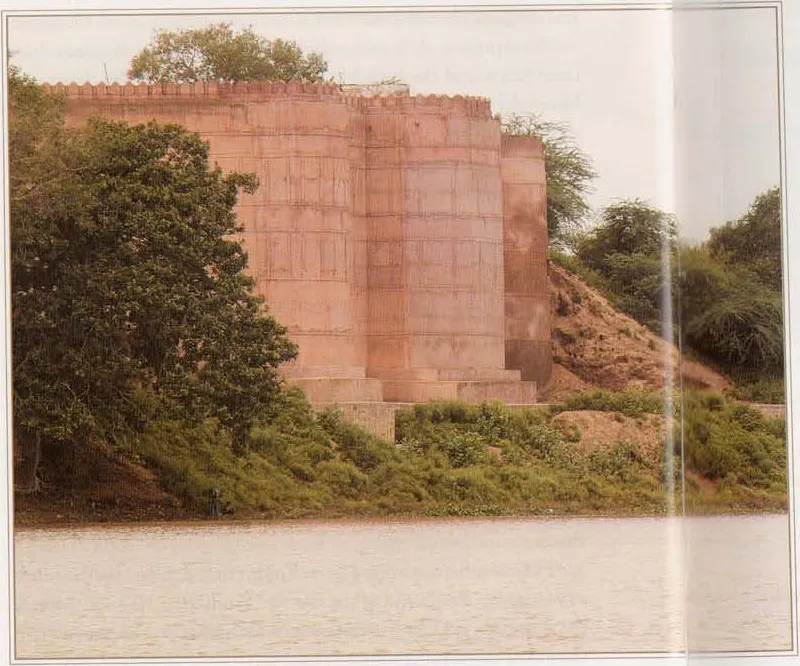
- What it is
- Kaṁsa-kilā, the fort of Kaṁsa, is the ruin of an old fort above the Yamunā in Mathurā.
- Visiting
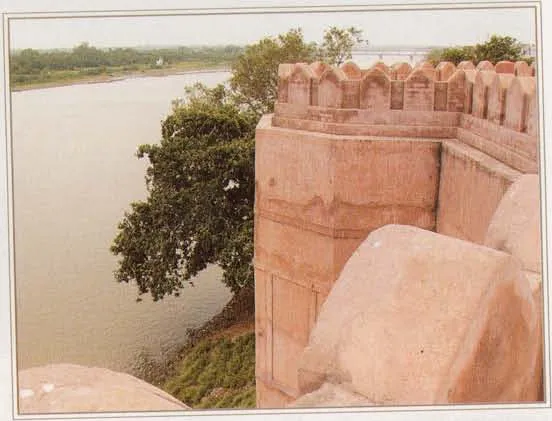
- Śrī Vraja-maṇḍala Parikramā (2007) shows the fort in its photographs and says that from it one may have a good view of the Yamunā and parts of Mathurā.
In short
Kaṁsa-kilā, the fort of Kaṁsa, is the ruin of an old fort above the Yamunā in Mathurā. The guidebook Śrī Vraja-maṇḍala Parikramā (2007) says that it was the residence or palace of Kaṁsa and that its ruins bear witness to this.[1] No scripture says where Kaṁsa's palace stood. The Bhāgavatam says only that Devakī was kept under arrest in Kaṁsa's house, and the Bhakti-ratnākara lists Kaṁsa's residence among the places of Mathurā without placing it.[2 +3] The historians A. W. Entwistle (1987) and Prabhudayāl Mītal (1966) credit the fort to Rājā Mān Singh in the time of the emperor Akbar; Savāī Jai Singh later built an observatory on it.[6 +1]
Key facts
| Kind | fort |
|---|---|
| Region · area | Mathurā |
| Ācāryas | Śrīla Narahari Cakravartī Ṭhākura, Śrīla Rāghava Paṇḍita Gosvāmī of Govardhana, Śrīla Śrīnivāsa Ācārya, Śrīla Nārāyaṇa Bhaṭṭa Gosvāmī, Śrīla Narottama dāsa Ṭhākura |
Divine pastimes
Śrīmad-Bhāgavatam (10.2.19) says that while Devakī carried Kṛṣṇa within her, she was under arrest in the house of Kaṁsa, like a fire covered by a pot. It does not say where that house stood.[2 +1]
sā devakī sarva-jagan-nivāsa- nivāsa-bhūtā nitarāṃ na reje / bhojendra-gehe 'gni-śikheva ruddhā sarasvatī jñāna-khale yathā satī
Devakī then kept within herself the Supreme Personality of Godhead, the cause of all causes, the foundation of the entire cosmos, but because she was under arrest in the house of Kaṁsa, she was like the flames of a fire covered by the walls of a pot, or like a person who has knowledge but cannot distribute it to the world for the benefit of human society.
Translation: Śrīla A.C. Bhaktivedanta Swami PrabhupādaTraditional accounts
According to the Bhakti-ratnākara, Śrīla Rāghava Paṇḍita Gosvāmī of Govardhana showed Śrīla Śrīnivāsa Ācārya and Śrīla Narottama …
According to the Bhakti-ratnākara, Śrīla Rāghava Paṇḍita Gosvāmī of Govardhana showed Śrīla Śrīnivāsa Ācārya and Śrīla Narottama dāsa Ṭhākura the residences of Ugrasena, Vasudeva and Kaṁsa when they came to Mathurā. The book does not say where these were and names no fort.[4 +1]
Śrīla Nārāyaṇa Bhaṭṭa Gosvāmī's Vraja-bhakti-vilāsa gives a prayer for a Kaṁsa-vāsantikā-sthāna, which it says grants the sight of Kṛṣṇa (the Hindi of its edition takes it as the place where Kaṁsa lived), and another for the Kaṁsa-śayana-sthala, the place of Kaṁsa's bed-chamber. It does not say where either place is, and no source identifies them with this fort.[8 +1]
The guidebook Śrī Vraja-maṇḍala Parikramā (2007) calls the fort Kaṁsa's residence or palace. On its parikramā one comes to the fort after Sarasvatī-patana-tīrtha and Soma-tīrtha.[1]
Visiting today
Śrī Vraja-maṇḍala Parikramā (2007) shows the fort in its photographs and says that from it one may have a good view of the Yamunā and parts of Mathurā. This has not been checked on the spot.[1]
Location
| Where it is | after Sarasvatī-patana-tīrtha and Soma-tīrtha on the route[12] |
|---|
Nearby places
Sarasvatī-patana-tīrtha · Yamunā
Pictures
1 pictures
History
Growse (1883) and the district gazetteer of 1911 describe the massive base of an old fort on the river, which the people call Kaṁsa's fort. They say that it was rebuilt by Rājā Mān Singh of Jaipur (Amber), the chief Hindu prince at Akbar's court, and that Savāī Jai Singh, who sometimes lived there, built an observatory on it, which had disappeared by 1911.[10 +1]
The historians A. W. Entwistle (1987) and Prabhudayāl Mītal (1966) also credit the fort to Rājā Mān Singh in Akbar's time, Mītal saying that he built it on the ruins of an older one. Mītal adds that Jai Singh repaired the fort, then somewhat decayed, when Mathurā came under his influence, and built an observatory there. Entwistle adds that the Daniell brothers drew the fort in 1789, that the traveller Tieffenthaler saw it in the middle of the eighteenth century, that the Jāṭs and the Marāṭhās used it, and that under British rule it was divided up and largely pulled down.[6 +1]
Where the sources differ
Whether Kaṁsa's palace and the prison where Devakī was kept were one place: Śrīla Prabhupāda speaks of the prison walls of …
Whether Kaṁsa's palace and the prison where Devakī was kept were one place: Śrīla Prabhupāda speaks of the prison walls of Kaṁsa's palace; the guidebook puts the palace at this fort and the prison at the Janma-sthāna.[3]
Accounts differ Whether Kaṁsa's palace and the prison where Devakī was kept were one place.
- Śrīla Prabhupāda, SB 10.2.18 purport and Kṛṣṇa ch. 2Devakī was kept within the prison walls of Kaṁsa's palace.
- Śrīmad-Bhāgavatam 10.2.19 (Śrīla Prabhupāda's translation)While she carried Kṛṣṇa, Devakī was under arrest 'in the house of Kaṁsa' (bhojendra-gehe); no site is given.
- Śrīmad-Bhāgavatam 10.3.21 and 10.3.51-52In his prayer Vasudeva tells the newborn Lord that He has appeared in Vasudeva's own house (gṛhe … mama; Śrīla Prabhupāda's translation: 'You have now appeared in my house'); after the exchange in Gokula Vasudeva went back to his house (punar gṛhān agāt), laid the girl on Devakī's bed and put the shackles back on. Summary; no site is given.
- Śrī Vraja-maṇḍala Parikramā (2007)The prison was at the Janma-sthāna in Mallapurā (Potrā-kuṇḍa 'originally within the walls of Kaṁsa's gigantic prison'); the ruins of Kaṁsa's residence or palace are at Kaṁsa-kilā on the river.
References
12 references
- Śrī Vraja-maṇḍala Parikramā (2007), PDF p. 53
- Śrīmad-Bhāgavatam 10.2.19, GRETIL
- Śrīla Prabhupāda, Śrīmad-Bhāgavatam, 10.2.18, purport · vedabase.io
- Śrīla Narahari Cakravartī, Bhakti-ratnākara, Fifth Wave (pañcama taraṅga), printed p. 287 (1912 ed.), 2nd ed., 1912
- Śrīla Narahari Cakravartī, Bhakti-ratnākara, Fifth Wave (pañcama taraṅga), printed p. 288 (1912 ed.), 2nd ed., 1912
- A. W. Entwistle, ch. 8 ('The pilgrimage itinerary'), §1.28 'Kans Kila', printed p. 328, Egbert Forsten, Groningen, 1987
- Prabhudayāl Mītal, first part ('ब्रज-संस्कृति की भूमिका'), section 'Mathurā kī parikramā', entry on Kaṁsa's fort (begun on p. 158), printed p. 159
- Śrīla Nārāyaṇa Bhaṭṭa, Vraja-bhakti-vilāsa, Mathurā circuit, verse numbered 10, with the edition's Hindi rendering on printed pp. 57-58, 1st ed., publ. Bābā Kṛṣṇadāsa, Kusuma-sarovara, Saṁvat 2008
- Śrīla Nārāyaṇa Bhaṭṭa, Vraja-bhakti-vilāsa, Mathurā circuit, verse numbered 96, 1st ed., publ. Bābā Kṛṣṇadāsa, Kusuma-sarovara, Saṁvat 2008
- Mathurá (1883), F. S. Growse, B.C.S., M.A. Oxon., C.I.E. (as the title page gives him, p. 139
- Muttra (1911), D. L. Drake-Brockman, I.C.S. (edited and compiled), p. 300
- Śrī Vraja-maṇḍala Parikramā (2007), p. 80-81