Sarasvatī-patana-tīrtha
सरस्वती-पतन-तीर्थ Hindi name proposed
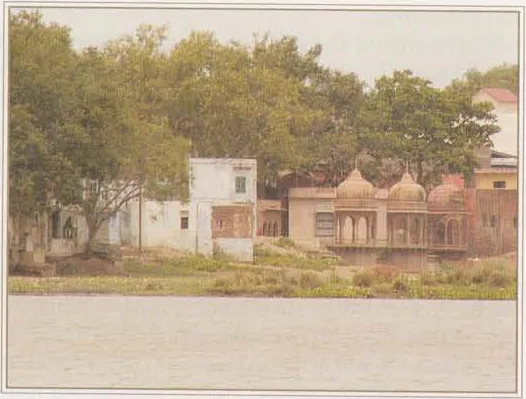
In short
Sarasvatī-patana-tīrtha, the place where the river Sarasvatī "falls", is a bathing place on the Yamunā at Mathurā. In the Bhakti-ratnākara it comes after Soma-tīrtha among the twelve tīrthas (holy bathing places) north of Viśrāma-ghāṭa.[1 +3] The Varāha Purāṇa says that a bath here takes away all sins, and that even a man without varṇa, without a place in the social order, becomes a yati, a renunciant.[1 +2] The guidebook Śrī Vraja-maṇḍala Parikramā (2007) also calls this ghāṭa Kṛṣṇa-gaṅgā-ghāṭa, but the older texts describe Kṛṣṇa-gaṅgā as a separate tīrtha (see below).[1 +5]
Key facts
| Kind | ghāṭa |
|---|---|
| Region · area | Mathurā |
| Also part of | Yamunā |
| Ācāryas | Śrīla Vyāsadeva, Śrīla Rūpa Gosvāmī, Śrīla Narahari Cakravartī Ṭhākura, Śrī Caitanya Mahāprabhu, Śrīla Rāghava Paṇḍita Gosvāmī of Govardhana |
Why it is glorified
In the Varāha Purāṇa the Lord, as Varāha, names the Sarasvatī's patana after Soma-tīrtha: it is auspicious and takes away all …
In the Varāha Purāṇa the Lord, as Varāha, names the Sarasvatī's patana after Soma-tīrtha: it is auspicious and takes away all sins, and a man who bathes there, even one without varṇa, becomes a yati (summarised here, not translated). Śrīla Rūpa Gosvāmī quotes the verse from the Ādi-varāha in his Mathurā-māhātmya, and the Bhakti-ratnākara quotes it too (summarised here, not translated); the 1912 editor of the Bhakti-ratnākara explains avarṇa as a person of low birth, and yati as one who has conquered the senses, or a sannyāsī.[1 +4]
सरस्वत्याश्च पतनं सर्वपापहरं शुभम् ॥ 22 ॥
तत्र स्नातो नरो देवि अवर्णोऽपि यतिर्भवेत्
sarasvatyāśca patanaṁ sarvapāpaharaṁ śubham
tatra snāto naro devi avarṇo'pi yatirbhavet
The confluence of the Sarasvatī
Several texts speak of the meeting (saṅgama) of the Sarasvatī with the Yamunā at Mathurā, without the name Sarasvatī-patana. In the Varāha Purāṇa's walk round Mathurā the pilgrim offers water to the gods, sages and ancestors at the confluence of the Sarasvatī and gives gifts, and so attains union with Viṣṇu.[13] In the same Purāṇa a childless merchant, Vasukarṇa, and his wife bathed at the confluence every day and worshipped the Śiva called Gokarṇa with flowers and lamps, until after ten years Śiva promised them a son; the Purāṇa ends the story by praising the great fruit of the Sarasvatī confluence and of Gokarṇa in Mathurā (summarised here, not translated).[14 +1]
Śrīla Nārāyaṇa Bhaṭṭa Gosvāmī's Vraja-bhakti-vilāsa calls the confluence of the Sarasvatī a charming king of tīrthas, where a gift of books or of learning bears a hundredfold fruit, and gives a prayer for bathing there that it ascribes to the Āśvalāyana-saṁhitā (summarised here, not translated).[13 +1]
संगमं च सरस्वत्या तीर्थराजं मनोहरं । देवानां च महाबुद्धि र्जायते नात्र संशयः ॥ पुस्तकानां कृतं दानं विद्यादानं शतं गुणं । ततो सरस्वतीसंगमस्नानप्रार्थनमन्त्रः । आश्वलायनसंहितायां— देवानां बुद्धिदायै त्वां सरस्वत्यै नमो नमः । तीर्थराज नमस्तुभ्यं कलाधर नमोस्तु ते ॥ इति मन्त्रमुदाहृत्य सप्तभिर्मज्जनैर्नमेत् ॥ ६८ ॥
saṁgamaṁ ca sarasvatyā tīrtharājaṁ manoharaṁ
devānāṁ ca mahābuddhi rjāyate nātra saṁśayaḥ
pustakānāṁ kṛtaṁ dānaṁ vidyādānaṁ śataṁ guṇaṁ
tato sarasvatīsaṁgamasnānaprārthanamantraḥ
āśvalāyanasaṁhitāyāṁ— devānāṁ buddhidāyai tvāṁ sarasvatyai namo namaḥ
tīrtharāja namastubhyaṁ kalādhara namostu te
iti mantramudāhṛtya saptabhirmajjanairnamet || 68 ||
The Nārada Purāṇa names a Prācī-sarasvatī, an "eastern Sarasvatī", north of Soma-tīrtha, where a man becomes a master of speech by merely bathing (summarised here, not translated). It does not use the name Sarasvatī-patana.[18]
Kṛṣṇa-gaṅgā
Śrīla Prabhupāda names Kṛṣṇa-gaṅgā among the twenty-four ghāṭas where Śrī Caitanya Mahāprabhu bathed, and the 2007 guidebook gives Kṛṣṇa-gaṅgā-ghāṭa as another name of Sarasvatī-patana-tīrtha. The Varāha Purāṇa, Śrīla Rūpa Gosvāmī and the Bhakti-ratnākara, however, describe the Sarasvatī and Kṛṣṇa-gaṅgā as two tīrthas, and the sources differ on whether they are one place.[1 +8]
Accounts differ Whether Kṛṣṇa-gaṅgā is another name of the Sarasvatī and of Sarasvatī-patana-tīrtha, or a separate tīrtha.
- Śrī Vraja-maṇḍala Parikramā (2007) (printed p. 56)'Another name of the river Sarasvatī is Śrī Kṛṣṇa-gaṅgā'; Sarasvatī-patana-tīrtha is 'also known as Kṛṣṇa-gaṅgā-ghāṭa'.
- Varāha Purāṇa 154.22-23, 175.1-4 and 176.69-71Sarasvatī-patana is one of the northern ghāṭas (154.22); Kṛṣṇa-gaṅgā, between Soma and Vaikuṇṭha, has its own chapter (175); bathing at five tīrthas including the Sarasvatī is surpassed tenfold by Kṛṣṇa-gaṅgā (176.69-71).
- Śrīla Rūpa Gosvāmī, Mathurā-māhātmya vv. 269, 276, 442Sarasvatī-patana within the twenty-four (v.269); Kṛṣṇa-gaṅgā after them (v.276); the list of great tīrthas names Kṛṣṇa-gaṅgā and the meeting with the Sarasvatī separately (v.442).
- Bhakti-ratnākara, printed pp. 177, 179 and 288Sarasvatī-patana (p. 177) and Kṛṣṇa-gaṅgā (p. 179) are separate stops; the Ambikā-kānana, where Nanda's party came, is on the bank of the Kṛṣṇa-gaṅgā (p. 288), the forest where the Bhāgavatam (10.34.2) has them bathe in the Sarasvatī.
The wording of these accounts is our summary of the sources, not a published translation.
For Kṛṣṇa-gaṅgā the Varāha Purāṇa says that it lies between Soma-tīrtha and Vaikuṇṭha, and that Kṛṣṇa-dvaipāyana Vyāsa, while staying in Mathurā, bathed there, performed austerities for twelve years and had an āśrama where sages came for the rainy-season vow, before he went to Badarī in the Himālaya. It says that a daily bath there gives ten times the fruit of bathing at five other tīrthas of Mathurā, and that seeing its Kāliñjara Mahādeva gives the fruit of Kṛṣṇa-gaṅgā (summarised here, not translated).[2 +4]
Traditional accounts
According to the local tradition recorded in Śrī Vraja-maṇḍala Parikramā (2007), Vyāsa was born to Satyavatī and Parāśara on an island in the Yamunā near this ghāṭa. No scripture found so far places that island at Mathurā, so this is not certain.[22 +1] The same book says that Vyāsa composed Śrīmad-Bhāgavatam here. The Bhāgavatam itself (1.7.2) places his āśrama, where he compiled it, at Śamyāprāsa on the western bank of the Sarasvatī; the sources differ (see below).[24 +1]
The Gosvāmīs and ācāryas
According to the Bhakti-ratnākara of Śrīla Narahari Cakravartī Ṭhākura, Śrīla Rāghava Paṇḍita Gosvāmī of Govardhana took Śrīla …
According to the Bhakti-ratnākara of Śrīla Narahari Cakravartī Ṭhākura, Śrīla Rāghava Paṇḍita Gosvāmī of Govardhana took Śrīla Śrīnivāsa Ācārya and Śrīla Narottama dāsa Ṭhākura round Mathurā. After Soma-tīrtha he showed them Sarasvatī-patana, where whoever bathes, even one without varṇa, becomes a yati and sin goes far away, and recited the Ādi-varāha verse (summarised here, not translated). Later on the tour, after the twenty-four ghāṭas and Gokarṇa, he showed them Kṛṣṇa-gaṅgā as a separate tīrtha.[1 +2]
সরস্বতীপতন তীর্থে যেই স্নান করে। অবর্ণ* হয়েন যতি পাপ যায় দূরে ॥ তথাহি আদিবারাহে ॥ সরস্বত্যাশ্চ পতনং সর্ব্বপাপহরং শুভং । তত্র স্নাত্বা নরো দেবি অবর্ণোঽপি যতির্ভবেৎ ॥
sarasbatīpatana tīrthe yei snāna kare| abarṇa* haẏena yati pāpa yāẏa dūre
tathāhi ādibārāhe
sarasbatyāśca patanaṁ sarbbapāpaharaṁ śubhaṁ
tatra snātbā naro debi abarṇo'pi yatirbhabet ||
At the end of their tour of Vraja, the same book says, they bathed at Viśrāma-tīrtha and came to Ambikāvana, Ambikā's forest, on the bank of the Kṛṣṇa-gaṅgā, where they saw Ambikā-devī and the Śiva called Gokarṇa.[27]
The Caitanya-caritāmṛta (Madhya 17.190) says that Śrī Caitanya Mahāprabhu bathed in the twenty-four ghāṭas of the Yamunā at Mathurā, without naming them. Sarasvatī-patana is one of them in the Bhakti-ratnākara's list; Śrīla Prabhupāda's list has Kṛṣṇa-gaṅgā instead.[4 +4] Read more: The twenty-four ghāṭas of Mathurā → According to Śrīla Murāri Gupta, Mahāprabhu's guide Kṛṣṇadāsa showed Him the Yamunā joined with the Sarasvatī, the Daśāśvamedha-ghāṭa and Soma-tīrtha; Śrīla Locana dāsa Ṭhākura has Him shown a Sarasvatī-kuṇḍa north of the city with the same two ghāṭas. Neither uses the name Sarasvatī-patana (summarised here, not translated).[9 +2]
Śrīla Prabhupāda
In his purport to Caitanya-caritāmṛta Madhya 17.190 Śrīla Prabhupāda lists the twenty-four ghāṭas; Kṛṣṇa-gaṅgā is the fourteenth.
In his purport to Caitanya-caritāmṛta Madhya 17.190 Śrīla Prabhupāda lists the twenty-four ghāṭas; Kṛṣṇa-gaṅgā is the fourteenth. His list has no Sarasvatī-patana.[7 +2]
Names this place“The twenty-four ghats (bathing places) along the Yamunā are (1) Avimukta, (2) Adhirūḍha, (3) Guhya-tīrtha, (4) Prayāga-tīrtha … (13) Gokarṇa, (14) Kṛṣṇa-gaṅgā”
Śrīla Prabhupāda, Śrī Caitanya-caritāmṛta, Madhya-līlā 17.190, purport · vedabase.io
On the place where Vyāsa compiled the Bhāgavatam he writes, in a purport about Śamyāprāsa and not about Mathurā:[30]
General teaching (does not name the place)“The river Sarasvatī is flowing in the Badarikāśrama area of the Himālayas. So the place indicated here is Śamyāprāsa in Badarikāśrama, where Śrī Vyāsadeva is residing.”
Śrīla Prabhupāda, Śrīmad-Bhāgavatam, Canto 1, 4.15, purport · vedabase.io
Location
| Where it is | 'near Gau-ghāṭa, or Soma-tīrtha'[31] |
|---|
Nearby places
Soma-tīrtha · Island near Kṛṣṇa-gaṅgā-ghāṭa · Kaṁsa-kilā
History
In 1883 F. S. Growse reported that the stonework of the Mahādeva temple at the Kṛṣṇa-gaṅgā ghāṭ was done a little before 1857, under Baladeva Byās, the brāhmaṇa then in charge of the shrine, and his list named a Kṛṣṇa-gaṅgā Ghāṭ with the shrine of Kāliñjareśvara Mahādeva.[26]
Where the sources differ
The sources differ on which bathing places make up Mathurā's twenty-four ghāṭas and on which side of Viśrāma-ghāṭa the second …
The sources differ on which bathing places make up Mathurā's twenty-four ghāṭas and on which side of Viśrāma-ghāṭa the second twelve lie; their accounts are set out on the page of Viśrāma-ghāṭa.[1 +2]
Accounts differ Where Vyāsadeva composed the Śrīmad-Bhāgavatam.
- Śrī Vraja-maṇḍala Parikramā (2007) (printed pp. 56-57)'Some say that Śrī Vyāsadeva composed Śrīmad-Bhāgavatam here [Sarasvatī-patana-tīrtha, Mathurā], and this is correct' — the opinion of learned devotees.
- Śrīmad-Bhāgavatam 1.7.2-8Vyāsa compiled the Bhāgavatam and taught it to Śukadeva in his āśrama at Śamyāprāsa on the western bank of the Sarasvatī.
- Śrīla Prabhupāda, SB 1.4.15 purport; lecture of 14 Oct 1975 (Johannesburg); morning walk of 2 Feb 1977 (Bhubaneswar)Śamyāprāsa is in Badarikāśrama, on the Sarasvatī that flows in the Badarikāśrama area of the Himālayas (SB 1.4.15); 'above Haridvāra' (1975); Vyāsa wrote in the Śamyāprāsa cottage (1977).
- Varāha Purāṇa 175.1-9Vyāsa performed austerities and had an āśrama at Kṛṣṇa-gaṅgā in Mathurā for twelve years, then went to Badarī; the chapter does not mention the Bhāgavatam.
Accounts differ Whether the Sarasvatī still meets the Yamunā at Mathurā.
- Śrī Vraja-maṇḍala Parikramā (2007) (printed p. 56)'The river Sarasvatī used to meet the Yamunā here.'
- Śrī Vraja-maṇḍala Parikramā (2007) (printed p. 78)'On the right hand side, near the confluence of the Sarasvatī and Yamunā, is Ambarīṣa-ṭīlā.'
- Growse, Mathurá (1883), printed p. 133A 'natural water-course known as the Sarasvati Sangam' was crossed by a bridge built in 1849.
- Śrīla Murāri Gupta, Kṛṣṇa-caitanya-caritāmṛta 4.3.14 and 4.4.22In Kṛṣṇadāsa's description of Vraja the river Sarasvatī, north of Madhu-purī, follows the Yamunā (4.3.14); on Śrī Caitanya's round of Mathurā he shows Him the Yamunā joined with the Sarasvatī, with the Daśāśvamedha-ghāṭa and Soma-tīrtha (4.4.22).
More on this place
The twenty-four ghāṭas of Mathurā
References
31 references
- Śrīla Narahari Cakravartī, Bhakti-ratnākara, Fifth Wave (pañcama taraṅga), printed p. 177 (1912 ed.), 2nd ed., 1912
- Śrīla Narahari Cakravartī, Bhakti-ratnākara, Fifth Wave (pañcama taraṅga), printed p. 179 (1912 ed.), 2nd ed., 1912
- Śrīla Narahari Cakravartī, Bhakti-ratnākara, Fifth Wave (pañcama taraṅga), printed p. 165 (1912 ed.), 2nd ed., 1912
- Śrīla Narahari Cakravartī, Bhakti-ratnākara, Fifth Wave (pañcama taraṅga), 1912 ed. p. 178, 2nd ed., 1912
- Varāha Purāṇa, adhyāya 154, vv. 22-23, Sanskrit Wikisource
- Śrīla Rūpa Gosvāmī, Mathurā-māhātmya v.269
- Śrīla Prabhupāda, Śrī Caitanya-caritāmṛta, Madhya-līlā 17.190, purport · vedabase.io
- Śrīla Prabhupāda, Śrīmad-Bhāgavatam, 4.8.42, purport · vedabase.io
- Śrīla Kṛṣṇadāsa Kavirāja Gosvāmī, Śrī Caitanya-caritāmṛta, Madhya-līlā 17.190, online edition · vedabase.io
- Śrīla Rūpa Gosvāmī, Mathurā-māhātmya v.276
- Śrīla Rūpa Gosvāmī, Mathurā-māhātmya v.442-443, 'mathurā-mahā-tīrthāni'
- Varāha Purāṇa, adhyāya 154, vv. 22-23, Sanskrit Wikisource
- Varāha Purāṇa, adhyāya 160, vv. 58-60, Sanskrit Wikisource
- Varāha Purāṇa, adhyāya 170, vv. 13-14, Sanskrit Wikisource
- Varāha Purāṇa, adhyāya 173, v. 13, Sanskrit Wikisource
- Śrīla Nārāyaṇa Bhaṭṭa, Vraja-bhakti-vilāsa, Mathurā circuit, verse numbered 68, 1st ed., publ. Bābā Kṛṣṇadāsa, Kusuma-sarovara, Saṁvat 2008
- Śrīla Nārāyaṇa Bhaṭṭa, Vraja-bhakti-vilāsa, Mathurā circuit, verse numbered 68, 1st ed., publ. Bābā Kṛṣṇadāsa, Kusuma-sarovara, Saṁvat 2008
- Nārada Purāṇa, उत्तरार्धः/अध्यायः 79 v.79-41 to 79-42
- Varāha Purāṇa, adhyāya 175, 'kṛṣṇa-gaṅgā-kāliñjara-prabhāva', vv. 1-4, Sanskrit Wikisource
- Varāha Purāṇa, adhyāya 175, vv. 7-9, Sanskrit Wikisource
Show all 31 references
- Varāha Purāṇa, 176.69-71, Sanskrit Wikisource
- Śrī Vraja-maṇḍala Parikramā (2007), PDF p. 41
- Śrī Vraja-maṇḍala Parikramā (2007), PDF p. 30
- Śrīmad-Bhāgavatam 1.7.2, GRETIL
- Śrīmad-Bhāgavatam 1.7.8, GRETIL
- Mathurá (1883), F. S. Growse, B.C.S., M.A. Oxon., C.I.E. (as the title page gives him, p. 145
- Śrīla Narahari Cakravartī, Bhakti-ratnākara, Fifth Wave (pañcama taraṅga), printed p. 288 (1912 ed.), 2nd ed., 1912
- Kṛṣṇa-caitanya-caritāmṛta of Śrīla Murāri Gupta, prakrama 4, sarga 4, v.22
- Śrīla Locana dāsa Ṭhākura, Caitanya-maṅgala, Śeṣa-khaṇḍa, printed p. 171, right column, the fourth and sixth lines after the heading 'পঠমঞ্জরী রাগ' (the fifth summarised)
- Śrīla Prabhupāda, Śrīmad-Bhāgavatam, Canto 1, 4.15, purport · vedabase.io
- Śrī Vraja-maṇḍala Parikramā (2007), p. 56-57