Khelanvana
खेलनवन Hindi name proposed
Also called Kelā-tīrtha
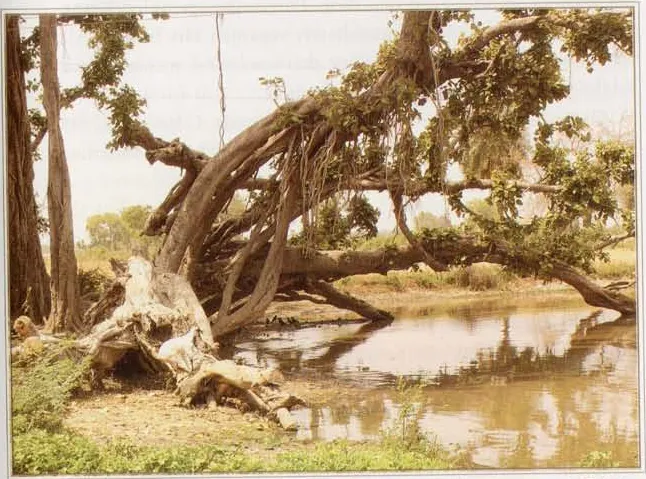
- What it is
- Khelanvana, "the forest of play", lies at Śergarh on the Yamunā, two miles south-east of Ūjānī, according to Śrī Vraja-maṇḍala Parikramā (2007).
- Visiting
- Śrī Vraja-maṇḍala Parikramā (2007) and the undated parikramā notes Khelanvana list as places of darśana at Khelanvana Balarāma-kuṇḍa, Gopī-ghāṭa and the temples of Śrī Rādhā-Govinda, Śrī …
In short
Khelanvana, "the forest of play", lies at Śergarh on the Yamunā, two miles south-east of Ūjānī, according to Śrī Vraja-maṇḍala Parikramā (2007).[1 +4] The Bhakti-ratnākara calls it Śrī Khelā-tīrtha: here Kṛṣṇa and Balarāma played with Their friends with no thought of eating, and ate only because Their mother took care of it.[6] Śrī Caitanya Mahāprabhu saw Khelā-tīrtha on His tour of Vraja, and Śrīla Prabhupāda retells the Bhakti-ratnākara's account in his purport.[7 +3]
Key facts
| Kind | forest |
|---|---|
| Region · area | Jāvaṭa |
| Ācāryas | Śrī Caitanya Mahāprabhu, Śrīla Rūpa Gosvāmī, Śrīla Viśvanātha Cakravartī Ṭhākura, Śrīla Rāghava Paṇḍita Gosvāmī of Govardhana, Śrīla Śrīnivāsa Ācārya |
Why it is glorified
Śrīla Rūpa Gosvāmī names Khelā-tīrtha in his list of Kṛṣṇa's places as the great tīrtha of the Yamunā where Kṛṣṇa always plays …
Śrīla Rūpa Gosvāmī names Khelā-tīrtha in his list of Kṛṣṇa's places as the great tīrtha of the Yamunā where Kṛṣṇa always plays with His dearmost. In his drama Lalita-mādhava, after Kṛṣṇa has left for Mathurā, Śrī Rādhā goes with Viśākhā to bathe at Khelā-tīrtha, where, Viśākhā says, Mukunda always plays (summarised here, not translated). Neither work says where on the Yamunā the tīrtha is.[11 +1]
Śrīla Viśvanātha Cakravartī Ṭhākura's Vraja-rīti-cintāmaṇi describes a Khelā-vana near the north-east corner of Nandīśvara, where the Yamunā winds as she searches for Kṛṣṇa and where the gopīs come again and again to meet Him on the pretext of fetching water, at a landing called the Gopī-ghaṭṭa (summarised here, not translated). He does not say whether it is this Khelanvana.[13]
Divine pastimes
The brothers called home from play
Śrīmad-Bhāgavatam (10.11) tells how the brothers were called home from play in Gokula, before the cowherds moved to Vṛndāvana. Kṛṣṇa and Balarāma were playing with the boys on the river bank and would not come when Rohiṇī called, so she sent mother Yaśodā, who called Kṛṣṇa to come and drink her milk, for He must be tired from playing so long. The Bhāgavatam sets this in Gokula and does not name Khelanvana.[14 +5]
kṛṣṇa kṛṣṇāravindākṣa tāta ehi stanaṃ piba / alaṃ vihāraiḥ kṣut-kṣāntaḥ krīḍā-śrānto 'si putraka
Mother Yaśodā said: My dear son Kṛṣṇa, lotus-eyed Kṛṣṇa, come here and drink the milk of my breast. My dear darling, You must be very tired because of hunger and the fatigue of playing so long. There is no need to play any more.
Translation: Śrīla A.C. Bhaktivedanta Swami PrabhupādaAccording to the Bhakti-ratnākara (Fifth Wave), Śrīla Rāghava Paṇḍita Gosvāmī, showing Śrīla Śrīnivāsa Ācārya and Śrīla Narottama dāsa Ṭhākura the places between Ūjānī and Rāma-ghāṭa, said: see Khelanavana, where the two brothers play with Their friends with no thought of eating; Kṛṣṇa and Balarāma eat only by Their mother's care, and the place is called Śrī Khelā-tīrtha (summarised here, not translated).[6 +2] Śrīla Prabhupāda gives the same account:[7 +3]
Names this place“In the Bhakti-ratnākara it is said that Śrī Kṛṣṇa and Balarāma used to play at Khelā-tīrtha with the cowherd boys during the entire day. Mother Yaśodā had to call Them to take Their baths and eat Their lunch.”
Śrīla Prabhupāda, Śrī Caitanya-caritāmṛta, Madhya-līlā 18.66, purport · vedabase.io
The sources therefore differ on where this happened; the accounts are shown below.[14 +5]
Traditional accounts
Śrī Vraja-maṇḍala Parikramā (2007) and the undated parikramā notes Khelanvana say that Kṛṣṇa, Balarāma and Their friends played …
Śrī Vraja-maṇḍala Parikramā (2007) and the undated parikramā notes Khelanvana say that Kṛṣṇa, Balarāma and Their friends played many games here when they came to herd the cows, and that Śrī Rādhā played here with Her sakhīs, so that the place is named from khelnā, "to play". The notes add the names Kela-tīrtha and Krīḍāvana, and say that Yaśodā sometimes called the boys home for lunch or brought it to the forest.[1 +4]
The Gosvāmīs and ācāryas
The Caitanya-caritāmṛta tells that Śrī Caitanya Mahāprabhu, after Śeṣaśāyī, saw Khelā-tīrtha and then went on to Bhāṇḍīravana.
The Caitanya-caritāmṛta tells that Śrī Caitanya Mahāprabhu, after Śeṣaśāyī, saw Khelā-tīrtha and then went on to Bhāṇḍīravana. Śrīla Prabhupāda names Khela-tīrtha among the important places the Lord visited.[7 +3]
tabe ‘khelā-tīrtha’ dekhi’ ‘bhāṇḍīravana’ āilā
yamunā pāra hañā ‘bhadra-vana’ gelā
Afterwards, Śrī Caitanya Mahāprabhu saw Khelā-tīrtha and then went to Bhāṇḍīravana. After crossing the Yamunā River, He went to Bhadravana.
Translation: Śrīla A.C. Bhaktivedanta Swami PrabhupādaVisiting today
Śrī Vraja-maṇḍala Parikramā (2007) and the undated parikramā notes Khelanvana list as places of darśana at Khelanvana Balarāma-kuṇḍa, Gopī-ghāṭa and the temples of Śrī Rādhā-Govinda, Śrī Rādhā-Gopīnātha and Śrī Rādhā-Madana-mohana. Neither describes them or gives their dates or builders.[2 +5] Whether this Gopī-ghāṭa is the Gopī-ghaṭṭa of Śrīla Viśvanātha Cakravartī Ṭhākura or the Gopī-ghāṭa of Tapovana no source says.[29] The guidebook also uses Śergarh to place a second Cīra-ghāṭa nearby and Rāma-ghāṭa two miles to the east.[1 +4]
Location
| Where it is | Khelanvana lies two miles south-east of Ūjānī.[4] |
|---|
Places at Khelanvana
6 places
Also listed here
- Śergarh town
- Balarāma-kuṇḍa (Khelanvana) kuṇḍa
- Gopī-ghāṭa (Khelanvana) ghāṭa
- Rādhā-Gopīnātha (Khelanvana) temple
- Rādhā-Govinda (Khelanvana) temple
- Rādhā-Madana-mohana (Khelanvana) temple
Nearby places
Ūjānī · Rāma-ghāṭa · Cīra-ghāṭa (near Śergarh)
History
Two historians record a fort at Śergarh. F. S. Growse (1883) wrote that the town takes its name from a large fort built by the emperor Sher Shah, then in ruins, and Prabhudayāl Mītal (1966) also records Sher Shah's fort, of which only ruins remained. Neither gives a date for it.[21 +1] Growse (1883) held that a town stood here long before Sher Shah, since he found a stone carved in an early style while a tower of the fort was taken down, and he noted that the Yamunā, which once washed the foot of the fort's walls, then flowed more than a mile away.[21]
The Hindi Bhaktamāla (1904) names a Śergarh, which it does not locate, as the home of Śrī Tripuradāsa, a dear disciple of Śrī Viṭṭhalanātha; it may be this town.[23]
Where the sources differ
Where Kṛṣṇa and Balarāma played so long that their mother had to call them to eat.
Accounts differ Where Kṛṣṇa and Balarāma played so long that their mother had to call them to eat.
- Śrīmad-Bhāgavatam 10.11.12-20On the river bank in Gokula, after the yamala-arjuna pastime and before the move to Vṛndāvana; Rohiṇī and then Yaśodā called them.
- Śrīla Prabhupāda, Kṛṣṇa book ch. 11'on the bank of the Yamunā', on Kṛṣṇa's birthday, before the move from Mahāvana to Vṛndāvana.
- Bhakti-ratnākara, Fifth WaveAt Khelanavana (Śrī Khelā-tīrtha), between Ujāni and Rāma-ghāṭa, as a place where the brothers play and eat only by their mother's care.
- Śrīla Prabhupāda, CC Madhya 18.66 purportAt Khelā-tīrtha, 'during the entire day'; mother Yaśodā had to call them to bathe and eat (citing the Bhakti-ratnākara).
Where Nanda's people lived after leaving Gokula: the 2007 guidebook and the notes Khelanvana say that Nanda Bābā stayed here for some time, and Vṛṣabhānu too; the Bhāgavatam tells only the move to Vṛndāvana.[1 +3]
Accounts differ Where Nanda's Vraja lived after leaving Gokula.
- Śrīmad-Bhāgavatam 10.11.21-36The cowherds moved from Gokula (Mahāvana) to the forest of Vṛndāvana.
- Śrī Vraja-maṇḍala Parikramā (2007)Nanda moved to Chaṭṭīkarā, then Kāmyavana, Khelanvana and other places, and finally returned to live at Nandīśvara (Nandagaon).
- Śrī Vraja-maṇḍala Parikramā (2007) and the undated parikramā notes KhelanvanaNanda Bābā resided at Khelanvana for some time; Vṛṣabhānu Bābā also stayed there.
Whether the Bhakti-ratnākara calls Śrī Khelā-tīrtha a banyan, Khelana-vaṭa, as the 1912 print reads, or the forest, Khelanavana, as the text of the 1913 edition reads.
Accounts differ The Bhakti-ratnākara's words naming Śrī Khelā-tīrtha: 'Khelana-vaṭa' or 'Khelanavana'.
- Bhakti-ratnākara, 1912 edition'এ খেলন বটের শ্রীখেলাতীর্থ নাম' (the name of this Khelana-vaṭa is Śrī Khelā-tīrtha).
- Bhakti-ratnākara, Grantha Mandira text of the 1913 edition'e khelanavanera śrīkhelātīrtha nāma' (the name of this Khelanavana is Śrī Khelā-tīrtha).
References
34 references
- Śrī Vraja-maṇḍala Parikramā (2007), PDF p. 236
- Śrī Vraja-maṇḍala Parikramā (2007), PDF p. 237
- the undated parikramā notes Khelanvana, ¶3
- the undated parikramā notes Khelanvana, ¶5
- the undated parikramā notes Khelanvana, ¶15
- Śrīla Narahari Cakravartī, Bhakti-ratnākara, Fifth Wave (pañcama taraṅga), printed p. 258: Rāghava Paṇḍita shows Khelanavana to Śrīnivāsa, 2nd ed., 1912
- Śrīla Kṛṣṇadāsa Kavirāja Gosvāmī, Śrī Caitanya-caritāmṛta, CC Madhya-līlā 18.66, online edition · vedabase.io
- Śrīla Prabhupāda, Śrī Caitanya-caritāmṛta, Madhya-līlā 18.66, purport · vedabase.io
- Śrīla Prabhupāda, Śrīmad-Bhāgavatam, Canto 1, Introduction, Introduction (life of Śrī Caitanya Mahāprabhu) · vedabase.io
- Śrīla Prabhupāda, Śrī Caitanya-caritāmṛta, Madhya-līlā chapter 18, summary · vedabase.io
- Śrīla Rūpa Gosvāmī, Rādhā-Kṛṣṇa-gaṇoddeśa-dīpikā, part 2, vv.116-120, in the list of Śrī Kṛṣṇa's places
- Śrīla Rūpa Gosvāmī, Lalita-mādhava, Act 3 (tṛtīyo'ṅkaḥ, 'unmatta-rādhikaḥ'), prose after v.55
- Śrīla Viśvanātha Cakravartī Ṭhākura, Vraja-rīti-cintāmaṇi, sarga 2 (dvitīyaḥ sargaḥ) vv.32-34
- Śrīmad-Bhāgavatam ŚB 10.11.12, GRETIL
- Śrīmad-Bhāgavatam ŚB 10.11.13, GRETIL
- Śrīmad-Bhāgavatam 10.11.15, GRETIL
- Śrīmad-Bhāgavatam ŚB 10.11.20, GRETIL
- Śrīmad-Bhāgavatam 10.11.28, GRETIL
- Śrīla Prabhupāda, Kṛṣṇa, the Supreme Personality of Godhead, Chapter 11 (Killing the Demons Vatsāsura and Bakāsura) · vedabase.io
- Śrīla Narahari Cakravartī, Bhakti-ratnākara, Fifth Wave, printed p. 271: the party returns to Nanda-ghāṭa; Jīva Gosvāmī's stay begins, 2nd ed., 1912
Show all 34 references
- Mathurá (1883), F. S. Growse, B.C.S., M.A. Oxon., C.I.E. (as the title page gives him, p. 378
- Prabhudayāl Mītal, printed p. 127: 'शेरगढ़'
- Bhaktamāla, Rūpakalā's prose tilaka ('vārtika tilaka') on Priyādāsa's kavitta 340, printed p. 830
- the undated parikramā notes Khelanvana, ¶7
- the undated parikramā notes Khelanvana, ¶8
- the undated parikramā notes Khelanvana, ¶9
- the undated parikramā notes Khelanvana, ¶10
- the undated parikramā notes Khelanvana, ¶11
- Śrīla Viśvanātha Cakravartī Ṭhākura, Vraja-rīti-cintāmaṇi, sarga 2 (dvitīyaḥ sargaḥ) vv.32 and 34
- the undated parikramā notes Rāma-ghāṭa, ¶5
- the undated parikramā notes Akṣayavaṭa, ¶5
- Vṛndāvana-Dhāma Ki Jaya! (c. 1986), by Dhruva Mahārāja dāsa, PDF p. 98
- Śrī Vraja-maṇḍala Parikramā (2007), PDF p. 194
- the undated parikramā notes Khelanvana, ¶14