Cīra-ghāṭa (near Śergarh)
चीर-घाट (शेरगढ़ के पास)
Also called Chira-Ghata, Siyāro
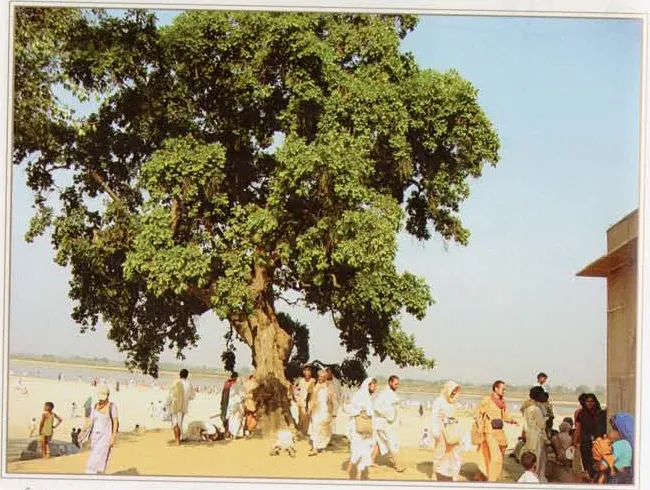
- What it is
- This Cīra-ghāṭa is a bathing place on the Yamunā up the river from Vṛndāvana, near Śergarh.
- Visiting
- Śrī Vraja-maṇḍala Parikramā (2007) says that the temple of Kātyāyanī-devī stands at this ghāṭa on the bank of the Yamunā, and that the village is now called Siyāro.
- Places here
- Kātyāyanī-devī Mandira (Cīra-ghāṭa near Śergarh), Kadamba tree (Cīra-ghāṭa near Śergarh)
In short
This Cīra-ghāṭa is a bathing place on the Yamunā up the river from Vṛndāvana, near Śergarh. According to the guidebook Śrī Vraja-maṇḍala Parikramā (2007), it lies two miles west of Akṣayavaṭa, in the village now called Siyāro, with a temple of the goddess Kātyāyanī on the bank.[1 +4] The guidebooks set here the pastime of Śrīmad-Bhāgavatam 10.22, in which Kṛṣṇa took the clothes of the unmarried girls of Vraja at the end of their vow to Kātyāyanī; the Bhakti-ratnākara tells it at a Cīra-ghāṭa up the river between Gopī-ghāṭa and Nanda-ghāṭa.[1 +4] The Bhāgavatam names only the Yamunā and a kadamba tree, and other sources place the pastime at the Cīra-ghāṭa of Vṛndāvana or elsewhere.[7 +5]
Key facts
| Kind | ghāṭa |
|---|---|
| Region · area | Jāvaṭa |
| Also part of | Yamunā |
| Ācāryas | Śrīla Rāghava Paṇḍita Gosvāmī of Govardhana, Śrīla Śrīnivāsa Ācārya, Śrīla Narottama dāsa Ṭhākura, Vīracandra Prabhu, Śrīla Raghunātha dāsa Gosvāmī |
Divine pastimes
The vow to Kātyāyanī
Śrīmad-Bhāgavatam (10.22) tells that in the first month of winter the unmarried girls of Nanda's Vraja kept a month-long vow to the goddess Kātyāyanī, also called Bhadrakālī, praying that Nanda's son would become their husband. Every day they rose at dawn and went singing of Kṛṣṇa to bathe in the Yamunā, and they worshipped an image of the goddess made of sand on the bank. One day, when they had left their clothes on the bank and were playing in the water, Kṛṣṇa came with His young friends, took the clothes and climbed a kadamba tree.[7 +6]
tāsāṃ vāsāṃsy upādāya nīpam āruhya satvaraḥ / hasadbhiḥ prahasan bālaiḥ parihāsam uvāca ha
Taking the girls’ garments, He quickly climbed to the top of a kadamba tree. Then, as He laughed loudly and His companions also laughed, He addressed the girls jokingly.
Translation: Śrīla Prabhupāda's disciples (BBT)About this place: Does not name the place; it is the verse of the tree itself. Kṛṣṇa took the girls' garments and quickly climbed a nīpa, which Śrīdhara Svāmī explains as a kadamba; the undated parikramā notes Chīra-Ghāṭa and Vṛndāvana-Dhāma Ki Jaya! (c. 1986) set this at Cīra-ghāṭa, and Śrī Vraja-maṇḍala Parikramā (2007) says that a kadamba tree also stands at this ghāṭa near Śergarh.
At the end Kṛṣṇa gave the clothes back and sent the girls home, telling them that their wish was fulfilled and that they would enjoy the coming nights with Him; this, He said, was the purpose of their vow.[17] When that promise was kept is read differently by the commentators and by Śrīla Prabhupāda, as shown on the page of the Vṛndāvana Cīra-ghāṭa.[17] Read more: The Kātyāyanī vow and the gopīs' clothes: the pastime and its places →
What the commentators add
The commentators on the Bhāgavatam place the taking of the clothes on the last day of the vow. Śrīla Jīva Gosvāmī and Śrīla Viśvanātha Cakravartī Ṭhākura take it as the full-moon day, and Śrīla Sanātana Gosvāmī as the end of the month; Śrīla Viśvanātha Cakravartī Ṭhākura and Śrīla Baladeva Vidyābhūṣaṇa add that Śrī Rādhā and other friends of the girls had been invited for the festival that closed the vow (summarised here, not translated).[18 +2]
None of them names a Cīra-ghāṭa. Śrīla Jīva Gosvāmī says that the girls bathed at a ghāṭa of Vraja that was known in his day by the name of the goddess Ghaṭṭa-vāsinī, "she who dwells at the ghāṭa", and which ghāṭa he meant is not known. He and Śrīla Sanātana Gosvāmī also say that the girls went a long way every day to reach the river, without giving a distance (summarised here, not translated).[7 +5]
Where the pastime took place
Other texts point to other places. The Padma Purāṇa puts the taking of the clothes in the north-eastern petal of the ring of eight petals within Vṛndāraṇya, without naming a ghāṭa.[12] Śrīla Raghunātha dāsa Gosvāmī's Vraja-vilāsa-stava (verse 84) takes shelter of the Cīra-ghāṭa of this pastime without saying where it is; in the hymn the verse stands among the holy places of Vṛndāvana.[22 +1] Śrīla Viśvanātha Cakravartī Ṭhākura's Vraja-rīti-cintāmaṇi sets the pastime at a shrine of Bhadrakālī under a kadamba among the holy spots of Vṛndāvana.[15 +1] In Śrīla Rūpa Gosvāmī's play Vidagdha-mādhava, Viśākhā recalls the pastime through "the kadamba of the Bhadrakālī-tīrtha", which the play does not locate.[24]
Traditional accounts
According to the Bhakti-ratnākara (Fifth Wave), on the parikramā north of Vṛndāvana Śrīla Rāghava Paṇḍita Gosvāmī showed Śrīla …
According to the Bhakti-ratnākara (Fifth Wave), on the parikramā north of Vṛndāvana Śrīla Rāghava Paṇḍita Gosvāmī showed Śrīla Śrīnivāsa Ācārya and Śrīla Narottama dāsa Ṭhākura three places in a row: Tapovana, where the cowherd girls performed their austerities; Gopī-ghāṭa, where they bathed; and a Cīra-ghāṭa, where after worshipping Kātyāyanī they left their clothes on the bank, and Hari took them and watched from a nīpa (kadamba) tree before giving them back. The party went on to Nanda-ghāṭa.[6 +2] The book gives only the order of the places, not a distance; that its Cīra-ghāṭa is this ghāṭa at Siyāro is the guidebooks' identification.[1 +4]
The same book tells in its Thirteenth Wave that Śrīla Vīracandra Prabhu, on his pilgrimage through Vraja, went from the Bhāṇḍīra banyan to Nanda-ghāṭa and "Cira-ghāṭa", probably this ghāṭa up the river, and then on to Bhadravana.[26]
Śrī Vraja-maṇḍala Parikramā (2007) tells that here, at the end of their month-long vow, Kṛṣṇa with some of His most intimate friends took the young gopīs' clothes and blessed them that their desire would be fulfilled. The undated parikramā notes Cīra-ghāṭa and Tapovana give the same place and add that the girls came here on the last day of the vow, after a month of austerities at Tapovana.[1 +5]
Śrīla Prabhupāda
Śrīla Prabhupāda tells the pastime in chapter 22 of his Kṛṣṇa book, on "the bank of the Yamunā".
Śrīla Prabhupāda tells the pastime in chapter 22 of his Kṛṣṇa book, on "the bank of the Yamunā". Later in the book, explaining how the night of the rāsa dance kept Kṛṣṇa's promise, he places it at Cīraghāṭa on the Yamunā, without saying which Cīra-ghāṭa he means.[19 +1]
Names this place“When Kṛṣṇa stole the garments of the gopīs while they were taking a bath at Cīraghāṭa on the Yamunā, He promised to fulfill their desire in some future night.”
Śrīla Prabhupāda, Kṛṣṇa, the Supreme Personality of Godhead, Chapter 33, 'Description of the Rāsa Dance' (last paragraph) · vedabase.io
Songs
A song in praise of the holy places of Vraja names Cīra-ghāṭa by the Yamunā together with Nanda-ghāṭa and the Akṣara-vaṭa; the …
A song in praise of the holy places of Vraja names Cīra-ghāṭa by the Yamunā together with Nanda-ghāṭa and the Akṣara-vaṭa; the song book does not name its author.[28] A prayer that the song book credits to Śrīla Sanātana Gosvāmī, a credit it marks as uncertain, honours Kṛṣṇa as the one who took the gopīs' clothes while they played in the water.[29]
Visiting today
Śrī Vraja-maṇḍala Parikramā (2007) says that the temple of Kātyāyanī-devī stands at this ghāṭa on the bank of the Yamunā, and that the village is now called Siyāro. The undated parikramā notes Cīra-ghāṭa say that the temple is right next to the ghāṭa and that the goddess is an orange-coloured Deity. These descriptions have not been checked on the spot.[1 +1]
The same book names Gāṅgralī, two miles south and slightly east of Cīra-ghāṭa and two miles north of Bhaya-gaon, only as a landmark, with no pastime; its present name and place have not been checked.[30]
Places at Cīra-ghāṭa (near Śergarh)
3 places
- ↳Kātyāyanī-devī Mandira (Cīra-ghāṭa near Śergarh)temple›
- ↳Kadamba tree (Cīra-ghāṭa near Śergarh)tree›
Also listed here
- Gāṅgralī (near Cīra-ghāṭa) village
Nearby places
Akṣayavaṭa (near Rāma-ghāṭa) · Śergarh · Yamunā · Khelanvana
Where the sources differ
Where Kṛṣṇa took the girls' clothes: at this Cīra-ghāṭa up the river, at the Cīra-ghāṭa of Vṛndāvana, or elsewhere. Śrī Vraja-maṇḍala Parikramā accepts both ghāṭas and adds that a kadamba stands here too, while Vṛndāvana, the Playground of God (2010) reports the place up the river as the one more generally accepted.[31 +2]
Accounts differ Where Kṛṣṇa took the clothes of the girls after their Kātyāyanī vow (ŚB 10.22): at this Cīra-ghāṭa up the river, at the Cīra-ghāṭa of Vṛndāvana, or elsewhere.
- Śrīmad-Bhāgavatam 10.22.2-9On the bank of the Kālindī (Yamunā), at a nīpa (kadamba) tree; no ghāṭa is named.
- Śrīla Jīva Gosvāmī, Laghu-vaiṣṇava-toṣaṇī on 10.22.2At the ghāṭa of Vraja famous in his day by the name of the goddess Ghaṭṭa-vāsinī; no Cīra-ghāṭa, no distance.
- Padma Purāṇa, Pātāla 69.29-30In the fourth, north-eastern petal of the eight-petalled ring within Vṛndāraṇya; no ghāṭa named.
- Bhakti-ratnākara, Fifth Wave (printed p.269)At a Cīra-ghāṭa up the river, between Gopī-ghāṭa (Tapovana) and Nanda-ghāṭa.
The wording of these accounts is our summary of the sources, not a published translation.
Accounts differ How and where the girls bathed and worshipped during the vow, and on which day the clothes were taken.
- Śrīmad-Bhāgavatam 10.22.2-7Every day they bathed in the Kālindī at dawn and worshipped a sand image (saikatī) of the goddess on the bank; 'one day' (kadācit) they left their clothes on the bank as before.
- Śrīla Viśvanātha Cakravartī on 10.22.7One day is the full-moon day on which the vow was completed; the play in the water was the closing bath, with Rādhā and others invited.
- the undated parikramā notes Cīra-ghāṭaAfter a month of austerities at Tapovana, the gopīs came to Chira-ghata on the final day to make a clay image of Kātyāyanī Devī, 'worshiped in her form as eight armed Durga riding a tiger', and bathed before the pūjā.
- the undated parikramā notes TapovanaDuring the vow they bathed daily at Gopī-ghāṭa in the brahma-muhūrta and did tapasya at Tapovana; on the last day they went to Chira-ghata to worship the deity of Kātyāyanī.
The wording of these accounts is our summary of the sources, not a published translation.
More on this place
The Kātyāyanī vow and the gopīs' clothes: the pastime and its places
References
35 references
- Śrī Vraja-maṇḍala Parikramā (2007), PDF p. 243
- the undated parikramā notes Cīra-ghāṭa, ¶5
- the undated parikramā notes Cīra-ghāṭa, ¶10
- the undated parikramā notes Tapovana, ¶12
- the undated parikramā notes Cīra-ghāṭa, ¶11
- Śrīla Narahari Cakravartī, Bhakti-ratnākara, Fifth Wave (pañcama taraṅga), printed p. 269 (1912 edition), 2nd ed., 1912
- Śrīmad-Bhāgavatam 10.22.2, GRETIL
- Śrīmad-Bhāgavatam 10.22.6, GRETIL
- Śrīmad-Bhāgavatam 10.22.9, GRETIL
- Laghu-vaiṣṇava-toṣaṇī (Śrīla Jīva Gosvāmī): commentary on ŚB 10.22.1-2 (Grantha Mandira canto 10 text, part 3, label 'v.10.22.1-2, jīva-gosvāmī (laghu-vaiṣṇava-toṣaṇī)'; the words comment on verse 2), Bhagavata Vidya Pith edition, ed. Bhagavata Rishi and Krishna Shankar Shastri, 1996
- Bṛhad-vaiṣṇava-toṣaṇī (Śrīla Sanātana Gosvāmī): commentary on ŚB 10.22.6-7'; the passage comments on verse 6), Bhagavata Vidya Pith edition, ed. Bhagavata Rishi and Krishna Shankar Shastri, 1996
- Padma Purāṇa, Pātāla-khaṇḍa (5) 69.29-30, Sanskrit Wikisource
- Śrīmad-Bhāgavatam 10.22.1, GRETIL
- Śrīmad-Bhāgavatam 10.22.4, GRETIL
- Śrīmad-Bhāgavatam 10.22.5, GRETIL
- Śrīmad-Bhāgavatam 10.22.7, GRETIL
- Śrīmad-Bhāgavatam 10.22.27, GRETIL
- Śrīla Sanātana Gosvāmī: commentary on ŚB 10.22.7, Bhagavata Vidya Pith edition, ed. Bhagavata Rishi and Krishna Shankar Shastri, 1996
- Śrīla Prabhupāda, Kṛṣṇa, the Supreme Personality of Godhead (Kṛṣṇa book), Chapter 22, 'Stealing the Garments of the Unmarried Gopī Girls' · vedabase.io
- Śrīla Viśvanātha Cakravartī, Vraja-rīti-cintāmaṇi, sarga 2 (dvitīyaḥ sargaḥ), v. 78
Show all 35 references
- Gopāla-campū, Pūrva-campū (32) ¶[23]: after the killing of Keśī
- Śrīla Raghunātha dāsa Gosvāmī, Vraja-vilāsa-stava, verse 84
- Śrīla Raghunātha dāsa Gosvāmī, Vraja-vilāsa-stava, Stavāvalī (9) Vraja-vilāsa-stava v.84
- Śrīla Rūpa Gosvāmī, Vidagdha-mādhava, Act 3 (tṛtīyo 'ṅkaḥ, 'rādhā-saṅgaḥ'), prose dialogue before v.30 veṇu-nāda-vilāsaḥ v.30')
- Śrīla Narahari Cakravartī, Bhakti-ratnākara, Fifth Wave, printed p. 271: the party returns to Nanda-ghāṭa; Jīva Gosvāmī's stay begins, 2nd ed., 1912
- Śrīla Narahari Cakravartī, Bhakti-ratnākara, Thirteenth Wave (trayodaśa taraṅga), printed p. 1025: Vīracandra Prabhu's tour of Vraja, 2nd ed., 1912
- Śrīla Prabhupāda, Kṛṣṇa, the Supreme Personality of Godhead, Chapter 33, 'Description of the Rāsa Dance' (last paragraph) · vedabase.io
- Jaya Jaya Madana Gopāla Baṁśī Dhārī (Narottama dāsa Ṭhākura (as the song book credits it)) · song book
- Obeisance 55 (Śrī Kṛṣṇa-līlā-stava) (Sanātana Gosvāmī (as the song book credits it; the credit is marked inferred in the song book data)) · song book
- Śrī Vraja-maṇḍala Parikramā (2007), PDF p. 245
- Śrī Vraja-maṇḍala Parikramā (2007), PDF p. 312
- Vṛndāvana, the Playground of God (2010), Bhakti Caitanya Svāmī, PDF p. 177
- Śrī Vraja-maṇḍala Parikramā (2007), PDF p. 343
- Śrī Vraja-maṇḍala Parikramā (2007), p. 460-461
- Vṛndāvana-Dhāma Ki Jaya! (c. 1986), by Dhruva Mahārāja dāsa, p. 38