Rāma-ghāṭa
राम-घाट
Also called Obe, Ohava
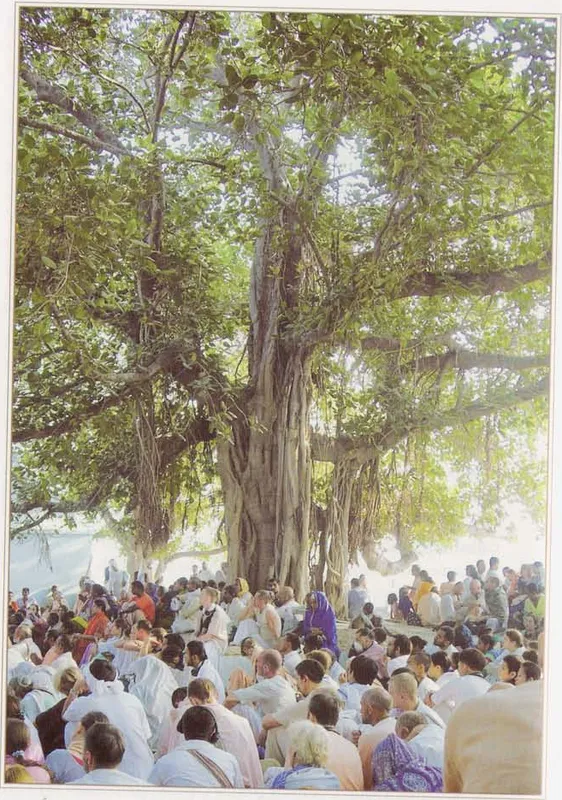
- What it is
- Rāma-ghāṭa is a place on the Yamunā near Śergarh, honoured as the place of Balarāma's rāsa dance with the gopīs and of His dragging of the Yamunā with His plough, during His two months' visit to …
- Visiting
- Śrī Vraja-maṇḍala Parikramā (2007) and the undated parikramā notes Rāma-ghāṭa say that even today the Yamunā leaves her natural course and flows by Rāma-ghāṭa.
- Places here
- Aśvattha tree (Rāma-ghāṭa), Balarāma Mandira (Rāma-ghāṭa), Brahma-ghāṭa (near Rāma-ghāṭa), Kacchavana
In short
Rāma-ghāṭa is a place on the Yamunā near Śergarh, honoured as the place of Balarāma's rāsa dance with the gopīs and of His dragging of the Yamunā with His plough, during His two months' visit to Vraja. Śrīmad-Bhāgavatam tells the pastime without naming a place.[1 +5] Śrīla Viśvanātha Cakravartī Ṭhākura explains the Bhāgavatam's garden by the Yamunā as the place known as Śrī Rāma-ghaṭṭa, and in 1970 Śrīla Prabhupāda wrote that Balarāma's dance with the gopīs took place at Rāma-ghāṭa.[2 +2] Śrīla Raghunātha dāsa Gosvāmī bows to this region, and the Bhakti-ratnākara tells that Śrī Nityānanda Prabhu stayed here.[9 +7]
Key facts
| Kind | ghāṭa |
|---|---|
| Region · area | Jāvaṭa |
| Also part of | Yamunā |
| Ācāryas | Śrī Nityānanda Prabhu, Śrī Jāhnavā Mātā (Jāhnavā Īśvarī), Vīracandra Prabhu (Vīrabhadra Gosvāmī), son of Śrī Nityānanda, Śrīla Raghunātha dāsa Gosvāmī, Śrīla Viśvanātha Cakravartī Ṭhākura |
Why it is glorified
Śrīla Raghunātha dāsa Gosvāmī's Vraja-vilāsa-stava offers obeisance with devotion to the wonderful region of Rāma-ghaṭṭa, where …
Śrīla Raghunātha dāsa Gosvāmī's Vraja-vilāsa-stava offers obeisance with devotion to the wonderful region of Rāma-ghaṭṭa, where even today everyone sees the Yamunā as she was when the angry Balarāma dragged her with the tip of His plough (summarised here, not translated). The Bhakti-ratnākara quotes this verse at Rāma-ghāṭa.[9 +2]
In the first chapter of his Gopāla-campū, which describes Goloka, Śrīla Jīva Gosvāmī names Rāma-ghaṭṭa as Śrī Balarāma's own pastime forest, a region that spreads happiness, lying north of the Bhāṇḍīra banyan (summarised here, not translated).[17 +2]
Divine pastimes
Balarāma's visit to Vraja
Śrīmad-Bhāgavatam (10.65) tells how Balarāma came back to Vraja from Dvārakā and stayed the two spring months of Madhu and Mādhava (Caitra and Vaiśākha). He spent the nights with the gopīs in a garden by the Yamunā, drank the vāruṇī that the demigod Varuṇa sent, and when the Yamunā did not come at His call, He dragged her with His plough. The Bhāgavatam does not name Rāma-ghāṭa.[1 +5]
pūrṇa-candra-kalā-mṛṣṭe kaumudī-gandha-vāyunā / yamunopavane reme sevite strī-gaṇair vṛtaḥ
In the company of numerous women, Lord Balarāma enjoyed in a garden by the Yamunā River. This garden was bathed in the rays of the full moon and caressed by breezes bearing the fragrance of night-blooming lotuses.
Translation: Śrīla Prabhupāda's disciples (BBT)Śrīla Viśvanātha Cakravartī Ṭhākura explains that this garden is the place well known as Śrī Rāma-ghaṭṭa, and that Balarāma kept far away from the place where Śrī Kṛṣṇa had danced His rāsa (summarised here, not translated). The BBT purport to the same verse repeats his explanation.[2 +1] The commentators and the other books differ on who the gopīs of Balarāma's rāsa were; the accounts are shown below.[15 +5]
Śrīla Prabhupāda tells the pastime in his Kṛṣṇa book, chapter 65, without naming the place.[1 +5] Read more: Balarāma's visit to Vraja →
The dragging of the Yamunā
The Bhāgavatam says that Balarāma called the Yamunā to play in her waters, and that when she ignored Him, thinking Him intoxicated, He grew angry and dragged her with the tip of His plough. It adds that the river still flows along the channels He made.[1 +5]
sa ājuhāva yamunāṃ jala-krīḍārtham īśvaraḥ / nijaṃ vākyam anādṛtya matta ity āpagāṃ balaḥ … anāgatāṃ halāgreṇa kupito vicakarṣa ha
The Lord then summoned the Yamunā River so that He could play in her waters, but she disregarded His command, thinking He was drunk. This angered Balarāma, and He began dragging the river with the tip of His plow.
Translation: Śrīla Prabhupāda's disciples (BBT)adyāpi dṛśyate rājan yamunākṛṣṭa-vartmanā / balasyānanta-vīryasya vīryaṃ sūcayatīva hi
Even today, O King, one can see how the Yamunā flows through the many channels created when it was dragged by the unlimitedly powerful Lord Balarāma. Thus she demonstrates His prowess.
Translation: Śrīla Prabhupāda's disciples (BBT)Śrīla Jīva Gosvāmī explains that the Yamunā still flows so out of love for Śrī Baladeva, and quotes Balarāma's order to her in the Harivaṁśa: to water this region along the path His plough had shown (summarised here, not translated).[17 +2] Śrīla Prabhupāda writes in the Kṛṣṇa book (a general reference; it does not name the place):[5 +5]
General teaching (does not name the place)“The river Yamunā still has many small branches due to being scratched by the plowshare of Lord Balarāma. And all these branches of the river Yamunā still glorify the omnipotence of Lord Balarāma.”
Śrīla Prabhupāda, Kṛṣṇa, the Supreme Personality of Godhead, ch. 65 'Lord Balarāma Visits Vṛndāvana' · vedabase.io
The commentators also explain which Yamunā Balarāma dragged. Śrīla Viśvanātha Cakravartī Ṭhākura says that it was the river form that flows to the ocean, an expansion of Kālindī and not Kālindī herself; Śrīla Jīva Gosvāmī's Krama-sandarbha speaks of her as a shadow-form known as the ocean's wife; and Śrīla Raghunātha dāsa Gosvāmī calls the dragged river "without connection with Kṛṣṇa" (summarised here, not translated).[9 +2]
The visit in other books
The Viṣṇu Purāṇa tells the same visit: Varuṇa sends the vāruṇī into the hollow of a kadamba tree in Vṛndāvana, the dragged river floods the forest where Balarāma is, and after two months He returns to Dvārakā.[29 +3] The Garga-saṁhitā sets His rāsa on the bank of the Kālindī on the full moon of Caitra and adds that the Yamunā flows along the course of the plough even today.[23 +3] The Harivaṁśa tells the visit differently; the accounts are shown below. None of these books names the place.[36 +3]
Traditional accounts
According to the Bhakti-ratnākara (Fifth Wave), Śrīla Rāghava Paṇḍita Gosvāmī of Govardhana told Śrīla Śrīnivāsa Ācārya: this is …
According to the Bhakti-ratnākara (Fifth Wave), Śrīla Rāghava Paṇḍita Gosvāmī of Govardhana told Śrīla Śrīnivāsa Ācārya: this is Rāma-ghāṭa, where Rohiṇī's son danced the rāsa, far from the place of Kṛṣṇa's rāsa. Coming from Dvārakā full of longing, Balarāma stayed in Caitra and Vaiśākha, consoled Nanda, Yaśodā and the cowherd boys, comforted Kṛṣṇa's beloveds and delighted His own (summarised here, not translated).[12 +5] The same book says that Balarāma brought the Yamunā to this place for water sports, and that here she fell at His feet in fear and prayed to Him, and He became pleased with her.[10 +3]
Śrīla Murāri Gupta, in verses that the Bhakti-ratnākara quotes here, describes Śrī Rāma and Kṛṣṇa in spring dress sporting and singing with the gopīs, each with His own group; the verses name no place (summarised here, not translated; the edition still has to be checked).[22 +2]
The Gosvāmīs and ācāryas
According to the Bhakti-ratnākara, Śrī Nityānanda Prabhu stayed at Rāma-ghāṭa during His pilgrimage, absorbed in the mood of …
According to the Bhakti-ratnākara, Śrī Nityānanda Prabhu stayed at Rāma-ghāṭa during His pilgrimage, absorbed in the mood of Baladeva. He played with the cowherd boys, gave darśana in Baladeva's form to a brāhmaṇa who could not live without Baladeva, and received the prayers of Kālindī. Lying on a platform of dust under a tree, He said again and again that He longed for the offenders to be delivered and for the Lord of Navadvīpa to appear (summarised here, not translated).[12 +4]
The same book tells that Śrīla Jāhnavā Mātā, on her tour of the forests of Vraja, saw Balarāma's rāsa here in a vision and fainted with joy, and that Śrīla Vīracandra Prabhu, Śrī Nityānanda's son, came here, sang Baladeva's pastimes and danced.[46 +1]
Śrīla Prabhupāda
Asked whether a painting should show Balarāma expanding Himself in His rāsa dance, as Kṛṣṇa did, Śrīla Prabhupāda answered in a …
Asked whether a painting should show Balarāma expanding Himself in His rāsa dance, as Kṛṣṇa did, Śrīla Prabhupāda answered in a letter of 11 July 1970 that the Bhāgavatam gives no such description, and named the place of Balarāma's dance:[8]
Names this place“You have inquired whether to illustrate Balaramaji's Rasa Dancing with expansions of Balaramaji just like Krsna expanded Himself for Rasa Dancing. No, we do not find such description in the Srimad-Bhagavatam. But He had His dancing pastime with the Gopis in a different place known as Ramaghata on the bank of the Yamuna.”
Śrīla Prabhupāda, Letter to Jadurani, letter dated 11 July 1970 · vedabase.io
In a recording of 25 September 1972 he sang the song Jaya Rādhe Jaya Kṛṣṇa Jaya Vṛndāvana, whose verse glorifies Rāma-ghāṭa and Rohiṇī's son; the words are the song's.[48]
Songs
The song that Śrīla Prabhupāda sang, credited in the song book to Kṛṣṇa dāsa, glorifies the holy places of Vṛndāvana; one verse …
The song that Śrīla Prabhupāda sang, credited in the song book to Kṛṣṇa dāsa, glorifies the holy places of Vṛndāvana; one verse greets Rāma-ghāṭa and Rohiṇī's son, Balarāma.[49]
jaya rāma-ghāta, jaya rohiṇī-nandan
jaya jaya vṛndāvana-bāsī jata jan
Visiting today
Śrī Vraja-maṇḍala Parikramā (2007) and the undated parikramā notes Rāma-ghāṭa say that even today the Yamunā leaves her natural course and flows by Rāma-ghāṭa. The scriptural statements behind this are general: the Bhāgavatam, Śrīla Jīva Gosvāmī and Śrīla Raghunātha dāsa Gosvāmī speak of the river's course "even today", and only the last places it at Rāma-ghaṭṭa. The river's present course here has not been checked.[5 +5] The place's temple of Balarāma, the Balarāma Mandira, has its own page, as do the nearby Brahma-ghāṭa, Kacchavana and Akṣayavaṭa; an aśvattha tree and the grove of Vihāravana are described below.[5 +5]
The aśvattha tree
This aśvattha (sacred fig) tree stands near the temple of Balarāma at Rāma-ghāṭa. According to Śrī Vraja-maṇḍala Parikramā (2007) and the undated parikramā notes Rāma-ghāṭa, which repeat it, it is known as a sakhā, a friend, of Balarāma, and Balarāma's rāsa dance with the gopīs took place at this tree. No older text has been found that names this tree.[15 +1] Śrīmad-Bhāgavatam (10.65) tells of that rāsa in a garden by the Yamunā, in the light of the full moon, without naming a place or a tree (above).[1 +2] Śrīla Viśvanātha Cakravartī Ṭhākura explains that garden as Śrī Rāma-ghaṭṭa, and in a letter of 1970 Śrīla Prabhupāda wrote that Balarāma had His dancing pastime with the gopīs at Rāma-ghāṭa, a different place from Kṛṣṇa's rāsa. Neither mentions the tree.[7 +1]
General teaching (does not name the place)“But He had His dancing pastime with the Gopis in a different place known as Ramaghata on the bank of the Yamuna.”
Śrīla Prabhupāda, Letter to Jadurani, letter dated 11 July 1970 · vedabase.io
The Bhakti-ratnākara speaks of another tree at Rāma-ghāṭa: a śākaṭa tree that, the book says, is Śrī Nityānanda Prabhu's tooth-stick, under which He lay overwhelmed on a platform of dust, longing to see the Lord of Navadvīpa (above).[51] No source found so far says whether that tree and this aśvattha are the same.[15 +1]
Vihāravana near Rāma-ghāṭa
According to Śrī Vraja-maṇḍala Parikramā (2007), Vihāravana lies one and a half miles south-west of Rāma-ghāṭa, near the Yamunā, and here Kṛṣṇa with Rādhikā and the gopīs performed the rāsa dance and other pastimes.[52] The same book recommends darśana of the Bihārījī temple and of Vihāra-kuṇḍa there. It says that, although most of the forests of Vraja have been cut down, Vihāravana remains somewhat protected, with peacocks, cuckoos, kuñjas (bowers) and kadamba groves.[52 +1]
- Bihārījī Mandira: the guidebook prints a photograph captioned "Bihārījī" that shows two Deities, one dark and one fair. No other description of the temple was found.[52 +1]
- Vihāra-kuṇḍa: the guidebook shows it in a photograph as a square pond with steps and a small domed pavilion. It is the only source found that describes this kuṇḍa.[52]
Śrīla Nārāyaṇa Bhaṭṭa Gosvāmī's Vraja-bhakti-vilāsa lists a Vihāravana seventeenth among the forty-two forests on the northern bank of the Yamunā. Citing the Brahmāṇḍa Purāṇa, it says that pilgrims come to this forest on the fourth day of the bright fortnight of Jyeṣṭha, that Kṛṣṇa danced the rāsa there with the gopīs, so that it is called Vihāravana, and that a rāsa-maṇḍala lies in its midst (summarised here, not translated). No source says whether that forest is the grove near Rāma-ghāṭa.[52 +2] Śrīmad-Bhāgavatam tells the rāsa dance on the bank of the Yamunā but names no grove.[56 +2]
Places at Rāma-ghāṭa
7 places
- ↳Aśvattha tree (Rāma-ghāṭa)tree›
- ↳Balarāma Mandira (Rāma-ghāṭa)temple›
- ↳Brahma-ghāṭa (near Rāma-ghāṭa)ghāṭa›
- ↳Kacchavanaforest›
Also described on this page
- Vihāravana (near Rāma-ghāṭa) forest
Also listed here
- Bihārījī Mandira (Vihāravana near Rāma-ghāṭa) temple
- Vihāra-kuṇḍa (Vihāravana, near Rāma-ghāṭa) kuṇḍa
Nearby places
Śergarh · Akṣayavaṭa (near Rāma-ghāṭa) · Khelanvana · Yamunā
Pictures
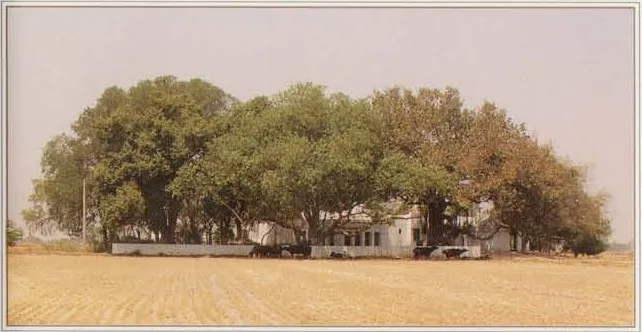
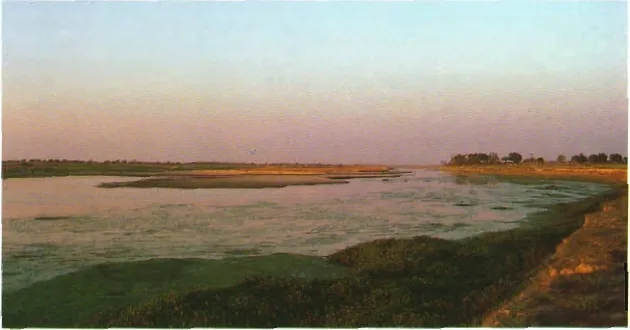
2 pictures
Where the sources differ
Accounts differ How Balarāma's visit to Vraja is told: the Bhāgavatam and Viṣṇu Purāṇa against the critical Harivaṁśa.
- Śrīmad-Bhāgavatam 10.65.19 and Viṣṇu Purāṇa 5.25.2-4Varuṇa sends the Vāruṇī, which flows from a tree hollow (a kadamba, in the Viṣṇu Purāṇa).
- Harivaṁśa (critical ed.) 83.19the cowherds bring the Vāruṇī to Rāma.
- Viṣṇu Purāṇa 5.25.18; Bhakti-ratnākara (Fifth Wave); KB ch. 65He came from, or returned to, Dvārakā after two months.
- Harivaṁśa (critical ed.) 83.51He returned to Mathurā; no two months or nightly rāsa are mentioned.
Accounts differ Who were the gopīs of Balarāma's rāsa?
- Śrīla Śrīdhara Svāmī (as cited by Viśvanātha on ŚB 10.65.17); Bhakti-ratnākara v.1449other girls, not yet born or very young at the time of Kṛṣṇa's pastimes.
- 'our masters' cited by Viśvanātha; Śrīla Jīva Gosvāmī (Laghu-toṣaṇī on 10.65.17); Bhakti-ratnākara vv.1442-1445Balarāma's own beloveds, named together with Kṛṣṇa's beloveds at the Holī when Śaṅkhacūḍa was killed.
- Śrīla Sanātana Gosvāmī, Bṛhad-vaiṣṇava-toṣaṇī on ŚB 10.65.17-18first: after consoling Kṛṣṇa's beloveds, Balarāma delighted other gopīs in spring, women other than those Kṛṣṇa enjoyed with; then, as another reading ('athavā'): the gopīs of the verse are Kṛṣṇa's grieving beloveds, and He stayed two months to give them a little comfort ('rati' = 'sukha') even at night.
- Śrī Vraja-maṇḍala Parikramā (2007), citing Śrīla Murāri GuptaBaladeva performed rāsa only with His own group of beloved gopīs.
The present name of the place: the guidebooks give one, but not the same one.
Accounts differ Present name of Rāma-ghāṭa, and whether Obe is the same place.
- Śrī Vraja-maṇḍala Parikramā (2007)'Its present name is Obe'; index: 'Rāma-ghāṭa, or Obe'.
- the undated parikramā notes Rāma-ghāṭa'Its present name is Ohava' (otherwise the same sentence).
- Śrī Vraja-maṇḍala Parikramā (2007) route listnames 'Obe' and 'Rāma-ghāṭa' as two consecutive stops ('… Ūjānī, Khelanavana, Obe, Rāma-ghāṭa, Kāśraṭa …').
More on this place
Balarāma's visit to Vraja
References
60 references
- Śrīmad-Bhāgavatam 10.65.17, GRETIL
- Śrīmad-Bhāgavatam 10.65.18, GRETIL
- Śrīmad-Bhāgavatam 10.65.19, GRETIL
- Śrīmad-Bhāgavatam 10.65.25 and the first line of 10.65.26 = 10.65.24-25 on vedabase, GRETIL
- Śrīmad-Bhāgavatam 10.65.33, GRETIL
- Śrīla Prabhupāda, Kṛṣṇa, the Supreme Personality of Godhead, ch. 65 'Lord Balarāma Visits Vṛndāvana' · vedabase.io
- Śrīla Viśvanātha Cakravartī Ṭhākura: commentary on ŚB 10.65.18, Bhagavata Vidya Pith edition, ed. Bhagavata Rishi and Krishna Shankar Shastri, 1996
- Śrīla Prabhupāda, Letter to Jadurani, letter dated 11 July 1970 · vedabase.io
- Raghunātha dāsa Gosvāmī, Stavāvalī (9) Vraja-vilāsa-stava v.94
- Śrīla Narahari Cakravartī, Bhakti-ratnākara, Fifth Wave (pañcama taraṅga), printed p. 266, vv.1544-1547 in the Grantha Mandira numbering, 2nd ed., 1912
- Vṛndāvana-Dhāma Ki Jaya! (c. 1986), by Dhruva Mahārāja dāsa, PDF p. 56
- Śrīla Narahari Cakravartī, Bhakti-ratnākara, Fifth Wave (pañcama taraṅga), printed p. 266, vv.1548-1550 in the Grantha Mandira numbering, 2nd ed., 1912
- Śrīla Narahari Cakravartī, Bhakti-ratnākara, Fifth Wave (pañcama taraṅga), printed p. 267, vv.1551-1556 in the Grantha Mandira numbering, 2nd ed., 1912
- Śrīla Narahari Cakravartī, Bhakti-ratnākara, Fifth Wave (pañcama taraṅga), printed p. 267, vv.1557-1562 in the Grantha Mandira numbering, 2nd ed., 1912
- Śrī Vraja-maṇḍala Parikramā (2007), PDF p. 238
- the undated parikramā notes Rāma-ghāṭa, ¶18
- Jīva Gosvāmī, Pūrva-campū (1) prathamaṁ pūraṇam ¶[54] v.30
- Jīva Gosvāmī, Pūrva-campū (1) prathamaṁ pūraṇam ¶[79], prose
- Śrīla Jīva Gosvāmī: commentary on ŚB 10.65.31 in the Śrīmad-Bhāgavatam canto 10, part 7, with ten commentaries numbering (= 10.65.33 on vedabase and in Bhāgavata Purāṇa), Bhagavata Vidya Pith edition, ed. Bhagavata Rishi and Krishna Shankar Shastri, 1996
- Śrīla Viśvanātha Cakravartī Ṭhākura, Śrīla Jīva Gosvāmī: commentary on ŚB 10.65.17, Bhagavata Vidya Pith edition, ed. Bhagavata Rishi and Krishna Shankar Shastri, 1996
Show all 60 references
- Śrīla Narahari Cakravartī, Bhakti-ratnākara, Fifth Wave (pañcama taraṅga), printed p. 258, vv.1440-1445 in the Grantha Mandira numbering, 2nd ed., 1912
- Śrīla Narahari Cakravartī, Bhakti-ratnākara, Fifth Wave (pañcama taraṅga), printed p. 259, vv.1446-1449 in the Grantha Mandira numbering, 2nd ed., 1912
- Garga-saṁhitā, Balabhadra-khaṇḍa (8), adhyāya 9, verse 3, Sanskrit Wikisource
- Śrīla Sanātana Gosvāmī: commentary on ŚB 10.65.17, the second explanation, introduced by 'athavā', Bhagavata Vidya Pith edition, ed. Bhagavata Rishi and Krishna Shankar Shastri, 1996
- Śrīmad-Bhāgavatam 10.65.25 and the first line of 10.65.26 = 10.65.24-25 on vedabase, GRETIL
- Śrī Vraja-maṇḍala Parikramā (2007), PDF p. 237
- the undated parikramā notes Rāma-ghāṭa, ¶12
- Śrīla Viśvanātha Cakravartī: commentary on ŚB 10.65.24-25 in the Śrīmad-Bhāgavatam canto 10, part 7, with ten commentaries numbering (= vedabase 10.65.26-27), Bhagavata Vidya Pith edition, ed. Bhagavata Rishi and Krishna Shankar Shastri, 1996
- Viṣṇu Purāṇa, 5.24.8, GRETIL
- Viṣṇu Purāṇa, 5.25.4, GRETIL
- Viṣṇu Purāṇa, 5.25.10-11, GRETIL
- Viṣṇu Purāṇa, 5.25.18, GRETIL
- Garga-saṁhitā, Balabhadra-khaṇḍa (8), adhyāya 9 ('rāma-rāsa-krīḍā-varṇana'), verse 2, Sanskrit Wikisource
- Garga-saṁhitā, Balabhadra-khaṇḍa (8), adhyāya 9, verse 7, Sanskrit Wikisource
- Garga-saṁhitā, Balabhadra-khaṇḍa (8), adhyāya 9, verse 11 (end of the chapter), Sanskrit Wikisource
- Harivaṁśa, HV 83.19, GRETIL
- Harivaṁśa, HV 83.39-40, GRETIL
- Harivaṁśa, HV 83.48-49, GRETIL
- Harivaṁśa, HV 83.51, GRETIL
- Śrīla Narahari Cakravartī, Bhakti-ratnākara, Fifth Wave (pañcama taraṅga), printed p. 258, vv.1436-1439 in the Grantha Mandira numbering, 2nd ed., 1912
- the undated parikramā notes Rāma-ghāṭa, ¶11
- Śrīla Narahari Cakravartī, Bhakti-ratnākara, Fifth Wave (pañcama taraṅga), printed p. 265, vv.1524-1525 in the Grantha Mandira numbering, 2nd ed., 1912
- Śrīla Narahari Cakravartī, Bhakti-ratnākara, Fifth Wave (pañcama taraṅga), printed p. 265, vv.1535-1537 in the Grantha Mandira numbering, 2nd ed., 1912
- Śrī Vraja-maṇḍala Parikramā (2007), PDF p. 249
- Kṛṣṇa-caitanya-caritāmṛta of Murāri Gupta, prakrama 4, sarga 10, vv.1-2 (4.10.1-2), PDF page 589
- Śrīla Narahari Cakravartī, Bhakti-ratnākara, Eleventh Wave (ekādaśa taraṅga), printed p. 671, vv.217-222 in the Grantha Mandira numbering, 2nd ed., 1912
- Śrīla Narahari Cakravartī, Bhakti-ratnākara, Thirteenth Wave (trayodaśa taraṅga), printed p. 1025, vv.375-377 in the Grantha Mandira numbering, 2nd ed., 1912
- Śrīla Prabhupāda, Jaya Rādhe Jaya Kṛṣṇa, Los Angeles, 25 September 1972 · vedabase.io
- Jaya Rādhe Jaya Kṛṣṇa Jaya Vṛndāvana (Śrī Vraja-dhāma-mahimāmṛta) (Kṛṣṇa dāsa (as the song book credits it: 'Krsna Dasa'); the last verse remembers Śrī Jāhnavā's feet) · song book
- the undated parikramā notes Rāma-ghāṭa, ¶14
- Śrīla Narahari Cakravartī, Bhakti-ratnākara, Fifth Wave (pañcama taraṅga), printed p. 267, vv.1554 and 1559 in the Grantha Mandira numbering, 2nd ed., 1912
- Śrī Vraja-maṇḍala Parikramā (2007), PDF p. 239
- Śrī Vraja-maṇḍala Parikramā (2007), PDF p. 240
- Śrīla Nārāyaṇa Bhaṭṭa, Vraja-bhakti-vilāsa, section 'Vihāravanotpatti-māhātmya-nirūpaṇa' (no. 71), opening verses; printed p. 136, 1st ed., publ. Bābā Kṛṣṇadāsa, Kusuma-sarovara, Saṁvat 2008
- Śrīla Nārāyaṇa Bhaṭṭa, Vraja-bhakti-vilāsa, chapter 2, the forty-two forests of the northern bank (2.19, citing the 'Sanmohana-tantra'), printed p. 36; Grantha Mandira text (2) v.19, 1st ed., publ. Bābā Kṛṣṇadāsa, Kusuma-sarovara, Saṁvat 2008
- Śrīmad-Bhāgavatam 10.29.1, GRETIL
- Śrīmad-Bhāgavatam 10.33.2, GRETIL
- Śrīla Prabhupāda, Kṛṣṇa, the Supreme Personality of Godhead (Kṛṣṇa book), Chapter 33, 'Description of the Rāsa Dance' · vedabase.io
- Śrī Vraja-maṇḍala Parikramā (2007), p. 448-449
- Vṛndāvana-Dhāma Ki Jaya! (c. 1986), by Dhruva Mahārāja dāsa, p. 38