Mukhāravinda-śilā (Jatīpurā)
मुखारविन्द-शिला (जतीपुरा) Hindi name proposed
Also called Mukharāvinda Śīlā
In short
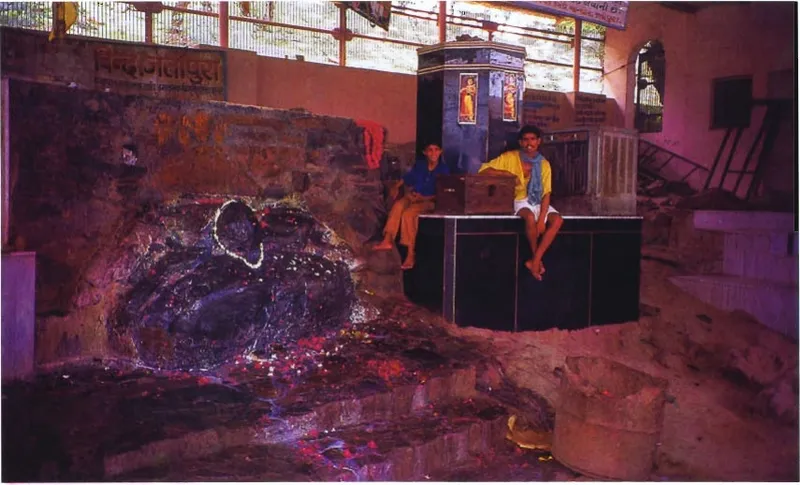
Mukhāravinda-śilā is a stone at Jatīpurā that stands in one compound with the samādhi (tomb) of Śrī Viṭṭhalanātha. The guidebook Govardhana Hill (2001) photographs it in a shed beside the samādhi.[1 +2] Its name means the lotus mouth of Govardhana. Which stone is the hill's mouth is told differently. According to the same book, the Vallabha sampradāya accepts this one, while the Gauḍīya Vaiṣṇavas accept the Mukhāravinda in the temple at Mānasī-gaṅgā, which, according to the local tradition recorded in the same book, Śrīla Bhaktisiddhānta Sarasvatī Ṭhākura confirmed as the real one; this is not certain.[2 +2] The Garga-saṁhitā places the mouth below Śṛṅgāra-maṇḍala, where the Annakūṭa was offered, but names no village or stone.[6]
Key facts
| Kind | śilā |
|---|---|
| Region · area | Govardhana · Jatīpurā |
| Ācāryas | Śrīla Bhaktisiddhānta Sarasvatī Ṭhākura |
Divine pastimes
The Annakūṭa in Śrīmad-Bhāgavatam
Śrīmad-Bhāgavatam (10.24) tells how Kṛṣṇa had the cowherds prepare many kinds of food for the worship of Govardhana Hill. He then took another, huge form, declared that He was the hill and ate the abundant offerings, and with the people of Vraja He bowed down to that form. The verses do not use the name Annakūṭa (the hill of food), name no place on the hill and say nothing of a mouth.[7 +4]
kṛṣṇas tv anyatamaṃ rūpaṃ gopa-viśrambhaṇaṃ gataḥ / śailo 'smīti bruvan bhūri balim ādad bṛhad-vapuḥ
Kṛṣṇa then assumed an unprecedented, huge form to instill faith in the cowherd men. Declaring “I am Govardhana Mountain!” He ate the abundant offerings.
Translation: Śrīla Prabhupāda's disciples (BBT)The commentators place that form on the summit (summarised here, not translated). Śrīla Sanātana Gosvāmī, quoting the Harivaṁśa, says that Kṛṣṇa appeared separately on the summit of Govardhana, and Śrīla Jīva Gosvāmī adds that many unseen forms appeared at that time. Śrīla Viśvanātha Cakravartī Ṭhākura describes the form as a second mountain on top of the hill, and Śrīla Baladeva Vidyābhūṣaṇa as a thousand-armed form above it. With very long arms, Śrīla Viśvanātha Cakravartī Ṭhākura adds, it took the offerings of the people of Vraja near and far, even of those in Nandagrāma.[12] The Harivaṁśa itself says that the cowherds saw Kṛṣṇa standing on the summit of the hill, mountain-shaped, with a divine garland and ointment.[13]
None of the commentators on these verses speaks of a mouth of the hill. Earlier in the chapter (10.24.27), where Kṛṣṇa asks that oblations be offered into the sacrificial fires, Śrīla Sanātana Gosvāmī remarks that this shows Govardhana, like the other deities, to have fire for its mouth. It is a remark about the sacrifice, not about a place on the hill (summarised here, not translated).[12 +1] Read more: The first Govardhana-pūjā and the Annakūṭa →
The mouth in the Garga-saṁhitā
The Garga-saṁhitā, describing Govardhana as a body, says that the hill's mouth is below Śṛṅgāra-maṇḍala, where Kṛṣṇa and the people of Vraja made the Annakūṭa; no source connects the verse with this stone.[6] Read more: The body of Govardhana: mouth, eyes, neck and the peacock →
Earlier in the same book, Śṛṅgāra-maṇḍala is the place on Govardhana where Rādhā was decorated in the rāsa dance. The form in which Kṛṣṇa held up the hill remains there, it says, and early in Kali-yuga this self-manifest form would come out of a cave of the hill and be called Śrīnātha. The book names no village and no stone, and no source says which stone, if any, lies below Śṛṅgāra-maṇḍala.[15 +1] Read more: The Gopāla Deity of Govardhana →
Traditional accounts
Govardhana Hill (2001) calls the Jatīpurā stone another Mukhāravinda, the one that the Vallabha sampradāya accepts.
Govardhana Hill (2001) calls the Jatīpurā stone another Mukhāravinda, the one that the Vallabha sampradāya accepts. The same book and the undated parikramā notes Govardhana say that the Mukhāravinda of the Gauḍīya Vaiṣṇavas is the Mukhāravinda-śilā in the temple at Mānasī-gaṅgā, and record the local tradition that Śrīla Bhaktisiddhānta Sarasvatī Ṭhākura confirmed it as the real one; neither book says where or when he said so, so this is not certain.[2 +2]
Śrīla Prabhupāda
In the Kṛṣṇa book Śrīla Prabhupāda retells how Kṛṣṇa, in a great form, declared that He was Govardhana Hill and ate the offerings.
In the Kṛṣṇa book Śrīla Prabhupāda retells how Kṛṣṇa, in a great form, declared that He was Govardhana Hill and ate the offerings. He speaks of no mouth and no stone of the hill; his remark that devotees worship rocks of Govardhana as the Deity is a general teaching.[10]
General teaching (does not name the place)“Kṛṣṇa assumed a great transcendental form and declared to the inhabitants of Vṛndāvana that He was Himself Govardhana Hill … Then Kṛṣṇa began to eat all the food offered there. … great devotees take rocks from Govardhana Hill and worship them exactly as they worship the Deity of Kṛṣṇa in the temples”
Śrīla Prabhupāda, Kṛṣṇa, the Supreme Personality of Godhead (Kṛṣṇa book), Chapter 24, 'Worshiping Govardhana Hill' · vedabase.io
Location
| Where it is | In the same compound as Viṭṭhalanātha's samādhi[17] |
|---|---|
| On the numbered Govardhana chart | 61 (printed as “Mukharavinda, Vitthala’s Samadhi”)[18] |
Nearby places
Viṭṭhalanātha Samādhi
Where the sources differ
Accounts differ Which śilā is Govardhana's mouth (Mukharāvinda)
- Govardhana Hill: India's Most Sacred Mountain (2001), p. 128the Vallabha sampradāya accepts this śilā at Jatīpurā as a Mukharāvinda
- Govardhana Hill: India's Most Sacred Mountain (2001), pp. 66, 128; the undated parikramā notes Govardhanathe Gauḍīya Vaiṣṇavas accept the śilā in the Mānasī-gaṅgā temple, confirmed by Śrīla Bhaktisiddhānta Sarasvatī
- Garga-saṁhitā 3.8.4the mouth is below Śṛṅgāra-maṇḍala, where the Annakūṭa was made
- Śrī Vraja-maṇḍala Parikramā (2007), pp. 216-217the lotus face is on the northern bank of Mānasī-gaṅgā
Where Kṛṣṇa's hill-form ate the offerings of the first Govardhana-pūjā, and what the hill's mouth is, is told differently by the sources; they are set side by side on the page of Annakūṭa-sthalī.[7 +4]
More on this place
The body of Govardhana: mouth, eyes, neck and the peacock · The first Govardhana-pūjā and the Annakūṭa · The Gopāla Deity of Govardhana
References
18 references
- the key of the numbered Govardhana chart, ¶64
- Govardhana Hill: India's Most Sacred Mountain (2001), Rajasekhara dasa Brahmacari, PDF p. 142
- Govardhana Hill: India's Most Sacred Mountain (2001), Rajasekhara dasa Brahmacari, PDF p. 143
- Govardhana Hill: India's Most Sacred Mountain (2001), Rajasekhara dasa Brahmacari, PDF p. 80
- the undated parikramā notes Govardhana, ¶59
- Garga-saṁhitā, Girirāja-khaṇḍa (3), adhyāya 8, verse 4, Sanskrit Wikisource
- Śrīmad-Bhāgavatam 10.24.26, GRETIL
- Śrīmad-Bhāgavatam 10.24.35, GRETIL
- Śrīmad-Bhāgavatam 10.24.36, GRETIL
- Śrīla Prabhupāda, Kṛṣṇa, the Supreme Personality of Godhead (Kṛṣṇa book), Chapter 24, 'Worshiping Govardhana Hill' · vedabase.io
- Śrīla Prabhupāda, Kṛṣṇa, the Supreme Personality of Godhead (Kṛṣṇa book), Chapter 24, Worshiping Govardhana Hill · vedabase.io
- Śrīla Sanātana Gosvāmī, Śrīla Jīva Gosvāmī: commentary on ŚB 10.24.35, Bhagavata Vidya Pith edition, ed. Bhagavata Rishi and Krishna Shankar Shastri, 1996
- Harivaṁśa, HV 60.20–21, 60.23 (first half) (critical edition), GRETIL
- Śrīla Sanātana Gosvāmī: commentary on ŚB 10.24.27, Bhagavata Vidya Pith edition, ed. Bhagavata Rishi and Krishna Shankar Shastri, 1996
- Garga-saṁhitā, Girirāja-khaṇḍa (3), adhyāya 7, verses 27–28, Sanskrit Wikisource
- Garga-saṁhitā, Girirāja-khaṇḍa (3), adhyāya 7, verses 29–31, Sanskrit Wikisource
- Govardhana Hill: India's Most Sacred Mountain (2001), Rajasekhara dasa Brahmacari, p. 128
- Numbered list of the Govardhana sites (key of the Govardhana chart)