Mukhāravinda-śilā (Mānasī-gaṅgā)
मुखारविन्द-शिला (मानसी-गंगा) Hindi name proposed
Also called Mukharvinda-śilā
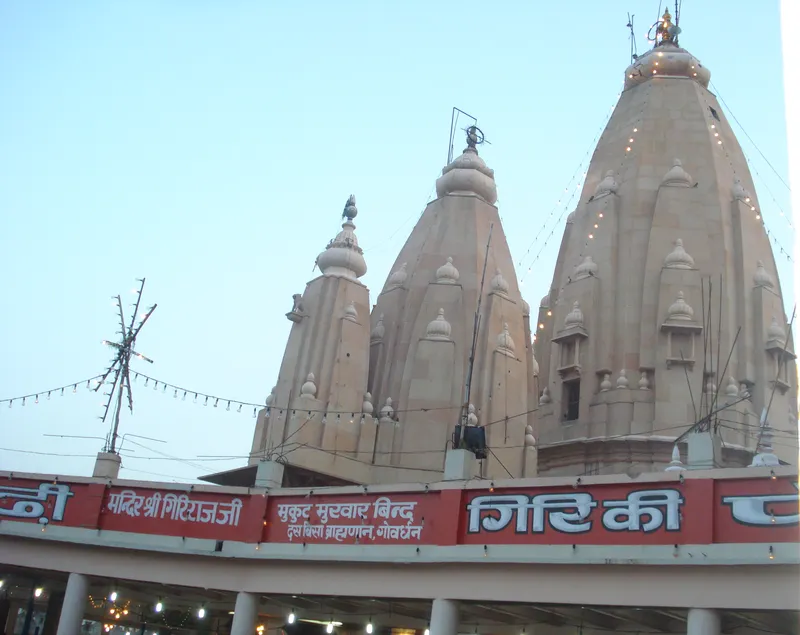
- What it is
- The Mukhāravinda-śilā is a stone of Govardhana in the Mukhāravinda temple on Mānasī-gaṅgā, worshipped as the hill's mukhāravinda, its lotus mouth.
- Visiting
- Govardhana Hill (2001) says that pilgrims feed the śilā milk and sweets and that gallons of milk are poured over it daily.
In short
The Mukhāravinda-śilā is a stone of Govardhana in the Mukhāravinda temple on Mānasī-gaṅgā, worshipped as the hill's mukhāravinda, its lotus mouth. According to the guidebooks, pilgrims feed it milk and sweets, and milk is poured over it every day.[1 +2] According to the local tradition recorded in two guidebooks, Śrīla Bhaktisiddhānta Sarasvatī Ṭhākura confirmed this śilā as the real Mukhāravinda, which is not certain, while the Vallabha sampradāya accepts another Mukhāravinda-śilā at Jatīpurā.[1 +2] No scripture names this stone, and the Bhāgavatam speaks of no mouth of the hill.[5 +4]
Key facts
| Kind | śilā |
|---|---|
| Region · area | Govardhana · Mukhāravinda Mandira |
| Ācāryas | Śrīla Bhaktisiddhānta Sarasvatī Ṭhākura |
Why it is glorified
In the Garga-saṁhitā's description of Govardhana as a body, the hill's mouth is below Śṛṅgāra-maṇḍala, the place where Kṛṣṇa and …
In the Garga-saṁhitā's description of Govardhana as a body, the hill's mouth is below Śṛṅgāra-maṇḍala, the place where Kṛṣṇa and the people of Vraja made the Annakūṭa, the hill of food offered to Govardhana. Mānasī-gaṅgā is the hill's eyes, Rādhā-kuṇḍa its tongue and Śyāma-kuṇḍa its chin. The text names no śilā and does not put the mouth at Mānasī-gaṅgā, and no source connects the verse with this stone.[7 +2]
Divine pastimes
Śrīmad-Bhāgavatam tells that at the first Govardhana-pūjā, the worship of the hill, Kṛṣṇa took another, huge form, declared that He was the hill and ate the offerings; with the people of Vraja He then bowed down to that form. It speaks of no mouth of the hill and of no śilā.[5 +1]
kṛṣṇas tv anyatamaṃ rūpaṃ gopa-viśrambhaṇaṃ gataḥ / śailo 'smīti bruvan bhūri balim ādad bṛhad-vapuḥ
tasmai namo vraja-janaiḥ saha cakra ātmanātmane / aho paśyata śailo 'sau rūpī no 'nugrahaṃ vyadhāt
Kṛṣṇa then assumed an unprecedented, huge form to instill faith in the cowherd men. Declaring “I am Govardhana Mountain!” He ate the abundant offerings. … Together with the people of Vraja, the Lord bowed down to this form of Govardhana Hill, thus in effect offering obeisances to Himself. Then He said, “Just see how this hill has appeared in person and bestowed mercy upon us!
Translation: Śrīla Prabhupāda's disciples (BBT)The commentators place that form on the top of the hill (summarised here, not translated): Śrīla Sanātana Gosvāmī and Śrīla Jīva Gosvāmī, who quote the Harivaṁśa, and Śrīla Viśvanātha Cakravartī Ṭhākura, who describes it above Govardhana like a second hill, taking with countless arms the offerings of the people near and far. None of them mentions the hill's mouth, a śilā or Mānasī-gaṅgā.[10] Read more: The first Govardhana-pūjā and the Annakūṭa →
Traditional accounts
Other works picture the hill's body differently.
Other works picture the hill's body differently. Śrīla Viśvanātha Cakravartī Ṭhākura's Vraja-rīti-cintāmaṇi puts a Saṅkarṣaṇa-kuṇḍa, for which it names no village, and Dāna-nivartana-kuṇḍa in the middle of the hill's chest, in a verse that also speaks of the great Annakūṭa festival; it asks whether the lotus lake Kusumākara (Kusuma-sarovara), where Nārada became a gopī, is its face, and calls Rādhā-kuṇḍa and Kṛṣṇa's kuṇḍa its eyes and Mānasī-gaṅgā its neck.[11 +2] Śrīla Kṛṣṇadāsa Kavirāja Gosvāmī's Govinda-līlāmṛta also makes the two kuṇḍas the hill's eyes. One guidebook says that this work pictures the hill as a peacock, but it does not, and it does not speak of the hill's mouth.[14] Read more: The body of Govardhana: mouth, eyes, neck and the peacock →
The guidebooks draw the hill's form in yet other ways, as a sitting cow or as a peacock.
Accounts differ Govardhana's form and which places are its eyes and mouth
- Garga-saṁhitā 3.8.4-6no animal form; mouth below Śṛṅgāra-maṇḍala; eyes Mānasī-gaṅgā; tongue Rādhā-kuṇḍa; chin Kṛṣṇa-kuṇḍa
- Śrī Vraja-maṇḍala Parikramā (2007)the form of a sitting cow: hind part Pūñcharī, the face turned to the stomach (Govardhana town), eyes Rādhā-kuṇḍa and Śyāma-kuṇḍa
- the undated parikramā notes Govardhana, citing the Govinda-līlāmṛta of Śrīla Kṛṣṇadāsa Kavirājathe shape of a peacock: eyes Rādhā-kuṇḍa and Śyāma-kuṇḍa, Dān Ghāṭī the neck, Mukhāravinda the mouth, Puñcharī the back and tail
- Śrīla Kṛṣṇadāsa Kavirāja Gosvāmī, Govinda-līlāmṛta 7.109 (the work the undated parikramā notes Govardhana cites)seeing the pair of lakes at the bowed head of the hill, Kṛṣṇa took them for its two eyes; no peacock form and no mouth are mentioned
The Gosvāmīs and ācāryas
According to the local tradition recorded in two guidebooks, Govardhana Hill (2001) and the undated parikramā notes Govardhana …
According to the local tradition recorded in two guidebooks, Govardhana Hill (2001) and the undated parikramā notes Govardhana, Śrīla Bhaktisiddhānta Sarasvatī Ṭhākura confirmed this śilā as the real Mukhāravinda; no writing of his with this statement has been found, so it is not certain. Govardhana Hill adds that local people point to other śilās as the Mukhāravinda, and that the Vallabha sampradāya accepts another Mukhāravinda at Jatīpurā.[1 +2]
Śrīla Prabhupāda
Śrīla Prabhupāda does not speak of this śilā by name.
Śrīla Prabhupāda does not speak of this śilā by name. In the Kṛṣṇa book he explains why Kṛṣṇa declared that He was Govardhana Hill (a general teaching):[6]
General teaching (does not name the place)“When everything was complete, Kṛṣṇa assumed a great transcendental form and declared to the inhabitants of Vṛndāvana that He was Himself Govardhana Hill in order to convince the devotees that Govardhana Hill and Kṛṣṇa Himself are identical.”
Śrīla Prabhupāda, Kṛṣṇa, the Supreme Personality of Godhead (Kṛṣṇa book), Chapter 24, Worshiping Govardhana Hill · vedabase.io
Visiting today
Govardhana Hill (2001) says that pilgrims feed the śilā milk and sweets and that gallons of milk are poured over it daily. Śrī Vraja-maṇḍala Parikramā (2007) says that it receives a daily abhiṣeka (ceremonial bath), worship and offerings of food, with festivals at Annakūṭa and Dīpāvalī. The undated parikramā notes Govardhana describe it as set in the ground.[1 +2]
Location
| Where it is | In the Mukharavinda temple on Mānasī-gaṅgā[15] |
|---|
Nearby places
Mukut-śilā (Mukhāravinda Mandira)
Where the sources differ
Accounts differ Where Govardhana's mouth (mukhāravinda) is
- Garga-saṁhitā, Girirāja-khaṇḍa 3.8.4-5the mouth is below Śṛṅgāra-maṇḍala, where the Annakūṭa was made; Mānasī-gaṅgā is the eyes
- Govardhana Hill: India's Most Sacred Mountain (2001) and the undated parikramā notes Govardhana, reporting Śrīla Bhaktisiddhānta Sarasvatīthe śilā in the Mukhāravinda temple on Mānasī-gaṅgā is the real Mukhāravinda, accepted by the Gauḍīya Vaiṣṇavas
- Govardhana Hill: India's Most Sacred Mountain (2001), reporting the Vallabha sampradāyaanother Mukhāravinda-śilā, at Jatīpurā beside Viṭṭhalanātha's samādhi, is the one they accept
- Govardhana Hill: India's Most Sacred Mountain (2001), reporting local people'a number of other śilās that the local people claim to be the Mukharvinda'
Accounts differ Where the Annakūṭa of ŚB 10.24 took place and where Govardhana's face is
- Śrīmad-Bhāgavatam 10.24.35–36Kṛṣṇa, in a huge form, declares 'I am the hill' and eats the offerings; no spot on the hill is named
- Śrīla Sanātana Gosvāmī and Śrīla Jīva Gosvāmī (quoting the Harivaṁśa) and Śrīla Viśvanātha Cakravartī on ŚB 10.24.35that form appeared on the top of the hill (Viśvanātha: above it, like a second hill)
- Garga-saṁhitā 3.8.4Govardhana's mouth is below Śṛṅgāra-maṇḍala, where the Annakūṭa was made
- Śrīla Viśvanātha Cakravartī, Vraja-rīti-cintāmaṇi 3.20the great Annakūṭa festival, in a verse on Saṅkarṣaṇa- and Dāna-nivartana-kuṇḍa in the middle of the hill's chest
More on this place
The body of Govardhana: mouth, eyes, neck and the peacock · The first Govardhana-pūjā and the Annakūṭa
References
15 references
- Govardhana Hill: India's Most Sacred Mountain (2001), Rajasekhara dasa Brahmacari, PDF p. 80
- Śrī Vraja-maṇḍala Parikramā (2007), PDF p. 121
- the undated parikramā notes Govardhana, ¶59
- Govardhana Hill: India's Most Sacred Mountain (2001), Rajasekhara dasa Brahmacari, PDF p. 142
- Śrīmad-Bhāgavatam 10.24.35–36, GRETIL
- Śrīla Prabhupāda, Kṛṣṇa, the Supreme Personality of Godhead (Kṛṣṇa book), Chapter 24, Worshiping Govardhana Hill · vedabase.io
- Garga-saṁhitā, Girirāja-khaṇḍa (3), adhyāya 8, verse 4, Sanskrit Wikisource
- Garga-saṁhitā, Girirāja-khaṇḍa (3), adhyāya 8, verse 5, Sanskrit Wikisource
- Garga-saṁhitā, Girirāja-khaṇḍa (3), adhyāya 8, verse 6, Sanskrit Wikisource
- Śrīla Sanātana Gosvāmī, Śrīla Jīva Gosvāmī: commentary on ŚB 10.24.35, Bhagavata Vidya Pith edition, ed. Bhagavata Rishi and Krishna Shankar Shastri, 1996
- Śrīla Viśvanātha Cakravartī Ṭhākura, Vraja-rīti-cintāmaṇi 3.20
- Śrīla Viśvanātha Cakravartī Ṭhākura, Vraja-rīti-cintāmaṇi, third sarga, verses 26, 27 and 29
- Śrīla Viśvanātha Cakravartī Ṭhākura, Vraja-rīti-cintāmaṇi, third sarga, verses 23–24
- Śrīla Kṛṣṇadāsa Kavirāja Gosvāmī, Govinda-līlāmṛta 7.109, after the editions of Haridas Das and Haridas Shastri
- Govardhana Hill: India's Most Sacred Mountain (2001), Rajasekhara dasa Brahmacari, p. 66