Nanda-bhavana (Nandagrāma)
नन्द-भवन (नन्दग्राम) Hindi name proposed
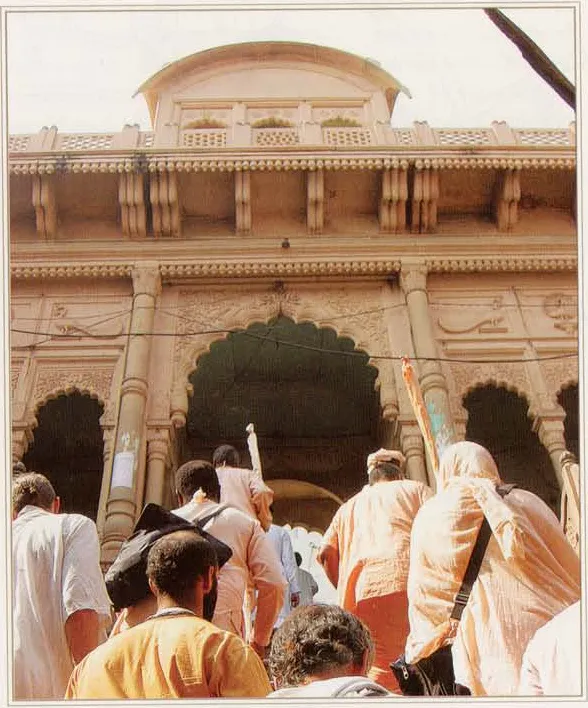
- What it is
- Nanda-bhavana is the home of Nanda Mahārāja, Kṛṣṇa's father, at Nandīśvara Hill in Nandagrāma.
- Places here
- Nanda-bhavan Mandira (Nandagrāma), Nandīśvara Mahādeva, Kitchen (Nanda-bhavana, Nandagrāma), Nārāyaṇa Mandira (Nanda-bhavana, Nandagrāma), Secluded garden with a lake (Nanda-bhavana, Nandagrāma) +6 more
In short
Nanda-bhavana is the home of Nanda Mahārāja, Kṛṣṇa's father, at Nandīśvara Hill in Nandagrāma. The Padma Purāṇa places Nanda's abode in the forest of Nandīśvara, and Śrīla Prabhupāda writes that Nandīśvara is the house of Mahārāja Nanda.[1 +3] Śrīla Rūpa Gosvāmī, Śrīla Raghunātha dāsa Gosvāmī and the later ācāryas call the hill Kṛṣṇa's home and describe the palace and the pastimes of each day in it.[5 +11] Śrīmad-Bhāgavatam does not name the place, but its commentators set Akrūra's and Uddhava's visits to Nanda's house here.[17 +5] The sources differ on when Nanda's family came to live here.
Key facts
| Kind | pastime site |
|---|---|
| Region · area | Nandagrāma |
| Also part of | Nandīśvara Hill |
| Ācāryas | Śrī Caitanya Mahāprabhu, Śrīla Rūpa Gosvāmī, Śrīla Raghunātha dāsa Gosvāmī, Śrīla Sanātana Gosvāmī, Śrīla Jīva Gosvāmī |
Why it is glorified
The Padma Purāṇa describes Vraja as a lotus of sixteen petals and places the forest of Nandīśvara, with Nanda's abode, in its …
The Padma Purāṇa describes Vraja as a lotus of sixteen petals and places the forest of Nandīśvara, with Nanda's abode, in its fourth petal. It is the only Purāṇa verse found so far that places Nanda's home at Nandīśvara.[1]
चतुर्थं दलमाख्यातं महाद्भुतरसस्थलम् ॥ 41 ॥ नंदीश्वरवनं रम्यं तत्र नंदालयः स्मृतः ।
caturthaṁ dalamākhyātaṁ mahādbhutarasasthalam
41
naṁdīśvaravanaṁ ramyaṁ tatra naṁdālayaḥ smṛtaḥ |
The Gosvāmīs name the hill as Kṛṣṇa's home. Śrīla Rūpa Gosvāmī writes that the hill named Nandīśvara is His home, and a verse that Śrīla Jīva Gosvāmī gives in his Gopāla-campū as the prayer of the people of Vraja says to Kṛṣṇa: Nandīśvara is Your home, Vṛndāvana Your garden. Śrīla Baladeva Vidyābhūṣaṇa calls the hill the capital of the king of Vraja (all summarised here, not translated).[4 +10] Śrīla Raghunātha dāsa Gosvāmī worships Nandīśvara as the abode of the lord of Vraja, where the goddess of fortune moves everywhere, the cows are born in plenty and Kṛṣṇa, lovingly protected by His parents, plays happily.[5 +7]
yatra śrīḥ parito bhramaty avirataṁ tās tā mahā-siddhayaḥ sphītāḥ sṛṣṭir alaṁ gavām udayanī vāso’pi goṣṭhaukasām
vātsalyāt paripālito viharate kṛṣṇaḥ pitṛbhyāṁ sukhai- stan nandīśvaram ālayaṁ vraja-pater goṣṭhottamāṅgaṁ bhaje ||8||
Śrīla Raghupati Upādhyāya recited a verse before Śrī Caitanya Mahāprabhu that Śrīla Rūpa Gosvāmī later placed in his Padyāvalī under the heading "obeisance to Śrī Nanda": let others worship the Vedas, he says, but I worship Nanda, in whose courtyard the Supreme Brahman is playing. The verse names no place.[23 +5]
śrutim apare smṛtim itare bhāratam anye bhajantu bhava-bhītāḥ aham iha nandaṃ vande yasyālinde paraṃ brahma
Raghupati Upādhyāya recited, “Those who are afraid of material existence worship the Vedic literature. Some worship smṛti, the corollaries to the Vedic literature, and others worship the Mahābhārata. As far as I am concerned, I worship Kṛṣṇa’s father, Mahārāja Nanda, in whose courtyard the Supreme Personality of Godhead, the Absolute Truth, is playing.”
Translation: Śrīla A.C. Bhaktivedanta Swami PrabhupādaDivine pastimes
When Nanda's family came here
Śrīmad-Bhāgavatam (10.11) tells how Nanda's people left Bṛhadvana, in Mahāvana, because of the demons, entered Vṛndāvana and made a camp with their carts in a half-moon. It names neither Nandīśvara nor Nandagrāma.[17 +5]
vṛndāvanaṃ sampraviśya sarva-kāla-sukhāvaham / tatra cakrur vrajāvāsaṃ śakaṭair ardha-candravat
In this way they entered Vṛndāvana, where it is always pleasing to live in all seasons. They made a temporary place to inhabit by placing their bullock carts around them in the shape of a half moon.
Translation: Śrīla A.C. Bhaktivedanta Swami PrabhupādaThe commentators place Nanda's main house at Nandīśvara, but not all at the same time. Śrīla Sanātana Gosvāmī says that King Nanda's main residence was mostly beside Nandīśvara Hill; Śrīla Jīva Gosvāmī, that it came into being at a later time; Śrīla Baladeva Vidyābhūṣaṇa, that the family lived at Nandīśvara after the demon Keśī had fled (all summarised here, not translated).[8 +9] In Śrīla Kavi-karṇapūra's Ānanda-vṛndāvana-campū the capital at Nandīśvara becomes manifest after the camp of carts.[33] Śrīla Prabhupāda writes that after some days in Gokula Kṛṣṇa moved with His family to Nanda-grāma (see his words below).[34] The accounts of when the family came to Nandīśvara are set side by side on the page of Nandīśvara Hill.[17 +5] Read more: Nanda's family at Nandagrāma →
Akrūra at Nanda's house
Śrīmad-Bhāgavatam (10.38) tells that Akrūra, sent by Kaṁsa, reached Gokula as the sun was setting and saw Kṛṣṇa and Balarāma going to milk the cows. Balarāma took him to Their house, where he was fed and Nanda questioned him. The Bhāgavatam does not name Nandīśvara or Nandagrāma.[20 +3]
saṅkarṣaṇaś ca praṇatam upaguhya mahā-manāḥ
gṛhītvā pāṇinā pāṇī anayat sānujo gṛham ||
As Akrūra stood with his head bowed, Lord Saṅkarṣaṇa [Balarāma] grasped his joined hands, and then Balarāma took him to His house in the company of Lord Kṛṣṇa.
Translation: Śrīla Prabhupāda's disciples (BBT)Śrīla Sanātana Gosvāmī names the house: "Śrī Nanda's house called Nandīśvara", well known at the edge of Vraja, thirteen krośas north-west of Mathurā. He adds that Akrūra's chariot could have reached it by midday, but that he came only in the evening, waiting for an auspicious moment (summarised here, not translated).[17 +6] Śrīla Viśvanātha Cakravartī Ṭhākura counts the days: Kaṁsa held his council on the Ekādaśī, and the meal Akrūra took in Kṛṣṇa's house broke his Dvādaśī fast, two days before Kaṁsa was killed on the Caturdaśī.[9 +9] Śrīla Prabhupāda writes that Akrūra saw the Lord's footprints in the dust of Nanda-grāma and fell on them in ecstasy.[47] Read more: Akrūra in Vraja: his arrival at Nandagrāma and Kṛṣṇa's departure →
Uddhava's night with Nanda
The Bhāgavatam (10.46) tells that Uddhava, sent by Kṛṣṇa from Mathurā, arrived at Nanda's home at sunset. Nanda embraced him, and the two talked of Kṛṣṇa through the night while Yaśodā listened in tears; at dawn the women of Vraja lit their lamps and churned the yoghurt. It does not name Nandagrāma, but Vaṁśīdhara explains Uddhava's destination as Nandagrāma.[17 +9]
tam āgataṁ samāgamya kṛṣṇasyānucaraṁ priyam
nandaḥ prītaḥ pariṣvajya vāsudeva-dhiyārcayat ||
As soon as Uddhava arrived at Nanda Mahārāja’s home, Nanda came forward to meet him. The cowherd King embraced him in great happiness and worshiped him as nondifferent from Lord Vāsudeva.
Translation: Śrīla Prabhupāda's disciples (BBT)According to the guidebook Śrī Vraja-maṇḍala Parikramā (2007), Uddhava spent the whole night consoling Nanda and Yaśodā at Nanda-bhavana and went before dawn to Kṛṣṇa-kuṇḍa to bathe and recite his morning mantras.[49 +2] Read more: Uddhava brings Kṛṣṇa's message to the gopīs →
"His father's houses"
In her message to the bee, Śrī Rādhā asks Uddhava whether Kṛṣṇa, now in Mathurā, remembers "His father's houses". Śrīla Sanātana Gosvāmī and Śrīla Jīva Gosvāmī explain the plural by the many divine palaces on Nandīśvara, though they also allow other readings (summarised here, not translated).[32 +1]
api bata madhu-puryām ārya-putro’dhunāste smarati sa pitṛ-gehān saumya bandhūṁś ca gopān
kvacid api sa kathāṁ naḥ kiṅkarīṇāṁ gṛṇīte bhujam aguru-sugandhaṁ mūrdhny adhāsyat kadā nu ||
O Uddhava! It is indeed regrettable that Kṛṣṇa resides in Mathurā. Does He remember His father’s household affairs and His friends, the cowherd boys? O great soul! Does He ever talk about us, His maidservants? When will He lay on our heads His aguru-scented hand?
Translation: Śrīla Prabhupāda's disciples (BBT)A day in Nanda's house
The Gosvāmīs describe the pastimes of each day in the palace. At daybreak Paurṇamāsī hurries to the house of the king of Vraja to see Kṛṣṇa, and finds the courtyard strewn with drops thrown up by the churning rods.[2 +6] Every morning Yaśodā calls Śrī Rādhā, who comes with Her friends and cooks for Kṛṣṇa with Rohiṇī in the kitchen; after the meal Kṛṣṇa rests on beds "a hundred steps" away.[11 +5] Śrīla Raghunātha dāsa Gosvāmī adds that Nanda daily satisfies crowds of brāhmaṇas with food and gifts of cows for his son's welfare.[6 +3]
Śrīla Viśvanātha Cakravartī Ṭhākura gives the plan of the palace: in the main quadrangle the treasury in the west, Kṛṣṇa's rooms in the south and Balarāma's in the north, and in the east a shrine where Nanda serves his chosen deity, Nārāyaṇa, for his son's welfare. The kitchen lies south of the treasury and west of Kṛṣṇa's rooms.[9 +6] South of Kṛṣṇa's rooms and the kitchen he places a secluded garden with a lake, charming, with many houses and platforms, and in the Kṛṣṇa-bhāvanāmṛta gardens line the lakes of the inner apartments on every side. No pastime is told in that garden, and no source identifies it with a place shown today.[45 +2] Read more: The morning in Nanda's house at Nandīśvara →
Traditional accounts
In the Fifth Wave of the Bhakti-ratnākara, Śrīla Rāghava Paṇḍita shows Śrīla Śrīnivāsa Ācārya and Śrīla Narottama dāsa Ṭhākura …
The round of the Bhakti-ratnākara
In the Fifth Wave of the Bhakti-ratnākara, Śrīla Rāghava Paṇḍita shows Śrīla Śrīnivāsa Ācārya and Śrīla Narottama dāsa Ṭhākura "Nandīśvara, Nanda's abode", where Rāma and Kṛṣṇa play in a hidden form.[61 +5]
দেখ শ্রীনিবাস নন্দীশ্বর নন্দালয়। এথা গূঢ়রূপে রামকৃষ্ণ বিলসয়॥
dekha śrīnibāsa nandīśbara nandālaẏa| ethā gūṛharūpe rāmakṛṣṇa bilasaẏa||
He then shows the boundary of Nanda's residence, with a garden to the east of Nanda's house on the path by which Śrī Rādhikā comes with Her friends from Yāvaṭa.[62] In turn he points out the kitchen where Rādhā cooks with Rohiṇī, the place where Kṛṣṇa eats with His friends and the bedroom a hundred steps away, the garden where Rādhikā rests, the place where Yaśodā dresses Rāma and Kṛṣṇa and sends Them to the forest, the path to the pastures, the place of churning and the path of Paurṇamāsī.[61 +5]
The path to the forest
The path to the forest is the place within Nanda's house where Yaśodā dressed Rāma and Kṛṣṇa and sent Them to the forest. The Bhakti-ratnākara shows it on Śrīla Rāghava Paṇḍita's round, after the kitchen and the garden where Rādhikā rests: here, it says, Yaśodā dresses the two brothers and feels her heart break as she bids Them farewell. The guidebook Śrī Vraja-maṇḍala Parikramā (2007) calls it "the path to the forest", where she decorated Them daily and sent Them off with Their friends with a heavy heart; its map does not mark the spot.[61 +6]
এথা শ্রীযশোদা রামকৃষ্ণ সাজাইয়া। বিপিনে বিদায় দিতে বিদরয়ে হিয়া॥ সখাগণ মধ্যে রামকৃষ্ণ এই পথে। চলে গোচারণে শোভা উপমা কি দিতে॥
ethā śrīyaśodā rāmakṛṣṇa sājāiẏā| bipine bidāẏa dite bidaraẏe hiẏā|| sakhāgaṇa madhye rāmakṛṣṇa ei pathe| cale gocāraṇe śobhā upamā ki dite||
Śrīmad-Bhāgavatam tells when the daily going out began: at the paugaṇḍa age, between six and ten, the cowherd men let Rāma and Kṛṣṇa tend the cows, and the two boys went into Vṛndāvana with Their friends, marking the land with Their footprints. It names no place or path in Nanda's house.[70 +4]
Śukadeva Gosvāmī said: When Lord Rāma and Lord Kṛṣṇa attained the age of paugaṇḍa [six to ten] while living in Vṛndāvana, the cowherd men allowed Them to take up the task of tending the cows. Engaging thus in the company of Their friends, the two boys rendered the land of Vṛndāvana most auspicious by imprinting upon it the marks of Their lotus feet.
Translation: Śrīla Prabhupāda's disciples (BBT)General teaching (does not name the place)“At that time, all the cowherd men conferred and agreed to give those boys who had passed their fifth year charge of the cows in the pasturing ground. Given charge of the cows, Kṛṣṇa and Balarāma traversed Vṛndāvana, purifying the land with Their lotus footprints.”
Śrīla Prabhupāda, Kṛṣṇa, the Supreme Personality of Godhead, ch. 15 'Killing of Dhenukāsura' · vedabase.io
In Śrīla Kṛṣṇadāsa Kavirāja Gosvāmī's Govinda-līlāmṛta, servants dress Kṛṣṇa, He leaves the house for the forest with His friends, and His parents follow Him with the people of Vraja to the edge of the forest, their eyes full of tears (summarised here, not translated).[75 +1] The Bengali Bhaktamāla of Kṛṣṇadāsa Bābājī (1905) tells that His mother, pained by affection, dresses Him before He goes with the cows and His friends to the pasture.[65 +1]
The path to go cow grazing
The path to go cow grazing is the place within Nanda's house by which Rāma and Kṛṣṇa went out with Their friends to graze the cows. The Bhakti-ratnākara shows it next on the round, before the place where Yaśodā bids Rādhā farewell: "by this path", it says, the two brothers go among Their friends to the pasture, and the poet asks what comparison could be given for Their beauty on this path. The guidebook Śrī Vraja-maṇḍala Parikramā (2007) calls it "the path to go cow grazing" and speaks of Rāma and Kṛṣṇa as "the best of dancers"; its map does not mark the spot.[61 +6]
The guidebook's words about the best of dancers follow a verse of the gopīs' song of the flute, which describes Kṛṣṇa and Balarāma among the cowherd boys. The Bhāgavatam does not name a path at Nanda's house.[70 +4]
Dressed in a charming variety of garments, upon which Their garlands rest, and decorating Themselves with peacock feathers, lotuses, lilies, newly grown mango sprouts and clusters of flower buds, Kṛṣṇa and Balarāma shine forth magnificently among the assembly of cowherd boys. They look just like the best of dancers appearing on a dramatic stage, and sometimes They sing.
Translation: Śrīla Prabhupāda's disciples (BBT)General teaching (does not name the place)“Another gopī expressed her opinion that Kṛṣṇa and Balarāma, while tending the cows with the cowherd boys, appeared just like actors going to play on a dramatic stage.”
Śrīla Prabhupāda, Kṛṣṇa, the Supreme Personality of Godhead, ch. 21 'The Gopīs Attracted by the Flute' · vedabase.io
In the Govinda-līlāmṛta Kṛṣṇa leaves the house for the forest surrounded by friends who carry flutes, horns and sticks, and the Bengali Bhaktamāla tells that He goes out to graze the cows when ten daṇḍas of the day have passed (summarised here, not translated).[65 +3]
The farewell
Among these places is the place where Yaśodā bids Rādhā farewell. According to the Bhakti-ratnākara, here Yaśodā takes Rādhā on her lap and, floating in tears, sends Her back to Yāvaṭa, and after the farewell neither Yaśodā nor Rohiṇī can become calm. The guidebook Śrī Vraja-maṇḍala Parikramā tells the same at this place.[66 +1]
এই খানে যশোদা রাধায় করি কোলে। যাবটে বিদায় দিতে ভাসে নেত্রজলে॥ ললিতাদি সখীগণ প্রতি স্নেহ যত। এক মুখে তাহা কহিবেক কেবা কত॥ যশোদা রোহিণী সখী সহ রাধিকারে। করিয়া বিদায় স্থির হইবারে নারে॥
ei khāne yaśodā rādhāẏa kari kole| yābaṭe bidāẏa dite bhāse netrajale|| lalitādi sakhīgaṇa prati sneha yata| eka mukhe tāhā kahibeka kebā kata|| yaśodā rohiṇī sakhī saha rādhikāre| kariẏā bidāẏa sthira haibāre nāre||
According to the Bengali Bhaktamāla of Kṛṣṇadāsa Bābājī (1905), after Her meal Mother Yaśodā lovingly dresses Rādhā in jewelled ornaments and clothes and sends Her home with Kundalatā. That book places the lap and the tears at Her arrival, not at the farewell.[66 +1]
Other accounts
The same Bhaktamāla praises Nandīśvara as the hill of eternal bliss where Nanda and Yaśodā are always at play with the cows, the cowherds and the gopīs, and ends: therefore at Nandīśvara the pastime is eternal.[80 +1] Śrīla Nārāyaṇa Bhaṭṭa Gosvāmī's Vraja-bhakti-vilāsa lists inside the village the place where Yaśodā churned yoghurt, and says that two vessels for yoghurt and butter, a small one and a large one, shine near Nanda's house.[82 +1]
Śrī Vraja-maṇḍala Parikramā describes Nanda's residence as large, with separate bedrooms for Nanda, Yaśodā, Rohiṇī, Kṛṣṇa and Baladeva, a kitchen, a storeroom, a dining hall and resting rooms for Rādhikā and Kṛṣṇa, in a compound that holds many places of pastimes.[31 +3]
Śrīla Prabhupāda
Explaining Śrī Caitanya Mahāprabhu's visit to Nandīśvara in the Caitanya-caritāmṛta, Śrīla Prabhupāda writes …
Explaining Śrī Caitanya Mahāprabhu's visit to Nandīśvara in the Caitanya-caritāmṛta, Śrīla Prabhupāda writes:[2 +2]
Names this place“Nandīśvara is the house of Mahārāja Nanda.”
Śrīla Prabhupāda, Śrī Caitanya-caritāmṛta, Madhya-līlā 18.57, purport · vedabase.io
On 28 November 1971 he came with his disciples to the temple at Nandagrāma and said there that Nanda Mahārāja had left Gokula and come here because the demons were disturbing Kṛṣṇa.[2 +1] In his purport to the opening of the Tenth Canto he gives the same journey:[34]
Names this place“Just after His birth in the house of Vasudeva in Mathurā, Kṛṣṇa transferred Himself to Gokula, on the other side of the Yamunā, and after some days He moved with His father, mother and other relatives to Nanda-grāma, Vṛndāvana.”
Śrīla Prabhupāda, Śrīmad-Bhāgavatam, Canto 10, chapter 1, verse 9, purport · vedabase.io
Location
| Where it is | to the south, adjacent to Nandīśvara Hill (staircase ruins)[86] 'built on top of Nandisvara Hill to protect Krsna from Kamsa's demons'[87] |
|---|
Places at Nanda-bhavana (Nandagrāma)
11 places
- ↳Nanda-bhavan Mandira (Nandagrāma)temple›
- ↳Nandīśvara Mahādevashrine›
- ↳Kitchen (Nanda-bhavana, Nandagrāma)pastime site›
- ↳Nārāyaṇa Mandira (Nanda-bhavana, Nandagrāma)temple›
- ↳Secluded garden with a lake (Nanda-bhavana, Nandagrāma)garden›
- ↳Rādhā-bāga (Nandagrāma)garden›
- ↳Path to the forest (Nandagrāma)street/lane›
- ↳Path to go cow grazing (Nandagrāma)street/lane›
- ↳Place where Rādhikā was bidden farewell (Nandagrāma)pastime site›
- ↳Place where yoghurt was churned (Nandagrāma)pastime site›
- ↳Pūrṇamāsī's arrival path (Nandagrāma)street/lane›
Nearby places
Nandīśvara Hill
History
In 1883 Growse's British district memoir recorded a flight of 114 broad steps of Bharatpur stone, built in 1818 at the cost of Bābū Gaur Prasād of Calcutta, leading from the plain up to the temple on the hill. Śrī Vraja-maṇḍala Parikramā (2007) mentions a few ruins of the staircase of Nanda-bhavana to the south, beside the hill; no source says whether they are the same.[31 +1] The temple of Nanda-rāya that now stands on the summit has its own page.
Where the sources differ
Whether pastimes of baby Kṛṣṇa can be set at Nanda-bhavana in Nandagrāma.
Accounts differ Whether pastimes of baby Kṛṣṇa can be set at Nanda-bhavana in Nandagrāma.
- Śrī Vraja-maṇḍala Parikramā (2007)Opens the compound with the verse on the Supreme crawling in Nanda's courtyard; Pūrṇamāsī came along her path 'to have darśana of baby Kṛṣṇa'; Śiva was called to Nanda-bhavana to pacify the crying baby; Pūrṇamāsī came to Nandagrāma before Kṛṣṇa's birth.
- Śrī Vraja-maṇḍala Parikramā (2007), its own historyKṛṣṇa was born in Gokula-Mahāvana, and the family settled at Nandīśvara only after several moves.
- Śrīmad-Bhāgavatam 10.8.21 and the order of chapters 8–11Kṛṣṇa and Balarāma crawled 'in Gokula'; the move to Vṛndāvana comes only in chapter 11.
- Śrīla Baladeva Vidyābhūṣaṇa on ŚB 10.11.35The crawling on the knees and the other infant pastimes belong to Bṛhadvana, before the coming to Vṛndāvana.
Accounts differ The lunar dates of Akrūra's visit to Nanda's house and of the departure for Mathurā.
- Śrīla Viśvanātha Cakravartī on ŚB 10.38.1–2Kaṁsa held council on the Ekādaśī of the dark fortnight of Phālguna; next morning Keśī was killed and Akrūra set out; in the evening Akrūra entered Vraja.
- Śrīla Viśvanātha Cakravartī on ŚB 10.38.39 (Śrīla Jīva Gosvāmī on 10.38.40 agrees)Akrūra's meal in Kṛṣṇa's house broke the Dvādaśī fast; Kaṁsa was killed on the Caturdaśī, the day after next.
- Śrīla Viśvanātha Cakravartī on ŚB 10.45.3, Grantha Mandira textThe departure for Mathurā was on the dark Trayodaśī of Caitra and Kaṁsa was killed on the Caturdaśī; the text has no clause for a Vṛndāvana period.
- ŚB 10.45.3 purport (BBT, by Śrīla Prabhupāda's disciples), rendering ViśvanāthaAt ten years and seven months, 'on the eleventh lunar day of the dark fortnight of the month of Caitra', He went to Mathurā; the paugaṇḍa period was spent in Vṛndāvana.
Accounts differ Whether Nanda's palace stood on top of Nandīśvara hill.
- the undated parikramā notes NandagrāmaNanda's original palace was built on top of Nandīśvara Hill, to protect Kṛṣṇa from Kaṁsa's demons.
- Vraja-bhakti-vilāsa 2.44The temple of Nanda-rāya stands on top of Rudra-parvata (a temple, not the palace).
- Śrīla Viśvanātha Cakravartī, Vraja-rīti-cintāmaṇi 1.16, 1.23People live on the east, north and south of Nandīśvara; on the ridge (sānu) in front stands King Nanda's city; behind it shines Nandīśvara.
- Kṛṣṇa-bhāvanāmṛta, commentary on 6.115–116Nandīśvara hill lies behind (west of) the compound of the king of Vraja.
Accounts differ When the present temple on the site of Nanda's palace was built.
- the undated parikramā notes NandagrāmaThe three-domed Kṛṣṇa-Balarāma temple was built in the nineteenth century on the site of Nanda Mahārāja's palace.
- F. S. Growse, Mathurá (1883), a historianGrowse thought the temple of Nanda-rāya dated only from the middle of the eighteenth century; its founder is said to have been Rūp Singh, a Sinsinwār Jāṭ; it has two towers.
- Entwistle (1987), printed p. 379Repeats Growse: built in the mid-eighteenth century by Rup Singh; records two traditions about the images (found in a cave by Śrīla Sanātana Gosvāmī; installed by Ānandghan, ancestor of the temple's Gosvāmīs).
More on this place
The morning in Nanda's house at Nandīśvara · Nanda's family at Nandagrāma · Akrūra in Vraja: his arrival at Nandagrāma and Kṛṣṇa's departure · Uddhava brings Kṛṣṇa's message to the gopīs
References
87 references
- Padma Purāṇa, Pātāla-khaṇḍa (5) 69.41–42, Sanskrit Wikisource
- Śrīla Prabhupāda, Śrī Caitanya-caritāmṛta, Madhya-līlā 18.57, purport · vedabase.io
- Śrīla Prabhupāda, Śrī Caitanya-caritāmṛta, Madhya-līlā 18.58, purport · vedabase.io
- Rūpa Gosvāmī, Mathurā-māhātmya v.433 (after v.432 headed "atha nāndīśvarasya")
- Śrīla Rūpa Gosvāmī, Rādhā-Kṛṣṇa-gaṇoddeśa-dīpikā, part 2, vv.116–117 (sthāna-vivaraṇa)
- Śrīla Raghunātha dāsa Gosvāmī, Vraja-vilāsa-stava, Stavāvalī (9) Vraja-vilāsa-stava 8
- Śrīla Raghunātha dāsa Gosvāmī, Vilāpa-kusumāñjali vv.61–62 (yugmaka; Stavāvalī text section (8))
- Gopāla-campū, Pūrva-campū 33 ¶[321]
- Śrīla Viśvanātha Cakravartī, Vraja-rīti-cintāmaṇi, sarga 1 vv.15–16 (the sarga is titled "nandīśvaroddeśa", v.87)
- Śrīla Rūpa Gosvāmī, Stava-mālā part 7 v.15 (a list of Kṛṣṇa's names) and the ṭīkā, after the edition of Bhakti Saranga Goswami and Purushottam Das, Vrindavan, 1959
- Śrīla Kṛṣṇadāsa Kavirāja Gosvāmī, Govinda-līlāmṛta, 2.1 (summary verse of the sarga on the morning pastimes), after the editions of Haridas Das and Haridas Shastri
- Śrīla Kṛṣṇadāsa Kavirāja Gosvāmī, Govinda-līlāmṛta, 3.14–3.15 (Yaśodā to Kundalatā), after the editions of Haridas Das and Haridas Shastri
- Śrīla Kṛṣṇadāsa Kavirāja Gosvāmī, Govinda-līlāmṛta, 3.62, after the editions of Haridas Das and Haridas Shastri
- Śrīla Kṛṣṇadāsa Kavirāja Gosvāmī, Govinda-līlāmṛta, 4.62, after the editions of Haridas Das and Haridas Shastri
- Śrīla Viśvanātha Cakravartī, Kṛṣṇa-bhāvanāmṛta, sarga 5 vv.53, 55 (text section (5); index label 'caturthaḥ sargaḥ'), after the edition of Radhikanath Goswami, Vrindavan, 1906
- Śrīla Viśvanātha Cakravartī, Kṛṣṇa-bhāvanāmṛta, sarga 6 v.103 (text section (6); index label 'pañcamaḥ sargaḥ'), after the edition of Radhikanath Goswami, Vrindavan, 1906
- Śrīmad-Bhāgavatam 10.11.35, GRETIL
- Bṛhad-vaiṣṇava-toṣaṇī on Śrīmad-Bhāgavatam 10.11.35 (Śrīla Sanātana Gosvāmī): commentary on ŚB 10.11.35 (Bṛhad-vaiṣṇava-toṣaṇī), Bhagavata Vidya Pith edition, ed. Bhagavata Rishi and Krishna Shankar Shastri, 1996
- Śrīla Jīva Gosvāmī: commentary on 10.11.35 (text label "v.10.11.34, jīva-gosvāmī (laghu-vaiṣṇava-toṣaṇī)"), Bhagavata Vidya Pith edition, ed. Bhagavata Rishi and Krishna Shankar Shastri, 1996
- Śrīmad-Bhāgavatam 10.38.24, Bhagavata Vidya Pith edition, ed. Bhagavata Rishi and Krishna Shankar Shastri, 1996
Show all 87 references
- Śrīla Sanātana Gosvāmī: commentary on ŚB 10.38.24, Bhagavata Vidya Pith edition, ed. Bhagavata Rishi and Krishna Shankar Shastri, 1996
- Śrīla Jīva Gosvāmī: commentary on 10.39.38, Bhagavata Vidya Pith edition, ed. Bhagavata Rishi and Krishna Shankar Shastri, 1996
- Śrīla Rūpa Gosvāmī, Padyāvalī 126, under the heading "atha śrī-nandapraṇāmaḥ", GRETIL
- Baladeva Vidyābhūṣaṇa: commentary on 10.11.35, Bhagavata Vidya Pith edition, ed. Bhagavata Rishi and Krishna Shankar Shastri, 1996
- Śrīla Raghunātha dāsa Gosvāmī, Vraja-vilāsa-stava v.9 (Stavāvalī text section (9))
- Śrīla Raghunātha dāsa Gosvāmī, Vraja-vilāsa-stava vv.32–33 (Stavāvalī text section (9))
- Śrīmad-Bhāgavatam 10.8.21, Bhagavata Vidya Pith edition, ed. Bhagavata Rishi and Krishna Shankar Shastri, 1996
- Śrīla Prabhupāda, Śrī Caitanya-caritāmṛta, Madhya-līlā 19.96, translation and purport · vedabase.io
- Śrīla Prabhupāda, Śrīmad-Bhāgavatam, 10.8.21, purport · vedabase.io
- Śrīla Prabhupāda, Kṛṣṇa, the Supreme Personality of Godhead, ch. 8 'Vision of the Universal Form' · vedabase.io
- Śrī Vraja-maṇḍala Parikramā (2007), PDF p. 195
- Śrīla Sanātana Gosvāmī: commentary v.10.47.21, sanātana-gosvāmī (bṛhad-vaiṣṇava-toṣaṇī), Bhagavata Vidya Pith edition, ed. Bhagavata Rishi and Krishna Shankar Shastri, 1996
- Kavi-karṇapūra, beginning of the seventh stavaka and 7.1–7.2, with the ṭīkā
- Śrīla Prabhupāda, Śrīmad-Bhāgavatam, Canto 10, chapter 1, verse 9, purport · vedabase.io
- Śrīmad-Bhāgavatam 10.38.28, Bhagavata Vidya Pith edition, ed. Bhagavata Rishi and Krishna Shankar Shastri, 1996
- Śrīmad-Bhāgavatam 10.38.37, Bhagavata Vidya Pith edition, ed. Bhagavata Rishi and Krishna Shankar Shastri, 1996
- Śrīla Prabhupāda, Kṛṣṇa, the Supreme Personality of Godhead, ch. 38 'Akrūra's Arrival in Vṛndāvana' · vedabase.io
- Śrīmad-Bhāgavatam 10.38.37, Bhagavata Vidya Pith edition, ed. Bhagavata Rishi and Krishna Shankar Shastri, 1996
- Śrīla Viśvanātha Cakravartī: commentary on 10.38.1–2, Bhagavata Vidya Pith edition, ed. Bhagavata Rishi and Krishna Shankar Shastri, 1996
- Śrīla Viśvanātha Cakravartī: commentary on 10.38.39, Bhagavata Vidya Pith edition, ed. Bhagavata Rishi and Krishna Shankar Shastri, 1996
- Śrīla Viśvanātha Cakravartī: commentary on 10.45.3, Bhagavata Vidya Pith edition, ed. Bhagavata Rishi and Krishna Shankar Shastri, 1996
- Śrīmad-Bhāgavatam 10.36.26, Bhagavata Vidya Pith edition, ed. Bhagavata Rishi and Krishna Shankar Shastri, 1996
- Śrī Vraja-maṇḍala Parikramā (2007), PDF p. 46
- Śrīla Viśvanātha Cakravartī, Vraja-rīti-cintāmaṇi, sarga 1 vv.19–20
- Śrīla Viśvanātha Cakravartī, Vraja-rīti-cintāmaṇi, sarga 1 vv.21–22
- Śrīla Viśvanātha Cakravartī, Kṛṣṇa-bhāvanāmṛta, sarga 5 (pañcamaḥ sargaḥ, preyo-geha-gamanānumodana) vv.50–51 (text section (5), which the index labels 'caturthaḥ sargaḥ'); the commentary printed with the text explains the directions, after the edition of Radhikanath Goswami, Vrindavan, 1906
- Śrīla Prabhupāda, Śrīmad-Bhāgavatam, 3.1.32, purport · vedabase.io
- Śrīmad-Bhāgavatam 10.46.14, Bhagavata Vidya Pith edition, ed. Bhagavata Rishi and Krishna Shankar Shastri, 1996
- Śrīmad-Bhāgavatam 10.46.44, Bhagavata Vidya Pith edition, ed. Bhagavata Rishi and Krishna Shankar Shastri, 1996
- Śrīmad-Bhāgavatam 10.46.46, Bhagavata Vidya Pith edition, ed. Bhagavata Rishi and Krishna Shankar Shastri, 1996
- Śrīla Prabhupāda, Kṛṣṇa, the Supreme Personality of Godhead, ch. 46 'Uddhava Visits Vṛndāvana' · vedabase.io
- Śrīmad-Bhāgavatam 10.46.14, Bhagavata Vidya Pith edition, ed. Bhagavata Rishi and Krishna Shankar Shastri, 1996
- Śrī Vraja-maṇḍala Parikramā (2007), PDF p. 208
- Vaṁśīdhara: commentary on ŚB 10.46.7, Bhagavata Vidya Pith edition, ed. Bhagavata Rishi and Krishna Shankar Shastri, 1996
- Śrīmad-Bhāgavatam 10.47.21, Bhagavata Vidya Pith edition, ed. Bhagavata Rishi and Krishna Shankar Shastri, 1996
- Śrīmad-Bhāgavatam 10.47.21, Bhagavata Vidya Pith edition, ed. Bhagavata Rishi and Krishna Shankar Shastri, 1996
- Śrīla Kṛṣṇadāsa Kavirāja Gosvāmī, Govinda-līlāmṛta, 2.2–2.3, after the editions of Haridas Das and Haridas Shastri
- Śrīla Viśvanātha Cakravartī, Kṛṣṇa-bhāvanāmṛta, sarga 3 v.37 with the commentary on v.38 (text section (3); index label 'dvitīyaḥ sargaḥ'), after the edition of Radhikanath Goswami, Vrindavan, 1906
- Śrī Vraja-maṇḍala Parikramā (2007), PDF p. 212
- the undated parikramā notes Nandagrāma, ¶9
- Śrīla Narahari Cakravartī, Bhakti-ratnākara, Fifth Wave, 1912 ed. p. 221; Grantha Mandira text v.931, 2nd ed., 1912
- Śrīla Narahari Cakravartī, Bhakti-ratnākara, Fifth Wave, 1912 ed. p. 221; Grantha Mandira text vv.933–934, 2nd ed., 1912
- Śrīla Narahari Cakravartī, Bhakti-ratnākara, Fifth Wave, 1912 ed. p. 228; Grantha Mandira text v.1017–1018, 2nd ed., 1912
- Śrīla Narahari Cakravartī, Bhakti-ratnākara, Fifth Wave, 1912 ed. p. 228; Grantha Mandira text vv.1019–1020, 2nd ed., 1912
- Śrīla Narahari Cakravartī, Bhakti-ratnākara, Fifth Wave, 1912 ed. p. 228; Grantha Mandira text vv.1021–1022, 2nd ed., 1912
- Śrīla Narahari Cakravartī, Bhakti-ratnākara, Fifth Wave, 1912 ed. p. 228; Grantha Mandira text vv.1023–1025, 2nd ed., 1912
- Śrīla Narahari Cakravartī, Bhakti-ratnākara, Fifth Wave, 1912 ed. p. 221; Grantha Mandira text v.931, 2nd ed., 1912
- Śrī Vraja-maṇḍala Parikramā (2007), PDF p. 196
- Śrīla Narahari Cakravartī, Bhakti-ratnākara, Fifth Wave, 1912 ed. p. 228; Grantha Mandira text vv.1021–1022, 2nd ed., 1912
- Śrīmad-Bhāgavatam 10.15.1, Bhagavata Vidya Pith edition, ed. Bhagavata Rishi and Krishna Shankar Shastri, 1996
- Śrīmad-Bhāgavatam 10.21.5, Bhagavata Vidya Pith edition, ed. Bhagavata Rishi and Krishna Shankar Shastri, 1996
- Śrīmad-Bhāgavatam 10.21.8, Bhagavata Vidya Pith edition, ed. Bhagavata Rishi and Krishna Shankar Shastri, 1996
- Śrīla Prabhupāda, Kṛṣṇa, the Supreme Personality of Godhead, ch. 15 'Killing of Dhenukāsura' · vedabase.io
- Śrīla Prabhupāda, Kṛṣṇa, the Supreme Personality of Godhead, ch. 21 'The Gopīs Attracted by the Flute' · vedabase.io
- Śrīla Kṛṣṇadāsa Kavirāja Gosvāmī, Govinda-līlāmṛta, 4.77, after the editions of Haridas Das and Haridas Shastri
- Śrīla Kṛṣṇadāsa Kavirāja Gosvāmī, Govinda-līlāmṛta, 5.19–5.20, after the editions of Haridas Das and Haridas Shastri
- Śrī Śrī Bhaktamāla grantha, twenty-sixth mālā, the section on Nandīśvara (continued); printed p. 322
- Śrīmad-Bhāgavatam 10.21.8, Bhagavata Vidya Pith edition, ed. Bhagavata Rishi and Krishna Shankar Shastri, 1996
- Śrīla Narahari Cakravartī, Bhakti-ratnākara, Fifth Wave, 1912 ed. p. 228; Grantha Mandira text vv.1023–1025, 2nd ed., 1912
- Śrī Śrī Bhaktamāla grantha, twenty-sixth mālā ('śrī-kṛṣṇa-līlā-saha śrī-vṛndāvana-mahimā-kathanam'), the section on Nandīśvara; Kolkata 1905 print, printed p. 320
- Śrī Śrī Bhaktamāla grantha, twenty-sixth mālā, end of the section on Nandīśvara; printed p. 322
- Śrīla Nārāyaṇa Bhaṭṭa, Vraja-bhakti-vilāsa, ch. 2 v.44 (list of the tīrthas and deities of Nandagrāma, under the label "vārāhe"), printed p. 45, 1st ed., publ. Bābā Kṛṣṇadāsa, Kusuma-sarovara, Saṁvat 2008
- Śrīla Nārāyaṇa Bhaṭṭa, Vraja-bhakti-vilāsa, ch. 4 v.24 (Nandagrāma section of the vana-yātrā), printed p. 91, 1st ed., publ. Bābā Kṛṣṇadāsa, Kusuma-sarovara, Saṁvat 2008
- Mathurá (1883), F. S. Growse, B.C.S., M.A. Oxon., C.I.E. (as the title page gives him, p. 315
- Śrīla Prabhupāda, Parikramā on the Way to Gokula, Vṛndāvana, 28 November 1971 · vedabase.io
- Śrī Vraja-maṇḍala Parikramā (2007), p. 364-365
- the undated parikramā notes Nandagrāma, ¶8