Prayāga-tīrtha (Mathurā)
प्रयाग-तीर्थ (मथुरा) Hindi name proposed
- What it is
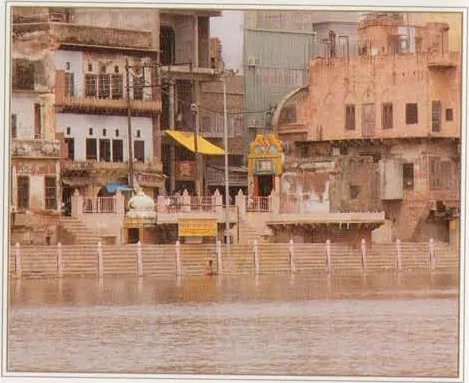
- Prayāga-tīrtha is a bathing place on the Yamunā at Mathurā, south of Viśrāma-ghāṭa.
- Visiting
- Śrī Vraja-maṇḍala Parikramā (2007) prints a photograph of the ghāṭa and counts it as the third of the twelve ghāṭas on the southern side.
- Places here
- Veṇī-Mādhava (Prayāga-tīrtha, Mathurā)
In short
Prayāga-tīrtha is a bathing place on the Yamunā at Mathurā, south of Viśrāma-ghāṭa. It is named in every list of Mathurā's Yamunā tīrthas found so far, and it is the fourth of the twenty-four ghāṭas in Śrīla Prabhupāda's list of the places where Śrī Caitanya Mahāprabhu bathed.[1 +6] The Varāha Purāṇa says that it is hard to reach even for the gods and that a bath here gives the fruit of the agniṣṭoma sacrifice.[5 +2] The guidebook Śrī Vraja-maṇḍala Parikramā (2007) says that Veṇī-Mādhava, the Lord of Prayāga, is present here.[9 +1]
Key facts
| Kind | ghāṭa |
|---|---|
| Region · area | Mathurā |
| Also part of | Yamunā |
| Ācāryas | Śrīla Rūpa Gosvāmī, Śrīla Narahari Cakravartī Ṭhākura, Śrī Caitanya Mahāprabhu, Śrīla Rāghava Paṇḍita Gosvāmī of Govardhana, Śrīla Śrīnivāsa Ācārya |
Why it is glorified
In the Varāha Purāṇa the Lord, as Varāha, names Prayāga after Guhya-tīrtha: it is rare even for the gods.
In the Varāha Purāṇa the Lord, as Varāha, names Prayāga after Guhya-tīrtha: it is rare even for the gods. One who bathes there gains the fruit of the agniṣṭoma sacrifice and rejoices in Indra's world, and one who gives up his life there goes to the Lord's own world (summarised here, not translated).[5 +2]
प्रयागं नाम तीर्थं तु देवानामपि दुर्ल्लभम् ॥ 39 ॥
यस्मिन्स्नातो नरो देवि अग्निष्टोमफलं लभेत् ।। इन्द्रलोकं समासाद्य नरोऽसौ देवि मोदते ॥ 152.40 ॥
अथात्र मुंचते प्राणान्मम लोके स गच्छति
prayāgaṁ nāma tīrthaṁ tu devānāmapi durllabham
yasminsnāto naro devi agniṣṭomaphalaṁ labhet
indralokaṁ samāsādya naro'sau devi modate
athātra muṁcate prāṇānmama loke sa gacchati
The Nārada Purāṇa, in its own list of Mathurā's tīrthas going south from Viśrānti, also calls Prayāga hard to obtain for the gods and promises the bather the fruit of the agniṣṭoma.[12] Prayāga belongs to the series of twelve tīrthas that the Varāha Purāṇa calls hard to reach even for the gods; merely remembering them frees one from all sins.[13]
Śrīla Rūpa Gosvāmī quotes the Varāha verse in his Mathurā-māhātmya and adds two verses from the Saura Purāṇa: what is offered to the forefathers at Prayāga-tīrtha becomes imperishable, and one who serves this tīrtha and Kṛṣṇa, the guru of the worlds, is not born again (summarised here, not translated). These Saura verses have not been found in the available edition of that Purāṇa.[6]
Traditional accounts
According to the local tradition recorded in the guidebook Śrī Vraja-maṇḍala Parikramā (2007), Tīrtharāja Prayāga, "the king of holy places", worships the Supreme Lord at this ghāṭa, and Veṇī-Mādhava, the Lord of Prayāga, is eternally present here. No older text found so far connects Veṇī-Mādhava with Mathurā, so this tradition is not certain.[4 +2]
The Varāha Purāṇa knows Veṇī-Mādhava as the form in which Viṣṇu Himself stays at Prayāga, where the Gaṅgā, the Yamunā and the Sarasvatī meet, and the Caitanya-caritāmṛta tells that Śrī Caitanya Mahāprabhu chanted and danced in the temple of Veṇī-Mādhava there. Both speak of Prayāga itself, not of Mathurā.[14 +1]
The Gosvāmīs and ācāryas
The Caitanya-caritāmṛta (Madhya 17.190) says that Śrī Caitanya Mahāprabhu bathed in the twenty-four ghāṭas along the Yamunā at …
Śrī Caitanya Mahāprabhu
The Caitanya-caritāmṛta (Madhya 17.190) says that Śrī Caitanya Mahāprabhu bathed in the twenty-four ghāṭas along the Yamunā at Mathurā; the verse names none of them. Śrīla Prabhupāda's list of the twenty-four, and the Bhakti-ratnākara's, both include Prayāga-tīrtha.[1 +2] Read more: The twenty-four ghāṭas of Mathurā →
In Śrīla Murāri Gupta's and Śrīla Locana dāsa Ṭhākura's accounts of Mahāprabhu's round of Mathurā, His guide names Prayāga among the twelve ghāṭas that follow one another southwards from Viśrāma; neither says more about it (summarised here, not translated).[1 +5]
The tour of Śrīla Śrīnivāsa Ācārya
According to the Bhakti-ratnākara of Śrīla Narahari Cakravartī Ṭhākura, Śrīla Rāghava Paṇḍita Gosvāmī of Govardhana took Śrīla Śrīnivāsa Ācārya and Śrīla Narottama dāsa Ṭhākura round Mathurā. After Guhya-tīrtha he showed them Prayāga-tīrtha, "rare even for the gods", where a bath gives the fruit of the agniṣṭoma.[8 +1]
দেবের দুর্ল্লভ এ প্রয়াগতীর্থ নাম। অগ্নিষ্টোম ফল মিলে এথা কৈলে স্নান ॥ তথাহি সৌরপুরাণে ॥ প্রয়াগনাম তীর্থন্তু দেবানামপি দুর্ল্লভং । তস্মিন্ স্নাতো নরো দেবি অগ্নিষ্টোমফলং লভেৎ ॥
debera durllabha e praẏāgatīrtha nāma| agniṣṭoma phala mile ethā kaile snāna
tathāhi saurapurāṇe
praẏāganāma tīrthantu debānāmapi durllabhaṁ
tasmin snāto naro debi agniṣṭomaphalaṁ labhet ||
Śrīla Prabhupāda
In his purport to that verse of the Caitanya-caritāmṛta, and again in a purport of the Fourth Canto of Śrīmad-Bhāgavatam …
In his purport to that verse of the Caitanya-caritāmṛta, and again in a purport of the Fourth Canto of Śrīmad-Bhāgavatam (4.8.42), Śrīla Prabhupāda lists the twenty-four ghāṭas; Prayāga-tīrtha is the fourth.[1 +1]
Names this place“The twenty-four ghats (bathing places) along the Yamunā are (1) Avimukta, (2) Adhirūḍha, (3) Guhya-tīrtha, (4) Prayāga-tīrtha … (13) Gokarṇa, (14) Kṛṣṇa-gaṅgā”
Śrīla Prabhupāda, Śrī Caitanya-caritāmṛta, Madhya-līlā 17.190, purport · vedabase.io
Visiting today
Śrī Vraja-maṇḍala Parikramā (2007) prints a photograph of the ghāṭa and counts it as the third of the twelve ghāṭas on the southern side.[1 +5] On Mathurā's ten-mile parikramā the same book lists a darśana of Veṇī-Mādhava first among the stops after Pīpaleśvara Mahādeva, followed by Rāmeśvara, but it does not say that this darśana is at Prayāga-tīrtha. Its present state has not been checked.[10 +2]
Location
| Where it is | 'On her southern side lie the following twelve ghāṭas: … (3) Prayāga-tīrtha'[19] |
|---|
Places at Prayāga-tīrtha (Mathurā)
1 places
History
In 1883 F. S. Growse recorded a shrine of Beni Mádho, Veṇī-Mādhava, at the Prāg Ghāṭ of Mathurā, with a shrine of Rāmeśvara Mahādeva beside it.[10 +1]
Where the sources differ
The sources differ on which bathing places make up Mathurā's twenty-four ghāṭas; their accounts are set out on the page of …
The sources differ on which bathing places make up Mathurā's twenty-four ghāṭas; their accounts are set out on the page of Viśrāma-ghāṭa.[1 +5]
What a bath at Prayāga-tīrtha gives: Indra's world, as the Varāha Purāṇa says, or Vaikuṇṭha, as the guidebook says.
Accounts differ What bathing at Prayāga-tīrtha gives: Indra's world or Vaikuṇṭha.
- Varāha Purāṇa 152.39-41The bather gains the agniṣṭoma's fruit and rejoices in Indra's world; one who dies there goes to Varāha's world.
- Śrīla Rūpa Gosvāmī (v.242) and the Bhakti-ratnākara (p. 172)Bathing gives the agniṣṭoma's fruit (no further destination named).
- Śrī Vraja-maṇḍala Parikramā (2007) (printed p. 50)Bathers 'receive the result of performing all the sacrifices headed by the agniṣṭoma-yajña and attain Vaikuṇṭha-dhāma'.
- Nārada Purāṇa, Uttara-bhāga 79.26: the Purāṇa's own verse'prayāgākhyaṁ tato dakṣe tīrthaṁ tridaśadurlabham': the tīrtha called Prayāga, hard to obtain for the gods; the bather gains the agniṣṭoma's fruit (no further destination named).
Accounts differ From which Purāṇa the verse on Prayāga-tīrtha ('prayāgaṁ nāma tīrthaṁ tu …') comes.
- Śrīla Rūpa Gosvāmī, Mathurā-māhātmya v.242 (under the Ādi-varāha heading of v.239); Śrī Vraja-maṇḍala Parikramā (2007) endnote 18Ādi-varāha.
- Varāha Purāṇa 152.39-40The verse stands in the Varāha's Mathurā-māhātmya.
- Bhakti-ratnākara, printed p. 172'tathāhi saura-purāṇe' (Saura-purāṇa).
More on this place
The twenty-four ghāṭas of Mathurā
References
19 references
- Śrīla Prabhupāda, Śrī Caitanya-caritāmṛta, Madhya-līlā 17.190, purport · vedabase.io
- Śrīla Prabhupāda, Śrīmad-Bhāgavatam, 4.8.42, purport · vedabase.io
- Śrīla Narahari Cakravartī, Bhakti-ratnākara, Fifth Wave (pañcama taraṅga), 1912 ed. p. 178, 2nd ed., 1912
- Śrī Vraja-maṇḍala Parikramā (2007), PDF p. 37
- Varāha Purāṇa, adhyāya 152, 'mathurā-tīrtha-praśaṁsā', vv. 39-41, Sanskrit Wikisource
- Śrīla Rūpa Gosvāmī, Mathurā-māhātmya vv. 242-244
- Śrīla Kṛṣṇadāsa Kavirāja Gosvāmī, Śrī Caitanya-caritāmṛta, Madhya-līlā 17.190, online edition · vedabase.io
- Śrīla Narahari Cakravartī, Bhakti-ratnākara, Fifth Wave (pañcama taraṅga), printed p. 172 (1912 ed.), 2nd ed., 1912
- Śrī Vraja-maṇḍala Parikramā (2007), PDF p. 38
- Śrī Vraja-maṇḍala Parikramā (2007), PDF p. 43
- Varāha Purāṇa, adhyāya 152, 'mathurā-tīrtha-praśaṁsā', vv. 39-41, Sanskrit Wikisource
- Nārada Purāṇa, उत्तरार्धः/अध्यायः 79 v.79-26
- Varāha Purāṇa, adhyāya 152, vv. 69-70, Sanskrit Wikisource
- Varāha Purāṇa, adhyāya 144, vv. 100-101, Sanskrit Wikisource
- Śrīla Prabhupāda, Śrī Caitanya-caritāmṛta, Madhya-līlā 17.149, translation · vedabase.io
- Mathurá (1883), F. S. Growse, B.C.S., M.A. Oxon., C.I.E. (as the title page gives him, p. 144
- Śrīla Narahari Cakravartī, Bhakti-ratnākara, Fifth Wave (pañcama taraṅga), printed p. 165 (1912 ed.), 2nd ed., 1912
- Śrī Vraja-maṇḍala Parikramā (2007), PDF p. 42
- Śrī Vraja-maṇḍala Parikramā (2007), p. 48-49