Śyāma-ḍhāka
श्याम-ढाक
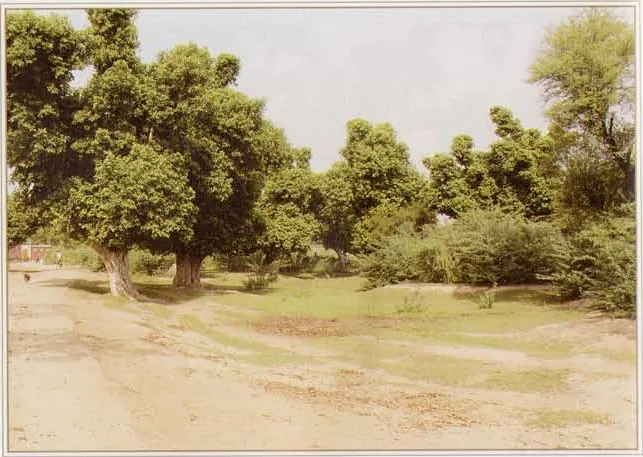
- What it is
- Śyāma-ḍhāka is a grove of palāśa trees on the circuit of Govardhana Hill, which the guidebook Śrī Vraja-maṇḍala Parikramā (2007) places about a mile west of Pūñcharī.
- Visiting
- Śrī Vraja-maṇḍala Parikramā (2007) places Śyāma-ḍhāka about one mile west of Pūñcharī and says that it is full of green palāśa trees; the guidebook Vṛndāvana-Dhāma Ki Jaya!
- Parikramā
- Govardhana parikramā, station 33
- Places here
- Kadamba grove (Śyāma-ḍhāka)
In short
Śyāma-ḍhāka is a grove of palāśa trees on the circuit of Govardhana Hill, which the guidebook Śrī Vraja-maṇḍala Parikramā (2007) places about a mile west of Pūñcharī.[1 +3] In the Bhakti-ratnākara, Śrīla Rāghava Paṇḍita shows Śrīla Śrīnivāsa Ācārya an old palāśa tree that, he says, people call Śyāmaḍhāka, a very secluded place, just before he reaches his own cave. This couplet is the only older text found that names the place.[4] The guidebooks connect Śyāma-ḍhāka with Kṛṣṇa and His friends drinking from cups made of leaves, but they do not agree on the details.
Key facts
| Kind | forest |
|---|---|
| Region · area | Govardhana |
| On the parikramā | Govardhana parikramā, station 33 · the route |
| Ācāryas | Śrīla Śrīnivāsa Ācārya, Śrīla Narottama dāsa Ṭhākura, Śrīla Rāghava Paṇḍita Gosvāmī of Govardhana, Śrīla Sanātana Gosvāmī |
Divine pastimes
Cups of leaves
The Garga-saṁhitā tells that Kṛṣṇa once made cups of nīpa (kadamba) and palāśa leaves and ate yogurt with the cowherd boys, and that the leaves of the trees there became cup-shaped. It calls that holy place Droṇa and does not say where it is or name Śyāma-ḍhāka:[5 +1]
द्रोणाकाराणि पत्राणि बभूवुः शाखिनां तदा । तत्क्षेत्रं च महापुण्यं द्रोणं नाम नृपेश्वर ॥ 23 ॥ दधिदानं तत्र कृत्वा पीत्वा पत्रधृतं दधि । नमस्कुर्यान्नरस्तस्य गोलोकान्न च्युतिर्भवेत् ॥ 24 ॥
droṇākārāṇi patrāṇi babhūvuḥ śākhināṁ tadā
tatkṣetraṁ ca mahāpuṇyaṁ droṇaṁ nāma nṛpeśvara
23
dadhidānaṁ tatra kṛtvā pītvā patradhṛtaṁ dadhi
namaskuryānnarastasya golokānna cyutirbhavet || 24 ||
Śrīmad-Bhāgavatam's forest lunch, at which the cowherd boys used flowers, leaves and bark as their plates, is set on a riverbank and mentions no leaf cups; no source says that it is the pastime told here.[7 +2]
The guidebooks set the leaf cups at Śyāma-ḍhāka itself, in the kadamba grove beside it or at Nipa-kuṇḍa, and they differ on what Kṛṣṇa and His friends drank:
Accounts differ Where Kṛṣṇa and His friends used leaves as cups, and what they drank
- Vṛndāvana-Dhāma Ki Jaya! (c. 1986)Śyāma Dhaka 'is especially known for the cup-shaped leaves which grow in the trees'; Kṛṣṇa used them to carry His friends' yogurt
- Śrī Vraja-maṇḍala Parikramā (2007)Śyāma-ḍhāka is 'filled with lush, green palāśa trees'; the kadamba grove next to it has 'leaves like cups', from which Kṛṣṇa drank buttermilk with His friends
- Govardhana Hill: India's Most Sacred Mountain (2001)at Nipa-kuṇḍa Kṛṣṇa and the cowherd boys used kadamba leaves as cups and fed butter and yogurt from them
- Garga-saṁhitā, Girirāja-khaṇḍa 3.7.22-24 and 3.8.8Kṛṣṇa made cups of nīpa (kadamba) and palāśa leaves and ate yogurt with the boys; the leaves of the trees there became cup-shaped; the holy place is called Droṇa, which 3.8.8 calls the back of Govardhana; it does not name Śyāma-ḍhāka
A place of the rāsa dance
According to Śrī Vraja-maṇḍala Parikramā (2007), Śyāma-ḍhāka is also a place of the rāsa dance, Kṛṣṇa's dance with the gopīs. The book does not say which rāsa, and no other source says so, so this is not certain.[1]
Śrīmad-Bhāgavatam tells the rāsa dance on the autumn nights, on the bank of the Yamunā, not at Govardhana.[10 +3] The commentators Vaṁśīdhara and Śrīla Jīva Gosvāmī speak of a rāsa at Govardhana in the middle of spring, on the night the bull demon Ariṣṭa came, and Śrīla Viśvanātha Cakravartī Ṭhākura and Śrīla Jīva Gosvāmī say that Kṛṣṇa enjoyed such pastimes on other nights too. None of them names a spot, and the Purāṇic verses that Śrīla Viśvanātha Cakravartī Ṭhākura quotes set that spring night's rāsa at Rādhā-kuṇḍa, at the other end of the hill (summarised here, not translated).[1 +3] Read more: The spring rāsa at Govardhana: Pārāsaulī, Candra-sarovara and Paiṭhā →
The Gosvāmīs and ācāryas
- According to the Bhakti-ratnākara, Śrīla Jīva Gosvāmī sent Śrīla Śrīnivāsa Ācārya and Śrīla Narottama dāsa Ṭhākura to see all the places of Vraja with Śrīla Rāghava Paṇḍita, who had just come from Govardhana. On that tour the guide showed Śrīnivāsa the old palāśa tree of Śyāmaḍhāka.[1 +3]
- The same book describes the guide as a brāhmaṇa from South India who lived at Govardhana, was learned in all the scriptures and wrote the Bhakti-ratna-prakāśa, and it quotes Śrīla Kavi-karṇapūra's Gaura-gaṇoddeśa-dīpikā, which says that he is Campakalatā of Vraja.[1 +4]
- According to the guidebook Govardhana Hill (2001), Śyāma-ḍhāka lay on Śrīla Sanātana Gosvāmī's twenty-four-mile parikramā, his walk around Govardhana; the Bhakti-ratnākara says that he walked a parikramā of the hill of twelve krośas (an old measure of distance) every day, but it does not list the places on it.[20 +2]
Visiting today
Śrī Vraja-maṇḍala Parikramā (2007) places Śyāma-ḍhāka about one mile west of Pūñcharī and says that it is full of green palāśa trees; the guidebook Vṛndāvana-Dhāma Ki Jaya! (c. 1986) calls it a small forest, and the key of the numbered chart of Govardhana lists it as no. 51.[1 +3]
Location
| Where it is | one mile west of Pūñcharī[23] 'filled with lush, green palāśa trees. Next to it is a very large grove of kadamba trees, with leaves like cups'[23] |
|---|---|
| On the numbered Govardhana chart | 51 (printed as “Syama Dhaka”)[24] |
Places at Śyāma-ḍhāka
1 places
Nearby places
Pūñcharī
History
The historian Prabhudayāl Mītal (1966) writes that Bābā Śyāmadāsa, an ascetic of the Nimbārka sampradāya who died in 1874, once lived in seclusion and worshipped at Śyāma-ḍhāka, as he did at other holy places of Vraja.[15]
Where the sources differ
Where the rāsa dance took place, and on what authority Śyāma-ḍhāka is called one of its places.
Where the rāsa dance took place, and on what authority Śyāma-ḍhāka is called one of its places.
Accounts differ Where the rāsa dance took place (bearing on Śrī Vraja-maṇḍala Parikramā (2007)'s 'This is also a place of rāsa' at Śyāma-ḍhāka)
- Śrīmad-Bhāgavatam 10.32.11–10.33.2Kṛṣṇa brought the gopīs onto the sandy bank of the Kālindī (Yamunā) and began the rāsa 'there', on the autumn nights
- Śrīla Prabhupāda, Kṛṣṇa book 32–33in the forest on the bank of the Yamunā, on soft sand, in the moonlight; after the dance Kṛṣṇa and the gopīs entered the water of the Yamunā
- Śrīla Viśvanātha Cakravartī and Śrīla Jīva Gosvāmī on ŚB 10.33.25such pastimes also on the nights of the other seasons and of all twelve months, in Śrī Vṛndāvana; no place named
- Vaṁśīdhara and Śrīla Jīva Gosvāmī on ŚB 10.36.6 and 10.36.16a rāsa at Govardhana in the middle of spring, on the night Ariṣṭa came; no spot named
The wording of these accounts is our summary of the sources, not a published translation.
More on this place
The spring rāsa at Govardhana: Pārāsaulī, Candra-sarovara and Paiṭhā
References
24 references
- Śrī Vraja-maṇḍala Parikramā (2007), PDF p. 132
- Vṛndāvana-Dhāma Ki Jaya! (c. 1986), by Dhruva Mahārāja dāsa, PDF p. 43
- the key of the numbered Govardhana chart, ¶54
- Śrīla Narahari Cakravartī, Bhakti-ratnākara, Fifth Wave, 1912 ed. p. 203, 2nd ed., 1912
- Garga-saṁhitā, Girirāja-khaṇḍa (3), adhyāya 7, verse 22, Sanskrit Wikisource
- Garga-saṁhitā, Girirāja-khaṇḍa (3), adhyāya 7, verses 23-24, Sanskrit Wikisource
- Śrīmad-Bhāgavatam 10.13.9, GRETIL
- Śrīmad-Bhāgavatam 10.13.6, GRETIL
- Śrīla Prabhupāda, Kṛṣṇa, the Supreme Personality of Godhead (Kṛṣṇa book), Chapter 13, The Stealing of the Boys and Calves by Brahmā · vedabase.io
- Śrīmad-Bhāgavatam 10.33.2, GRETIL
- Śrīmad-Bhāgavatam 10.33.25, GRETIL
- Śrīla Prabhupāda, Kṛṣṇa, the Supreme Personality of Godhead (Kṛṣṇa book), Chapter 32, Kṛṣṇa Returns to the Gopīs (the scene before the rāsa dance of ch. 33) · vedabase.io
- Śrīla Prabhupāda, Kṛṣṇa, the Supreme Personality of Godhead (Kṛṣṇa book), Chapter 33, 'Description of the Rāsa Dance' · vedabase.io
- Vaṁśīdhara, Śrīla Jīva Gosvāmī: commentary on ŚB 10.36.16, Bhagavata Vidya Pith edition, ed. Bhagavata Rishi and Krishna Shankar Shastri, 1996
- Prabhudayāl Mītal, 'Braj ke katipaya bhakta jan': 'Śyāmadās jī', printed p. 290
- Śrīla Narahari Cakravartī, Bhakti-ratnākara, Fifth Wave, 1912 ed., first page of the wave (no page number printed; the next page is numbered 150), 2nd ed., 1912
- Śrīla Narahari Cakravartī, Bhakti-ratnākara, Fifth Wave, 1912 ed. p. 199, 2nd ed., 1912
- Śrīla Narahari Cakravartī, Bhakti-ratnākara, Fifth Wave, 1912 ed. p. 150, 2nd ed., 1912
- Gaura-gaṇoddeśa-dīpikā, v.162
- Govardhana Hill: India's Most Sacred Mountain (2001), Rajasekhara dasa Brahmacari, PDF p. 35
- Govardhana Hill: India's Most Sacred Mountain (2001), Rajasekhara dasa Brahmacari, PDF p. 38
- Śrīla Narahari Cakravartī, Bhakti-ratnākara, Fifth Wave, 1912 ed. p. 208, 2nd ed., 1912
- Śrī Vraja-maṇḍala Parikramā (2007), p. 238-239
- Numbered list of the Govardhana sites (key of the Govardhana chart)