Kṛṣṇa's promise to return to Vraja, and Loṭhā Bābā of Pūñcharī
श्रीकृष्ण का व्रज लौटने का वचन और पूँछरी के लौठा बाबा
In short
Kṛṣṇa kept His promise. Śrīla Prabhupāda writes in the Kṛṣṇa book (chapter 46) that Kṛṣṇa was neither a cheater nor a breaker of promises. In His original identity He returned with Nanda Mahārāja and stayed in Vṛndāvana in His bhāva expansion, while His expansions stayed in Mathurā. The Gosvāmīs and Śrīla Viśvanātha Cakravartī Ṭhākura explain the promise verse by verse.[1–6]
On this page
At a glance
- As He left for Mathurā, Kṛṣṇa sent the gopīs loving messages that He would return (Śrīmad-Bhāgavatam 10.39.35).[7–11]
- Śrīla Prabhupāda: according to expert opinion, Kṛṣṇa never goes even a step out of Vṛndāvana; only externally were He and Balarāma absent.[1–3]
- Śrīla Rūpa Gosvāmī quotes a verse from the Yāmala: Kṛṣṇa, the son of Nanda, never at any time leaves Vṛndāvana.[12–14]
- Śrīla Sanātana Gosvāmī and Śrīla Jīva Gosvāmī point to Kṛṣṇa's visit to Gokula after He killed Dantavakra, as the Padma Purāṇa, an old scripture, tells it.[4–6]
- Śrīla Viśvanātha Cakravartī Ṭhākura explains that by Yogamāyā, Kṛṣṇa's inner power, the promise of a quick return was made true.[1–3]
- At Pūñcharī, the "tail" of Govardhana Hill, the guidebooks tell of Loṭhā, a cowherd friend who still waits for Kṛṣṇa.[15–22]
Did Kṛṣṇa promise to return to Vraja?
At Pūñcharī, where Govardhana Hill ends like a tail, stands the small temple of Loṭhā Bābā. The guidebooks say that Loṭhā was a cowherd friend of Kṛṣṇa. He vowed not to eat or drink until Kṛṣṇa and Balarāma came back from Mathurā, and he is waiting there still. His story rests on Kṛṣṇa's promise to return to Vraja.[15–22]
This article first gives the promise as the Bhāgavatam tells it. Then comes Śrīla Prabhupāda's explanation, and after that the explanations of the Gosvāmīs and of Śrīla Viśvanātha Cakravartī Ṭhākura, each in its own setting. Last comes the story of Loṭhā and what is known of his shrine.[1 +7]
Akrūra came to take Kṛṣṇa and Balarāma from Vraja to Mathurā. The chariot left at sunrise while the gopīs were crying, and Nanda and the cowherd men followed in their wagons (10.39.32–33). As He went, Kṛṣṇa sent the gopīs loving messages that He would return (10.39.35). Śrīla Prabhupāda tells it like this:[7–11]
General teaching (does not name the place)“Kṛṣṇa therefore consoled the gopīs. He told them that they should not be aggrieved: He was coming back very soon after finishing His business. … The gopīs did not move from their places but stood until the chariot could not be seen at all. They remained standing still, as if they were painted pictures.”
Śrīla Prabhupāda, Kṛṣṇa, the Supreme Personality of Godhead (Kṛṣṇa book), Chapter 39, 'Akrūra’s Return Journey and His Vision of Viṣṇuloka Within the Yamunā River' · vedabase.io
The gopīs stood as still as figures in a painting for as long as they could see the chariot's flag and its dust. When it could no longer be seen, they turned back. From then on they spent their days and nights singing of their beloved's deeds (10.39.36–37).[7–11] Read more: Akrūra in Vraja: his arrival at Nandagrāma and Kṛṣṇa's departure →
The promise repeated in Mathurā
After Kaṁsa's death, Kṛṣṇa sent Nanda and the cowherd men home from Mathurā with a second promise: We shall come to see you (10.45.23). In Śrīla Prabhupāda's telling, They would come back to Vṛndāvana after giving some satisfaction to Vasudeva, Devakī and Their other relatives.[1 +5]
General teaching (does not name the place)“Dear Father and Mother, We know that you will feel separation upon returning to Vṛndāvana and leaving Us here, but please rest assured that We shall come back to Vṛndāvana just after giving some satisfaction to Our real father and mother, Vasudeva and Devakī, and Our grandfather and other family members.”
Śrīla Prabhupāda, Kṛṣṇa, the Supreme Personality of Godhead (Kṛṣṇa book), Chapter 45, 'Kṛṣṇa Recovers the Son of His Teacher' · vedabase.io
When Kṛṣṇa later sent Uddhava to Vraja, He spoke of the gopīs. His fully devoted cowherd girlfriends, He said, were keeping themselves alive only because He had promised to return to them.[1 +5]
dhārayanty ati-kṛcchreṇa prāyaḥ prāṇān kathañcana / pratyāgamana-sandeśair ballavyo me mad-ātmikāḥ
Simply because I have promised to return to them, My fully devoted cowherd girlfriends struggle to maintain their lives somehow or other.
Translation: Śrīla Prabhupāda's disciples (BBT)In Vraja, Nanda asked Uddhava whether Kṛṣṇa still remembered His mother, His friends, the cows, the forest of Vṛndāvana and Govardhana Hill. Would He come back even once (10.46.18–19)? Uddhava assured Nanda and Yaśodā that Kṛṣṇa would soon return to Vraja and keep His word (10.46.34–35).[1 +5] Read more: Uddhava brings Kṛṣṇa's message to the gopīs →
Later Balarāma came to Vraja without Kṛṣṇa. The cowherd men and their wives, who had long suffered in separation, embraced Him (10.65). The Tenth Canto then brings Nanda, the cowherds and the gopīs to meet Kṛṣṇa at Kurukṣetra (10.82). In these chapters the Bhāgavatam does not describe Kṛṣṇa Himself coming back to Vraja. How His promise was still kept is what Śrīla Prabhupāda and the ācāryas explain.[1 +8] Read more: Balarāma's visit to Vraja →
What does Śrīla Prabhupāda say: did Kṛṣṇa leave Vṛndāvana?
Śrīla Prabhupāda answers this question at the start of the Kṛṣṇa book's chapter on Uddhava's visit. Nanda Mahārāja came back to Vṛndāvana without Kṛṣṇa and Balarāma. But according to expert opinion, he writes, Kṛṣṇa, the original Supreme Personality of Godhead, never goes even a step out of Vṛndāvana. Then he explains the promise:[1–3]
General teaching (does not name the place)“But when He failed to come back with Nanda Mahārāja, it appeared that He either cheated them or could not keep His promise. Expert devotees, however, have decided that Kṛṣṇa was neither a cheater nor a breaker of promises. Kṛṣṇa, in His original identity, returned with Nanda Mahārāja and stayed with the gopīs and Mother Yaśodā in His bhāva expansion.”
Śrīla Prabhupāda, Kṛṣṇa, the Supreme Personality of Godhead (Kṛṣṇa book), Chapter 46, 'Uddhava Visits Vṛndāvana' · vedabase.io
Kṛṣṇa and Balarāma, he goes on, stayed in Mathurā in Their expansions as Vāsudeva and Saṅkarṣaṇa. He calls this the expert opinion of advanced devotees. Then he adds that externally, however, They were absent from Vṛndāvana.[1–3]
So, in Śrīla Prabhupāda's explanation, Kṛṣṇa did not break His promise. The separation was apparent. Externally Kṛṣṇa and Balarāma were absent, but Kṛṣṇa in His original identity never left Vṛndāvana.[1–3]
For the people of Vraja the separation was still felt. In the same chapter Śrīla Prabhupāda writes that Kṛṣṇa sent Uddhava to Vṛndāvana with a message, to calm the residents' deep feelings of separation. Uddhava carried His message to Gokula.[1]
General teaching (does not name the place)“Kṛṣṇa wanted to send him to Vṛndāvana with a message to the residents to pacify their deep feelings of separation. … Requested by Lord Kṛṣṇa, Uddhava immediately left on his chariot and carried the message to Gokula.”
Śrīla Prabhupāda, Kṛṣṇa, the Supreme Personality of Godhead (Kṛṣṇa book), Chapter 46, 'Uddhava Visits Vṛndāvana' · vedabase.io
When Balarāma came, Śrīla Prabhupāda writes, the people of Vṛndāvana, who had waited so long to see Kṛṣṇa and Balarāma, all embraced Him.[29]
General teaching (does not name the place)“The inhabitants of Vṛndāvana had been anxious to see Kṛṣṇa and Balarāma for a very long time. When Lord Balarāma returned to Vṛndāvana, all the cowherd boys and the gopīs had grown up; but still, on His arrival, they all embraced Him, and Balarāma embraced them in reciprocation.”
Śrīla Prabhupāda, Kṛṣṇa, the Supreme Personality of Godhead (Kṛṣṇa book), Chapter 65, 'Lord Balarāma Visits Vṛndāvana' · vedabase.io
Kṛṣṇa the son of Nanda never leaves Vṛndāvana
The same truth is in a verse from the Yāmala that Śrīla Rūpa Gosvāmī quotes in his Laghu-bhāgavatāmṛta (1.5.461). The Caitanya-caritāmṛta repeats it (Antya-līlā 1.67). Here is Śrīla Prabhupāda's translation:[12–14]
tathā śrī-yāmala-vacanaṃ samudāharanti - kṛṣṇo'nyo yadu-sambhūto yaḥ pūrṇaḥ so'sty ataḥ param
vṛndāvanaṃ parityajya sa kvacit naiva gacchati //
“ ‘The Kṛṣṇa known as Yadu-kumāra is Vāsudeva Kṛṣṇa. He is different from the Kṛṣṇa who is the son of Nanda Mahārāja. Yadu-kumāra Kṛṣṇa manifests His pastimes in the cities of Mathurā and Dvārakā, but Kṛṣṇa the son of Nanda Mahārāja never at any time leaves Vṛndāvana.’ ”
Translation: Śrīla A.C. Bhaktivedanta Swami PrabhupādaHow do the Gosvāmīs explain the promise?
The Tenth Canto commentators explain the promise verse by verse. Each explanation answers the question that a particular verse raises. Each is summarised here with its verse.[1–6]
Śrīla Sanātana Gosvāmī
On the verse of the loving messages (10.39.35), Śrīla Sanātana Gosvāmī gives their meaning by an example. Kṛṣṇa is going only to protect the Yadus; when that is done, it is as good as if He had come back. He says that the Lord made His word true when, after killing Dantavakra, He went to Gokula, as the Padma Purāṇa's Uttara-khaṇḍa tells.[4–6]
On the gopīs' turning back (10.39.37), he first explains the verse by the manifest pastime, the pastime as seen in the world. Then he reports how some Vaiṣṇavas explain it by the eternal pastime. The one Lord shows Himself in different ways, so there is no contradiction: in one manifestation Kṛṣṇa always plays in Vṛndāvana, and in another He set out for the city.[3 +4]
To support this he recalls a line of the Rudra-yāmala that he had quoted earlier (on 10.5.1): Kṛṣṇa never leaves Vṛndāvana to go anywhere. On Balarāma's visit (10.65.1) he gives, as a second explanation, that Balarāma, the elder brother, went to make good His younger brother's words, I will return.[3 +5]
Śrīla Jīva Gosvāmī
Some people said that Kṛṣṇa meant He would come only in the form of messages, not in person. Śrīla Jīva Gosvāmī, on the same verse, rejects this. Uddhava, the most trustworthy of messengers, said that Kṛṣṇa would come back to Vraja before long (10.46.34). And the promise, Śrīla Jīva Gosvāmī says, came true after the killing of Dantavakra, as the Padma Purāṇa's Uttara-khaṇḍa tells.[4–6]
On 10.45.23 he adds that Kṛṣṇa's coming to Vraja, and His staying there for ever, will be shown at the end of the killing of Dantavakra. On 10.39.37 he says that the gopīs lost only the hope that Kṛṣṇa would turn back then. They still hoped He would return from Mathurā, because He had said, I will return.[3–6]
On Balarāma's visit he explains why Kṛṣṇa Himself did not go. Vasudeva and the others would not allow it. They feared that, bound by the love of Vraja, He would stay there.[33]
In other places in his commentary he teaches that Kṛṣṇa is always present in Vraja. The Bhāgavatam says that He stays in Vṛndāvana (10.18.3), and he reads it as He plays there eternally. On 10.28.17 he quotes the Bṛhad-gautamīya Tantra, in which Kṛṣṇa calls Vṛndāvana His own body and says that He never leaves it.[34–36]
The Padma Purāṇa's account of the visit
Both Gosvāmīs point to the same Padma Purāṇa passage (Uttara-khaṇḍa 252). After killing Dantavakra at Mathurā, it says, Kṛṣṇa crossed the Yamunā and went to Nanda's Vraja. He comforted His parents and the elder cowherds and, dressed as a cowherd, stayed there two months. Another chapter of the same Purāṇa (Pātāla-khaṇḍa 76) also tells of this return, but gives His stay as three nights (summarised here, not translated).[6]
How does Śrīla Viśvanātha Cakravartī Ṭhākura explain it?
Śrīla Viśvanātha Cakravartī Ṭhākura takes up the question where Nanda leaves Mathurā without Kṛṣṇa (10.45.25). First he reports an objection raised by some who taste the moods of devotion. Kṛṣṇa's loving messages had promised a return the day after tomorrow. Yet the Tenth Canto shows only Balarāma coming to Vraja. And a coming only after the killing of Dantavakra, as the Padma Purāṇa tells it, would not by itself suit such love. So, they ask, in what way were the messages loving?[2 +5]
In his answer, Kṛṣṇa's promise to the gopīs had to come true. So Kṛṣṇa, with Balarāma, by His Yogamāyā power showed at once two forms each of Himself, of Nanda and of all the people of Vraja. In one, Nanda went to Vraja separated from Kṛṣṇa. In the other, he went together with Him.[1–3]
The two could not see each other and did not mix. One was sunk in sorrow, the other in joy. That is why, he says, the Bhāgavatam's word for the gopīs' days of grief (10.39.37) is in the dual number, meaning "two". In the manifestation of union, the separation lasted only two days.[1 +6]
Śrīla Rāghava Paṇḍita Gosvāmī of Govardhana
The Bhakti-ratnākara shows Śrīla Rāghava Paṇḍita Gosvāmī living in a cave at the end of Govardhana. In his Kṛṣṇa-bhakti-ratna-prakāśa he asks how Śrī Kṛṣṇa, if He is always in Vṛndāvana, went to Mathurā and other places. He answers with a verse. Had Mukunda left Vṛndāvana, His belongings would have gone with Him: the guñjā berries, the peacock feathers and the flute, the women of Vraja and the cows. None of them did.[38]
His conclusion is that Śrī Rādhā's beloved went elsewhere by a part of Himself (aṁśena), and stayed in Vṛndāvana in His own form (svarūpeṇa).[38]
The explanations side by side
These explanations are given here as each ācārya gives them. They are not joined into one timeline of events. Each comments on a particular verse. The verses raise different questions: what Kṛṣṇa's words to the gopīs meant, why only Balarāma came, how the people of Vraja lived through the separation, and where Kṛṣṇa in His original form remains.[1–6]
Śrīla Prabhupāda, Śrīla Sanātana Gosvāmī, Śrīla Jīva Gosvāmī and Śrīla Viśvanātha Cakravartī Ṭhākura all hold that His word was true. Śrīla Sanātana Gosvāmī and Śrīla Jīva Gosvāmī point to the visit after the killing of Dantavakra told in the Padma Purāṇa. Śrīla Viśvanātha Cakravartī Ṭhākura explains, by Yogamāyā's two manifestations, how the promise of a quick return came true.[1–6]
On the gopīs' turning back, Śrīla Sanātana Gosvāmī gives both readings: the manifest pastime, and the eternal pastime followed by the Vaiṣṇavas he reports. In that explanation, the different manifestations leave no contradiction. This article follows Śrīla Prabhupāda's explanation first: Kṛṣṇa was neither a cheater nor a breaker of promises, the separation was apparent, and Kṛṣṇa in His original identity stayed in Vṛndāvana.[1 +5]
The Garga-saṁhitā tells, in its own Aśvamedha-khaṇḍa, of a later and separate visit. It is not the return that chapter 46 of the Kṛṣṇa book speaks of. Following the horse of a sacrifice with the Yādavas, Kṛṣṇa saw Nandagrāma from His chariot and went ahead. There He saw His father Nanda standing before Him with the cowherds (Aśvamedha-khaṇḍa 40.14–16; summarised here, not translated).[39]
What happened to Kṛṣṇa's cowherd friends?
The Bhāgavatam does not say that any of Kṛṣṇa's friends stayed behind. Kṛṣṇa entered Mathurā with Balarāma and the cowherd boys (10.41.19). Śrīla Sanātana Gosvāmī, Śrīla Jīva Gosvāmī and Śrīla Viśvanātha Cakravartī Ṭhākura explain that these were His friends, and Śrīla Sanātana Gosvāmī names Śrīdāmā and others. Śrīla Prabhupāda writes:[40, 41]
General teaching (does not name the place)“After Akrūra’s departure, Lord Kṛṣṇa, Balarāma and the cowherd boys entered Mathurā to see the city.”
Śrīla Prabhupāda, Kṛṣṇa, the Supreme Personality of Godhead (Kṛṣṇa book), Chapter 41, 'Kṛṣṇa Enters Mathurā' · vedabase.io
Kṛṣṇa sent messages to His parents and to the gopīs, but none to His friends. Śrīla Jīva Gosvāmī explains why (on 10.46.6). The friends such as Śrīdāmā, whose love rests mainly on trust, felt that they were still with Him. Each was sure that Kṛṣṇa came from Mathurā and met him in private. For them, having no message was itself the comfort.[42]
When Balarāma came, he adds, they laughed and clasped His hands, because in private Kṛṣṇa's coming appeared to them again and again. Śrīla Viśvanātha Cakravartī Ṭhākura says (on 10.65.6) that from the day Kṛṣṇa left, the cowherds could not even sleep or eat (summarised here, not translated). None of these texts names Loṭhā.[28, 43]
Who is Loṭhā Bābā of Pūñcharī?
The story of Loṭhā is found in the modern guidebooks, and they tell it in slightly different ways. According to Govardhana Hill (2001), Loṭhā had cooked for Kṛṣṇa and Balarāma as They were leaving for Mathurā. Kṛṣṇa told him He would come back the day after next. Loṭhā then vowed not to eat or drink until They returned, and he is still waiting at this spot.[15–20]
The undated parikramā notes Govardhana Hill give the promise as the day after tomorrow. Vṛndāvana-Dhāma Ki Jaya! (c. 1986) says only that the friend sat down to wait for Kṛṣṇa when He left, and that the Deity is worshipped in that mood. No older text is known to tell the story itself.[15–20]
The temple is known locally as the Pūñcharī-kā-Loṭhā Bābā temple, because it stands at the pūñch, the tail end, of Govardhana Hill, according to Govardhana Hill (2001).[15 +2]
The day after tomorrow
The same span of time appears in Śrīla Viśvanātha Cakravartī Ṭhākura's commentary. He gives an example of Kṛṣṇa's loving messages to the gopīs (on 10.39.35). In it Kṛṣṇa says that if He does not return the day after tomorrow, neither He nor they will be able to live. In an explanation he reports from others, the elders comfort Yaśodā that her son will come back with His father the day after tomorrow (on 10.39.32–33).[2 +5]
In his own answer on 10.45.25, given above, that promise came true: in the manifestation of union, the separation lasted only two days. The commentary speaks of the gopīs and Yaśodā, not of a cowherd boy. The likeness is noted here only as a comparison.[1 +6]
How old is the shrine?
The shrine is older than the guidebooks. The historian A. W. Entwistle (1987) reports that it is named in Sundarlāl's Vraj yātrā, a pilgrimage book in the Braj language that he dates to 1849, and in later pilgrimage books.[44, 45]
In 1966 Prabhudayāl Mītal described a small temple outside the village. It held an image like a wrestler, covered with vermilion and called the Lauṭhā of Pūñcharī. He recorded that it was then regarded as a cowherd friend of Śrī Kṛṣṇa. Neither historian gives the year the shrine was founded.[44, 45]
Where the sources differ
On Kṛṣṇa's friends, the books do not tell the same thing. The guidebooks say that the cowherd friend Loṭhā stayed behind at Pūñcharī and still waits there. The Bhāgavatam's commentators say that the cowherds who entered Mathurā with Kṛṣṇa were His friends. They explain how the friends who stayed in Vraja lived through the separation, without naming Loṭhā.[15 +8]
Accounts differ Where Kṛṣṇa's cowherd friends were, and how they fared, after He left for Mathurā
- Govardhana Hill: India's Most Sacred Mountain (2001), the undated parikramā notes Govardhana, Vṛndāvana-Dhāma Ki Jaya! (c. 1986)the cowherd friend Loṭhā vowed not to eat or drink until Kṛṣṇa and Balarāma returned and is still waiting for Them at Pūñcharī
- Śrīla Jīva Gosvāmī on ŚB 10.46.6 (Laghu-vaiṣṇava-toṣaṇī and Krama-sandarbha), 10.65.5 and 10.41.19the friends such as Śrīdāmā, whose love is chiefly trust, thought themselves in union with Kṛṣṇa, each convinced from their secret talks that He comes here from Mathurā and meets me in private; so He sent them no consolation (Jīva rejects the view that they were consoled by going to Him and coming back); when Balarāma came they laughed and clasped His hands, joyful because in private Kṛṣṇa's coming appeared to them again and again; on 10.41.19 the cowherds who entered Mathurā with Kṛṣṇa are His friends (vayasya)
- Śrīla Sanātana Gosvāmī on ŚB 10.46.6, 10.39.33, 10.41.19 and 10.65.6no message was sent to the friends such as Śrīdāmā, with the idea that they could meet Him in Mathurā (in another reading Kṛṣṇa sustains the cowherds such as Śrīdāmā); the Lord's companions such as Śrīdāmā followed the chariot, and the cowherds who entered Mathurā with Him were His friends such as Śrīdāmā (on 10.41.19); after Uddhava's visit, nearly without hope of His coming, the people of Vraja neglected their bodies
- Śrīla Viśvanātha Cakravartī on ŚB 10.45.23, 10.65.6 and 10.41.19Balarāma and the dear friends such as Madhumaṅgala are among the 'We' who will come to see the people of Vraja; from the day Kṛṣṇa left, the cowherds could not even accomplish natural acts such as sleeping and eating; on 10.41.19 the cowherds who entered Mathurā with Kṛṣṇa are His friends (vayasya)
The wording of these accounts is our summary of the sources, not a published translation.
The Padma Purāṇa itself gives two lengths for Kṛṣṇa's stay in Vraja after the killing of Dantavakra: two months in the Uttara-khaṇḍa, and three nights in the Pātāla-khaṇḍa. Both are given here as the Purāṇa gives them.[6]
Places in this article
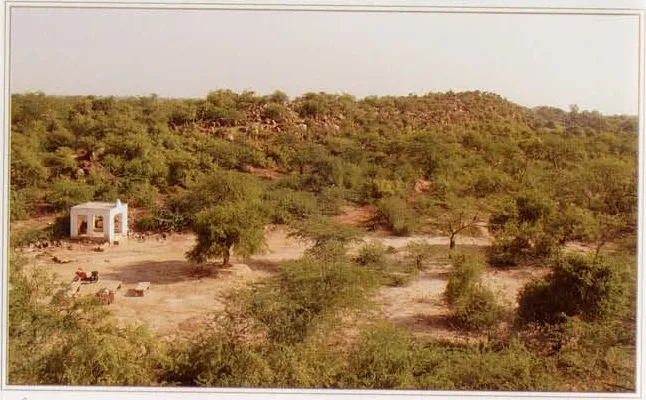
Pūñcharī
पूँछरीPūñcharī is the village at the southern end of Govardhana Hill, at the opposite end of the hill from Rādhā-kuṇḍa.
Punchari-ka-loṭhā Bābā Mandira
पूँछरी का लौठा बाबा मन्दिरThe temple of Loṭhā Bābā stands at Pūñcharī, at the tail end of Govardhana Hill.
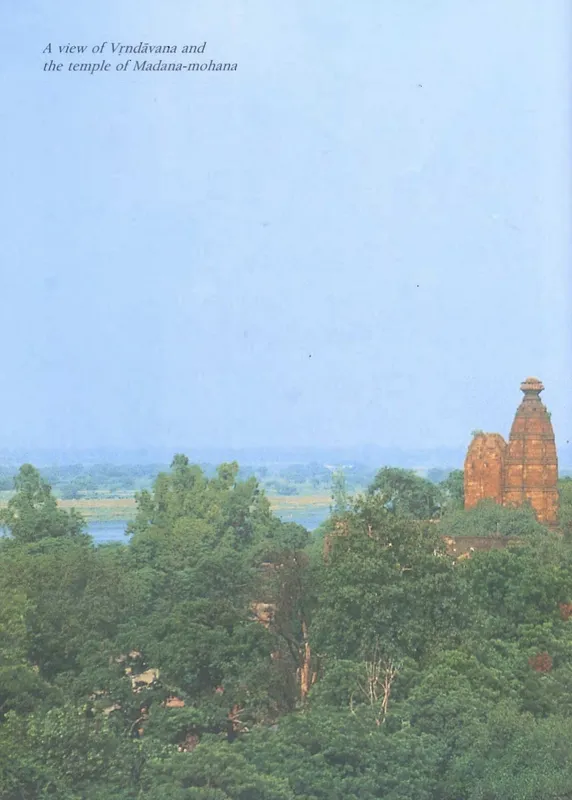
Vṛndāvana
वृन्दावनVṛndāvana is the forest on the bank of the Yamunā where Kṛṣṇa spent His childhood and youth, and the town of temples that stands in that forest today.
Questions and answers
Śrīla Prabhupāda writes that Kṛṣṇa, in His original identity, returned with Nanda Mahārāja and stayed with the gopīs and Mother Yaśodā in His bhāva expansion. Externally He and Balarāma were absent, staying in Mathurā as Vāsudeva and Saṅkarṣaṇa (Kṛṣṇa book, chapter 46).[1–3]
No. Śrīla Prabhupāda writes that expert devotees have decided that Kṛṣṇa was neither a cheater nor a breaker of promises. The Gosvāmīs and Śrīla Viśvanātha Cakravartī Ṭhākura all hold that His word was true.[1–6]
In chapter 39 Kṛṣṇa comforts the gopīs that He is coming back very soon. In chapter 45 He tells Nanda that They will come back to Vṛndāvana. In chapter 46 Śrīla Prabhupāda explains how the promise was kept.[1 +2]
According to expert opinion, Śrīla Prabhupāda writes, Kṛṣṇa, the original Supreme Personality of Godhead, never goes even a step out of Vṛndāvana. The Yāmala verse that Śrīla Rūpa Gosvāmī quotes says that the son of Nanda never at any time leaves it.[1 +3]
Śrīla Sanātana Gosvāmī and Śrīla Jīva Gosvāmī say that He made His word true when, after killing Dantavakra, He went to Gokula, as the Padma Purāṇa's Uttara-khaṇḍa tells.[4–6]
According to the guidebooks, he is a cowherd friend of Kṛṣṇa. He vowed not to eat or drink until Kṛṣṇa and Balarāma came back from Mathurā, and he still waits for Them at Pūñcharī. No older text is known to tell the story.[15–20]
At Pūñcharī, the tail end of Govardhana Hill, which gives the temple its local name. The historian Entwistle (1987) reports that a pilgrimage book he dates to 1849 already names the shrine.[15 +4]
Sources
- Śrīla Prabhupāda, Kṛṣṇa, the Supreme Personality of Godhead (Kṛṣṇa book), Chapter 46, 'Uddhava Visits Vṛndāvana' · vedabase.io
- Śrīla Viśvanātha Cakravartī Ṭhākura: commentary on ŚB 10.45.25, Bhagavata Vidya Pith edition, ed. Bhagavata Rishi and Krishna Shankar Shastri, 1996
- Śrīla Jīva Gosvāmī, Śrīla Viśvanātha Cakravartī Ṭhākura, Śrīla Sanātana Gosvāmī: commentary on ŚB 10.39.37, Bhagavata Vidya Pith edition, ed. Bhagavata Rishi and Krishna Shankar Shastri, 1996
- Śrīla Sanātana Gosvāmī: commentary on ŚB 10.39.35, Bhagavata Vidya Pith edition, ed. Bhagavata Rishi and Krishna Shankar Shastri, 1996
- Śrīmad-Bhāgavatam 10.46.34, GRETIL
- Padma Purāṇa, Uttara-khaṇḍa (khaṇḍa 6), adhyāya 252, verses 25-27, Sanskrit Wikisource
- Śrīmad-Bhāgavatam 10.39.32, GRETIL
- Śrīmad-Bhāgavatam 10.39.35, GRETIL
- Śrīmad-Bhāgavatam 10.39.36, GRETIL
- Śrīmad-Bhāgavatam 10.39.37, GRETIL
- Śrīla Prabhupāda, Kṛṣṇa, the Supreme Personality of Godhead (Kṛṣṇa book), Chapter 39, 'Akrūra’s Return Journey and His Vision of Viṣṇuloka Within the Yamunā River' · vedabase.io
- Śrīla Rūpa Gosvāmī, Laghu-bhāgavatāmṛta, 1.5.461 (quoting the Yāmala), GRETIL
- Śrī Vraja-maṇḍala Parikramā (2007), PDF p. 294
- The Color Guide to Vṛndāvana (2000), Written and Photographed by Rājaśekhara dāsa Brahmacārī, PDF p. 15
- Govardhana Hill: India's Most Sacred Mountain (2001), Rajasekhara dasa Brahmacari, PDF p. 124
- Govardhana Hill: India's Most Sacred Mountain (2001), Rajasekhara dasa Brahmacari, PDF p. 125
- the undated parikramā notes Govardhana, ¶125
- the undated parikramā notes Govardhana, ¶127
- the undated parikramā notes Govardhana, ¶129
- Vṛndāvana-Dhāma Ki Jaya! (c. 1986), by Dhruva Mahārāja dāsa, PDF p. 43
Show all 45 references
- the undated parikramā notes Govardhana, ¶124
- the key of the numbered Govardhana chart, ¶53
- Śrīmad-Bhāgavatam 10.45.23, GRETIL
- Śrīmad-Bhāgavatam 10.46.6, GRETIL
- Śrīmad-Bhāgavatam 10.46.18, GRETIL
- Śrīla Prabhupāda, Kṛṣṇa, the Supreme Personality of Godhead (Kṛṣṇa book), Chapter 45, 'Kṛṣṇa Recovers the Son of His Teacher' · vedabase.io
- Śrīmad-Bhāgavatam 10.65.1, GRETIL
- Śrīmad-Bhāgavatam 10.65.4-6, GRETIL
- Śrīla Prabhupāda, Kṛṣṇa, the Supreme Personality of Godhead (Kṛṣṇa book), Chapter 65, 'Lord Balarāma Visits Vṛndāvana' · vedabase.io
- Vaṁśīdhara: commentary on ŚB 10.3.51, Bhagavata Vidya Pith edition, ed. Bhagavata Rishi and Krishna Shankar Shastri, 1996
- Śrīla Sanātana Gosvāmī: commentary on ŚB 10.5.1, Bhagavata Vidya Pith edition, ed. Bhagavata Rishi and Krishna Shankar Shastri, 1996
- Śrī Vraja-maṇḍala Parikramā (2007), PDF p. 285
- Śrīla Sanātana Gosvāmī, Śrīla Jīva Gosvāmī, Śrīla Viśvanātha Cakravartī Ṭhākura: commentary on ŚB 10.65.1, Bhagavata Vidya Pith edition, ed. Bhagavata Rishi and Krishna Shankar Shastri, 1996
- Śrīmad-Bhāgavatam 10.18.3, Bhagavata Vidya Pith edition, ed. Bhagavata Rishi and Krishna Shankar Shastri, 1996
- Śrīla Jīva Gosvāmī: commentary on ŚB 10.28.17, parts 3/4-4/4, Bhagavata Vidya Pith edition, ed. Bhagavata Rishi and Krishna Shankar Shastri, 1996
- Baladeva Vidyābhūṣaṇa: commentary on ŚB 10.11.36, Bhagavata Vidya Pith edition, ed. Bhagavata Rishi and Krishna Shankar Shastri, 1996
- Śrīla Viśvanātha Cakravartī Ṭhākura: commentary on ŚB 10.39.32-33, Bhagavata Vidya Pith edition, ed. Bhagavata Rishi and Krishna Shankar Shastri, 1996
- Śrīla Rāghava Paṇḍita Gosvāmī, Kṛṣṇa-bhakti-ratna-prakāśa, second prakāśa, part 2: prose after v.54, v.55 and prose after v.55, after Haridas Shastri's edition, ca. 1980
- Garga-saṁhitā, Aśvamedha-khaṇḍa (10) 40.14–16, Sanskrit Wikisource
- Śrīmad-Bhāgavatam 10.41.19, GRETIL
- Śrīla Prabhupāda, Kṛṣṇa, the Supreme Personality of Godhead (Kṛṣṇa book), Chapter 41, 'Kṛṣṇa Enters Mathurā' · vedabase.io
- Śrīla Jīva Gosvāmī, Śrīla Sanātana Gosvāmī: commentary on ŚB 10.46.6, Bhagavata Vidya Pith edition, ed. Bhagavata Rishi and Krishna Shankar Shastri, 1996
- Śrīla Viśvanātha Cakravartī Ṭhākura, Śrīla Jīva Gosvāmī: commentary on ŚB 10.65.4-6, Bhagavata Vidya Pith edition, ed. Bhagavata Rishi and Krishna Shankar Shastri, 1996
- A. W. Entwistle, Govardhan entries, '20b Punchhari kau Lautha', printed p. 353, Egbert Forsten, Groningen, 1987
- Prabhudayāl Mītal, 'Braj-yātrā', Govardhana: 'Pūñcharī ko lauṭhā', printed p. 111
Further sources
- Śrīmad-Bhāgavatam, Tenth Canto, chapters 39, 41, 45, 46, 65 and 82 (translation by the disciples of Śrīla Prabhupāda); Śrīla Prabhupāda, Kṛṣṇa, chapters 39, 41, 45, 46 and 65; Caitanya-caritāmṛta, Antya-līlā 1.67, translation by Śrīla Prabhupāda, quoting Śrīla Rūpa Gosvāmī's Laghu-bhāgavatāmṛta 1.5.461.
- Commentaries on the Tenth Canto by Śrīla Sanātana Gosvāmī, Śrīla Jīva Gosvāmī and Śrīla Viśvanātha Cakravartī Ṭhākura: summarised here, not translated.
- Padma Purāṇa, Uttara-khaṇḍa 252 and Pātāla-khaṇḍa 76; Garga-saṁhitā, Aśvamedha-khaṇḍa 40.14–16; Śrīla Rāghava Paṇḍita Gosvāmī, Kṛṣṇa-bhakti-ratna-prakāśa, second prakāśa: summarised here, not translated.
- Govardhana Hill (2001); Govardhana Hill, undated parikramā notes; Vṛndāvana-Dhāma Ki Jaya! (c. 1986); A. W. Entwistle (1987); Prabhudayāl Mītal (1966): reported, not quoted.