Rāghava Paṇḍita's cave
राघव पण्डित की गुफा Hindi name proposed
Also called Maṇi kaṇḍali cave, Raghava Pandit’s Gufa
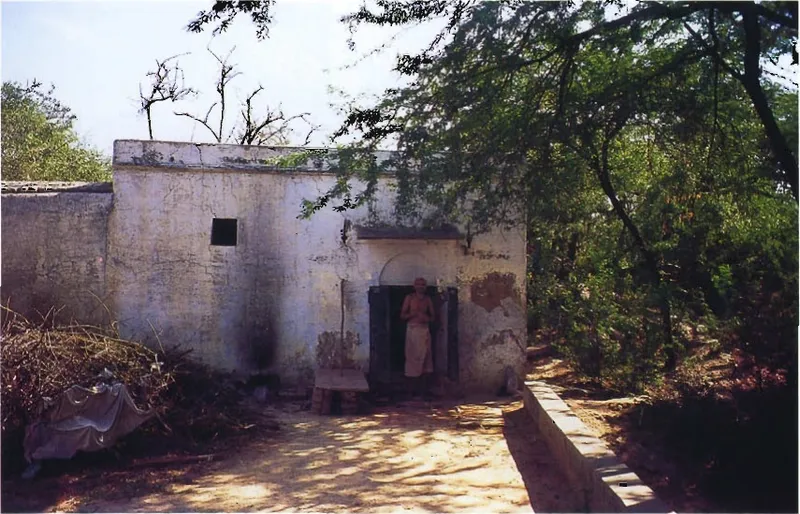
- What it is
- Rāghava Paṇḍita's cave lies near Apsarā-kuṇḍa at Govardhana, close to Pūñcharī, and the guidebooks call it the place of bhajana (chanting and worship) of Śrīla Rāghava Paṇḍita Gosvāmī of Govardhana.
- Visiting
- Modern guidebooks (Vṛndāvana-Dhāma Ki Jaya!
- Parikramā
- Govardhana parikramā, station 32
In short
Rāghava Paṇḍita's cave lies near Apsarā-kuṇḍa at Govardhana, close to Pūñcharī, and the guidebooks call it the place of bhajana (chanting and worship) of Śrīla Rāghava Paṇḍita Gosvāmī of Govardhana.[1 +7] In the Bhakti-ratnākara he is the guide with whom Śrīla Jīva Gosvāmī sent Śrīla Śrīnivāsa Ācārya and Śrīla Narottama dāsa Ṭhākura round Vraja. On the circuit of Govardhana he shows Śrīnivāsa his own cave and says that Rādhā and Kṛṣṇa enjoy pastimes in this cave of Govardhana constantly.[1 +8] A kuṭira, a small hut, has been built around the cave, which Govardhana Hill (2001) also calls the Maṇi-kaṇḍalī cave.[4 +4]
Key facts
| Kind | cave |
|---|---|
| Region · area | Govardhana |
| On the parikramā | Govardhana parikramā, station 32 · the route |
| Ācāryas | Śrīla Jīva Gosvāmī, Śrīla Śrīnivāsa Ācārya, Śrīla Narottama dāsa Ṭhākura, Śrīla Rāghava Paṇḍita Gosvāmī of Govardhana, Śrīla Narahari Cakravartī Ṭhākura |
Divine pastimes
Rādhā and Kṛṣṇa in the cave
According to the Bhakti-ratnākara, on the round of Govardhana the guide showed Śrīla Śrīnivāsa Ācārya Apsarā-kuṇḍa at the end of Govardhana, where the most fortunate bathe, and the old palāśa trees that people call Śyāma-ḍhāka, a very lonely place. Then he went on joyfully to his own dwelling and told Śrīnivāsa that this was his cave, that he stayed right there, and that seeing the beauty of Govardhana gave him great happiness.[8 +2] He added that this cave of Govardhana is very charming and that Rādhā and Kṛṣṇa enjoy pastimes here constantly. The book does not say in so many words that this cave is the same as his own, though the lines run on at the same spot (summarised here, not translated).[8 +2]
Right after these lines the Bhakti-ratnākara quotes a verse of Śrīla Raghunātha dāsa Gosvāmī's Vraja-vilāsa-stava in praise of the best of hills, where Mādhava (Kṛṣṇa) plays with His friends, is painted by them with coloured minerals and herds the cows, and in whose caves He enjoys with Śrī Rādhā. The verse speaks of Govardhana's caves in general; it is the Bhakti-ratnākara that applies it to this cave (summarised here, not translated).[8 +3]
Traditional accounts
In his list of Kṛṣṇa's places, Śrīla Rūpa Gosvāmī's Rādhā-Kṛṣṇa-gaṇoddeśa-dīpikā names Kṛṣṇa's cave Maṇi-kandalī, right after …
The name Maṇi-kaṇḍalī
In his list of Kṛṣṇa's places, Śrīla Rūpa Gosvāmī's Rādhā-Kṛṣṇa-gaṇoddeśa-dīpikā names Kṛṣṇa's cave Maṇi-kandalī, right after Govardhana, His pleasure-hill, but it does not say where the cave is.[15] Govardhana Hill (2001) and an untitled numbered list of the sites of Govardhana call this cave Maṇi-kaṇḍalī; no source connects the two, so the link rests on the name alone.[4 +4]
The Gosvāmīs and ācāryas
The Bhakti-ratnākara tells that when Śrīla Jīva Gosvāmī wished to send Śrīla Śrīnivāsa Ācārya and Śrīla Narottama dāsa Ṭhākura …
Śrīla Rāghava Paṇḍita Gosvāmī of Govardhana
The Bhakti-ratnākara tells that when Śrīla Jīva Gosvāmī wished to send Śrīla Śrīnivāsa Ācārya and Śrīla Narottama dāsa Ṭhākura quickly to see all the holy places, Rāghava Gosāñi arrived from Govardhana and said that he was going round Vraja, and Śrīla Jīva Gosvāmī arranged that the two should go with him.[1 +5] On the Govardhana pages of the book the same guide is called Rāghava Paṇḍita. At the end of the tour he told Śrīla Jīva Gosvāmī everything, stayed a day or two in Vṛndāvana and went back to Govardhana.[9 +4]
The book describes him as a South Indian brāhmaṇa of a high family and a great Vaiṣṇava, merciful to the fallen, who wrote the Bhakti-ratna-prakāśa and other books and knew all the scriptures. Govardhana was everything to him: he lived there, at times travelled about Vraja or stayed with Śrīla Raghunātha dāsa Gosvāmī, and was grey with dust and very renounced.[1 +11] It quotes Śrīla Kavi-karṇapūra's Gaura-gaṇoddeśa-dīpikā, which says that she who was Śrī Campakalatā in Vraja is now Rāghava Gosvāmī, who lives at Govardhana.[7 +3]
The Bhakti-ratnākara of Śrīla Narahari Cakravartī Ṭhākura is the only old text found that records this cave.[8 +1]
Visiting today
Modern guidebooks (Vṛndāvana-Dhāma Ki Jaya! (c. 1986), Govardhana Hill (2001), Śrī Vraja-maṇḍala Parikramā (2007) and others) place the cave in a secluded spot near Apsarā-kuṇḍa, next to the place of rāsa beside Apsarā-kuṇḍa and Navala-kuṇḍa, close to Pūñcharī and near Sutala-kuṇḍa.[1 +5] That the cave shown today is the cave of the Bhakti-ratnākara rests on the guidebooks and on the general location; the old book gives the cave no name and no closer description.[8 +1]
Location
| Where it is | Near Sutala-kuṇḍa[27] adjacent to the place of rāsa near Apsarā-kuṇḍa and Navala-kuṇḍa[28] |
|---|---|
| On the numbered Govardhana chart | 52 (printed as “Mani Kandali Cave”)[29] |
Nearby places
Place of rāsa (Apsarā-kuṇḍa and Navala-kuṇḍa) · Sutala-kuṇḍa · Imprint of Kṛṣṇa's crown (Rāghava Paṇḍita's cave) · Surabhi-kuṇḍa (Govardhana)
History
Govardhana Hill (2001) reports that a kuṭira has now been built around the cave; it gives no date or builder.[7 +1] Pulinbihārī Datta's Bengali Vṛndāvana-kathā (1920) retells the Bhakti-ratnākara's tour and writes that Śrīla Rāghava Paṇḍita, a kulīna brāhmaṇa from the South, lived in a secluded cave of Govardhana and worshipped the Lord in solitude.[17] Elsewhere he says that the cave of Rāghava Gosvāmī, the guide, could be seen at Govardhana; he mentions it right after the temples by Mānasī-gaṅgā, and it is not clear whether he means that spot or Govardhana as a whole.[18]
Where the sources differ
Who the Rāghava of the cave was. The Bhakti-ratnākara describes a South Indian brāhmaṇa living at Govardhana; three guidebooks …
Who the Rāghava of the cave was. The Bhakti-ratnākara describes a South Indian brāhmaṇa living at Govardhana; three guidebooks call him an associate of Śrī Caitanya Mahāprabhu; Śrīla Prabhupāda's purports speak of Śrīla Rāghava Paṇḍita, Mahāprabhu's associate, whose house and tomb are at Pānihāṭi in Bengal. No source read says that the Rāghava of Govardhana met Mahāprabhu.[1 +5]
Accounts differ Who the Rāghava of the cave was
- Śrī Vraja-maṇḍala Parikramā (2007) (English 2007)'an associate of Śrīman Mahāprabhu, the Gauḍīya Vaiṣṇava Śrīla Rāghava Paṇḍita, used to perform his bhajana' here
- the undated parikramā notes Govardhana'an associate of Mahāprabhu, Śrīla Rāghava Paṇḍita'
- Vṛndāvana-Dhāma Ki Jaya! (c. 1986)'Rāghava Paṇḍita, an intimate associate of Lord Caitanya … one of the main characters in the Bhakti-ratnākara'
- Govardhana Hill: India's Most Sacred Mountain (2001)'Rāghava Paṇḍita Gosvāmī' used the cave; a close friend of Śrīla Raghunātha dāsa Gosvāmī who always lived at Govardhana; according to the Gaura-gaṇoddeśa-dīpikā the sakhī Campakalatā
Accounts differ Which cave is Rāghava Paṇḍita's cave, and whose is the cave beside Navala-kuṇḍa?
- Bhakti-ratnākara, Fifth Wave p. 203 (1912 ed.)after Apsarā-kuṇḍa at the end of Govardhana and the old palāśa trees of Śyāma-ḍhāka, the guide (Rāghava Paṇḍita) reaches his own dwelling and says this is my cave; I stay right here; no name or closer description of the cave
- Modern Gauḍīya guidebooks: Vṛndāvana-Dhāma Ki Jaya! (c. 1986), Govardhana Hill: India's Most Sacred Mountain (2001), Śrī Vraja-maṇḍala Parikramā (2007), The Colour Guide to Rādhā-kuṇḍa (1999), the undated parikramā notes GovardhanaRāghava Paṇḍita's cave, his bhajana place ('Maṇi Kaṇḍalī' in Govardhana Hill: India's Most Sacred Mountain (2001)), lies near Apsarā-kuṇḍa, next to the place of rāsa by Apsarā- and Navala-kuṇḍa, close to Puñcari; a kuṭira has now been built round it (Govardhana Hill: India's Most Sacred Mountain (2001))
- Pulinbihārī Datta, Vṛndāvana-kathā (Bengali, 1920), p. 122under Govardhana-giri, after the temples of Harideva and Cakreśvara on the bank of Mānasī-gaṅgā: at that very place the cave of the guide Rāghava Gosvāmī can be seen; Āniyora (Annakūṭa) is near it; Pūñcharī is not mentioned
- Prabhudayāl Mītal (1966), a historianMītal places beside Navala-kuṇḍa, near Pūñcharī, a cave he names after Rāmadāsa or Rāghavadāsa, where Rāmadāsa Cauhāna, the first pūjārī of Śrīnāthjī, did his sādhanā; Chītasvāmī's place is on the other side.
The wording of these accounts is our summary of the sources, not a published translation.
The order of Śyāma-ḍhāka and the cave on the parikramā: each source gives its own.[1 +4]
Accounts differ Order of Śyāma-ḍhāka and Rāghava Paṇḍita's cave on the parikramā
- Bhakti-ratnākara, Fifth Wave p. 203Apsarā-kuṇḍa at the end of Govardhana (গোবর্দ্ধন অন্তে), then the old palāśa trees called Śyāma-ḍhāka, then the guide's own cave, then (after the stava) Airāvata's footprint
- Śrī Vraja-maṇḍala Parikramā (2007)(29) Apsarā-kuṇḍa and Navala-kuṇḍa, (30) Rāghava Paṇḍita's cave, (31) Śyāma-ḍhāka 'one mile west of Pūñcharī', (32) Surabhi-kuṇḍa 'somewhat further along than Rāghava Paṇḍita's cave'
- the key of the numbered Govardhana chart (list)49 Apsara Kunda, 50 Puncharika Lautha Baba Temple, 51 Syama Dhaka, 52 Mani Kandali Cave, 53 Nathji Temple, 54 Airavata's Footprint
- Govardhana Hill: India's Most Sacred Mountain (2001)Apsarā-kuṇḍa, Naval-kuṇḍa, Narasiṁha Mandīra, Loṭhā Bābā Mandīra, Sutala Vana, Maṇi Kaṇḍalī Cave, Airāvata's Foot-print (no Śyāma-ḍhāka)
References
29 references
- Śrī Vraja-maṇḍala Parikramā (2007), PDF p. 132
- The Colour Guide to Rādhā-kuṇḍa (1999), Rājaśekhara dāsa Brahmacārī, PDF p. 83
- Vṛndāvana-Dhāma Ki Jaya! (c. 1986), by Dhruva Mahārāja dāsa, PDF p. 43
- Govardhana Hill: India's Most Sacred Mountain (2001), Rajasekhara dasa Brahmacari, PDF p. 125
- the undated parikramā notes Govardhana, ¶135
- Śrī Vraja-maṇḍala Parikramā (2007), PDF p. 110
- Govardhana Hill: India's Most Sacred Mountain (2001), Rajasekhara dasa Brahmacari, PDF p. 127
- Śrīla Narahari Cakravartī, Bhakti-ratnākara, Fifth Wave, 1912 ed. p. 203, 2nd ed., 1912
- Śrīla Narahari Cakravartī, Bhakti-ratnākara, Fifth Wave, 1912 ed., first page of the wave (no page number printed; the next page is numbered 150), 2nd ed., 1912
- Śrīla Narahari Cakravartī, Bhakti-ratnākara, Fifth Wave, 1912 ed. p. 211, 2nd ed., 1912
- Śrīla Narahari Cakravartī, Bhakti-ratnākara, Fifth Wave, 1912 ed. p. 203; the stava verse is numbered 65 in the Bhakti-ratnākara's heading, 2nd ed., 1912
- Śrīla Raghunātha dāsa Gosvāmī, Vraja-vilāsa-stava, verse 65
- Govardhana Hill: India's Most Sacred Mountain (2001), Rajasekhara dasa Brahmacari, PDF p. 126
- the key of the numbered Govardhana chart, ¶55
- Śrīla Rūpa Gosvāmī, Rādhā-Kṛṣṇa-gaṇoddeśa-dīpikā, description of places (sthāna-vivaraṇa), vv.114-115
- Śrīla Narahari Cakravartī, Bhakti-ratnākara, Fifth Wave, 1912 ed. p. 150, lines after the Gaura-gaṇoddeśa-dīpikā quotation, 2nd ed., 1912
- Vṛndāvana-kathā, printed p. 118
- Vṛndāvana-kathā, printed p. 122, 'Govardhana-giri'
- Śrīla Narahari Cakravartī, Bhakti-ratnākara, Fifth Wave, 1912 ed. p. 150, with its quotation of Gaura-gaṇoddeśa-dīpikā '162', 2nd ed., 1912
- Śrīla Narahari Cakravartī, Bhakti-ratnākara, Fifth Wave, 1912 ed. p. 452, end of the Vraja-maṇḍala tour, 2nd ed., 1912
Show all 29 references
- Śrīla Narahari Cakravartī, Bhakti-ratnākara, Twelfth Wave, 1912 ed. p. 999, Śrīnivāsa's dream of Śrī Caitanya with His devotees, 2nd ed., 1912
- Śrīla Narahari Cakravartī, Bhakti-ratnākara, First Wave, 1912 ed. p. 3, opening invocation of the devotees, 2nd ed., 1912
- Śrīla Narahari Cakravartī, Bhakti-ratnākara, Fifth Wave, 1912 ed. p. 150, 2nd ed., 1912
- Gaura-gaṇoddeśa-dīpikā, v.162
- the undated parikramā notes Govardhana, ¶136
- the key of the numbered Govardhana chart, ¶54
- Govardhana Hill: India's Most Sacred Mountain (2001), Rajasekhara dasa Brahmacari, p. 112
- Śrī Vraja-maṇḍala Parikramā (2007), p. 238-239
- Numbered list of the Govardhana sites (key of the Govardhana chart)