Balarāma's visit to Vraja
The rāsa at Rāma-ghāṭa and the dragging of the Yamunā
In short
Long after Kṛṣṇa and Balarāma had left Vraja, Balarāma came back alone from Dvārakā. He stayed for two spring months. He consoled Nanda, Yaśodā and the gopīs (cowherd girls), enjoyed the rāsa dance (circle dance) with His own gopīs in a garden by the Yamunā, and dragged the river with His plough. The ācāryas name the place Rāma-ghāṭa.[1–10]
On this page
At a glance
- Scripture: Śrīmad-Bhāgavatam, Tenth Canto, chapter 65, translated by Śrīla Prabhupāda's disciples. Śrīla Prabhupāda's own telling is in the Kṛṣṇa book, chapter 65.[4–9]
- The time: the two months Madhu and Mādhava, that is, Caitra and Vaiśākha, in spring (about March to May).[4]
- The place: Śrīla Viśvanātha Cakravartī Ṭhākura identifies the Bhāgavatam's Yamunā garden with Śrī Rāma-ghaṭṭa.[5, 10]
- Śrīla Prabhupāda wrote in 1970 that Balarāma's dance with the gopīs took place at Rāma-ghāṭa on the Yamunā.[11]
- The sign: according to the Bhāgavatam, the Yamunā is still seen flowing along the channels made by the dragging.[8]
- Visitors: according to the Bhakti-ratnākara, Śrī Nityānanda Prabhu, Śrī Jāhnavā Mātā and Śrī Vīracandra Prabhu came here.[12–18]
Why did Balarāma return to Vraja?
Śukadeva Gosvāmī tells that once Balarāma was eager to see His well-wishing friends. So He mounted His chariot and went to Nanda's Gokula. The cowherd men and their wives had long suffered the pain of separation, and they embraced Him.[1–3]
śrī-śuka uvāca balabhadraḥ kuru-śreṣṭha bhagavān ratham āsthitaḥ / suhṛd-didṛkṣur utkaṇṭhaḥ prayayau nanda-gokulam
Śukadeva Gosvāmī said: O best of the Kurus, once Lord Balarāma, eager to visit His well-wishing friends, mounted His chariot and traveled to Nanda Gokula.
Translation: Śrīla Prabhupāda's disciples (BBT)He greeted the elder cowherds and was greeted by the younger ones. He met each one with smiles and handclasps, as fitted their age, friendship and relationship. Then He sat among them. The cowherds, who had given everything to lotus-eyed Kṛṣṇa, asked Him about their dear ones in Dvārakā, and He asked about their welfare.[1–3] Śrīla Prabhupāda writes:
General teaching (does not name the place)“The inhabitants of Vṛndāvana had been anxious to see Kṛṣṇa and Balarāma for a very long time. When Lord Balarāma returned to Vṛndāvana, all the cowherd boys and the gopīs had grown up; but still, on His arrival, they all embraced Him, and Balarāma embraced them in reciprocation.”
Śrīla Prabhupāda, Kṛṣṇa, the Supreme Personality of Godhead (Kṛṣṇa book), Chapter 65, 'Lord Balarāma Visits Vṛndāvana' · vedabase.io
The commentators add a note on why He came without Kṛṣṇa (summarised here, not translated). Śrīla Jīva Gosvāmī follows the Harivaṁśa. He says that Balarāma went alone with Kṛṣṇa's consent. Vasudeva and the others did not let Kṛṣṇa go, for fear that the love of Nanda and the others would keep Him there. Śrīla Viśvanātha Cakravartī Ṭhākura says that the Yadus held Him back for the same fear.[19]
Consoling the gopīs
The young gopīs asked whether Kṛṣṇa would ever come back, even once, to see His mother. Balarāma was expert at every kind of comforting. He consoled them by giving them the confidential messages Kṛṣṇa had sent with Him, and the messages touched their hearts.[1–3, 20]
saṅkarṣaṇas tāḥ kṛṣṇasya sandeśair hṛdayaṅgamaiḥ
sāntvayām āsa bhagavān nānānunaya-kovidaḥ ||
The Supreme Lord Balarāma, the attractor of all, being expert at various kinds of conciliation, consoled the gopīs by relaying to them the confidential messages Lord Kṛṣṇa had sent with Him. These messages deeply touched the gopīs’ hearts.
Translation: Śrīla Prabhupāda's disciples (BBT)The Bhāgavatam does not give the messages themselves. Another article tells how Kṛṣṇa keeps His promise to the people of Vraja, as Śrīla Prabhupāda explains it.[20] Read more: Kṛṣṇa's promise to return to Vraja, and Loṭhā Bābā of Pūñcharī →
Balarāma's rāsa by the Yamunā
Balarāma stayed in Vraja for the two months of Madhu and Mādhava. During the nights He gave His gopīs joy.[4] He enjoyed with them in a garden by the Yamunā. The garden was bathed in the light of the full moon, and the breezes carried the scent of night-blooming lotuses.[5]
pūrṇa-candra-kalā-mṛṣṭe kaumudī-gandha-vāyunā / yamunopavane reme sevite strī-gaṇair vṛtaḥ
In the company of numerous women, Lord Balarāma enjoyed in a garden by the Yamunā River. This garden was bathed in the rays of the full moon and caressed by breezes bearing the fragrance of night-blooming lotuses.
Translation: Śrīla Prabhupāda's disciples (BBT)Śrīla Prabhupāda tells the same in his Kṛṣṇa book:
General teaching (does not name the place)“Thus Balarāma also enjoyed the rāsa dance with the gopīs during those two months. Since the season was springtime, the breeze on the bank of the Yamunā was blowing very mildly, carrying the aroma of different flowers, especially the flower known as kaumudī.”
Śrīla Prabhupāda, Kṛṣṇa, the Supreme Personality of Godhead (Kṛṣṇa book), Chapter 65, 'Lord Balarāma Visits Vṛndāvana' · vedabase.io
Who these gopīs were is explained in more than one way (all summarised here, not translated). Śrīla Viśvanātha Cakravartī Ṭhākura cites Śrīdhara Svāmī, who says they were other girls, not yet born or very young during Kṛṣṇa's pastimes. The ācāryas whom Śrīla Viśvanātha Cakravartī Ṭhākura calls "our masters", and Śrīla Jīva Gosvāmī, say they were Balarāma's own beloveds. Śrīla Sanātana Gosvāmī gives two readings. In one they are women other than Kṛṣṇa's beloveds. In the other, Balarāma stayed to give some comfort to Kṛṣṇa's grieving beloveds.[15 +5]
Why did Balarāma drag the Yamunā?
The demigod Varuṇa sent the divine drink called Vāruṇī. It flowed from a hollow in a tree and filled the forest with its scent.[6] Then Balarāma called the Yamunā to come, so that He could play in her waters. She ignored Him, thinking He was intoxicated. In anger He began to drag the river with the tip of His plough.[7]
sa ājuhāva yamunāṃ jala-krīḍārtham īśvaraḥ / nijaṃ vākyam anādṛtya matta ity āpagāṃ balaḥ … anāgatāṃ halāgreṇa kupito vicakarṣa ha
The Lord then summoned the Yamunā River so that He could play in her waters, but she disregarded His command, thinking He was drunk. This angered Balarāma, and He began dragging the river with the tip of His plow.
Translation: Śrīla Prabhupāda's disciples (BBT)Śrīla Prabhupāda's Kṛṣṇa book tells how the river, threatened, came in person and fell at His feet:[27]
Names this place“Therefore He called the Yamunā to come nearby. But the Yamunā neglected the order of Balarāmajī, considering Him intoxicated. … When the Yamunā was threatened like this, she became greatly afraid of the power of Balarāma and immediately came in person, falling at His lotus feet”
Śrīla Prabhupāda, Kṛṣṇa, the Supreme Personality of Godhead, ch. 65 "Lord Balarāma Visits Vṛndāvana" · vedabase.io
The Bhāgavatam ends the episode with a sign that, it says, can still be seen. The Yamunā flows through the many channels made when Balarāma dragged her, and so shows His power.[8]
adyāpi dṛśyate rājan yamunākṛṣṭa-vartmanā / balasyānanta-vīryasya vīryaṃ sūcayatīva hi
Even today, O King, one can see how the Yamunā flows through the many channels created when it was dragged by the unlimitedly powerful Lord Balarāma. Thus she demonstrates His prowess.
Translation: Śrīla Prabhupāda's disciples (BBT)Śrīla Jīva Gosvāmī explains that the river flows this way out of love for Śrī Baladeva (summarised here, not translated). He quotes Balarāma's order to her in the Harivaṁśa: to water the whole region along the path the plough has shown, as long as His fame lasts.[28] Śrīla Prabhupāda puts it in one sentence:[9]
General teaching (does not name the place)“The river Yamunā still has many small branches due to being scratched by the plowshare of Lord Balarāma. And all these branches of the river Yamunā still glorify the omnipotence of Lord Balarāma.”
Śrīla Prabhupāda, Kṛṣṇa, the Supreme Personality of Godhead, ch. 65 'Lord Balarāma Visits Vṛndāvana' · vedabase.io
Why is Rāma-ghāṭa honoured as the place?
The Bhāgavatam does not name the garden.[4–9] Śrīla Viśvanātha Cakravartī Ṭhākura does. He says that the Yamunā garden where Balarāma enjoyed with the gopīs is the place famous as Śrī Rāma-ghaṭṭa, far from the place of Kṛṣṇa's rāsa.[5, 10]
Śrīla Raghunātha dāsa Gosvāmī, in his Vraja-vilāsa-stava, bows with devotion to the wonderful region of Rāma-ghaṭṭa (summarised here, not translated). There, he says, people still see the Yamunā today as she was when the angry plough-bearer dragged her.[29–31]
Śrīla Jīva Gosvāmī's Gopāla-campū describes Kṛṣṇa's eternal abode. It names Rāma-ghaṭṭa as Śrī Balarāma's own pastime forest, north of the Bhāṇḍīra banyan.[32, 33] Read more: The Bhāṇḍīra banyan →
In 1970 a painter asked Śrīla Prabhupāda a question. He wrote back that the Bhāgavatam does not describe Balarāma expanding Himself for His rāsa. Balarāma had His dancing pastime with the gopīs at a different place, he wrote: Rāma-ghāṭa on the Yamunā.[11]
Names this place“You have inquired whether to illustrate Balaramaji's Rasa Dancing with expansions of Balaramaji just like Krsna expanded Himself for Rasa Dancing. No, we do not find such description in the Srimad-Bhagavatam. But He had His dancing pastime with the Gopis in a different place known as Ramaghata on the bank of the Yamuna.”
Śrīla Prabhupāda, Letter to Jadurani, letter dated 11 July 1970 · vedabase.io
According to the Bhakti-ratnākara, Śrīla Rāghava Paṇḍita showed the place to Śrīla Śrīnivāsa Ācārya as Balarāma's rāsa-sthalī, the place of His rāsa. Here Balarāma consoled Nanda, Yaśodā, the cowherd boys and Kṛṣṇa's beloveds, and delighted His own beloved gopīs. Here, the book says, He brought the Yamunā for water sports. And here she fell at His feet and prayed to Him until He was pleased with her.[22 +7]
অহে শ্রীনিবাস এই রামঘাট হয়। এথা রাসলীলা করে রোহিণীতনয়॥ যথা কৃষ্ণ প্রিয়াসহ কৈল রাসকেলি। তথা হৈতে দূর এ রামের রাসস্থলী॥ কহিতে কি তেহোঁ কোটি সমুদ্রগভীর। কৃষ্ণের দ্বিতীয় দেহ পরম সুধীর॥ দ্বারকা হইতে উৎকণ্ঠায় ব্রজে আইলা। চৈত্র বৈশাখ দুই মাস স্থিতি কৈলা॥
ahe śrīnibāsa ei rāmaghāṭa haẏa| ethā rāsalīlā kare rohiṇītanaẏa|| yathā kṛṣṇa priẏāsaha kaila rāsakeli| tathā haite dūra e rāmera rāsasthalī|| kahite ki tehom̐ koṭi samudragabhīra| kṛṣṇera dbitīẏa deha parama sudhīra|| dbārakā haite utkaṇṭhāẏa braje āilā| caitra baiśākha dui māsa sthiti kailā||
At this place the Bhakti-ratnākara also quotes two verses of Śrīla Murāri Gupta (summarised here, not translated). In them Śrī Rāma and Kṛṣṇa, in spring dress, sport with the beauties of Vraja, each with His own group of leading gopīs. The verses themselves name no place.[23, 40]
The guidebooks say that even today the Yamunā leaves her natural course and flows by Rāma-ghāṭa. The scripture statements behind this are general, and whether the river flows there now is not certain.[8 +5]
According to the guidebook Śrī Vraja-maṇḍala Parikramā (2007), an aśvattha tree (a sacred fig) near the Balarāma Mandira is known as a friend of Balarāma. His rāsa, the book says, took place there. Another guidebook says the temple is called Khencha Dāūjī, from the dragging of the Yamunā.[15 +2]
The historian A. W. Entwistle (1987) reports what is said about the temple of Balarāma beside the Śergarh bridge. One of the Sindhiya rulers of Gwalior is said to have restored it in the late eighteenth century. He cites no document.[44]
Who came to Rāma-ghāṭa later?
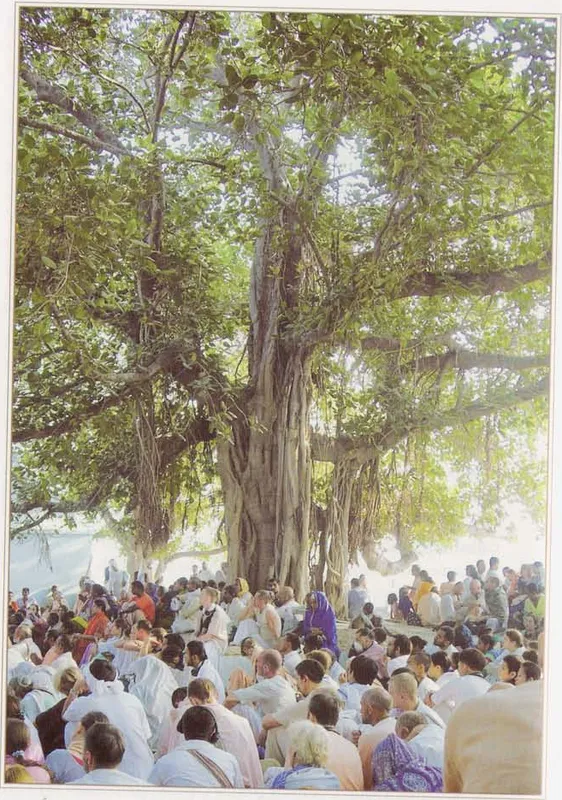
The Bhakti-ratnākara remembers three of Śrī Caitanya's associates here. According to the book, Śrī Nityānanda Prabhu stayed at Rāma-ghāṭa during His pilgrimage, absorbed in the mood of Baladeva. He played with the cowherd boys and gave darśana (a sight of Himself) as Baladeva to a brāhmaṇa there. Lying on a platform of dust under a tree, He asked again and again when the offenders would be delivered, and when the Lord of Navadvīpa would appear in Navadvīpa.[12–16]
শ্রীরাসবিলাসী নিত্যানন্দ বলরামে। স্তুতি কৈল কালিন্দী দেখিয়া এই খানে॥ এথা নিত্যানন্দ রঙ্গ দেখি দেবগণ। হইলা বিহ্বল অশ্রু নহে নিবারণ॥ এই বৃক্ষ তলে ধূলাবেদীর উপর। শয়নে বিহ্বল নিত্যানন্দ হলধর। শয়নে থাকিয়া প্রভু কহে বার বার॥ কত দিনে পাষণ্ডির হইব উদ্ধার॥ (ক) নবদ্বীপনাথ নবদ্বীপে কতদিনে। হইবেন ব্যক্ত গিয়া দেখিব নয়নে॥ ঐছে কত কহে কেহ বুঝিতে না পারে। নিতাইর অদ্ভুত লীলা বিদিত সংসারে॥
śrīrāsabilāsī nityānanda balarāme| stuti kaila kālindī dekhiẏā ei khāne|| ethā nityānanda raṅga dekhi debagaṇa| hailā bihbala aśru nahe nibāraṇa|| ei bṛkṣa tale dhūlābedīra upara| śaẏane bihbala nityānanda haladhara| śaẏane thākiẏā prabhu kahe bāra bāra|| kata dine pāṣaṇḍira haiba uddhāra|| (ka) nabadbīpanātha nabadbīpe katadine| haibena byakta giẏā dekhiba naẏane|| aiche kata kahe keha bujhite nā pāre| nitāira adbhuta līlā bidita saṁsāre||
According to the same book, Śrī Jāhnavā Mātā came to Rāma-ghāṭa on her tour of Vraja. As she meditated on Balarāma's rāsa, she saw it in a vision and fainted in joy.[17] According to its Thirteenth Wave (chapter), Śrī Vīracandra Prabhu, Śrī Nityānanda Prabhu's son, came here too. He sang Baladeva's pastimes, danced, and went on to Bhāṇḍīravaṭa.[18]
In 1972 Śrīla Prabhupāda sang the song Jaya Rādhe jaya Kṛṣṇa jaya Vṛndāvana. One of its verses glorifies Rāma-ghāṭa and Rohiṇī's son, Balarāma.[46]
Names this place“jaya jaya rāma-ghāta, rohiṇī-nandan jaya jaya vṛndāvana-bāsī jata jan”
Śrīla Prabhupāda, Jaya Rādhe Jaya Kṛṣṇa, Los Angeles, 25 September 1972 · vedabase.io
Where the sources differ
The Purāṇas tell the visit in their own ways (each summarised here, not translated). In the Viṣṇu Purāṇa, Varuṇa sends the Vāruṇī into the hollow of a kadamba tree. The river floods the forest where Balarāma was, and He returns to Dvārakā after two months.[47–50] In the Garga-saṁhitā, He begins the rāsa on the full moon of Caitra on the bank of the Kālindī (the Yamunā), with Nāga girls who had become gopīs.[24 +3] In the critical edition of the Harivaṁśa, the cowherds bring Him the Vāruṇī and He returns to Mathurā, without the two months:[54–57]
Accounts differ How Balarāma's visit to Vraja is told: the Bhāgavatam and Viṣṇu Purāṇa against the critical Harivaṁśa.
- Śrīmad-Bhāgavatam 10.65.19 and Viṣṇu Purāṇa 5.25.2-4Varuṇa sends the Vāruṇī, which flows from a tree hollow (a kadamba, in the Viṣṇu Purāṇa).
- Harivaṁśa (critical ed.) 83.19the cowherds bring the Vāruṇī to Rāma.
- Viṣṇu Purāṇa 5.25.18; Bhakti-ratnākara (Fifth Wave); KB ch. 65He came from, or returned to, Dvārakā after two months.
- Harivaṁśa (critical ed.) 83.51He returned to Mathurā; no two months or nightly rāsa are mentioned.
Accounts differ Who were the gopīs of Balarāma's rāsa?
- Śrīla Śrīdhara Svāmī (as cited by Viśvanātha on ŚB 10.65.17); Bhakti-ratnākara v.1449other girls, not yet born or very young at the time of Kṛṣṇa's pastimes.
- 'our masters' cited by Viśvanātha; Śrīla Jīva Gosvāmī (Laghu-toṣaṇī on 10.65.17); Bhakti-ratnākara vv.1442-1445Balarāma's own beloveds, named together with Kṛṣṇa's beloveds at the Holī when Śaṅkhacūḍa was killed.
- Śrīla Sanātana Gosvāmī, Bṛhad-vaiṣṇava-toṣaṇī on ŚB 10.65.17-18first: after consoling Kṛṣṇa's beloveds, Balarāma delighted other gopīs in spring, women other than those Kṛṣṇa enjoyed with; then, as another reading ('athavā'): the gopīs of the verse are Kṛṣṇa's grieving beloveds, and He stayed two months to give them a little comfort ('rati' = 'sukha') even at night.
- Śrī Vraja-maṇḍala Parikramā (2007), citing Śrīla Murāri GuptaBaladeva performed rāsa only with His own group of beloved gopīs.
The ācāryas also explain differently which form of the Yamunā was dragged. Śrīla Viśvanātha Cakravartī Ṭhākura says it was the river form, the ocean's wife, an expansion of Kālindī, not Kālindī herself. Śrīla Jīva Gosvāmī says it was a shadow-form known as the ocean's wife. The Vraja-vilāsa-stava calls the dragged river one without connection with Kṛṣṇa.[15 +2]
Accounts differ Whose form was the Yamunā that Balarāma dragged?
- Śrī Vraja-maṇḍala Parikramā (2007)Yamunā is Viśākhā herself; the Yamunā that flows into the sea is a manifestation of her, and that manifestation was dragged.
- Śrīla Viśvanātha Cakravartī on ŚB 10.65.24-25; Śrīla Jīva Gosvāmī (Krama-sandarbha)Viśvanātha: the river form, the ocean's wife, an expansion (vibhūti) of Kālindī, not Kālindī herself; Jīva (Krama-sandarbha): a shadow-form of Kṛṣṇa's chief queen in Dvārakā, known as the ocean's wife.
Places in this article
Rāma-ghāṭa
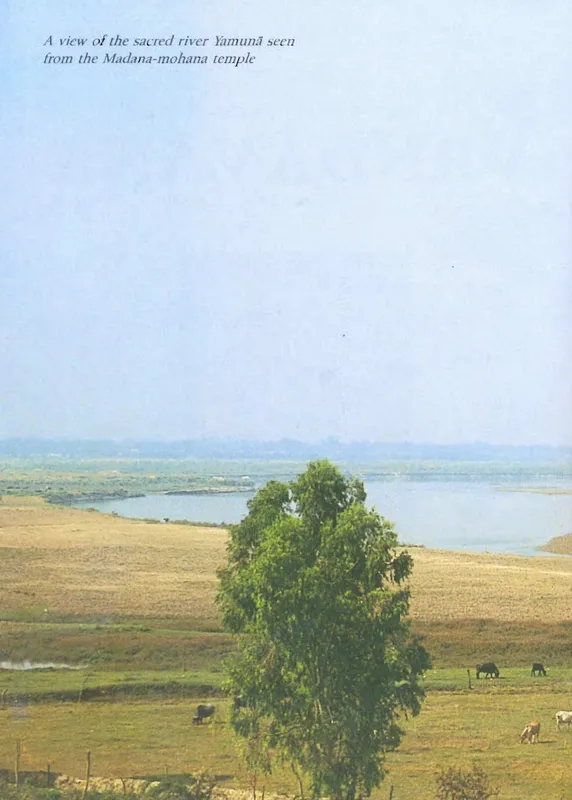
राम-घाटRāma-ghāṭa is a place on the Yamunā near Śergarh, honoured as the place of Balarāma's rāsa dance with the gopīs and of His dragging of the Yamunā with His plough, during …
Yamunā
यमुनाThe Yamunā, also called the Kālindī, is the river that runs through Vraja-maṇḍala.
Balarāma Mandira (Rāma-ghāṭa)
बलराम मन्दिर (राम-घाट)This temple of Balarāma stands at Rāma-ghāṭa on the Yamunā.
Aśvattha tree (Rāma-ghāṭa)
अश्वत्थ वृक्ष (राम-घाट)Śergarh
शेरगढ़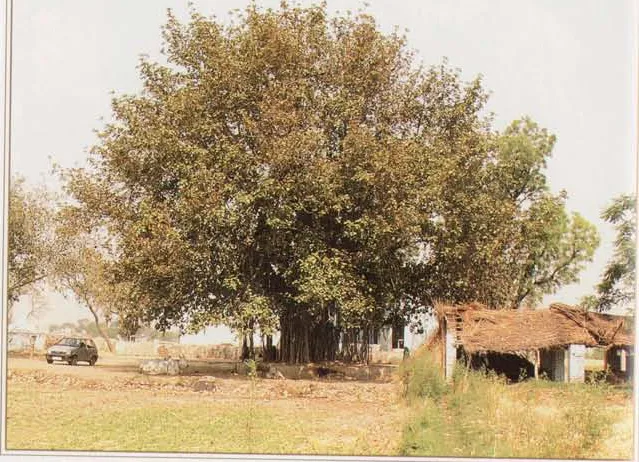
Akṣayavaṭa (near Rāma-ghāṭa)
अक्षयवट (राम-घाट के पास)Akṣayavaṭa, "the imperishable banyan", stands near Rāma-ghāṭa on the Yamunā.
Questions and answers
He was eager to see His friends and well-wishers. The cowherds, long anxious in separation, embraced Him. He consoled the gopīs with the messages Kṛṣṇa had sent.[1–3]
Two months, Madhu and Mādhava, that is Caitra and Vaiśākha, in spring. The Bhāgavatam and Śrīla Prabhupāda's Kṛṣṇa book both say so.[4, 59]
He called the river for water play, and she did not come, because she thought He was intoxicated. In anger He dragged her with the tip of His plough, until she came and fell at His feet.[7, 27]
On the Yamunā near Śergarh, according to the guidebook Śrī Vraja-maṇḍala Parikramā (2007). Śrīla Jīva Gosvāmī's Gopāla-campū names Rāma-ghaṭṭa north of the Bhāṇḍīra banyan.[8 +7]
The commentators answer differently. Śrīdhara Svāmī says they were other girls, too young during Kṛṣṇa's pastimes. Śrīla Jīva Gosvāmī says they were Balarāma's own beloveds.[15 +5]
The Bhāgavatam says that even today the Yamunā flows through the channels made by the dragging. Śrīla Raghunātha dāsa Gosvāmī places this sight at Rāma-ghaṭṭa.[8 +3]
Yes, according to the Bhakti-ratnākara. He stayed there on His pilgrimage, absorbed in the mood of Baladeva. He played with the cowherd boys and gave a brāhmaṇa darśana as Baladeva.[12–16]
Sources
- Śrīmad-Bhāgavatam 10.65.1, GRETIL
- Śrīmad-Bhāgavatam 10.65.4-6, GRETIL
- Śrīla Prabhupāda, Kṛṣṇa, the Supreme Personality of Godhead (Kṛṣṇa book), Chapter 65, 'Lord Balarāma Visits Vṛndāvana' · vedabase.io
- Śrīmad-Bhāgavatam 10.65.17, GRETIL
- Śrīmad-Bhāgavatam 10.65.18, GRETIL
- Śrīmad-Bhāgavatam 10.65.19, GRETIL
- Śrīmad-Bhāgavatam 10.65.25 and the first line of 10.65.26 = 10.65.24-25 on vedabase, GRETIL
- Śrīmad-Bhāgavatam 10.65.33, GRETIL
- Śrīla Prabhupāda, Kṛṣṇa, the Supreme Personality of Godhead, ch. 65 'Lord Balarāma Visits Vṛndāvana' · vedabase.io
- Śrīla Viśvanātha Cakravartī Ṭhākura: commentary on ŚB 10.65.18, Bhagavata Vidya Pith edition, ed. Bhagavata Rishi and Krishna Shankar Shastri, 1996
- Śrīla Prabhupāda, Letter to Jadurani, letter dated 11 July 1970 · vedabase.io
- Śrīla Narahari Cakravartī, Bhakti-ratnākara, Fifth Wave (pañcama taraṅga), printed p. 266, vv.1548-1550 in the Grantha Mandira numbering, 2nd ed., 1912
- Śrīla Narahari Cakravartī, Bhakti-ratnākara, Fifth Wave (pañcama taraṅga), printed p. 267, vv.1551-1556 in the Grantha Mandira numbering, 2nd ed., 1912
- Śrīla Narahari Cakravartī, Bhakti-ratnākara, Fifth Wave (pañcama taraṅga), printed p. 267, vv.1557-1562 in the Grantha Mandira numbering, 2nd ed., 1912
- Śrī Vraja-maṇḍala Parikramā (2007), PDF p. 238
- the undated parikramā notes Rāma-ghāṭa, ¶18
- Śrīla Narahari Cakravartī, Bhakti-ratnākara, Eleventh Wave (ekādaśa taraṅga), printed p. 671, vv.217-222 in the Grantha Mandira numbering, 2nd ed., 1912
- Śrīla Narahari Cakravartī, Bhakti-ratnākara, Thirteenth Wave (trayodaśa taraṅga), printed p. 1025, vv.375-377 in the Grantha Mandira numbering, 2nd ed., 1912
- Śrīla Sanātana Gosvāmī, Śrīla Jīva Gosvāmī, Śrīla Viśvanātha Cakravartī Ṭhākura: commentary on ŚB 10.65.1, Bhagavata Vidya Pith edition, ed. Bhagavata Rishi and Krishna Shankar Shastri, 1996
- Śrīmad-Bhāgavatam 10.65.16, Bhagavata Vidya Pith edition, ed. Bhagavata Rishi and Krishna Shankar Shastri, 1996
Show all 59 references
- Śrīla Viśvanātha Cakravartī Ṭhākura, Śrīla Jīva Gosvāmī: commentary on ŚB 10.65.17, Bhagavata Vidya Pith edition, ed. Bhagavata Rishi and Krishna Shankar Shastri, 1996
- Śrīla Narahari Cakravartī, Bhakti-ratnākara, Fifth Wave (pañcama taraṅga), printed p. 258, vv.1440-1445 in the Grantha Mandira numbering, 2nd ed., 1912
- Śrīla Narahari Cakravartī, Bhakti-ratnākara, Fifth Wave (pañcama taraṅga), printed p. 259, vv.1446-1449 in the Grantha Mandira numbering, 2nd ed., 1912
- Garga-saṁhitā, Balabhadra-khaṇḍa (8), adhyāya 9, verse 3, Sanskrit Wikisource
- Śrīla Sanātana Gosvāmī: commentary on ŚB 10.65.17, the second explanation, introduced by 'athavā', Bhagavata Vidya Pith edition, ed. Bhagavata Rishi and Krishna Shankar Shastri, 1996
- Śrīmad-Bhāgavatam 10.65.25 and the first line of 10.65.26 = 10.65.24-25 on vedabase, GRETIL
- Śrīla Prabhupāda, Kṛṣṇa, the Supreme Personality of Godhead, ch. 65 "Lord Balarāma Visits Vṛndāvana" · vedabase.io
- Śrīla Jīva Gosvāmī: commentary on ŚB 10.65.31 in the Śrīmad-Bhāgavatam canto 10, part 7, with ten commentaries numbering (= 10.65.33 on vedabase and in Bhāgavata Purāṇa), Bhagavata Vidya Pith edition, ed. Bhagavata Rishi and Krishna Shankar Shastri, 1996
- Raghunātha dāsa Gosvāmī, Stavāvalī (9) Vraja-vilāsa-stava v.94
- Śrīla Narahari Cakravartī, Bhakti-ratnākara, Fifth Wave (pañcama taraṅga), printed p. 266, vv.1544-1547 in the Grantha Mandira numbering, 2nd ed., 1912
- Vṛndāvana-Dhāma Ki Jaya! (c. 1986), by Dhruva Mahārāja dāsa, PDF p. 56
- Jīva Gosvāmī, Pūrva-campū (1) prathamaṁ pūraṇam ¶[54] v.30
- Jīva Gosvāmī, Pūrva-campū (1) prathamaṁ pūraṇam ¶[79], prose
- Śrīla Narahari Cakravartī, Bhakti-ratnākara, Fifth Wave (pañcama taraṅga), printed p. 258, vv.1436-1439 in the Grantha Mandira numbering, 2nd ed., 1912
- Śrī Vraja-maṇḍala Parikramā (2007), PDF p. 237
- the undated parikramā notes Rāma-ghāṭa, ¶11
- Śrīla Narahari Cakravartī, Bhakti-ratnākara, Fifth Wave (pañcama taraṅga), printed p. 265, vv.1524-1525 in the Grantha Mandira numbering, 2nd ed., 1912
- Śrīla Narahari Cakravartī, Bhakti-ratnākara, Fifth Wave (pañcama taraṅga), printed p. 265, vv.1535-1537 in the Grantha Mandira numbering, 2nd ed., 1912
- Śrīla Narahari Cakravartī, Bhakti-ratnākara, Fifth Wave (pañcama taraṅga), printed p. 258, vv.1436-1439 in the Grantha Mandira numbering, 2nd ed., 1912
- Kṛṣṇa-caitanya-caritāmṛta of Murāri Gupta, prakrama 4, sarga 10, vv.1-2 (4.10.1-2), PDF page 589
- the undated parikramā notes Rāma-ghāṭa, ¶12
- the undated parikramā notes Rāma-ghāṭa, ¶14
- the undated parikramā notes Rāma-ghāṭa, ¶13
- A. W. Entwistle, ch. 8 §58 'Shergarh', printed p. 392, Egbert Forsten, Groningen, 1987
- Śrīla Narahari Cakravartī, Bhakti-ratnākara, Fifth Wave (pañcama taraṅga), printed p. 267, vv.1557-1562 in the Grantha Mandira numbering, 2nd ed., 1912
- Śrīla Prabhupāda, Jaya Rādhe Jaya Kṛṣṇa, Los Angeles, 25 September 1972 · vedabase.io
- Viṣṇu Purāṇa, 5.24.8, GRETIL
- Viṣṇu Purāṇa, 5.25.4, GRETIL
- Viṣṇu Purāṇa, 5.25.10-11, GRETIL
- Viṣṇu Purāṇa, 5.25.18, GRETIL
- Garga-saṁhitā, Balabhadra-khaṇḍa (8), adhyāya 9 ('rāma-rāsa-krīḍā-varṇana'), verse 2, Sanskrit Wikisource
- Garga-saṁhitā, Balabhadra-khaṇḍa (8), adhyāya 9, verse 7, Sanskrit Wikisource
- Garga-saṁhitā, Balabhadra-khaṇḍa (8), adhyāya 9, verse 11 (end of the chapter), Sanskrit Wikisource
- Harivaṁśa, HV 83.19, GRETIL
- Harivaṁśa, HV 83.39-40, GRETIL
- Harivaṁśa, HV 83.48-49, GRETIL
- Harivaṁśa, HV 83.51, GRETIL
- Śrīla Viśvanātha Cakravartī: commentary on ŚB 10.65.24-25 in the Śrīmad-Bhāgavatam canto 10, part 7, with ten commentaries numbering (= vedabase 10.65.26-27), Bhagavata Vidya Pith edition, ed. Bhagavata Rishi and Krishna Shankar Shastri, 1996
- Śrīla Prabhupāda, Kṛṣṇa, the Supreme Personality of Godhead, chapter 65, 'Lord Balarāma Visits Vṛndāvana' · vedabase.io
Further sources
- Śrīmad-Bhāgavatam 10.65, translation by Śrīla Prabhupāda's disciples (BBT); Śrīla Prabhupāda's Kṛṣṇa book, chapter 65; his letter to Jadurani, 11 July 1970.
- The Canto 10 commentaries of Śrīla Sanātana Gosvāmī, Śrīla Jīva Gosvāmī and Śrīla Viśvanātha Cakravartī Ṭhākura (Sanskrit), summarised, not translated.
- Śrīla Raghunātha dāsa Gosvāmī, Vraja-vilāsa-stava 94; Śrīla Jīva Gosvāmī, Gopāla-campū; Bhakti-ratnākara (1912 edition); Viṣṇu Purāṇa, Harivaṁśa, Garga-saṁhitā: summarised unless a published translation is shown.