Saṅkarṣaṇa-kuṇḍa (Aniyora)
संकर्षण-कुण्ड (आन्यौर) Hindi name proposed
Also called Saṅkarṣaṅa-kuṇḍa
- What it is
- Saṅkarṣaṇa-kuṇḍa is a pond that bears a name of Lord Balarāma, Saṅkarṣaṇa.
- Visiting
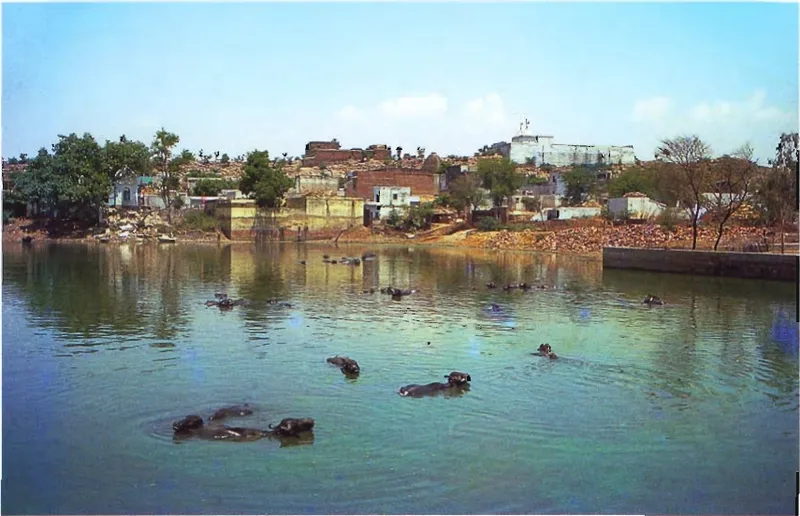
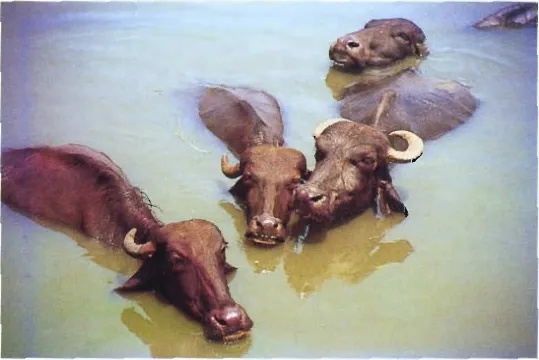
- In 2001 Govardhana Hill described the kuṇḍa as once much larger and surrounded by ghāṭas (bathing steps), but long neglected, with its ghāṭas gone; its photographs show buffaloes bathing in the water.
In short
Saṅkarṣaṇa-kuṇḍa is a pond that bears a name of Lord Balarāma, Saṅkarṣaṇa. The guidebook Govardhana Hill (2001) places it on the outskirts of Aniyora and says that it is dedicated to Balarāma; Śrī Vraja-maṇḍala Parikramā (2007) puts a Saṅkarṣaṇa-kuṇḍa with a temple of Śrī Baladeva on its bank in Pārāsaulī instead (Saṅkarṣaṇa-kuṇḍa (Pārāsaulī)).[1 +1] The Varāha Purāṇa names a tīrtha called Saṅkarṣaṇa on the Govardhana circuit, protected by Balabhadra (Balarāma).[1 +1] Śrīla Rūpa Gosvāmī sets a scene of his play Vidagdha-mādhava at a Saṅkarṣaṇa-kuṇḍa, and Śrīla Viśvanātha Cakravartī Ṭhākura names a Saṅkarṣaṇa-kuṇḍa, with Dāna-nivartana-kuṇḍa, as the place of the great Annakūṭa festival. None of these texts names a village, so no source says whether they mean this kuṇḍa or the one in Pārāsaulī.[4 +2]
Key facts
| Kind | kuṇḍa |
|---|---|
| Region · area | Govardhana |
| Ācāryas | Śrīla Śrīnivāsa Ācārya, Śrīla Narahari Cakravartī Ṭhākura, Śrīla Rūpa Gosvāmī, Śrīla Viśvanātha Cakravartī Ṭhākura |
Why it is glorified
The Varāha Purāṇa, in its chapter on Govardhana, names a tīrtha called Saṅkarṣaṇa, protected by Balabhadra, and says that by …
The Varāha Purāṇa, in its chapter on Govardhana, names a tīrtha called Saṅkarṣaṇa, protected by Balabhadra, and says that by bathing there the sin of killing a cow leaves a person quickly (summarised here, not translated). It calls the place a tīrtha, not a kuṇḍa, and names no village, so it does not say that it is this kuṇḍa.[1 +1]
In the Bhakti-ratnākara, Śrīla Śrīnivāsa Ācārya is shown Saṅkarṣaṇa-kuṇḍa on his round of Govardhana. His guide calls it full of splendour and says that bathing there fulfils one's desires. The book names it just before Pārāsaulī village, not at Aniyora.[7 +1]
Divine pastimes
The first Govardhana-pūjā
Śrīmad-Bhāgavatam (10.24) tells how Kṛṣṇa had the cowherds use what they had gathered for Indra's sacrifice to worship the cows, the brāhmaṇas and the hill. They presented their offerings, fed the cows and walked around the hill, and Kṛṣṇa, in a huge form, said that He was the hill and ate the offerings. The chapter calls it only "the hill" and names no kuṇḍa, no spot on the hill and no village.[9 +3]
tathā ca vyadadhuḥ sarvaṃ yathāha madhusūdanaḥ / vācayitvā svasty-ayanaṃ tad-dravyeṇa giri-dvijān … upahṛtya balīn samyag ādṛtā yavasaṃ gavām / go-dhanāni puraskṛtya giriṃ cakruḥ pradakṣiṇam
The cowherd community then did all that Madhusūdana had suggested. They arranged for the brāhmaṇas to recite the auspicious Vedic mantras, and using the paraphernalia that had been intended for Indra’s sacrifice, they presented offerings to Govardhana Hill and the brāhmaṇas with reverential respect. They also gave grass to the cows. Then, placing the cows, bulls and calves in front of them, they circumambulated Govardhana.
Translation: Śrīla Prabhupāda's disciples (BBT)Śrīla Viśvanātha Cakravartī Ṭhākura's Vraja-rīti-cintāmaṇi places Saṅkarṣaṇa's lake on the eastern side of Govardhana, in its southern part, with Gaurī-tīrtha (Gaurī-kuṇḍa) to its east; it names no village. Two verses later it names Saṅkarṣaṇa-kuṇḍa and Dāna-nivartana-kuṇḍa together as the place where Nanda, the king of bliss who delights the young prince, holds the great Annakūṭa festival, told in the present tense as an eternal pastime (summarised here, not translated).[5 +1] Read more: The first Govardhana-pūjā and the Annakūṭa →
Candrāvalī on the way to Gaurī-tīrtha
In Act 7 of Śrīla Rūpa Gosvāmī's Vidagdha-mādhava, Candrāvalī goes with her friends to Gaurī-tīrtha to worship the goddess Kātyāyanī, and Śaibyā remarks that she can be seen east of Saṅkarṣaṇa-kuṇḍa. Later Kṛṣṇa decides to wait for a moment in the forest on the bank of Saṅkarṣaṇa-tīrtha to see what will follow (summarised here, not translated). The play names no village.[4]
Traditional accounts
According to the local tradition recorded in Govardhana Hill (2001), this kuṇḍa is connected with the Dāūjī (Balarāma) Deity of …
According to the local tradition recorded in Govardhana Hill (2001), this kuṇḍa is connected with the Dāūjī (Balarāma) Deity of Aniyora, which, the book says, Vajranābha installed. No date, document or other source has been found for this connection, so it is not certain.[13]
Śrīla Prabhupāda
Śrīla Prabhupāda does not speak of the kuṇḍa by name.
Śrīla Prabhupāda does not speak of the kuṇḍa by name. Of the Govardhana-pūjā, the festival that the Vraja-rīti-cintāmaṇi sets at a Saṅkarṣaṇa-kuṇḍa, he writes in the Kṛṣṇa book:[12]
General teaching (does not name the place)“From that day, Govardhana-pūjā has been going on and is known as Annakūṭa. In all the temples of Vṛndāvana or outside of Vṛndāvana, huge quantities of food are prepared in this ceremony and are very sumptuously distributed to the general population.”
Śrīla Prabhupāda, Kṛṣṇa, the Supreme Personality of Godhead (Kṛṣṇa book), Chapter 24, Worshiping Govardhana Hill · vedabase.io
Visiting today
In 2001 Govardhana Hill described the kuṇḍa as once much larger and surrounded by ghāṭas (bathing steps), but long neglected, with its ghāṭas gone; its photographs show buffaloes bathing in the water.[1 +1]
Location
| Where it is | 'on the outskirts of Aniyora'; Aniyora is 'on the banks' of it[15] |
|---|---|
| On the numbered Govardhana chart | 40 (printed as “Sankarsana Kund”)[16] |
Nearby places
Aniyora · Gaurī-kuṇḍa (Govardhana)
Pictures
1 pictures
Where the sources differ
Where the kuṇḍa is: Govardhana Hill (2001) puts it on the outskirts of Aniyora, Śrī Vraja-maṇḍala Parikramā (2007) in Pārāsaulī, the Bhakti-ratnākara names it just before Pārāsaulī, and the older texts name no village; there may be two kuṇḍas of this name.[1 +5]
Accounts differ Where Saṅkarṣaṇa-kuṇḍa is (and whether the Aniyora and Pārāsaulī kuṇḍas are one or two)
- Govardhana Hill: India's Most Sacred Mountain (2001)'on the outskirts of Aniyora'; caption 'The village of Aniyora on the banks of Saṅkarṣaṅa-kuṇḍa'; Gaurī-kuṇḍa is 'near' it
- the key of the numbered Govardhana chart (Govardhana chart key)no. 40 'Sankarsana Kund', listed between 39 'Balarama (Dauji) Temple' and 41 'Gopala Prakata Sthall', after 36 'Aniyor Village'
- Śrī Vraja-maṇḍala Parikramā (2007)'In the south-eastern part of Pārāsaulī is Saṅkarṣaṇa-kuṇḍa, on whose bank is a temple of Śrī Baladeva'
- Bhakti-ratnākara, Fifth Wave (1912 ed. p. 200)names the kuṇḍa right after the Ṛṇa-mocana and Pāpa-mocana kuṇḍas and right before this Parāsauli village; Āniyora and Gaurī-tīrtha come later in the tour
The wording of these accounts is our summary of the sources, not a published translation.
More on this place
The first Govardhana-pūjā and the Annakūṭa
References
16 references
- Govardhana Hill: India's Most Sacred Mountain (2001), Rajasekhara dasa Brahmacari, PDF p. 102
- Śrī Vraja-maṇḍala Parikramā (2007), PDF p. 124
- Varāha Purāṇa, adhyāya 164, verses 22-23a, Sanskrit Wikisource
- Śrīla Rūpa Gosvāmī, Vidagdha-mādhava, Act 7, v.9 and the dialogue after v.11
- Śrīla Viśvanātha Cakravartī Ṭhākura, Vraja-rīti-cintāmaṇi, third sarga, v.18
- Śrīla Viśvanātha Cakravartī Ṭhākura, Vraja-rīti-cintāmaṇi 3.20
- Śrīla Narahari Cakravartī, Bhakti-ratnākara, Fifth Wave, 1912 ed. p. 200, 2nd ed., 1912
- Vṛndāvana-Dhāma Ki Jaya! (c. 1986), by Dhruva Mahārāja dāsa, PDF p. 43
- Śrīmad-Bhāgavatam 10.24.25, GRETIL
- Śrīmad-Bhāgavatam 10.24.32–33, GRETIL
- Śrīmad-Bhāgavatam 10.24.35, GRETIL
- Śrīla Prabhupāda, Kṛṣṇa, the Supreme Personality of Godhead (Kṛṣṇa book), Chapter 24, Worshiping Govardhana Hill · vedabase.io
- Govardhana Hill: India's Most Sacred Mountain (2001), Rajasekhara dasa Brahmacari, PDF p. 97
- Govardhana Hill: India's Most Sacred Mountain (2001), Rajasekhara dasa Brahmacari, PDF p. 96
- Govardhana Hill: India's Most Sacred Mountain (2001), Rajasekhara dasa Brahmacari, p. 88
- Numbered list of the Govardhana sites (key of the Govardhana chart)