Dāmodara and the twin arjuna trees
The deliverance of Nalakūvara and Maṇigrīva
In short
Dāmodara-līlā is the pastime in which Mother Yaśodā tied the child Kṛṣṇa to a wooden mortar with a rope. Dragging the mortar, He passed between two arjuna trees and pulled them down. This freed Kuvera's sons, Nalakūvara and Maṇigrīva, from Nārada's curse. Because of the rope around His waist, He is called Dāmodara.[1–10]
On this page
At a glance
- Scripture: Śrīmad-Bhāgavatam, Tenth Canto, chapters 9 to 11, with Śrīla Prabhupāda's translation and purports (his explanations of the verses).[4–9]
- The name: Dāmodara means the one bound with a rope round the waist. As Śrīla Prabhupāda explains, the name comes from this pastime.[10]
- The trees: they were the two sons of Kuvera. Nārada had cursed them to stand as trees until they saw Vāsudeva.[9, 11]
- The place: Gokula, which three scriptures name as Mahāvana.[12–14]
- Śrī Caitanya Mahāprabhu saw the place and was moved to great ecstatic love.[15–18]
- In the month of Kārttika (October–November), devotees sing the Dāmodarāṣṭaka, which remembers how Kuvera's sons were freed.[19]
Why did Mother Yaśodā bind Kṛṣṇa?
The Bhāgavatam's ninth chapter tells of the morning that led to it. Kṛṣṇa had stolen the milk products. He was sitting on a wooden mortar turned upside down, giving yogurt and butter to the monkeys. He kept looking round anxiously in case His mother came. Yaśodā crept up on Him from behind.[1 +3]
ulūkhalāṅghrer upari vyavasthitaṁ markāya kāmaṁ dadataṁ śici sthitam
haiyaṅgavaṁ caurya-viśaṅkitekṣaṇaṁ nirīkṣya paścāt sutam āgamac chanaiḥ ||
Kṛṣṇa, at that time, was sitting on an upside-down wooden mortar for grinding spices and was distributing milk preparations such as yogurt and butter to the monkeys as He liked. Because of having stolen, He was looking all around with great anxiety, suspecting that He might be chastised by His mother. Mother Yaśodā, upon seeing Him, very cautiously approached Him from behind.
Translation: Śrīla A.C. Bhaktivedanta Swami PrabhupādaŚrīla Viśvanātha Cakravartī Ṭhākura says that Kṛṣṇa had slipped out by a side door into an outer courtyard of Nanda's house. There the mortar had been turned over for fear of crows (summarised here, not translated).[22] Śrīla Prabhupāda's Kṛṣṇa book tells the same scene:
General teaching (does not name the place)“After she sought all over, she found her son sitting on a big wooden grinding mortar, which was kept upside down. He was taking butter from a pot which was hanging from the ceiling on a swing, and He was feeding it to the monkeys.”
Śrīla Prabhupāda, Kṛṣṇa, the Supreme Personality of Godhead, ch. 9 "Mother Yaśodā Binds Lord Kṛṣṇa" · vedabase.io
Then Yaśodā tied Him to the mortar. The Bhāgavatam points out what this meant. The Lord, who is beyond the senses, had appeared as a human child. Thinking Him her own ordinary son, she bound Him with a rope.[1–3]
That unmanifested person, who is beyond the perception of the senses, had now appeared as a human child, and mother Yaśodā, considering Him her own ordinary child, bound Him to the wooden mortar with a rope.
Translation: Śrīla A.C. Bhaktivedanta Swami PrabhupādaBut the rope was never long enough. Then Kṛṣṇa saw how tired His mother had become. Her body was covered with sweat, and the flowers were falling from her hair. Then He agreed to be bound.[2, 3]
General teaching (does not name the place)“Although He is beyond the reach of all senses, she endeavored to bind Him to a wooden grinding mortar. … Then Lord Kṛṣṇa appreciated the hard labor of His mother, and being compassionate upon her, He agreed to be bound up by the ropes.”
Śrīla Prabhupāda, Kṛṣṇa, the Supreme Personality of Godhead, ch. 9 "Mother Yaśodā Binds Lord Kṛṣṇa" · vedabase.io
Why is Kṛṣṇa called Dāmodara?
Dāma means a rope, and udara means the waist or belly. In his purport to the verse in which the trees fall, Śrīla Prabhupāda names the whole episode:[10]
General teaching (does not name the place)“This is the pastime of Kṛṣṇa known as dāmodara-līlā. Therefore another of Kṛṣṇa’s names is Dāmodara.”
Śrīla Prabhupāda, Śrīmad-Bhāgavatam, 10.10.27, purport · vedabase.io
The same purport quotes the Harivaṁśa. There the gopīs, the cowherd women of the settlement, sing of Him as Dāmodara.[10] The Padma Purāṇa, an old scripture, names Bāla-gopāla, the five-year-old Kṛṣṇa called Dāmodara, as the presiding Deity of Mahāvana. It says that the twin arjuna trees were broken there.[12]
Who were Nalakūvara and Maṇigrīva?
The two trees had once been the sons of Kuvera, the treasurer of the demigods. Yaśodā was busy with her household work. Meanwhile, the bound child saw the two trees standing before Him.[4–9]
kṛṣṇas tu gṛha-kṛtyeṣu vyagrāyāṁ mātari prabhuḥ
adrākṣīd arjunau pūrvaṁ guhyakau dhanadātmajau ||
While mother Yaśodā was very busy with household affairs, the Supreme Lord, Kṛṣṇa, observed twin trees known as yamala-arjuna, which in a former millennium had been the demigod sons of Kuvera.
Translation: Śrīla A.C. Bhaktivedanta Swami PrabhupādaIn the tenth chapter, Śukadeva Gosvāmī tells their story. The two brothers were drunk and playing naked, and the sage Nārada cursed them to become trees. But by his mercy, after a hundred years of the demigods, they would see Vāsudeva face to face. Then they would return to their real position as devotees.[9, 11]
Moreover, by my special favor, after the expiry of one hundred years by the measurement of the demigods, they will be able to see the Supreme Personality of Godhead, Vāsudeva, face to face, and thus revive their real position as devotees.
Translation: Śrīla A.C. Bhaktivedanta Swami PrabhupādaŚrīla Prabhupāda reads the curse as mercy. He writes that Nārada's favour let the two grow in Nanda's courtyard and see Kṛṣṇa face to face.[9]
Names this place“The two demigods were favored by the causeless mercy of Nārada and given a chance to grow in Nanda’s courtyard and see Lord Kṛṣṇa face to face.”
Śrīla Prabhupāda, Kṛṣṇa, the Supreme Personality of Godhead, ch. 10 "The Deliverance of Nalakūvara and Maṇigrīva" · vedabase.io
Śrīla Sanātana Gosvāmī explains Nārada's words (summarised here, not translated). By this favour, he says, they were born as great arjuna trees near Śrī Nanda's home in Bṛhadvana. There they gave shade and were helpful to all.[23]
How did Kṛṣṇa pull down the trees?
Kṛṣṇa wanted to make the words of His great devotee Nārada come true. So He went slowly to the place where the two trees stood.[5] He passed between them, and the big mortar turned sideways and got stuck.[6]
ity antareṇārjunayoḥ kṛṣṇas tu yamayor yayau
ātma-nirveśa-mātreṇa tiryag-gatam ulūkhalam ||
Having thus spoken, Kṛṣṇa soon entered between the two arjuna trees, and thus the big mortar to which He was bound turned crosswise and stuck between them.
Translation: Śrīla A.C. Bhaktivedanta Swami PrabhupādaThe mortar was tied to His belly. Dragging it, the child pulled with great force. The trees shook, with their trunks, leaves and branches, and fell to the ground with a great crash.[7]
bālena niṣkarṣayatānvag ulūkhalaṁ tad dāmodareṇa tarasotkalitāṅghri-bandhau
niṣpetatuḥ parama-vikramitātivepa- skandha-pravāla-viṭapau kṛta-caṇḍa-śabdau ||
By dragging behind Him with great force the wooden mortar tied to His belly, the boy Kṛṣṇa uprooted the two trees. By the great strength of the Supreme Person, the two trees, with their trunks, leaves and branches, trembled severely and fell to the ground with a great crash.
Translation: Śrīla A.C. Bhaktivedanta Swami PrabhupādaIn that very place, two perfected beings came out of the fallen trees, shining like fire. They bowed their heads to Kṛṣṇa and offered their prayers with folded hands.[8]
tatra śriyā paramayā kakubhaḥ sphurantau siddhāv upetya kujayor iva jāta-vedāḥ
kṛṣṇaṁ praṇamya śirasākhila-loka-nāthaṁ baddhāñjalī virajasāv idam ūcatuḥ sma ||
Thereafter, in that very place where the two arjuna trees had fallen, two great, perfect personalities, who appeared like fire personified, came out of the two trees. The effulgence of their beauty illuminating all directions, with bowed heads they offered obeisances to Kṛṣṇa, and with hands folded they spoke the following words.
Translation: Śrīla A.C. Bhaktivedanta Swami PrabhupādaThe cowherd men came running at the sound. They saw the fallen trees and the child dragging the mortar, and they could not understand what had happened. The boys who had been there told them that Kṛṣṇa had done it, and that two men had come out of the trees.[25–27]
Names this place“When the twin arjuna trees fell to the ground, making a sound like the falling of thunderbolts, all the inhabitants of Gokula, including Nanda Mahārāja, immediately came to the spot. … the small children who were playing there informed the men that the trees had fallen because Kṛṣṇa had pulled the wooden mortar with the ropes binding Him.”
Śrīla Prabhupāda, Kṛṣṇa, the Supreme Personality of Godhead, ch. 11 "Killing the Demons Vatsāsura and Bakāsura" · vedabase.io
Later Upananda counted this among the signs of the Lord's protection. Neither Kṛṣṇa nor His playmates died when the trees fell, though the children were near them or even between them.[28] He said this in the meeting that led the cowherds to leave Gokula for Vṛndāvana.[28] Read more: The original Gokula: Mahāvana and the later village of Gokula →
Where did the twin arjuna trees stand?
The Bhāgavatam speaks of the spot only as the place where the two arjunas stood. It does not say how far it was from the house.[4–9] Śrīla Prabhupāda puts the trees in the courtyard of Mother Yaśodā and Nanda Mahārāja.[29]
Names this place“By the curse of the devarṣi, Nalakūvara and Maṇigrīva became twin arjuna trees and remained in the courtyard of mother Yaśodā and Nanda Mahārāja, waiting for the opportunity to see Kṛṣṇa directly.”
Śrīla Prabhupāda, Śrīmad-Bhāgavatam, Canto 10, chapter 10, chapter summary · vedabase.io
The ācāryas, the great teachers of the tradition, give a little more (summarised here, not translated). Śrīla Jīva Gosvāmī's Gopāla-campū says that the two stood near Nanda's house in Bṛhadvana. Śrīla Baladeva Vidyābhūṣaṇa says they stood at the gate of Yaśodā's house.[30, 31] A later verse calls Kṛṣṇa "the breaker of the arjunas" when He went to play by the river. On that verse, Śrīla Sanātana Gosvāmī offers one possible reading: that the two had stood on the Yamunā's bank.[32]
Three scriptures name Mahāvana. In the Padma Purāṇa, the arjunas were broken in Mahāvana. In the Garga-saṁhitā, the sons are told they will get back their forms beside the Yamunā, close to Mahāvana. The Ādi-purāṇa says it happened in beautiful Mahāvana.[12–14]
कदाचिद्देवलो नाम मुनींद्रो वेदपारगः । नग्नौ दृष्ट्वा च तावाह दुष्टशीलौ गतस्मृती ॥ 29 ॥ देवल उवाच - युवां वृक्षसमौ दृष्टौ निर्लज्जौ द्रव्यदर्पितौ । तस्माद्वृक्षौ तु भूयास्तां वर्षाणां शतकं भुवि ॥ 30 ॥ द्वापरांते भारते च माथुरे व्रजमंडले । कलिंदनंदिनीतीरे महावनसमीपतः ॥ 31 ॥ परिपूर्णतमं साक्षात्कृष्णं दामोदरं हरिम् । गोलोकनाथं तं दृष्ट्वा पूर्वरूपौ भविष्यथः ॥ 32 ॥
kadāciddevalo nāma munīṁdro vedapāragaḥ
nagnau dṛṣṭvā ca tāvāha duṣṭaśīlau gatasmṛtī
29
devala uvāca - yuvāṁ vṛkṣasamau dṛṣṭau nirlajjau dravyadarpitau
tasmādvṛkṣau tu bhūyāstāṁ varṣāṇāṁ śatakaṁ bhuvi
30
dvāparāṁte bhārate ca māthure vrajamaṁḍale
kaliṁdanaṁdinītīre mahāvanasamīpataḥ
31
paripūrṇatamaṁ sākṣātkṛṣṇaṁ dāmodaraṁ harim
golokanāthaṁ taṁ dṛṣṭvā pūrvarūpau bhaviṣyathaḥ || 32 ||
The accounts of the exact spot are listed together:
Accounts differ Where the twin arjuna trees stood.
- Śrīmad-Bhāgavatam 10.10.24-28Kṛṣṇa went slowly to 'where the two arjunas stood'; the Bhāgavatam gives no distance from the house.
- Śrīla Prabhupāda, Kṛṣṇa book ch. 10 and the summary of ŚB 10.10In Nanda's courtyard; 'in the courtyard of mother Yaśodā and Nanda Mahārāja'.
- Śrīla Sanātana Gosvāmī, Bṛhad-vaiṣṇava-toṣaṇī on 10.10.22 and 10.11.12Near Śrī Nanda's residence in Bṛhadvana; on 10.11.12 he also offers that the two stood on the Yamunā's bank.
- Śrīla Jīva Gosvāmī, Gopāla-campū, Pūrva 9In the place near Nanda's house in Bṛhadvana.
How do the other Purāṇas tell it?
The other Purāṇas tell the pastime with differences of their own (each summarised here, not translated). In the Garga-saṁhitā, the one who curses the brothers is the sage Devala, not Nārada. There Kṛṣṇa goes to the Yamunā with the boys, dragging the mortar.[13, 33] In the Brahma-vaivarta Purāṇa, Yaśodā ties Him with a cloth to a single tree at her house. Only Nalakūbara, cursed by Devala, comes out of it.[34, 35]
The Viṣṇu Purāṇa and the Harivaṁśa give the trees no former identity, and they have no churning of butter. In them Yaśodā binds the restless child after He has wandered about the cow-pens or the settlement. He drags the mortar out between the two trees.[36, 37] In the Harivaṁśa, the gopīs on the path to the Yamunā are the first to see Him. The cowherds ask who has cut down the foremost trees of the settlement.[38, 39]
In the Uttara-khaṇḍa of the Padma Purāṇa, Yaśodā ties Him up and goes off to sell milk products. The freed beings become Kiṁnaras, a kind of heavenly singer.[40] The Ādi-purāṇa follows the Bhāgavatam more closely. It has Nārada's curse of a hundred years of the gods, and boys who tell the elders what they saw.[14, 41]
Who the trees had been is listed here with each source:
Accounts differ Who the two trees were, and what they became when freed.
- Śrīmad-Bhāgavatam 10.9.22-23, 10.10Two Guhyakas, Nalakūvara and Maṇigrīva, sons of Kuvera; freed, they praised Kṛṣṇa and returned to their abode.
- Vraja-bhakti-vilāsa 4.77Two Gandharvas named Yamala and Arjuna, who regained the state of Gandharvas.
- Brahma-vaivarta, Kṛṣṇa-janma-khaṇḍa 14.11-14, 14.29-42One tree: Nalakūbara alone, cursed with Rambhā.
- Padma Purāṇa, Uttara-khaṇḍa 245.94Freed, the Yamala-arjunas attained the state of Kiṁnaras.
The Yamalārjuna place in Mahāvana
The pilgrimage texts name a tīrtha, a holy bathing place, here. Śrīla Rūpa Gosvāmī's Mathurā-māhātmya quotes the Ādi-vārāha under the heading of Mahāvana. It says that the Yamalārjuna-tīrtha and a kuṇḍa, a sacred pond, are there. The Bhakti-ratnākara has Śrīla Rāghava Paṇḍita show the tīrtha with its clear kuṇḍa to Śrīla Śrīnivāsa Ācārya.[42–44]
The printed Varāha Purāṇa has the same lines under the spelling "Malayārjunaka", which is probably a copying mistake. It adds that bathing there on the twelfth day of the bright half of the month of Jyeṣṭha (May–June) destroys great sins.[45] Just before the tīrtha, the Bhakti-ratnākara shows a separate place. There Yaśodā bound Kṛṣṇa, and He playfully accepted the binding.[46] Read more: Rāghava Paṇḍita's tour of Gokula-Mahāvana in the Bhakti-ratnākara →
Śrīla Nārāyaṇa Bhaṭṭa Gosvāmī's Vraja-bhakti-vilāsa names two kuṇḍas at the place of the mortar, called Yamala and Arjuna. It says that Dāmodara made them, and gives a prayer for bathing in them. It also names a great Deity of Dāmodara installed there, and calls the two freed beings Gandharvas.[47–51] Nearby stands Gopīśvara Mahādeva, whom the same pilgrimage texts name in the next line.[42–44]
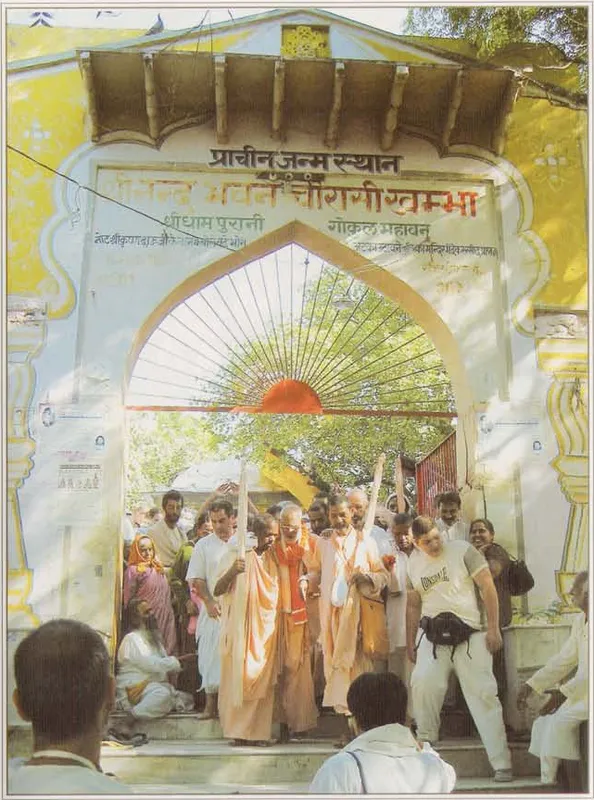
Śrī Caitanya Mahāprabhu came here. The Caitanya-caritāmṛta says that after seeing the birthplace at Mahāvana, He saw the place where the twin arjuna trees had been broken. His mind was shaken by love.[15–18]
Names this place“Upon seeing the place where the twin arjuna trees had been broken by Śrī Kṛṣṇa, Śrī Caitanya Mahāprabhu was moved to great ecstatic love.”
Śrīla Prabhupāda, Śrī Caitanya-caritāmṛta, Madhya-līlā 18.68, translation · vedabase.io
Śrīla Murāri Gupta tells it too. In his account, the guide Kṛṣṇadāsa tells the Lord that right here Yaśodā bound Kṛṣṇa, so that He became known as Dāmodara. Here too, he says, Kṛṣṇa broke the twin arjunas. Śrīla Locana dāsa Ṭhākura tells the same. Both are summarised here, not translated.[15 +4] Read more: Śrī Caitanya Mahāprabhu in Gokula-Mahāvana →
Two historians report a later building, but they do not quote a document. According to Prabhudayāl Mītal (1966), Rājā Vīrasiṁhadeva of Orchhā is said to have built a large temple here in saṁvat 1676 of the Indian Vikrama calendar, about 1619. It was later destroyed. A. W. Entwistle (1987) says that the small shrine he saw was built by the same king.[53, 54]
The Dāmodarāṣṭaka
The song book credits the Dāmodarāṣṭaka to Satyavrata Muni. Devotees sing it in the month of Kārttika. In one of its verses the singer asks for pure loving devotion. He recalls how Kṛṣṇa, while bound, freed Kuvera's two sons and made them devotees.[19]
kuverātmajau baddha-mūrtyaiva yadvat
tvayā mocitau bhakti-bhājau kṛtau ca
tathā prema-bhaktiṁ svakāṁ me prayaccha
na mokṣe graho me 'sti dāmodareha
Where the sources differ
The sources differ on the place and on who the trees had been. They also differ on who cursed Kuvera's sons, and for how long. In the Bhāgavatam and the Ādi-purāṇa it is Nārada, for a hundred years of the gods. In the Garga-saṁhitā and the Brahma-vaivarta it is Devala. One guidebook says a thousand years.[11 +4]
Accounts differ Who cursed Kuvera's sons to become trees.
- Śrīmad-Bhāgavatam 10.10.8-22; Kṛṣṇa book ch. 10Śrīla Nārada Muni.
- Ādi-purāṇa (29) v.15-28Nārada.
- Vraja-bhakti-vilāsa 4.77Nārada (calling the two Gandharvas).
- the undated parikramā notes MahāvanaNārada.
They differ too on why Yaśodā bound the child. In the Bhāgavatam and the Garga-saṁhitā it happens during the churning. In the Viṣṇu Purāṇa and the Harivaṁśa it happens after He had wandered about the cow-pens or the settlement. The Padma and the Brahma-vaivarta give other reasons.[34 +3]
Accounts differ Why and how Yaśodā bound Kṛṣṇa.
- Śrīmad-Bhāgavatam 10.9.1-14; Ādi-purāṇa (28)During the churning: after He broke the yogurt pot and gave butter to a monkey from the upturned mortar, she bound Him to the mortar with ropes.
- Garga-saṁhitā 1.19.1-10Likewise after the churning in Nanda's palace.
- Viṣṇu Purāṇa 5.6.11-15Because the restless boys roamed the cow-pens pulling the calves' tails; no churning.
- Harivaṁśa 51.12-14Because the boys roamed the whole settlement; angry, she tied Him to the mortar.
Places in this article
Yamalārjuna-uddhāra-sthala
यमलार्जुन-उद्धार-स्थलYamalārjuna-uddhāra-sthala is the place in Mahāvana that the Bhakti-ratnākara and the guidebooks show as where Kṛṣṇa, tied to a wooden mortar, pulled down the twin arjuna …
Mahāvana
महावनMahāvana, "the great forest", also called Bṛhadvana, is the forest on the eastern bank of the Yamunā where Kṛṣṇa spent His infancy.
Nanda-bhavana (Mahāvana)
नन्द-भवन (महावन)The Bhakti-ratnākara and the guidebooks show Nanda-bhavana in Mahāvana as the house of Nanda Mahārāja and Mother Yaśodā, where Vasudeva left the newborn Kṛṣṇa, where Nand …
Dāmodara-līlā-sthala
दामोदर-लीला-स्थलOkhala-sthala
ओखल-स्थलGopīśvara Mahādeva (Mahāvana)
गोपीश्वर महादेव (महावन)Gopīśvara (also Gopeśvara) Mahādeva is a deity of Lord Śiva in Mahāvana.
Yamunā
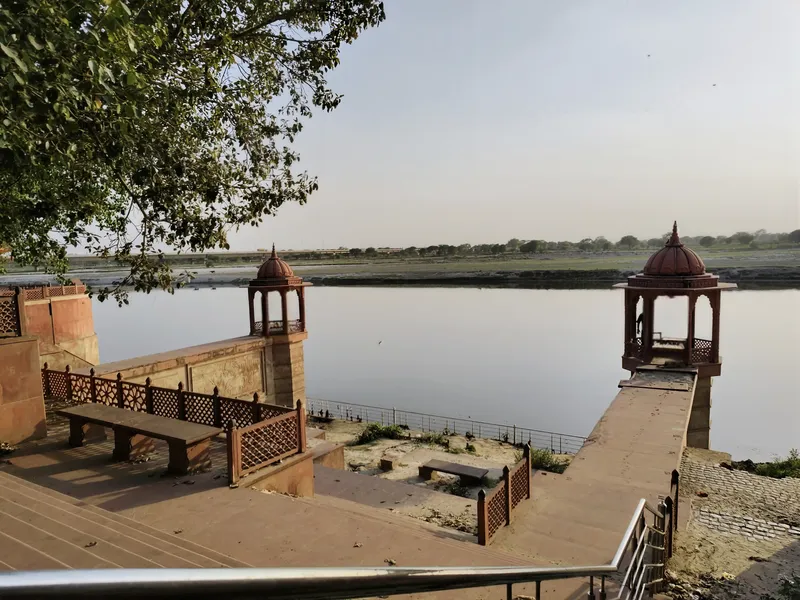
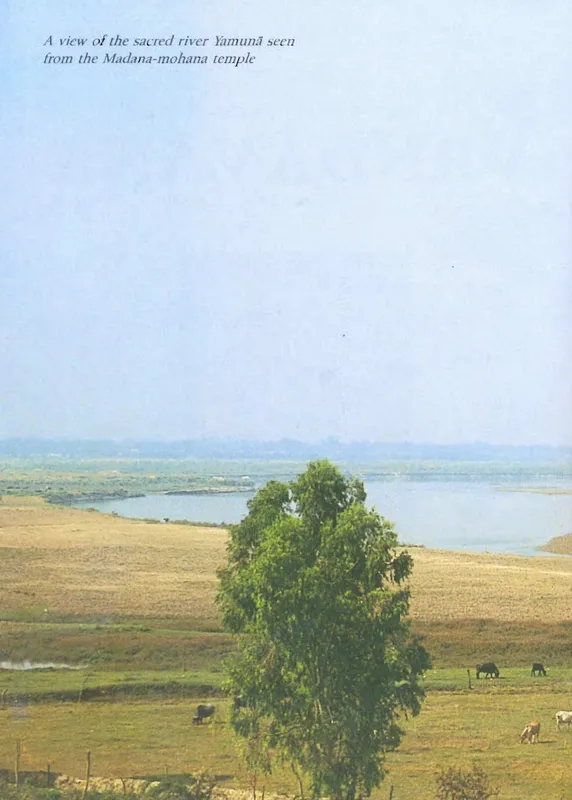
यमुनाThe Yamunā, also called the Kālindī, is the river that runs through Vraja-maṇḍala.
Questions and answers
Because He had stolen the butter and was feeding it to the monkeys. Thinking Him her ordinary child, she tied Him to a wooden mortar. He agreed to be bound only when He saw how tired she had become.[1–3]
The two demigod sons of Kuvera. They were drunk and playing naked, so Nārada cursed them to stand as twin arjuna trees until they would see Vāsudeva.[9, 11]
Śrīla Prabhupāda explains the curse as mercy. Because of it, the two demigods could grow in Nanda's courtyard and see Kṛṣṇa face to face.[9]
The Bhāgavatam says only where the two arjunas stood. Śrīla Prabhupāda puts them in Nanda's courtyard. The ācāryas place them near Nanda's house or at its gate, and the Garga-saṁhitā on the Yamunā shore near Mahāvana.[13 +2]
Because He was bound with a rope (dāma) round His waist (udara). Śrīla Prabhupāda calls the pastime the dāmodara-līlā. He says that this is why another of Kṛṣṇa's names is Dāmodara.[10]
A prayer of eight verses to Kṛṣṇa as Dāmodara. The song book credits it to Satyavrata Muni, and it is sung in Kārttika. It asks for pure devotion, as He gave it to Kuvera's sons.[19]
Yes. The Caitanya-caritāmṛta says that at Mahāvana He saw the place where the twin arjuna trees had been broken. He was moved to great ecstatic love.[15–18]
Sources
- Śrīmad-Bhāgavatam 10.9.13-14, Bhagavata Vidya Pith edition, ed. Bhagavata Rishi and Krishna Shankar Shastri, 1996
- Śrīmad-Bhāgavatam 10.9.18, Bhagavata Vidya Pith edition, ed. Bhagavata Rishi and Krishna Shankar Shastri, 1996
- Śrīla Prabhupāda, Kṛṣṇa, the Supreme Personality of Godhead, ch. 9 "Mother Yaśodā Binds Lord Kṛṣṇa" · vedabase.io
- Śrīmad-Bhāgavatam 10.9.22, Bhagavata Vidya Pith edition, ed. Bhagavata Rishi and Krishna Shankar Shastri, 1996
- Śrīmad-Bhāgavatam 10.10.24, Bhagavata Vidya Pith edition, ed. Bhagavata Rishi and Krishna Shankar Shastri, 1996
- Śrīmad-Bhāgavatam 10.10.26, Bhagavata Vidya Pith edition, ed. Bhagavata Rishi and Krishna Shankar Shastri, 1996
- Śrīmad-Bhāgavatam 10.10.27, Bhagavata Vidya Pith edition, ed. Bhagavata Rishi and Krishna Shankar Shastri, 1996
- Śrīmad-Bhāgavatam 10.10.28, Bhagavata Vidya Pith edition, ed. Bhagavata Rishi and Krishna Shankar Shastri, 1996
- Śrīla Prabhupāda, Kṛṣṇa, the Supreme Personality of Godhead, ch. 10 "The Deliverance of Nalakūvara and Maṇigrīva" · vedabase.io
- Śrīla Prabhupāda, Śrīmad-Bhāgavatam, 10.10.27, purport · vedabase.io
- Śrīmad-Bhāgavatam 10.10.22, Bhagavata Vidya Pith edition, ed. Bhagavata Rishi and Krishna Shankar Shastri, 1996
- Padma Purāṇa, Pātāla-khaṇḍa 69.52-54; = Vṛndāvana-māhātmya (1) vv.52-54, Sanskrit Wikisource
- Garga-saṁhitā, Goloka-khaṇḍa (1) 19.29-32, Sanskrit Wikisource
- Ādi-purāṇa (29) v.24-28, Śrī Veṅkaṭeśvara Press, Mumbai, 1929
- Śrīla Kṛṣṇadāsa Kavirāja Gosvāmī, Śrī Caitanya-caritāmṛta, CC Madhya-līlā 18.68, online edition · vedabase.io
- Śrīla Prabhupāda, Śrī Caitanya-caritāmṛta, Madhya-līlā 18.68, translation · vedabase.io
- Kṛṣṇa-caitanya-caritāmṛta, 4.6.10
- Śrīla Locana dāsa Ṭhākura, Caitanya-maṅgala, Śeṣa-khaṇḍa, 1903 ed. printed p. 172, left column
- Namāmīśvaraṁ Sac-cid-ānanda-rūpaṁ (Śrī Dāmodarāṣṭakam) (Satyavrata Muni (as the song book credits it; its 'about' says the hymn is found in the Padma Purāṇa)) · song book
- Śrīmad-Bhāgavatam 10.8.30, Bhagavata Vidya Pith edition, ed. Bhagavata Rishi and Krishna Shankar Shastri, 1996
Show all 55 references
- Śrīmad-Bhāgavatam 10.9.8, Bhagavata Vidya Pith edition, ed. Bhagavata Rishi and Krishna Shankar Shastri, 1996
- Śrīla Viśvanātha Cakravartī Ṭhākura: commentary on ŚB 10.9.8, Bhagavata Vidya Pith edition, ed. Bhagavata Rishi and Krishna Shankar Shastri, 1996
- Śrīla Sanātana Gosvāmī: commentary on ŚB 10.10.22, Bhagavata Vidya Pith edition, ed. Bhagavata Rishi and Krishna Shankar Shastri, 1996
- Śrīmad-Bhāgavatam 10.10.27, Bhagavata Vidya Pith edition, ed. Bhagavata Rishi and Krishna Shankar Shastri, 1996
- Śrīmad-Bhāgavatam 10.11.2-3, Bhagavata Vidya Pith edition, ed. Bhagavata Rishi and Krishna Shankar Shastri, 1996
- Śrīmad-Bhāgavatam 10.11.4, Bhagavata Vidya Pith edition, ed. Bhagavata Rishi and Krishna Shankar Shastri, 1996
- Śrīla Prabhupāda, Kṛṣṇa, the Supreme Personality of Godhead, ch. 11 "Killing the Demons Vatsāsura and Bakāsura" · vedabase.io
- Śrīmad-Bhāgavatam 10.11.26, Bhagavata Vidya Pith edition, ed. Bhagavata Rishi and Krishna Shankar Shastri, 1996
- Śrīla Prabhupāda, Śrīmad-Bhāgavatam, Canto 10, chapter 10, chapter summary · vedabase.io
- Gopāla-campū, Pūrva-campū 9.[2]
- Baladeva Vidyābhūṣaṇa: commentary on ŚB 10.9.22, Bhagavata Vidya Pith edition, ed. Bhagavata Rishi and Krishna Shankar Shastri, 1996
- Śrīla Sanātana Gosvāmī: commentary on ŚB 10.11.12, Bhagavata Vidya Pith edition, ed. Bhagavata Rishi and Krishna Shankar Shastri, 1996
- Garga-saṁhitā, Goloka-khaṇḍa (1) 19.14-16, Sanskrit Wikisource
- Brahma-vaivarta Purāṇa, Kṛṣṇa-janma-khaṇḍa (4) 14.11-13, Sanskrit Wikisource
- Brahma-vaivarta Purāṇa, Kṛṣṇa-janma-khaṇḍa (4) 14.40-42, Sanskrit Wikisource
- Viṣṇu Purāṇa 5.6.12-16, GRETIL
- Harivaṁśa, HV 51.14-16, GRETIL
- Harivaṁśa, HV 51.20-22, GRETIL
- Harivaṁśa, HV 51.25, 51.28, GRETIL
- Padma Purāṇa, Uttara-khaṇḍa (6) 245.88-91, Sanskrit Wikisource
- Ādi-purāṇa (29) v.51-53, Śrī Veṅkaṭeśvara Press, Mumbai, 1929
- Śrīla Rūpa Gosvāmī, Mathurā-māhātmya v.347-349, quoting the Ādi-vārāha
- Śrīla Narahari Cakravartī, Bhakti-ratnākara, Fifth Wave (pañcama taraṅga), at Mahāvana, 1912 ed. p. 282, 2nd ed., 1912
- Śrīla Narahari Cakravartī, Bhakti-ratnākara, Fifth Wave, 1912 ed. p. 283; Grantha Mandira text v.1768-1769 (quotation headed 'তথাহি আদিবারাহে' on p. 282), 2nd ed., 1912
- Varāha Purāṇa, adhyāya 157, verses 1-3, Sanskrit Wikisource
- Śrīla Narahari Cakravartī, Bhakti-ratnākara, Fifth Wave, 1912 ed. p. 282; Grantha Mandira text v.1762, 2nd ed., 1912
- Śrīla Nārāyaṇa Bhaṭṭa Gosvāmī, Vraja-bhakti-vilāsa, chapter 2 v.48 ('atha gokulaliṅgāni', under the name of the Viṣṇu-purāṇa), printed p. 46; Grantha Mandira text (2) [part 12] v.48, 1st ed., publ. Bābā Kṛṣṇadāsa, Kusuma-sarovara, Saṁvat 2008
- Śrīla Nārāyaṇa Bhaṭṭa Gosvāmī, Vraja-bhakti-vilāsa, chapter 4 v.77, printed p. 106; Grantha Mandira text (4) v.77, 1st ed., publ. Bābā Kṛṣṇadāsa, Kusuma-sarovara, Saṁvat 2008
- Śrīla Nārāyaṇa Bhaṭṭa Gosvāmī, Vraja-bhakti-vilāsa, chapter 4 v.78, printed p. 106; Grantha Mandira text (4) v.78, 1st ed., publ. Bābā Kṛṣṇadāsa, Kusuma-sarovara, Saṁvat 2008
- Śrīla Nārāyaṇa Bhaṭṭa Gosvāmī, Vraja-bhakti-vilāsa, chapter 4 v.79, printed pp. 106-107; Grantha Mandira text (4) v.79, 1st ed., publ. Bābā Kṛṣṇadāsa, Kusuma-sarovara, Saṁvat 2008
- Śrīla Nārāyaṇa Bhaṭṭa Gosvāmī, Vraja-bhakti-vilāsa, chapter 4 v.77 (lines 5-6) and v.79 (first line), printed p. 106; Grantha Mandira text (4) vv.77 and 79, 1st ed., publ. Bābā Kṛṣṇadāsa, Kusuma-sarovara, Saṁvat 2008
- Kṛṣṇa-caitanya-caritāmṛta, 4.6.8-9
- Prabhudayāl Mītal, heading 'यमलार्जुन का मदिर' (as printed), printed p. 144
- A. W. Entwistle, §71.2 'Places commemorating incidents in Krishna's infancy', printed p. 424, Egbert Forsten, Groningen, 1987
- the undated parikramā notes Mahāvana, ¶96
Further sources
- Śrīmad-Bhāgavatam, Tenth Canto, chapters 9 to 11, translation and purports by Śrīla Prabhupāda (BBT); his Kṛṣṇa book, chapters 9 to 11.
- The commentaries of Śrīla Sanātana Gosvāmī, Śrīla Viśvanātha Cakravartī Ṭhākura and Śrīla Baladeva Vidyābhūṣaṇa, and Śrīla Jīva Gosvāmī's Gopāla-campū (Sanskrit), summarised, not translated.
- Garga-saṁhitā, Goloka-khaṇḍa 19; Harivaṁśa 51; Viṣṇu, Padma, Brahma-vaivarta, Varāha and Ādi Purāṇas: summarised from the Sanskrit unless a published translation is shown.
- Bhakti-ratnākara (1912 edition); Vraja-bhakti-vilāsa (Hindi edition); historians only for the building: P. Mītal (1966), A. W. Entwistle (1987).