The deliverance of Pūtanā: the Bhāgavatam and the other accounts
पूतना का उद्धार: भागवतम् और दूसरे विवरण
In short
Pūtanā was a Rākṣasī, a child-killing witch sent by Kaṁsa. She came to Gokula in the form of a beautiful woman and gave the infant Kṛṣṇa her poisoned breast. He drank out her life with the milk. Because He had drunk from her, she attained the position of a mother in the spiritual world.[1–8]
On this page
At a glance
- Scripture: Śrīmad-Bhāgavatam, Tenth Canto, chapter 6, with Śrīla Prabhupāda's translation and purports (his explanations of the verses).[1–5]
- The place: Nanda's house in Gokula. Following Śrīla Prabhupāda, this website presents it at Mahāvana.[1–5, 9]
- The fall: as she died, she took her own form and fell outside the village. Her body crushed the trees within twelve miles.[4 +3]
- The cremation: the cowherds burned the pieces of her body, and the smoke smelled like aguru, a sweet-smelling incense wood.[4 +4]
- Her destination: the position of a mother, or of a nurse, in Kṛṣṇa's abode.[6–8]
- Other accounts: the Garga-saṁhitā, the Brahma-vaivarta Purāṇa (an old scripture) and the Harivaṁśa make her the daughter of King Bali.[17–20]
Who was Pūtanā, and why did she come to Gokula?
The Bhāgavatam calls her a Rākṣasī: a demoness whose work was to kill small children. Kaṁsa had sent her. She could move through the sky at will. By mystic power she turned herself into a very beautiful woman and entered Gokula, the home of Nanda Mahārāja.[1]
sā khe-cary ekadotpatya pūtanā nanda-gokulam
yoṣitvā māyayātmānaṁ prāviśat kāma-cāriṇī ||
Once upon a time, Pūtanā Rākṣasī, who could move according to her desire and was wandering in outer space, converted herself by mystic power into a very beautiful woman and thus entered Gokula, the abode of Nanda Mahārāja.
Translation: Śrīla A.C. Bhaktivedanta Swami PrabhupādaBecause of her beauty, Śrīla Prabhupāda writes, no one stopped her. She walked freely into Nanda's house.[4]
Names this place“Because of her exquisite beauty, no one checked her movement, and therefore she freely entered the house of Nanda Mahārāja. Pūtanā, the killer of many, many children, found baby Kṛṣṇa lying on a small bed”
Śrīla Prabhupāda, Kṛṣṇa, the Supreme Personality of Godhead, ch. 6 "Pūtanā Killed" · vedabase.io
The commentators add the time (summarised here, not translated). Śrīla Sanātana Gosvāmī says that the Bhāgavatam's "one day" was the sixth day after the birth, as people commonly say. More exactly, he says, it was at night, as the Viṣṇu Purāṇa and the Harivaṁśa have it. Śrīla Jīva Gosvāmī and Śrīla Viśvanātha Cakravartī Ṭhākura also read "one night".[21]
What happened in Nanda's house
Pūtanā was searching for infants. She found the child sleeping on a bed in Nanda's room. The Bhāgavatam says that she could see He was no ordinary child. His unlimited power was covered, like a fire covered by ashes.[2]
bāla-grahas tatra vicinvatī śiśūn yadṛcchayā nanda-gṛhe 'sad-antakam
bālaṁ praticchanna-nijoru-tejasaṁ dadarśa talpe 'gnim ivāhitaṁ bhasi ||
While searching for small children, Pūtanā, whose business was to kill them, entered the house of Nanda Mahārāja unobstructed, having been sent by the superior potency of the Lord. Without asking anyone’s permission, she entered Nanda Mahārāja’s room, where she saw the child sleeping in bed, His unlimited power covered like a powerful fire covered by ashes. She could understand that this child was not ordinary, but was meant to kill all demons.
Translation: Śrīla A.C. Bhaktivedanta Swami PrabhupādaYaśodā and Rohiṇī were in the room. In front of them, Pūtanā took Kṛṣṇa on her lap and pushed her breast into His mouth. The breast was smeared with a quick poison.[1–5] Then the Bhāgavatam tells the moment that gives the place its name:
tasmin stanaṁ durjara-vīryam ulbaṇaṁ ghorāṅkam ādāya śiśor dadāv atha
gāḍhaṁ karābhyāṁ bhagavān prapīḍya tat prāṇaiḥ samaṁ roṣa-samanvito 'pibat ||
On that very spot, the fiercely dangerous Rākṣasī took Kṛṣṇa on her lap and pushed her breast into His mouth. The nipple of her breast was smeared with a dangerous, immediately effective poison, but the Supreme Personality of Godhead, Kṛṣṇa, becoming very angry at her, took hold of her breast, squeezed it very hard with both hands, and sucked out both the poison and her life.
Translation: Śrīla A.C. Bhaktivedanta Swami PrabhupādaŚrīla Prabhupāda's summary of the chapter adds two points. No one stopped her from entering the house or the room, because that was Kṛṣṇa's desire. And after she had fallen, Kṛṣṇa began to play on her breast just like a small child.[5]
Names this place“Taking courage, she immediately entered Kṛṣṇa’s bedroom without anyone’s permission; by the grace of Kṛṣṇa, no one forbade her to enter the house or the room, because that was Kṛṣṇa’s desire. … she had to assume her original body and fell to the ground. Then Kṛṣṇa began playing on her breast just like a small child.”
Śrīla Prabhupāda, Śrīmad-Bhāgavatam, Canto 10, chapter 6, chapter summary · vedabase.io
Where did Pūtanā fall?
As she died, Pūtanā opened her mouth wide and spread her arms, legs and hair. She fell in the grazing ground in her own form, as the demon Vṛtra had fallen when Indra struck him with his thunderbolt.[10] As her huge body fell, it smashed all the trees within twelve miles.[11]
patamāno 'pi tad-dehas tri-gavyūty-antara-drumān
cūrṇayām āsa rājendra mahad āsīt tad adbhutam ||
O King Parīkṣit, when the gigantic body of Pūtanā fell to the ground, it smashed all the trees within a limit of twelve miles. Appearing in a gigantic body, she was certainly extraordinary.
Translation: Śrīla A.C. Bhaktivedanta Swami PrabhupādaThe Bhāgavatam does not say how she got from the room to the grazing ground. Śrīla Prabhupāda explains it in his purport to this verse:[4 +3]
Names this place“Because of the grievous hurt imposed upon her by Kṛṣṇa’s sucking her breast, Pūtanā, while dying, not only left the room but abandoned the village and fell down in the pasturing ground in her gigantic body.”
Śrīla Prabhupāda, Śrīmad-Bhāgavatam, 10.6.14, purport · vedabase.io
The commentators give two pictures (both summarised here, not translated). Śrīla Viśvanātha Cakravartī Ṭhākura says that she leapt from the inner rooms, crossed the village and fell outside it. Her body crushed the trees in Kaṁsa's gardens. Śrīla Jīva Gosvāmī says that she died inside the house. Kṛṣṇa, still drinking, carried her out and threw her far from the settlement, so that her growing body would not break the houses.[22]
The Garga-saṁhitā says that she ran outside carrying the child before she fell.[23] In the Ādi-purāṇa she grows to her own size, cries out, falls to the earth and dies. The trees and creepers are thrown down over the same distance. But it does not say that she first left the house (summarised here, not translated).[24]
Śrīla Nārāyaṇa Bhaṭṭa Gosvāmī's Vraja-bhakti-vilāsa keeps the two places apart. The drinking of her breast happens in Nanda's house in Gokula. Her fall happens in a garden called Kharavāṭī, ten yojanas wide (a yojana is an old, long measure of distance), which the book does not locate.[25–27] The accounts of the fall are listed together here:
Accounts differ Where Pūtanā died and fell, and how far her body reached.
- Śrīmad-Bhāgavatam 10.6.13-14 with Śrīla Prabhupāda's translation and purportDying, she fell 'in the pasturing ground' (goṣṭhe) and smashed the trees 'within a limit of twelve miles' (tri-gavyūti); the purport: she left the room and the village before falling.
- Śrīla Jīva Gosvāmī, Bṛhat-krama-sandarbha on 10.6.14She died right there in the house; Kṛṣṇa, still drinking, carried her out and threw her far from the settlement; the ground crushed measured twelve daṇḍas.
- Śrīla Viśvanātha Cakravartī on 10.6.14She leapt from the inner rooms, crossed the village and fell outside; the trees within six krośas, in Kaṁsa's gardens, were crushed.
- Garga-saṁhitā 1.13.7-10She ran outside carrying the child and fell; her body crushed the trees over six krośas.
Why did her burning body smell sweet?
The cowherds did not leave the body lying there. They cut it into pieces with axes and threw the pieces far away. Then they covered them with wood and burned them.[4, 13] The Bhāgavatam then tells what happened to the smoke:
Because of Kṛṣṇa’s having sucked the breast of the Rākṣasī Pūtanā, when Kṛṣṇa killed her she was immediately freed of all material contamination. Her sinful reactions automatically vanished, and therefore when her gigantic body was being burnt, the smoke emanating from her body was fragrant like aguru incense.
Translation: Śrīla A.C. Bhaktivedanta Swami PrabhupādaPeople of Vraja who had been away smelled the smoke from far off. They asked where the sweet smell came from and went to the spot where the body was burning.[4 +4]
Śrīla Jīva Gosvāmī explains the word the verse uses for the place of the fire. Quoting the dictionary-writer Kṣīrasvāmin, he takes it to mean a cremation ground. He also says that the burning was done by men whom Upananda and the others guarding Gokula had appointed (summarised here, not translated).[28]
Śrīla Prabhupāda tells it in his Kṛṣṇa book:
General teaching (does not name the place)“After this, all the residents of Vraja cut the gigantic body of Pūtanā into pieces and piled it up with wood for burning. When all the limbs of Pūtanā’s body were burning, the smoke emanating from the fire created a good aroma of aguru.”
Śrīla Prabhupāda, Kṛṣṇa, the Supreme Personality of Godhead, ch. 6 "Pūtanā Killed" · vedabase.io
In 1974, on a morning walk in Bombay, the passage was being read aloud. He gave the reason in one sentence: because Kṛṣṇa had killed her, her whole body had become sanctified, or made holy.[16]
General teaching (does not name the place)“Because she was killed by Kṛṣṇa, the whole body has become sanctified. So when it was..., the body was burned, there was good aroma.”
Śrīla Prabhupāda, Morning Walk, Bombay, 12 April 1974 · vedabase.io
In the Garga-saṁhitā the gopas burn the body on many pyres on the bank of the Yamunā. The smoke smells of cardamom, clove, sandalwood, tagara and aguru.[29]
Why did Kṛṣṇa give Pūtanā liberation?
Pūtanā came to kill, yet the Bhāgavatam says that she reached the highest perfection. The reason it gives is the act itself. Kṛṣṇa embraced her and drank from her breast, and so she attained the position of a mother.[6–8]
padbhyāṁ bhakta-hṛdi-sthābhyāṁ vandyābhyāṁ loka-vanditaiḥ
aṅgaṁ yasyāḥ samākramya bhagavān api tat-stanam
yātudhāny api sā svargam avāpa jananī-gatim
kṛṣṇa-bhukta-stana-kṣīrāḥ kim u gāvo'numātaraḥ ||
Because Kṛṣṇa embraced Pūtanā’s body with great pleasure and sucked her breast, although she was a great witch, she attained the position of a mother in the transcendental world and thus achieved the highest perfection.
Translation: Śrīla A.C. Bhaktivedanta Swami PrabhupādaIn the Third Canto, Uddhava remembers the same mercy. He asks whom he could take shelter of, if not the Lord. For the Lord gave a mother's position to the demoness who had smeared poison on her breast to kill Him.[7]
aho bakī yaṃ stana-kāla-kūṭaṃ jighāṃsayāpāyayad apy asādhvī / lebhe gatiṃ dhātry-ucitāṃ tato 'nyaṃ kaṃ vā dayāluṃ śaraṇaṃ vrajema
Alas, how shall I take shelter of one more merciful than He who granted the position of mother to a she-demon [Pūtanā] although she was unfaithful and she prepared deadly poison to be sucked from her breast?
Translation: Śrīla A.C. Bhaktivedanta Swami PrabhupādaŚrīla Prabhupāda joins the two verses in his purport and names her place in the spiritual world:[6–8]
General teaching (does not name the place)“In Vaikuṇṭhaloka, Pūtanā attained the position of a nurse (dhātry-ucitām), as described by Uddhava. Pūtanā was elevated to the position of a nurse and maidservant in Goloka Vṛndāvana to assist mother Yaśodā.”
Śrīla Prabhupāda, Śrīmad-Bhāgavatam, 10.6.37-38, purport · vedabase.io
So the place in Mahāvana is called the place of Pūtanā's deliverance (uddhāra), not of her killing alone.[1–5] When the danger had passed, Yaśodā, Rohiṇī and the elder gopīs protected the child with a name of the Lord for every limb. That scene is told in its own article.[30–32] Read more: How Nanda and Yaśodā prayed for Kṛṣṇa's protection →
Pūtanā in the other accounts
The Bhāgavatam tells nothing of a former life of Pūtanā. Other books do, and they do not agree. The Garga-saṁhitā, the Brahma-vaivarta Purāṇa and the Harivaṁśa make her the daughter of King Bali. The first two tell this story. Bali's daughter Ratnamālā saw Lord Vāmana at her father's sacrifice and felt a mother's love for Him. She wished to nurse such a son, and the wish came true when she was born as Pūtanā.[17–20]
श्रीनारद उवाच - बलियज्ञे वामनस्य दृष्ट्वा रूपमतः परम् । बलिकन्या रत्नमाला पुत्रस्नेहं चकार ह ॥ 30 ॥ एतादृशो यदि भवेद्बालस्तं हि शुचिस्मितम् । पाययामि स्तनं तेन प्रसन्नं मे मनस्तदा ॥ 31 ॥ बलेः परमभक्तस्य सुतायै वामनो हरिः । मनोरथस्तु ते भूयान् मनस्यपि वरं ददौ ॥ 32 ॥
śrīnārada uvāca - baliyajñe vāmanasya dṛṣṭvā rūpamataḥ param
balikanyā ratnamālā putrasnehaṁ cakāra ha
30
etādṛśo yadi bhavedbālastaṁ hi śucismitam
pāyayāmi stanaṁ tena prasannaṁ me manastadā
31
baleḥ paramabhaktasya sutāyai vāmano hariḥ
manorathastu te bhūyān manasyapi varaṁ dadau || 32 ||
The Brahma-vaivarta also tells the visit in its own way (summarised here, not translated). Pūtanā comes as a richly adorned lady and is received as a brāhmaṇa woman. Yaśodā herself hands her the child. After her death she goes to Goloka on a chariot, while Nanda burns the body.[19]
The Ādi-purāṇa gives her another past. There she was Cārumatī, the wife of the brāhmaṇa Kakṣīvān, and he cursed her to be born among the Rākṣasas. In the Brahma-vaivarta story itself, Kaṁsa calls her his sister. She moves by a great mantra that she received from the sage Durvāsā.[33, 34] The Vraja-bhakti-vilāsa calls her a disciple of Durvāsā.[25]
The form in which she came also differs. In the Harivaṁśa she is a bird. She comes at midnight and perches on the axle of the cart to give the sleeping child her breast.[21, 35] In the Vraja-bhakti-vilāsa she comes dressed like a heavenly woman, not in her Rākṣasī form. The Garga-saṁhitā gives yet another form.[25] The accounts are listed with their sources:
Accounts differ In what form, and when, Pūtanā came.
- Śrīmad-Bhāgavatam 10.6.4-6By illusion she made herself a beautiful woman and entered Nanda's Gokula and house; the time of day is not given.
- Garga-saṁhitā 1.13.3She took a divine form of a sixteen-year-old woman.
- Vraja-bhakti-vilāsa 4.86Dressed like a celestial woman, without her Rākṣasī form.
- Brahma-vaivarta, Kṛṣṇa-janma-khaṇḍa 10.13-29A beautiful, richly adorned woman, received as a brāhmaṇa lady.
Where is the Pūtanā place in Mahāvana?
The Bhāgavatam names Nanda's Gokula and his house, but no spot inside the house.[1–5] The Padma Purāṇa links the pastime to Mahāvana. There, it says, Pūtanā and others were killed and the twin arjuna trees were broken.[9] Later, when Upananda urged the cowherds to leave Gokula, the first danger he named was Pūtanā.[36] Read more: The original Gokula: Mahāvana and the later village of Gokula →
According to the Bhakti-ratnākara, Śrīla Rāghava Paṇḍita showed Śrīla Śrīnivāsa Ācārya the place where the prince of Vraja killed Pūtanā. He said that her cremation took place right there.[37]
Śrīla Murāri Gupta wrote a life of Śrī Caitanya. In it, the guide Kṛṣṇadāsa shows the Lord the place of Pūtanā's deliverance, at Nanda's house in Mahāvana. Śrīla Locana dāsa Ṭhākura's Caitanya-maṅgala tells of the same tour. Both are summarised here, not translated.[38, 39] Read more: Śrī Caitanya Mahāprabhu in Gokula-Mahāvana →
According to the guidebook Śrī Vraja-maṇḍala Parikramā (2007), Pūtanā came to this place in Nanda-bhavana, Nanda's house. There, it says, she took the sleeping child from the cradle in front of Yaśodā and Rohiṇī and was delivered. The same book prints a photograph of a wall-painting of Pūtanā there.[40–42] The Bhāgavatam's account places her fall and her cremation outside the village. The sources differ on where the body was burned:
Accounts differ Where Pūtanā's body was cremated.
- Śrīmad-Bhāgavatam 10.6.33 (Śrīla Prabhupāda's translation; Kṛṣṇa book ch. 6)The residents of Vraja cut the body to pieces, threw them far away and burned them covered with wood; no place is named.
- Ādi-purāṇa (17) v.69The same: cut to pieces, thrown far away (sudūrataḥ) and burned.
- Garga-saṁhitā 1.13.26Burned on many pyres 'by Śrī Yamunā's shore'.
- Padma Purāṇa, Uttara-khaṇḍa 245.79-80Nanda placed the body outside the cow-settlement and burned it there with the cowherds.
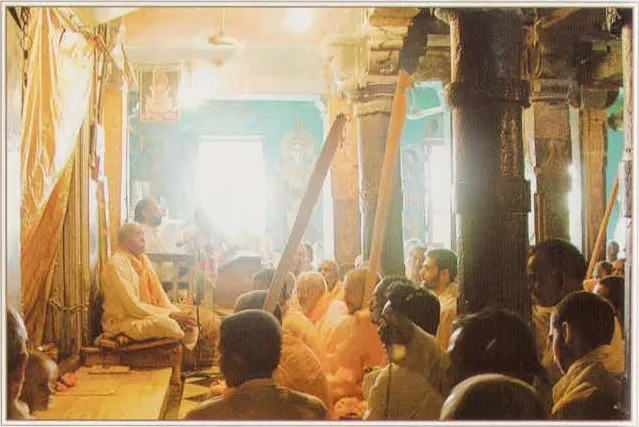
Where the sources differ
The Bhāgavatam gives no age for Kṛṣṇa when Pūtanā came. Śrīla Sanātana Gosvāmī reports the sixth day, as people commonly say. The Vraja-bhakti-vilāsa and Śrīla Locana dāsa Ṭhākura say seven days, and the Ādi-purāṇa says after ten days. Śrīla Prabhupāda, in a conversation of 1976, said three months.[1 +5]
Accounts differ How old Kṛṣṇa was when Pūtanā came.
- Śrīmad-Bhāgavatam 10.6Gives no age (she came while Nanda was away in Mathurā to pay the tax).
- Śrīla Sanātana Gosvāmī on 10.6.4The sixth day after the birth, according to popular repute, and at night.
- Vraja-bhakti-vilāsa 4.86 and 2.82Seven days old.
- Śrīla Locana dāsa, Caitanya-maṅgalaSeven days old.
The wording of these accounts is our summary of the sources, not a published translation.
Two guidebooks tell something without naming a source. They say that Ratnamālā, when Vāmana bound her father, thought of killing such a son with poisoned milk. No known scripture says this. The texts that tell her story speak only of her wish to nurse Him.[17 +4]
Accounts differ Who Pūtanā was before, and whose daughter (or sister) she was.
- Śrīmad-Bhāgavatam 3.2.23; 10.6.35-38Tells no former life: the she-demon (bakī) who offered her poisoned breast reached a nurse's (mother's) destination because the Lord drank from her.
- Garga-saṁhitā 1.13.30-33Bali's daughter Ratnamālā, seeing Vāmana at Bali's sacrifice, felt a mother's love and wished to nurse Him; she became Pūtanā at the end of Dvāpara. No wish to poison.
- Brahma-vaivarta, Kṛṣṇa-janma-khaṇḍa 10.42-44 and 10.9-11Bali's daughter Ratnamālā, as in Garga; in the story itself Kaṁsa calls Pūtanā his sister (bhaginī), and she moves by a mantra received from Durvāsā.
- Harivaṁśa 45.6Pūtanā, the daughter of Bali; no former life told.
The wording of these accounts is our summary of the sources, not a published translation.
Places in this article
Pūtanā-uddhāra-sthala
पूतना-उद्धार-स्थलThe Pūtanā-uddhāra-sthala, the place of Pūtanā's deliverance, is a spot within Nanda-bhavana in Mahāvana.
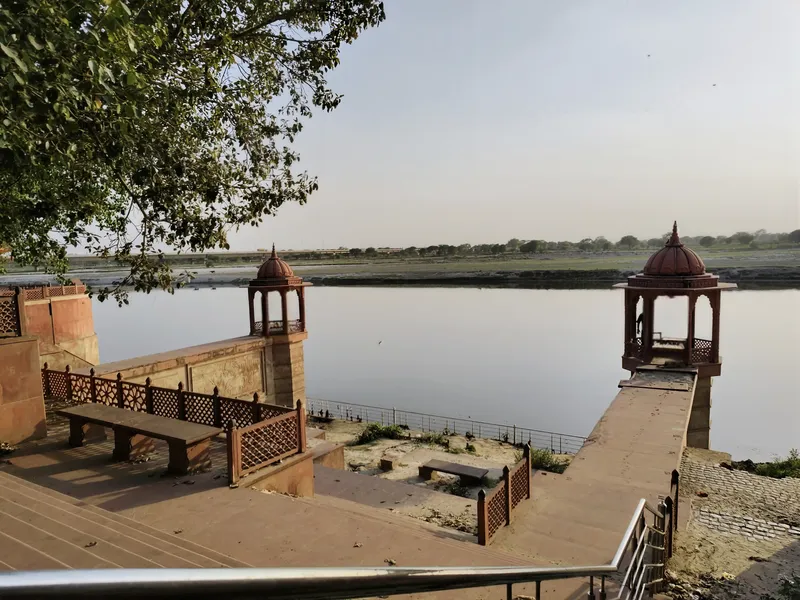
Mahāvana
महावनMahāvana, "the great forest", also called Bṛhadvana, is the forest on the eastern bank of the Yamunā where Kṛṣṇa spent His infancy.
Mahāvana (village)
महावन (गाँव)Mahāvana, the great forest, is the village where, according to the Gauḍīya tradition, Nanda and Yaśodā lived and Kṛṣṇa spent His infancy: the Gokula of Śrīmad-Bhāgavatam' …
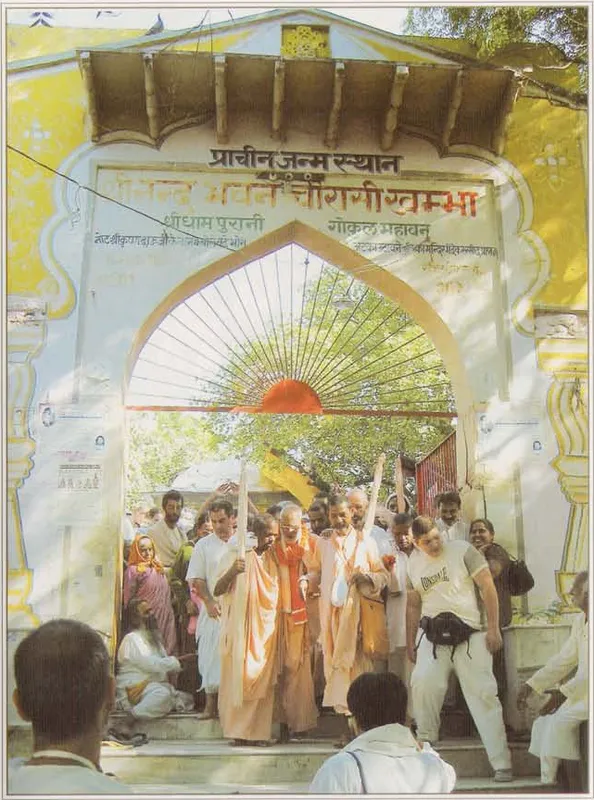
Nanda-bhavana (Mahāvana)
नन्द-भवन (महावन)The Bhakti-ratnākara and the guidebooks show Nanda-bhavana in Mahāvana as the house of Nanda Mahārāja and Mother Yaśodā, where Vasudeva left the newborn Kṛṣṇa, where Nand …
Agni-saṁskāra-sthala
अग्नि-संस्कार-स्थलStanya-pāna-sthala
स्तन्य-पान-स्थल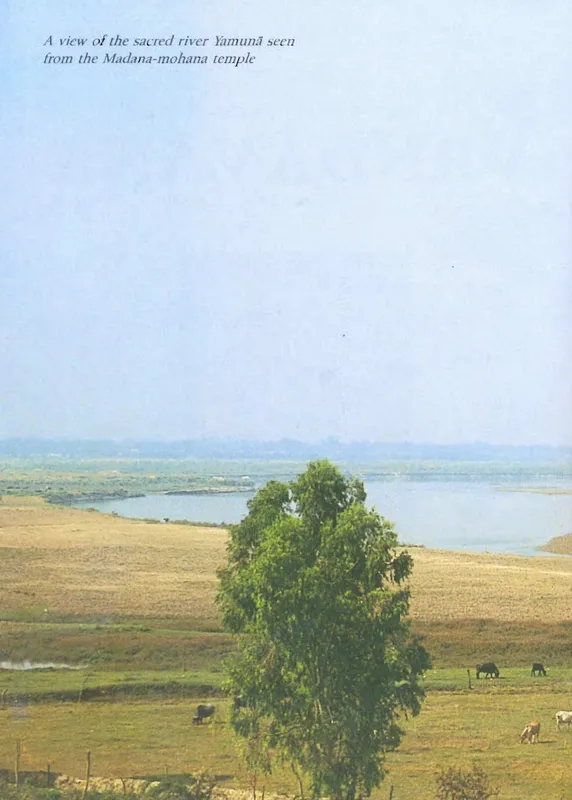
Yamunā
यमुनाThe Yamunā, also called the Kālindī, is the river that runs through Vraja-maṇḍala.
Questions and answers
A Rākṣasī, a child-killing witch, sent by Kaṁsa. She came to Gokula disguised as a beautiful woman. She gave the infant Kṛṣṇa her poisoned breast, and He drank out her life with the milk.[1–5]
Because she had given Him her breast, even though she meant to kill Him. The Bhāgavatam says she attained the position of a mother. Śrīla Prabhupāda explains that she became a nurse and maidservant of Mother Yaśodā in Goloka Vṛndāvana.[6–8]
The Bhāgavatam does not say. The Garga-saṁhitā and the Brahma-vaivarta Purāṇa say she was Ratnamālā, King Bali's daughter, who wished to nurse Lord Vāmana. The Ādi-purāṇa names a brāhmaṇa's wife who was cursed.[17 +5]
Outside the village, in the grazing ground. Her body crushed the trees within twelve miles. Śrīla Prabhupāda explains that in her pain she left the room and the village before she fell.[4 +3]
Because Kṛṣṇa had drunk from her breast, her sins vanished at once. So the smoke from her burning body smelled like aguru incense.[14]
The Bhāgavatam does not say. Śrīla Sanātana Gosvāmī reports the sixth day, as people commonly say. The Vraja-bhakti-vilāsa says seven days.[21, 25]
The guidebook Śrī Vraja-maṇḍala Parikramā (2007) shows it in Nanda-bhavana at Mahāvana. In the Bhakti-ratnākara, Śrīla Rāghava Paṇḍita shows the place of the killing there.[37 +3]
Sources
- Śrīmad-Bhāgavatam 10.6.4, Bhagavata Vidya Pith edition, ed. Bhagavata Rishi and Krishna Shankar Shastri, 1996
- Śrīmad-Bhāgavatam 10.6.7, Bhagavata Vidya Pith edition, ed. Bhagavata Rishi and Krishna Shankar Shastri, 1996
- Śrīmad-Bhāgavatam 10.6.10, Bhagavata Vidya Pith edition, ed. Bhagavata Rishi and Krishna Shankar Shastri, 1996
- Śrīla Prabhupāda, Kṛṣṇa, the Supreme Personality of Godhead, ch. 6 "Pūtanā Killed" · vedabase.io
- Śrīla Prabhupāda, Śrīmad-Bhāgavatam, Canto 10, chapter 6, chapter summary · vedabase.io
- Śrīmad-Bhāgavatam 10.6.37-38, Bhagavata Vidya Pith edition, ed. Bhagavata Rishi and Krishna Shankar Shastri, 1996
- Śrīmad-Bhāgavatam ŚB 3.2.23, GRETIL
- Śrīla Prabhupāda, Śrīmad-Bhāgavatam, 10.6.37-38, purport · vedabase.io
- Padma Purāṇa, Pātāla-khaṇḍa 69.52-54; = Vṛndāvana-māhātmya (1) vv.52-54, Sanskrit Wikisource
- Śrīmad-Bhāgavatam 10.6.13, Bhagavata Vidya Pith edition, ed. Bhagavata Rishi and Krishna Shankar Shastri, 1996
- Śrīmad-Bhāgavatam 10.6.14, Bhagavata Vidya Pith edition, ed. Bhagavata Rishi and Krishna Shankar Shastri, 1996
- Śrīla Prabhupāda, Śrīmad-Bhāgavatam, 10.6.14, purport · vedabase.io
- Śrīmad-Bhāgavatam 10.6.33, Bhagavata Vidya Pith edition, ed. Bhagavata Rishi and Krishna Shankar Shastri, 1996
- Śrīmad-Bhāgavatam 10.6.34, Bhagavata Vidya Pith edition, ed. Bhagavata Rishi and Krishna Shankar Shastri, 1996
- Śrīmad-Bhāgavatam 10.6.41, Bhagavata Vidya Pith edition, ed. Bhagavata Rishi and Krishna Shankar Shastri, 1996
- Śrīla Prabhupāda, Morning Walk, Bombay, 12 April 1974 · vedabase.io
- Garga-saṁhitā, Goloka-khaṇḍa (1) 13.30-32, Sanskrit Wikisource
- Garga-saṁhitā, Goloka-khaṇḍa (Canto 1) 13.33, as printed on the wisdomlib page of the Danavir Goswami edition, online edition
- Brahma-vaivarta Purāṇa, Kṛṣṇa-janma-khaṇḍa (4) 10.42-44, Sanskrit Wikisource
- Harivaṁśa, HV 45.6, GRETIL
Show all 44 references
- Śrīla Sanātana Gosvāmī: commentary on ŚB 10.6.4, Bhagavata Vidya Pith edition, ed. Bhagavata Rishi and Krishna Shankar Shastri, 1996
- Śrīla Viśvanātha Cakravartī Ṭhākura: commentary on ŚB 10.6.14, Bhagavata Vidya Pith edition, ed. Bhagavata Rishi and Krishna Shankar Shastri, 1996
- Garga-saṁhitā, Goloka-khaṇḍa (1) 13.7, Sanskrit Wikisource
- Ādi-purāṇa (17) v.52-53, Śrī Veṅkaṭeśvara Press, Mumbai, 1929
- Śrīla Nārāyaṇa Bhaṭṭa Gosvāmī, Vraja-bhakti-vilāsa, chapter 4 v.86, printed p. 109; Grantha Mandira text (4) v.86, 1st ed., publ. Bābā Kṛṣṇadāsa, Kusuma-sarovara, Saṁvat 2008
- Śrīla Nārāyaṇa Bhaṭṭa Gosvāmī, Vraja-bhakti-vilāsa, chapter 2 v.82 (in the text's section (3)), printed p. 77; Grantha Mandira text (3) v.82, 1st ed., publ. Bābā Kṛṣṇadāsa, Kusuma-sarovara, Saṁvat 2008
- Śrīla Nārāyaṇa Bhaṭṭa Gosvāmī, Vraja-bhakti-vilāsa, chapter 2 v.48 ('atha gokulaliṅgāni', under the name of the Viṣṇu-purāṇa), printed p. 46; Grantha Mandira text (2) [part 12] v.48, 1st ed., publ. Bābā Kṛṣṇadāsa, Kusuma-sarovara, Saṁvat 2008
- Śrīla Jīva Gosvāmī: commentary on ŚB 10.6.41, Bhagavata Vidya Pith edition, ed. Bhagavata Rishi and Krishna Shankar Shastri, 1996
- Garga-saṁhitā, Goloka-khaṇḍa (1) 13.26-27, Sanskrit Wikisource
- Śrīmad-Bhāgavatam ŚB 10.6.19, GRETIL
- Śrīla Prabhupāda, Kṛṣṇa, the Supreme Personality of Godhead, Chapter 6 (Pūtanā Killed) · vedabase.io
- Śrīla Prabhupāda, Śrīmad-Bhāgavatam, Canto 10, Chapter 6, Texts 27–29, purport · vedabase.io
- Ādi-purāṇa (18) v.55-59, Śrī Veṅkaṭeśvara Press, Mumbai, 1929
- Brahma-vaivarta Purāṇa, Kṛṣṇa-janma-khaṇḍa (4) 10.9-11, Sanskrit Wikisource
- Harivaṁśa, HV 50.20 (last line), 50.21-22, 50.24, GRETIL
- Śrīmad-Bhāgavatam 10.11.24, Bhagavata Vidya Pith edition, ed. Bhagavata Rishi and Krishna Shankar Shastri, 1996
- Śrīla Narahari Cakravartī, Bhakti-ratnākara, Fifth Wave, 1912 ed. pp. 278-279; Grantha Mandira text v.1730, 2nd ed., 1912
- Kṛṣṇa-caitanya-caritāmṛta of Murāri Gupta, 4.6.2 (prakrama 4, sarga 6), PDF page 558
- Śrīla Locana dāsa Ṭhākura, Caitanya-maṅgala, Śeṣa-khaṇḍa, 1903 ed. printed p. 172, left column
- Śrī Vraja-maṇḍala Parikramā (2007), PDF p. 274
- the undated parikramā notes Mahāvana, ¶71
- the undated parikramā notes Mahāvana, ¶73
- Ādi-purāṇa (17) v.1, Śrī Veṅkaṭeśvara Press, Mumbai, 1929
- the undated parikramā notes Mahāvana, ¶72
Further sources
- Śrīmad-Bhāgavatam 10.6 and 3.2.23, translation and purports by Śrīla Prabhupāda (BBT); his Kṛṣṇa book, chapter 6.
- The Canto 10 commentaries of Śrīla Sanātana Gosvāmī, Śrīla Jīva Gosvāmī and Śrīla Viśvanātha Cakravartī Ṭhākura (Sanskrit), summarised, not translated.
- Garga-saṁhitā, Goloka-khaṇḍa 13; Harivaṁśa; Brahma-vaivarta, Padma, Viṣṇu and Ādi Purāṇas: summarised from the Sanskrit unless a published translation is shown.
- Bhakti-ratnākara (1912 edition); Vraja-bhakti-vilāsa (Hindi edition).