Nanda-bhavana (Mahāvana)
नन्द-भवन (महावन) Hindi name proposed
Also called Chaurasi Khamba, Nanda Bhavana, Janma-sthāna
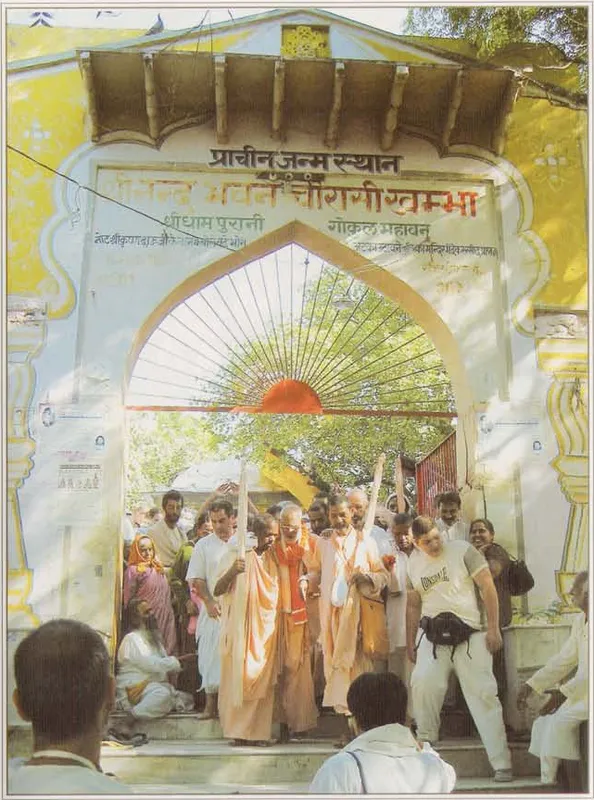
- What it is
- The Bhakti-ratnākara and the guidebooks show Nanda-bhavana in Mahāvana as the house of Nanda Mahārāja and Mother Yaśodā, where Vasudeva left the newborn Kṛṣṇa, where Nanda held the festival of His …
- Visiting
- The 2007 guidebook places Nanda-bhavana in Mahāvana, with the place where the twin arjuna trees were broken just outside it.
- Places here
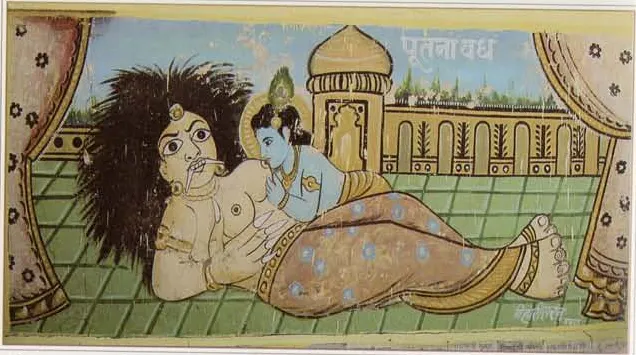
- Pūtanā-uddhāra-sthala, Dadhi-manthana-sthala (Mahāvana)
In short
The Bhakti-ratnākara and the guidebooks show Nanda-bhavana in Mahāvana as the house of Nanda Mahārāja and Mother Yaśodā, where Vasudeva left the newborn Kṛṣṇa, where Nanda held the festival of His birth, and where Kṛṣṇa spent His infancy. Śrīmad-Bhāgavatam tells these events in Nanda's house without naming a site.[1 +5] The Bhakti-ratnākara, in lines that Śrīla Prabhupāda quotes and translates, shows the house of Nanda and Yaśodā and Kṛṣṇa's birthplace in Mahāvana, and tells how Śrī Caitanya Mahāprabhu danced in ecstasy at the place of the birth festival.[7 +3] Within it lie the place of Pūtanā's deliverance and the place where the yogurt was churned.[1 +5] Śrīmad-Bhāgavatam tells Kṛṣṇa's appearance from Devakī at Mathurā; Śrīla Viśvanātha Cakravartī Ṭhākura's teaching that He appeared at the same time as Yaśodā's son is noted briefly below.[1 +6] The books differ on what the pillared building here is.
Key facts
| Kind | pastime site |
|---|---|
| Region · area | Mahāvana · Mahāvana (village) |
| Ācāryas | Śrī Caitanya Mahāprabhu, Śrīla Rāghava Paṇḍita Gosvāmī of Govardhana, Śrīla Viśvanātha Cakravartī Ṭhākura, Śrīla Sanātana Gosvāmī, Śrīla Rūpa Gosvāmī |
Why it is glorified
Śrīla Raghunātha dāsa Gosvāmī bows to Bṛhat-kānana, the great forest of Mahāvana, as the place where, at the great festival of …
Śrīla Raghunātha dāsa Gosvāmī bows to Bṛhat-kānana, the great forest of Mahāvana, as the place where, at the great festival of Kṛṣṇa's appearance, the lord of Vraja joyfully gave the brāhmaṇas two lakhs of young cows adorned with gold and pearls, with mountains of ornaments, jewels and sesame. The Bhakti-ratnākara quotes his verse at Mahāvana.[7 +1]
Śrīla Raghupati Upādhyāya's verse, which Śrīla Rūpa Gosvāmī keeps in his Padyāvalī and which the Caitanya-caritāmṛta records, honours Nanda as the one in whose courtyard the Supreme Brahman plays. The guidebook Śrī Vraja-maṇḍala Parikramā (2007) quotes it at Nanda-bhavana; the verse itself names no village.[13 +3]
śrutim apare smṛtim itare bhāratam anye bhajantu bhava-bhītāḥ
aham iha nandaṁ vande yasyālinde paraṁ brahma
Raghupati Upādhyāya recited, “Those who are afraid of material existence worship the Vedic literature. Some worship smṛti, the corollaries to the Vedic literature, and others worship the Mahābhārata. As far as I am concerned, I worship Kṛṣṇa’s father, Mahārāja Nanda, in whose courtyard the Supreme Personality of Godhead, the Absolute Truth, is playing.”
Translation: Śrīla A.C. Bhaktivedanta Swami PrabhupādaŚrīla Nārāyaṇa Bhaṭṭa Gosvāmī's Vraja-bhakti-vilāsa (4.73) gives a prayer to Nanda's mandira in Gokula: obeisance to the abode of Nanda, the cause of the supreme festival of love for his son Kṛṣṇa.[17]
Divine pastimes
Kṛṣṇa comes to Nanda's house
Śrīmad-Bhāgavatam (10.3.47-51) tells that as Vasudeva was about to carry his newborn son out of the prison, Yogamāyā took birth from Nanda's wife. Vasudeva crossed to Nanda's Vraja, found the cowherd men fast asleep, laid his son on Yaśodā's bed and took her daughter back with him.[1 +5] Śrīla Jīva Gosvāmī, commenting on these verses, says that the Yamunā gave way to him as he came from Mathurā to Mahāvana (summarised here, not translated).[18 +5]
When Vasudeva reached the house of Nanda Mahārāja, he saw that all the cowherd men were fast asleep. Thus he placed his own son on the bed of Yaśodā, picked up her daughter, an expansion of Yoga-māyā, and then returned to his residence, the prison house of Kaṁsa.
Translation: Śrīla A.C. Bhaktivedanta Swami PrabhupādaThe Garga-saṁhitā calls the house Nanda's palace: the newborn Lord tells Vasudeva to take Him there, and Vasudeva lays the child on Yaśodā's bed.[24 +3]
The festival of His birth
Nanda, overjoyed that a son was born to him, bathed and dressed, called learned brāhmaṇas and had the birth ceremony performed; the cowherd men came to his house in fine dress, carrying gifts.[1 +5] The Garga-saṁhitā describes Nanda's palace decorated for the festival with flags, golden pots, awnings and gateways.[24 +3] The Aiśvarya-kādambinī, attributed to Śrīla Baladeva Vidyābhūṣaṇa, adds that the women of Vraja came to the king's palace to see Hari, and that Brahmā, Śiva and the sages danced in the king's courtyard, scattering ghee, yogurt and turmeric.[28]
śrī-śuka uvāca nandas tv ātmaja utpanne jātāhlādo mahā-manāḥ / āhūya viprān veda-jñān snātaḥ śucir alaṅkṛtaḥ
vācayitvā svastyayanaṃ jāta-karmātmajasya vai / kārayām āsa vidhivat pitṛ-devārcanaṃ tathā
Śukadeva Gosvāmī said: Nanda Mahārāja was naturally very magnanimous, and when Lord Śrī Kṛṣṇa appeared as his son, he was overwhelmed by jubilation. Therefore, after bathing and purifying himself and dressing himself properly, he invited brāhmaṇas who knew how to recite Vedic mantras. After having these qualified brāhmaṇas recite auspicious Vedic hymns, he arranged to have the Vedic birth ceremony celebrated for his newborn child according to the rules and regulations, and he also arranged for worship of the demigods and forefathers.
Translation: Śrīla A.C. Bhaktivedanta Swami PrabhupādaThe same work says that Nanda's city stood in Bṛhadvana, where Hari was born, and that the palace of King Vṛṣabhānu, where Rādhikā appeared, stood near it; later the city of the lord of Vraja was at Nandīśvara hill.[29] Read more: The appearance of Śrī Rādhā: the traditions of Rāvala and Varṣāṇā →
Kṛṣṇa's infancy in the house
Pūtanā entered Nanda's house and found the child on His bed (Pūtanā-uddhāra-sthala), and Yaśodā churned the yogurt herself and bound Kṛṣṇa to the mortar (Dadhi-manthana-sthala); the Bhāgavatam tells both in Nanda's house without naming a spot.[1 +5] Śrīla Sanātana Gosvāmī and Śrīla Jīva Gosvāmī place the twin arjuna trees near Nanda's residence in Bṛhadvana, and the 2007 guidebook says that the place where Nalakūvara and Maṇigrīva were delivered lies just outside Nanda-bhavana (Yamalārjuna-uddhāra-sthala).[22 +2]
In Śrīla Murāri Gupta's account, Śrī Caitanya Mahāprabhu's guide Kṛṣṇadāsa shows Him Nanda's house in Mahāvana and points out, spot by spot, where Pūtanā was delivered, the cart broken (Śakaṭa-bhañjana-sthāna) and Tṛṇāvarta killed (Tṛṇāvarta-badha-sthala), and where Kṛṣṇa showed the universe in His mouth, Garga gave Him His name, He ate earth, His mother churned and bound Him, and He broke the twin arjuna trees. Śrīla Locana dāsa Ṭhākura gives the same list at Nanda's dwelling in Mahāvana.[32 +2] Read more: Śrī Caitanya Mahāprabhu in Gokula-Mahāvana →
Kṛṣṇa's appearance and Nanda's house
The Bhāgavatam tells Kṛṣṇa's birth from Devakī in Kaṁsa's prison at Mathurā, remembered at the Kṛṣṇa Janma-sthāna, and it names only Yogamāyā as born to Yaśodā.[1 +11] The Caitanya-caritāmṛta calls what Śrī Caitanya Mahāprabhu saw at Mahāvana the birth-site, the janma-sthāna.[10 +2] Śrīla Prabhupāda writes in his purport to ŚB 10.3.47:[11 +1]
General teaching (does not name the place)“Śrīla Viśvanātha Cakravartī Ṭhākura discusses that Kṛṣṇa appeared simultaneously as the son of Devakī and as the son of Yaśodā, along with the spiritual energy Yoga-māyā.”
Śrīla Prabhupāda, Śrīmad-Bhāgavatam, 10.3.47, purport · vedabase.io
Śrīla Rūpa Gosvāmī records a related view of some ancient devotees and calls it very secret (Laghu-bhāgavatāmṛta 1.5.456).[16]
Balarāma and Yogamāyā
By the Lord's order Yogamāyā moved Balarāma from Devakī's womb into the womb of Rohiṇī, who lived in Nanda's Gokula; the Bhāgavatam tells no scene of His birth.[37 +2] The books differ on where and when Balarāma was born, and also on whether Yogamāyā was born here or at the nearby Yaśodā-bhavana.[37 +2]
Accounts differ Where and when Balarāma was born.
- Garga-saṁhitā 1.10.27-28In Nanda's home in Vraja, on the bright sixth of Bhādra, at midday.
- Vraja-bhakti-vilāsa 4.82-84Baladeva's birthplace is in the inner house of Rohiṇī's house in Gokula.
- Śrī Vraja-maṇḍala Parikramā (2007)In Gokula-Mahāvana, eight days before Kṛṣṇa.
- Vṛndāvana-Dhāma Ki Jaya! (c. 1986)Mahāvana is the appearance site of Balarāma.
The Gosvāmīs and ācāryas
According to the Bhakti-ratnākara, Śrī Caitanya Mahāprabhu, seeing the place of the birth festival, was absorbed in dancing and …
Śrī Caitanya Mahāprabhu
According to the Bhakti-ratnākara, Śrī Caitanya Mahāprabhu, seeing the place of the birth festival, was absorbed in dancing and singing and drew everyone's heart. Śrīla Murāri Gupta tells that His guide crossed the Yamunā with Him and showed Him Nanda's house in Mahāvana, and the Caitanya-caritāmṛta calls what He saw at Mahāvana the birth-site.[7 +4]
Śrīla Rāghava Paṇḍita Gosvāmī of Govardhana
The Bhakti-ratnākara tells that Śrīla Rāghava Paṇḍita Gosvāmī of Govardhana, coming to Mahāvana with Śrīla Śrīnivāsa Ācārya and Śrīla Narottama dāsa Ṭhākura, softly showed them the home of Nanda and Yaśodā, Kṛṣṇa's birthplace, and the courtyard into which the cowherd men and women came running and where the festival of the son's birth was held.[7]
The Gosvāmīs' writings
- Śrīla Rūpa Gosvāmī's song Putram udāram celebrates the birth festival.[14 +1]
- Śrīla Sanātana Gosvāmī places the twin arjuna trees near Śrī Nanda's residence in Bṛhadvana.[22]
- According to Śrīla Jīva Gosvāmī's Kṛṣṇa-sandarbha, the people of Vraja felt that Kṛṣṇa, the blue jewel, had appeared from the great mine that is the mother of the Vraja of Mahāvana.[18 +5]
- Śrīla Nārāyaṇa Bhaṭṭa Gosvāmī gives the prayer to Nanda's mandira in Gokula.[17]
Śrīla Prabhupāda
Explaining Śrī Caitanya Mahāprabhu's visit to Mahāvana, Śrīla Prabhupāda quotes the Bhakti-ratnākara and translates it …
Explaining Śrī Caitanya Mahāprabhu's visit to Mahāvana, Śrīla Prabhupāda quotes the Bhakti-ratnākara and translates it:[7 +2]
Names this place“Behold the house of Nanda and Yaśodā in Mahāvana. See the birthplace of Lord Kṛṣṇa. Mahāvana and the birthplace of Lord Kṛṣṇa, Gokula, are one and the same.”
Śrīla Prabhupāda, Śrī Caitanya-caritāmṛta, Madhya-līlā 18.67, purport (quoting the Bhakti-ratnākara, Fifth Wave) · vedabase.io
In his Kṛṣṇa book he tells the exchange of the children in Yaśodā's house in Gokula; he does not identify a present-day site.[1 +5]
Names this place“On the other side, he went to the place of Nanda Mahārāja, situated in Gokula, where he saw that all the cowherd men were fast asleep. He took the opportunity to silently enter the house of Yaśodā, and without difficulty he exchanged his son for the baby girl newly born there.”
Śrīla Prabhupāda, Kṛṣṇa, the Supreme Personality of Godhead, ch. 3 "The Birth of Lord Kṛṣṇa" · vedabase.io
Songs
Śrīla Rūpa Gosvāmī's songs of the birth festival in Nanda's house.
Śrīla Rūpa Gosvāmī's songs of the birth festival in Nanda's house.[14 +1]
putram udāram asūta yaśodā
samajani ballava-tati-rati-modā
sūnur adbhuta-sundaro 'jani nanda-rāja tavāyam
dehi goṣṭha-janāya vāñchitam utsavocita-dāyam
Visiting today
The 2007 guidebook places Nanda-bhavana in Mahāvana, with the place where the twin arjuna trees were broken just outside it.[22 +2]
Places at Nanda-bhavana (Mahāvana)
2 places
Nearby places
Brahmāṇḍa-ghāṭa · Yamalārjuna-uddhāra-sthala · Sanātana Gosvāmī's bhajana-kuṭī (Mahāvana) · Yaśodā-bhavana (Mahāvana)
Pictures
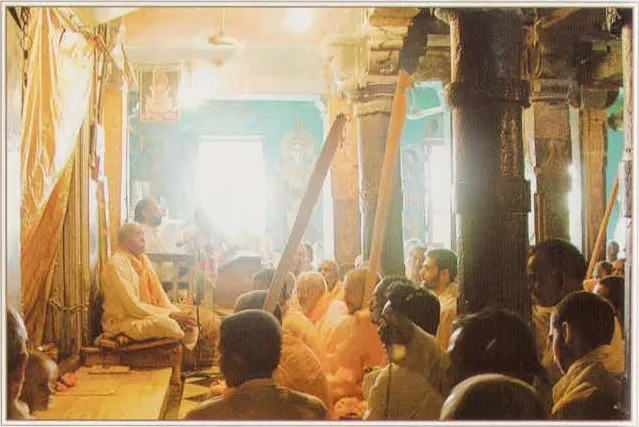
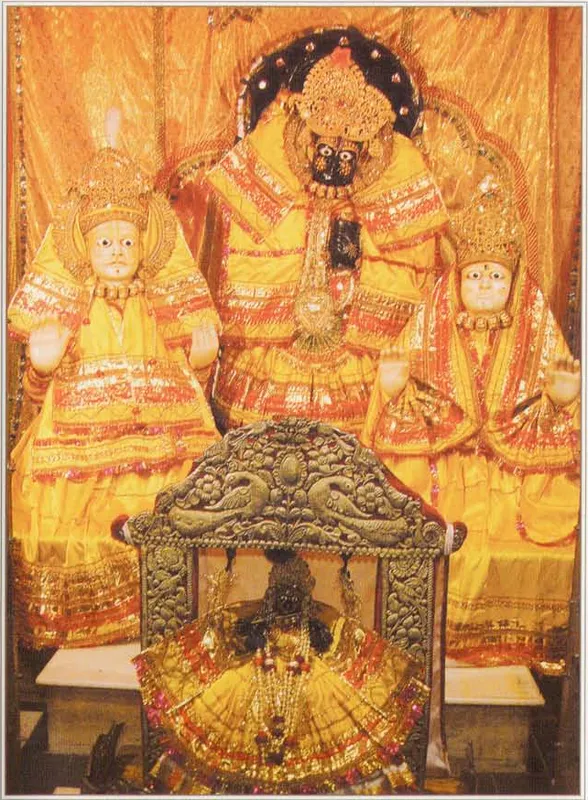
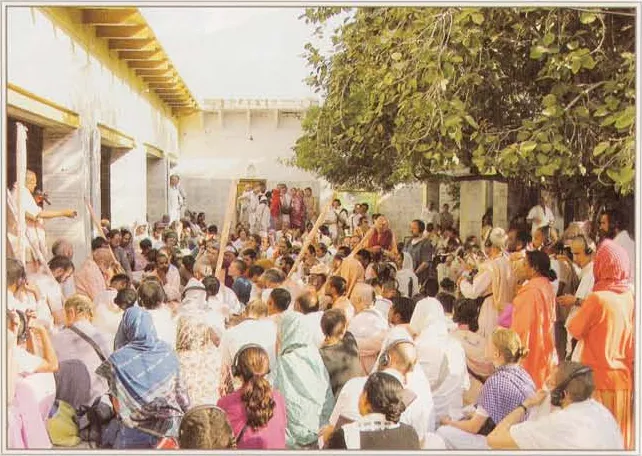
4 pictures
Where the sources differ
Where Yogamāyā was born and Kṛṣṇa's umbilical cord was cut: Śrī Vraja-maṇḍala Parikramā (2007) says in the delivery room of Nanda-bhavana, the undated parikramā notes Mahāvana at Yaśodā-bhavana, a short distance away; the accounts are set side by side on the page of Yaśodā-bhavana.[40 +3]
Accounts differ Who was born to Yaśodā on the night of Kṛṣṇa's birth.
- Śrīmad-Bhāgavatam 10.3.47Yoga-māyā was born of Nanda's wife (only the girl is named).
- Harivaṁśa 48.11-12 (crit. ed.)Yaśodā gave birth to a girl at the same time as Devakī.
- Garga-saṁhitā 1.11.43Yogamāyā was born of Nanda's wife in Vraja.
- Śrīla Viśvanātha Cakravartī on ŚB 10.3.47; Śrīla Prabhupāda's purportKṛṣṇa appeared simultaneously as Devakī's son and as Yaśodā's son, together with Yoga-māyā.
Accounts differ Which place is called Kṛṣṇa's birthplace: Kaṁsa's prison at Mathurā or Nanda's house in Mahāvana.
- Śrīmad-Bhāgavatam 10.3; CC Madhya 18.69Kṛṣṇa appeared from Devakī in Kaṁsa's prison at Mathurā; Śrī Caitanya saw the janma-sthāna in Mathurā after Gokula.
- CC Madhya 18.67At Mahāvana Śrī Caitanya saw the "janma-sthāna" (Śrīla Prabhupāda's translation: "saw Gokula").
- Bhakti-ratnākara (Fifth and Thirteenth Waves)See here the birthplace (janma-sthala) of Śrī Kṛṣṇacandra in Mahāvana; Śrī Caitanya and Vīracandra went to Kṛṣṇa's birthplace at Gokula-Mahāvana.
- Aiśvarya-kādambinī 4.1 (attributed to Śrīla Baladeva Vidyābhūṣaṇa)The birth of Hari took place in Nanda's city in Bṛhadvana.
The wording of these accounts is our summary of the sources, not a published translation.
Accounts differ What the pillared building at Nanda-bhavana (Caurāsī- or Assī-khambā) is.
- Vṛndāvana-Dhāma Ki Jaya! (c. 1986)Its pillars come from Nanda's original house and are "still present from Lord Kṛṣṇa's time 5,000 years ago".
- A. W. Entwistle (1987), a historianEntwistle says that in Aurangzeb's reign medieval pillars were set up again in the form of a mosque, now five rows of sixteen pillars (hence the name Assī-khambhā, eighty pillars); Cunningham found it built of Hindu materials, and Growse also noted Buddhist remains and pieces of a Hindu temple later than 1500.
- Mītal (1966, p. 143)Built later from the remains of a large Balarāma temple destroyed by Muslim invaders; called the 84-pillar temple, though it has fewer pillars.
- Śrī Vraja-maṇḍala Parikramā (2007)The "temple of Caurāsī-khambā", with Śrīla Sanātana Gosvāmī's cave below it.
More on this place
Śrī Caitanya Mahāprabhu in Gokula-Mahāvana · The appearance of Śrī Rādhā: the traditions of Rāvala and Varṣāṇā
References
45 references
- Śrīmad-Bhāgavatam 10.3.51, Bhagavata Vidya Pith edition, ed. Bhagavata Rishi and Krishna Shankar Shastri, 1996
- Śrīmad-Bhāgavatam 10.3.47, Bhagavata Vidya Pith edition, ed. Bhagavata Rishi and Krishna Shankar Shastri, 1996
- Śrīmad-Bhāgavatam 10.5.1-2, GRETIL
- Śrīmad-Bhāgavatam 10.5.8, GRETIL
- Śrīmad-Bhāgavatam 10.6.7, GRETIL
- Śrīmad-Bhāgavatam 10.9.1–2, GRETIL
- Śrīla Narahari Cakravartī, Bhakti-ratnākara, Fifth Wave, 1912 ed. pp. 277-278; Grantha Mandira text v.1713-1717, 2nd ed., 1912
- Śrīla Narahari Cakravartī, Bhakti-ratnākara, Fifth Wave, 1912 ed. p. 284; Grantha Mandira text v.1787-1789, 2nd ed., 1912
- Śrīla Prabhupāda, Śrī Caitanya-caritāmṛta, Madhya-līlā 18.67, purport (quoting the Bhakti-ratnākara, Fifth Wave) · vedabase.io
- Śrīla Narahari Cakravartī, Bhakti-ratnākara, Fifth Wave, 1912 ed. p. 283; Grantha Mandira text v.1770-1776, 2nd ed., 1912
- Śrīla Prabhupāda, Śrīmad-Bhāgavatam, 10.3.47, purport · vedabase.io
- Śrīla Raghunātha dāsa Gosvāmī, Vraja-vilāsa-stava, Stavāvalī (9) Vraja-vilāsa-stava v.89
- Śrīla Kṛṣṇadāsa Kavirāja Gosvāmī, Śrī Caitanya-caritāmṛta, Madhya-līlā 19.96, online edition · vedabase.io
- Śrīla Rūpa Gosvāmī, Padyāvalī 126, GRETIL
- Śrī Vraja-maṇḍala Parikramā (2007), PDF p. 282
- Śrīla Rūpa Gosvāmī, Laghu-bhāgavatāmṛta, 1.5.454-456, GRETIL
- Śrīla Nārāyaṇa Bhaṭṭa Gosvāmī, Vraja-bhakti-vilāsa, chapter 4 v.73, printed p. 104; Grantha Mandira text (4) v.73, 1st ed., publ. Bābā Kṛṣṇadāsa, Kusuma-sarovara, Saṁvat 2008
- Śrīla Viśvanātha Cakravartī Ṭhākura: commentary on ŚB 10.1.9, Bhagavata Vidya Pith edition, ed. Bhagavata Rishi and Krishna Shankar Shastri, 1996
- Śrīla Viśvanātha Cakravartī Ṭhākura: commentary on ŚB 10.11.21 (opening verse of the comment), Bhagavata Vidya Pith edition, ed. Bhagavata Rishi and Krishna Shankar Shastri, 1996
- Śrīla Jīva Gosvāmī: commentary on ŚB 10.3.51-53, Bhagavata Vidya Pith edition, ed. Bhagavata Rishi and Krishna Shankar Shastri, 1996
Show all 45 references
- Śrīla Jīva Gosvāmī: commentary on ŚB 10.11.37, Bhagavata Vidya Pith edition, ed. Bhagavata Rishi and Krishna Shankar Shastri, 1996
- Śrīla Sanātana Gosvāmī: commentary on ŚB 10.10.22, Bhagavata Vidya Pith edition, ed. Bhagavata Rishi and Krishna Shankar Shastri, 1996
- Śrīla Jīva Gosvāmī, Kṛṣṇa-sandarbha, anuccheda 182, GRETIL
- Garga-saṁhitā, Goloka-khaṇḍa (1) 11.41, Sanskrit Wikisource
- Garga-saṁhitā, Goloka-khaṇḍa (1) 11.43, Sanskrit Wikisource
- Garga-saṁhitā, Goloka-khaṇḍa (1) 11.48, Sanskrit Wikisource
- Garga-saṁhitā, Goloka-khaṇḍa (1) 12.5, Sanskrit Wikisource
- Aiśvarya-kādambinī, Fifth Shower vv.11-13, after Haridas Shastri's undated edition
- Aiśvarya-kādambinī, Fourth Shower (caturthī vṛṣṭiḥ) vv.1-3, after Haridas Shastri's undated edition
- Gopāla-campū, Pūrva-campū 9.[2]
- Śrī Vraja-maṇḍala Parikramā (2007), PDF p. 275
- Kṛṣṇa-caitanya-caritāmṛta, prakrama 4, sarga 6, v.1
- Kṛṣṇa-caitanya-caritāmṛta, prakrama 4, sarga 6, vv.2-4
- Caitanya-maṅgala, Śeṣa-khaṇḍa, 1903 ed. printed p. 172, left column
- Śrīla Kṛṣṇadāsa Kavirāja Gosvāmī, Śrī Caitanya-caritāmṛta, Madhya-līlā 18.67, online edition · vedabase.io
- Sārārtha-darśinī of Śrīla Viśvanātha Cakravartī Ṭhākura on Śrīmad-Bhāgavatam 10.3.47: commentary v.10.3.47, viśvanātha-cakravartī (sārārtha-darśiṇī), Bhagavata Vidya Pith edition, ed. Bhagavata Rishi and Krishna Shankar Shastri, 1996
- Śrīmad-Bhāgavatam 10.2.7, GRETIL
- Śrīmad-Bhāgavatam 10.2.8, GRETIL
- Śrīla Prabhupāda, Kṛṣṇa, the Supreme Personality of Godhead, ch. 2 "Prayers by the Demigods for Lord Kṛṣṇa in the Womb" · vedabase.io
- Śrī Vraja-maṇḍala Parikramā (2007), PDF p. 271
- Śrī Vraja-maṇḍala Parikramā (2007), PDF p. 272
- the undated parikramā notes Mahāvana, ¶80
- the undated parikramā notes Mahāvana, ¶78
- Śrī Vraja-maṇḍala Parikramā (2007), p. 518-519
- Śrī Vraja-maṇḍala Parikramā (2007), p. 526-527