Rāghava Paṇḍita's tour of Gokula-Mahāvana in the Bhakti-ratnākara
भक्ति-रत्नाकर में श्रील राघव पण्डित गोस्वामी की गोकुल-महावन परिक्रमा
In short
In the Fifth Wave (chapter) of the Bhakti-ratnākara, Śrīla Rāghava Paṇḍita of Govardhana leads Śrīla Śrīnivāsa Ācārya and Śrīla Narottama dāsa Ṭhākura through Gokula-Mahāvana. He shows them about twenty places, one after another. The tour runs from the home of Nanda and Yaśodā to the path by which the cowherds left for Vṛndāvana. At many stops he quotes scripture.[1–7]
On this page
At a glance
- The book: the Bhakti-ratnākara of Śrīla Narahari Cakravartī Ṭhākura, Fifth Wave, in the 1912 edition, printed pages 277 to 285 (summarised here, not translated).[1–6]
- The guide: Śrīla Rāghava Paṇḍita, who speaks to Śrīla Śrīnivāsa Ācārya.[1, 3–8]
- The first stop, according to the Bhakti-ratnākara: the home of Nanda and Yaśodā, Kṛṣṇa's birthplace and the courtyard of the birth festival.[1]
- The key line: Śrī Gokula and Mahāvana are one. Śrīla Prabhupāda quotes it.[1, 5, 9]
- The verses quoted, according to the same book: the Ādi-vārāha, Śrīla Raghunātha dāsa Gosvāmī, Śrīla Rūpa Gosvāmī's songs and Padyāvalī, and Śrīla Murāri Gupta.[3 +7]
- The last stop, according to the Bhakti-ratnākara: Sakaraurī, where the cowherds gathered their cows for the journey.[17, 18]
Who showed the places, and in which book?
The Bhakti-ratnākara was written by Śrīla Narahari Cakravartī Ṭhākura. Its Fifth Wave (chapter) tells of a long parikramā of Vraja, a pilgrimage tour of its holy places. On it, Śrīla Rāghava Paṇḍita of Govardhana guides Śrīla Śrīnivāsa Ācārya and Śrīla Narottama dāsa Ṭhākura. At Mahāvana the book calls him simply Śrī Paṇḍita. Again and again he speaks to Śrīnivāsa with the words "ahe Śrīnivāsa".[1, 3–8]
The tour of Mahāvana fills about nine printed pages. Its pattern is simple. Rāghava Paṇḍita points to a spot and says "here" (ethā). He names the pastime and often supports it with a verse. We quote only the translations of the Bhaktivedanta Book Trust (BBT), so every stop below is a summary of the Bengali of the 1912 edition.[1–6]
Śrīla Prabhupāda quotes the opening lines of this passage, with the line on Gokula and Mahāvana. He does so in his purport (explanation) to Caitanya-caritāmṛta Madhya 18.67:[1, 5, 9]
Names this place“Behold the house of Nanda and Yaśodā in Mahāvana. See the birthplace of Lord Kṛṣṇa. Mahāvana and the birthplace of Lord Kṛṣṇa, Gokula, are one and the same.”
Śrīla Prabhupāda, Śrī Caitanya-caritāmṛta, Madhya-līlā 18.67, purport (quoting the Bhakti-ratnākara, Fifth Wave) · vedabase.io
Nanda's house and the birth festival
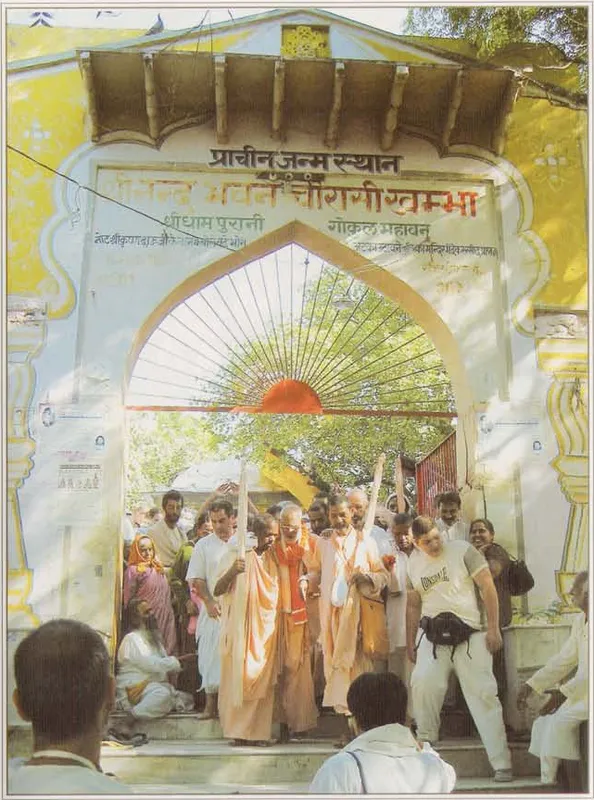
The tour begins at Nanda's house. Śrī Paṇḍita goes to Mahāvana in loving ecstasy. Softly he tells Śrīnivāsa and Narottama to see the home of Nanda and Yaśodā and Kṛṣṇa's birthplace. He shows them this courtyard, into which the cowherd men and women came running. The festival of the son's birth took place right here, and Nanda gave much in charity for his son's welfare.[1] The place is Nanda-bhavana.
মহাবনে গিয়া শ্রীপণ্ডিত প্রেমাবেশে। শ্রীনিবাস নরোত্তমে কহে মৃদুভাষে ॥ দেখ নন্দ যশোদা আলয় মহাবনে। এথা যে যে রঙ্গ তাহা কে বর্ণিতে জানে ॥ এই দেখ শ্রীকৃষ্ণচন্দ্রের জন্মস্থল। পুত্রমুখ দেখি এথা নন্দাদি বিহ্বল ॥ ব্রজগোপ গোপী ধাই আইসে এ অঙ্গণে। পুত্রজন্ম উৎসব হইল এই খানে ॥ বহুদান কৈল নন্দপুত্র কল্যাণেতে। পরম অদ্ভুত সুখ ব্যাপিল জগতে ॥
mahābane giẏā śrīpaṇḍita premābeśe| śrīnibāsa narottame kahe mṛdubhāṣe
dekha nanda yaśodā ālaẏa mahābane| ethā ye ye raṅga tāhā ke barṇite jāne
ei dekha śrīkṛṣṇacandrera janmasthala| putramukha dekhi ethā nandādi bihbala
brajagopa gopī dhāi āise e aṅgaṇe| putrajanma utsaba haila ei khāne
bahudāna kaila nandaputra kalyāṇete| parama adbhuta sukha byāpila jagate ||
Here the book quotes Śrīla Raghunātha dāsa Gosvāmī's Vraja-vilāsa-stava. The verse bows to the great forest where Nanda gave the brāhmaṇas two lakhs (200,000) of young cows at the festival of Kṛṣṇa's appearance. The cows were adorned with gold and pearls.[1, 13]
It then quotes two songs of Śrīla Rūpa Gosvāmī's Gītāvalī on Nanda's festival. Yaśodā has borne a noble son, and the cowherds bring presents, dance, sing and scatter curd and butter.[12] After the songs, Rāghava Paṇḍita shows the place where all the usual rites of Kṛṣṇa's birth were performed, the Janma-saṁskāra-sthāna.[10–13]
The cowshed, the name-giving and the infant pastimes
Next comes Nanda's cowshed. Here, Rāghava Paṇḍita says, Nanda told Gargācārya what was in his heart. Out of fear of Kaṁsa, Garga secretly performed the name-giving of Rāma and Kṛṣṇa right here.[20] Then he shows the place where the prince of Vraja killed Pūtanā. He says that her cremation took place right there.[21] Read more: The deliverance of Pūtanā: the Bhāgavatam and the other accounts →
He shows the place where Kṛṣṇa, lying in bed, broke the cart. There he recites a Padyāvalī verse on the infant who overturned it.[22] He shows the Stanya-pāna-sthala, the place where Kṛṣṇa drank His mother's milk, climbing onto her lap while she gazed at His face. He shows the place where He went crawling with a sweet smile; a later guidebook lists it as the place where Kṛṣṇa and Balarāma crawled. Each comes with a verse from the Padyāvalī.[23–28]
এথা কৃষ্ণ যশোদা আকর্ষে মহাসুখে। হামাগুড়ি যান, কি মধুর হাসি মুখে॥
ethā kṛṣṇa yaśodā ākarṣe mahāsukhe| hāmāguṛi yāna, ki madhura hāsi mukhe||
Then he points out the spot from which the whirlwind demon Tṛṇāvarta carried Kṛṣṇa into the sky. Kṛṣṇa killed him there. The book does not say where the demon fell.[30] At the Yamunā he shows the Brahmāṇḍa-ghāṭa. Here Kṛṣṇa happily ate earth, and the queen of Vraja saw the universe in His mouth. That, the book says, is why the ghāṭa (bathing steps) has its name.[2]
এথা কৃষ্ণ মৃত্তিকাভক্ষণ কৈল সুখে। ব্রজেশ্বরী ব্রহ্মাণ্ড দেখিল কৃষ্ণমুখে ॥ এ হেতু ব্রহ্মাণ্ড-ঘাট নাম সে ইহার। দেখ যমুনার তীর শোভা চমৎকার ॥
ethā kṛṣṇa mṛttikābhakṣaṇa kaila sukhe| brajeśbarī brahmāṇḍa dekhila kṛṣṇamukhe
e hetu brahmāṇḍa-ghāṭa nāma se ihāra| dekha yamunāra tīra śobhā camatkāra ||
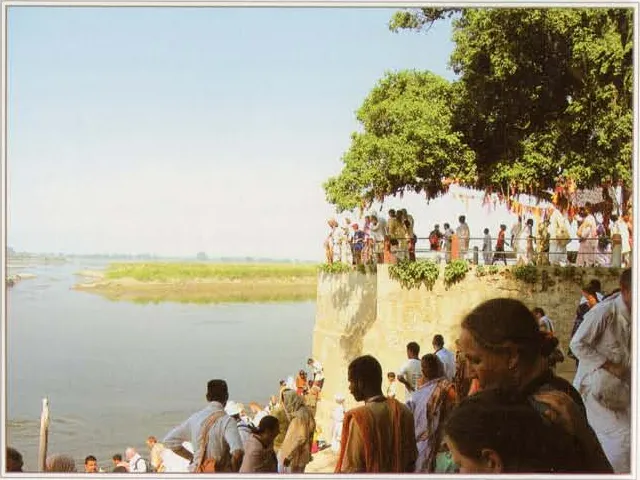
Back at the house he shows Yaśodā's courtyard. There she sat happily with the gopīs, the cowherd women, watching her son's beauty. A Padyāvalī verse tells of the five-year-old child running about in it.[26 +2] He shows the place where Kṛṣṇa, most expert in stealing butter, thought of His fear of His mother. Here he quotes a verse on child Keśava eyeing a pot of butter and turning His face away.[34, 35]
The binding and the Yamalārjuna-tīrtha
Here, Rāghava Paṇḍita says, Yaśodā bound Kṛṣṇa to the mortar, and Kṛṣṇa playfully accepted being bound.[36] The next stop is a separate place. It is the tīrtha (holy bathing place) where the twin arjuna trees were broken, with a kuṇḍa (sacred pond) of very clear water.[3 +3] Read more: Dāmodara and the twin arjuna trees →
এই যমলার্জ্জুন ভঞ্জন তীর্থস্থল। অপূর্ব্ব কুণ্ডের শোভা সুনির্ম্মল জল ॥ মিলয়ে অনন্ত ফল স্নানোপবাসেতে। ইন্দ্রলোকে পূজ্য মহাবন গমনেতে ॥ দেখ গোপীশ্বর মহাপাতক নাশয়। কৃষ্ণপ্রিয় মহাবন কৃষ্ণলীলাময় ॥ সপ্তসামুদ্রিক কূপ দেখ এই খানে। পিণ্ড প্রদানাদি ফল ব্যক্ত সে পুরাণে ॥
ei yamalārjjuna bhañjana tīrthasthala| apūrbba kuṇḍera śobhā sunirmmala jala
milaẏe ananta phala snānopabāsete| indraloke pūjya mahābana gamanete
dekha gopīśbara mahāpātaka nāśaẏa| kṛṣṇapriẏa mahābana kṛṣṇalīlāmaẏa
saptasāmudrika kūpa dekha ei khāne| piṇḍa pradānādi phala byakta se purāṇe ||
At this tīrtha the book gives its longest quotation. It says the lines come from the Ādi-vārāha. They are the same lines that Śrīla Rūpa Gosvāmī collects under the heading of Mahāvana in his Mathurā-māhātmya. In them, Mahāvana, the eighth forest, is always dear to the Lord. The Yamalārjuna-tīrtha and a kuṇḍa are there, where the cart was overturned. Bathing and fasting there give endless merit. And there stands Gopīśvara, who destroys great sins.[3 +6]
Rāghava Paṇḍita then shows Gopīśvara and the Sapta-sāmudrika well. There, he says, the Purāṇa gives the fruit of offering piṇḍa, the rice-ball offering for the ancestors.[3]
Śrī Caitanya and Śrīla Sanātana Gosvāmī in Mahāvana
The tour then turns from Kṛṣṇa's pastimes to His devotees. Here, Rāghava Paṇḍita tells Śrīnivāsa, Śrī Kṛṣṇa Caitanya saw the place of the birth festival and was overjoyed. He danced and sang in ecstasy. People ran from all sides and said that He was no sannyāsī (renounced monk) but Kṛṣṇa. In Mahāvana there was an ocean of bliss, and on seeing Madana-gopāla the Lord lost all composure.[42–45] Read more: Śrī Caitanya Mahāprabhu in Gokula-Mahāvana →
Then he shows the place where Śrīla Sanātana Gosvāmī stayed. His presence revived the people of Mahāvana.[4] On the Ramaṇaka sand by the Yamunā, he says, Madana-gopāla plays. One day He came as a cowherd boy with the children of Mahāvana. Śrīla Sanātana Gosvāmī followed Him into the temple. There he saw not the boy but Madana-mohana. He bowed and went home without a word.[4 +4]
অহে শ্রীনিবাস স্থান করহ দর্শন। এই খানে ছিলেন গোস্বামী সনাতন ॥ মহাবনবাসী যত লোক ভাগ্যবান্। সনাতনে দেখিলেই সবে পায় প্রাণ ॥ সনাতন মদনগোপাল দরশনে ॥ মহাসুখ পাইয়া রহয়ে মহাবনে ॥
ahe śrīnibāsa sthāna karaha darśana| ei khāne chilena gosbāmī sanātana
mahābanabāsī yata loka bhāgyabān| sanātane dekhilei sabe pāẏa prāṇa
sanātana madanagopāla daraśane
mahāsukha pāiẏā rahaẏe mahābane ||
Gopa-kūpa, the old tree and the council
Next Rāghava Paṇḍita shows a well that everyone calls Gopa-kūpa. Here he says the line Śrīla Prabhupāda quotes: Śrī Gokula and Mahāvana are one. This Gokula-Mahāvana is very beautiful, he goes on. And here, in turn, were the homes of Upananda and the other gopas, the cowherd men.[18 +2]
দেখ এই কূপে গোপকূপ সবে কয়। শ্রীগোকুল মহাবন দুই এক হয় ॥ এই শ্রীগোকুল মহাবন শোভা অতি। ক্রমে উপনন্দাদিক গোপের বসতি ॥ গোকুলে কৃষ্ণের বাল্য লীলা অতিশয়। যাতে উল্লসিত গোপ গোপীর হৃদয় ॥
dekha ei kūpe gopakūpa sabe kaẏa| śrīgokula mahābana dui eka haẏa
ei śrīgokula mahābana śobhā ati| krame upanandādika gopera basati
gokule kṛṣṇera bālya līlā atiśaẏa| yāte ullasita gopa gopīra hṛdaẏa ||
He shows an old tree in Gokula, where the people of the village find comfort. He tells that Gaurāṅga sat under it when He came from Prayāga by way of Agravana, Reṇukā and Rājagrāma.[6] To support this, the book quotes a verse of Śrīla Murāri Gupta's Sanskrit life of the Lord. From Reṇukā He went to Rājagrāma, and on seeing Gokula He was overwhelmed.[16]
Here, Rāghava Paṇḍita adds, the Lord went with many people to Kṛṣṇa's birthplace in saṅkīrtana, singing the holy names together. Here all the rites of Kṛṣṇa's birth were done. And here the elderly gopīs sing auspicious songs for Him.[11]
The last places of Mahāvana belong to the departure. Right here, he says, Nanda and the other gopas sat in council. They saw troubles again and again, and decided to go and live in Vṛndāvana. By this path the gopas of Gokula, Rāval and other places all went there.[53]
The guidebook's list calls the council place the Gopa-baiṭhaka. It gives the path to Vṛndāvana right after it, in the same order as here. On the way, the Bhakti-ratnākara says, the cowherds crossed the Yamunā beside Bhāṇḍīravana.[7, 53] Read more: Nanda's family at Nandagrāma →
The very last stop explains a village name. Everyone gathered the cows, the calves and the rest in one place. So the village there is called Sakraulī (Sakaraurī in the book). From there the tour goes on to Rāval.[17, 18]
Which of these places do the guidebooks list?
The guidebook Śrī Vraja-maṇḍala Parikramā (2007) takes its list of Mahāvana's places from this tour. Its list has the Yamalārjuna site, the Pūtanā site, the Sapta-sāmudrika well, Gopīśvara, the cowshed and the place where Tṛṇāvarta was killed. It also has Śrīla Sanātana Gosvāmī's place of bhajana (worship), Ramaṇa-retī and the homes of Upananda and the other gopas. The old texts do name these places.[18 +5]
The guidebook's list also adds some separate items. It has a place of the birth ceremonies apart from the birthplace, and a place of the name-giving apart from the cowshed. The Bhakti-ratnākara itself treats each of these as one spot.[10 +4]
Where the sources differ
The Bhakti-ratnākara's "here" is its own tradition. The Bhāgavatam tells these pastimes in Nanda's settlement without naming spots, and other works place some of them differently. For the name-giving, the Bhāgavatam and the Garga-saṁhitā speak of a lonely place in Nanda's cow-pen. The guidebook lists the cowshed and the place of the name-giving as two items:[20]
Accounts differ Whether the place of the name-giving (Nāma-karaṇa-sthāna) is Nanda's cowshed itself or a separate place.
- Śrī Vraja-maṇḍala Parikramā (2007), list of the Bhakti-ratnākara's places, p. 517Names 'the cowshed (gośālā)' and 'the place of the name-giving ceremony (Nāma-karaṇa-sthāna)' as two items.
- Śrī Vraja-maṇḍala Parikramā (2007), text, pp. 516 and 527The name-giving took place 'in the nearby cowshed (gośālā) of Nanda Mahārāja'; 'Gargācārya performed Kṛṣṇa's and Baladeva's name-giving ceremony in this solitary cowshed.'
- Bhakti-ratnākara, Fifth Wave v.1728-1729'See here the place of Nanda's cowshed … Garga secretly performed the name-giving right here (ethāi).'
- Śrīmad-Bhāgavatam 10.8.10-11; Garga-saṁhitā 1.15.22-23The name-giving was done secretly in a solitary place in Nanda's cow-pen (go-vraja); no present-day site.
For the binding, the Bhakti-ratnākara shows a place of its own before the Yamalārjuna-tīrtha. The Vraja-bhakti-vilāsa and Śrīla Murāri Gupta tell of the binding at the place of the trees:[36 +2]
Accounts differ Where Kṛṣṇa was bound to the mortar (the Dāmodara-līlā).
- Śrīmad-Bhāgavatam 10.9In Nanda's house (the churning place, a room, the upturned mortar); no present-day site.
- Bhakti-ratnākara, Fifth Wave v.1762-1763Shows 'here' the place where Yaśodā bound Kṛṣṇa, then the Yamalārjuna-bhañjana tīrtha as the next place.
- Vraja-bhakti-vilāsa 4.77-79Tells the binding within the Yamalārjuna section and says the Dāmodara image was installed there.
- Śrī Vraja-maṇḍala Parikramā (2007), p. 525'Mother Yaśodā had tied Kṛṣṇa to the mortar right here in Nanda-bhavana' (the Dadhi-manthana-sthala), with the place of deliverance of the trees 'just outside'.
The sources also tell differently where the birth rites and festival took place, and how the cowherds went to Vṛndāvana:[10 +4]
Accounts differ Whether the place of Kṛṣṇa's birth rites and birth festival is His birthplace in Nanda-bhavana itself or a separate place, and how many places the list names for them.
- Śrī Vraja-maṇḍala Parikramā (2007), list of the Bhakti-ratnākara's places, pp. 517-518Three items: Kṛṣṇa's birthplace (Janma-sthāna); 'the place where the sanctifying ceremonies took place at the time of Kṛṣṇa's birth (Janma-saṁskāra-sthāna)'; and, near the end, after the homes of Upananda and the other gopas, 'the place of Śrī Kṛṣṇa's birth-ceremony and other ceremonies'.
- Śrī Vraja-maṇḍala Parikramā (2007), text, pp. 516 and 518The birth was in the delivery room at Nanda-bhavana, where 'the umbilical cord was cut and other Vedic purificatory rituals were performed here' (p. 516); under 'Nanda-bhavana (Kṛṣṇa's birthplace)' Nanda called the brāhmaṇas to perform the rites of childbirth (p. 518). No separate place.
- the undated parikramā notes Mahāvana'the Chaurasi Khambha, also called Nanda Bhavan, where Krishna's birth celebrations took place'.
- Bhakti-ratnākara, Fifth Wave v.1715-1717, 1727, 1801-1803Shows Kṛṣṇa's birthplace and this courtyard, where the birth festival took place right here; the couplet 'here were performed all the customary rites of Kṛṣṇa's birth' follows the birthplace both times (after the quoted verses at v.1727; right after Śrī Caitanya 'went to Kṛṣṇa's birthplace' at v.1802). It does not say whether these are one spot.
The wording of these accounts is our summary of the sources, not a published translation.
Accounts differ By what way the cowherds went from Gokula-Mahāvana to Vṛndāvana, and where they first camped.
- Śrīmad-Bhāgavatam 10.11.28-35They went to Vṛndāvana with carts and cows and camped there with the carts in a half-moon; no route.
- Bhakti-ratnākara 5.1806-1807By this path shown at Gokula-Mahāvana; on the way they crossed the Yamunā beside Bhāṇḍīravana.
- Śrīla Jīva Gosvāmī, Gopāla-campū Pūrva 9.[61]-[65]They crossed the Yamunā on raft-bridges into the forest between Mathurā and Kāliya's lake and came from the Vatsa-krīḍana ghāṭa to Saṭṭīkarā, where they camped in a half-moon.
- Śrī Vraja-maṇḍala Parikramā (2007)Nanda came with all the Vrajavāsīs to Śakaṭīkarā (Chaṭṭīkarā) and camped there with the carts in a crescent; from there Kṛṣṇa and Balarāma would go to Vṛndāvana and nearby places to graze the calves and cows (the residence was outside Vṛndāvana).
The wording of these accounts is our summary of the sources, not a published translation.
Places in this article
Mahāvana
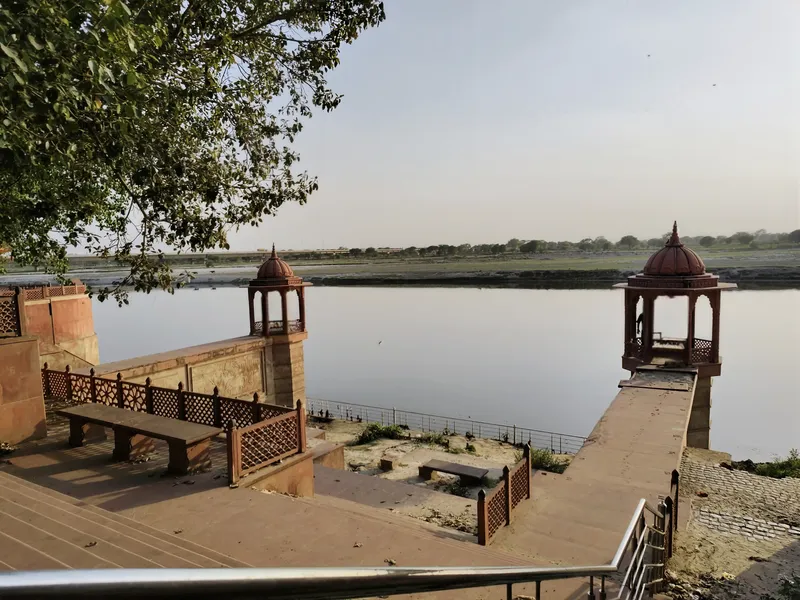
महावनMahāvana, "the great forest", also called Bṛhadvana, is the forest on the eastern bank of the Yamunā where Kṛṣṇa spent His infancy.
Mahāvana (village)
महावन (गाँव)Mahāvana, the great forest, is the village where, according to the Gauḍīya tradition, Nanda and Yaśodā lived and Kṛṣṇa spent His infancy: the Gokula of Śrīmad-Bhāgavatam' …
Nanda-bhavana (Mahāvana)
नन्द-भवन (महावन)The Bhakti-ratnākara and the guidebooks show Nanda-bhavana in Mahāvana as the house of Nanda Mahārāja and Mother Yaśodā, where Vasudeva left the newborn Kṛṣṇa, where Nand …
Janma-saṁskāra-sthāna
जन्म-संस्कार-स्थानNanda Bābā's cowshed (Mahāvana)
नन्द बाबा की गोशाला (महावन)Nanda Bābā's cowshed, the gośālā of Nanda's house in Mahāvana, is remembered as the place where the sage Garga secretly gave Kṛṣṇa and Balarāma Their names.
Nāma-karaṇa-sthāna
नामकरण-स्थानPūtanā-uddhāra-sthala
पूतना-उद्धार-स्थलThe Pūtanā-uddhāra-sthala, the place of Pūtanā's deliverance, is a spot within Nanda-bhavana in Mahāvana.
Agni-saṁskāra-sthala
अग्नि-संस्कार-स्थलŚakaṭa-bhañjana-sthāna
शकट-भंजन-स्थानŚakaṭa-bhañjana-sthāna, "the place where the cart was broken", is the place in Mahāvana that the Bhakti-ratnākara and the guidebooks show as where baby Kṛṣṇa, lying under …
Stanya-pāna-sthala
स्तन्य-पान-स्थलPlace where Kṛṣṇa and Balarāma crawled on Their knees
कृष्ण और बलराम के घुटनों के बल चलने का स्थानTṛṇāvarta-badha-sthala
तृणावर्त-वध-स्थलTṛṇāvarta-badha-sthala, "the place where Tṛṇāvarta was killed", is a pastime place of Mahāvana.
Brahmāṇḍa-ghāṭa
ब्रह्माण्ड-घाटBrahmāṇḍa-ghāṭa is a bathing place on the Yamunā in Mahāvana.
Yaśodājī's courtyard (Mahāvana)
यशोदाजी का आँगन (महावन)Navanīta-corī-sthala
नवनीत-चोरी-स्थलDāmodara-līlā-sthala
दामोदर-लीला-स्थलYamalārjuna-uddhāra-sthala
यमलार्जुन-उद्धार-स्थलYamalārjuna-uddhāra-sthala is the place in Mahāvana that the Bhakti-ratnākara and the guidebooks show as where Kṛṣṇa, tied to a wooden mortar, pulled down the twin arjuna …
Gopīśvara Mahādeva (Mahāvana)
गोपीश्वर महादेव (महावन)Gopīśvara (also Gopeśvara) Mahādeva is a deity of Lord Śiva in Mahāvana.
Place of Madana-mohanajī (Mahāvana)
मदनमोहनजी का स्थान (महावन)Ramaṇa-reti (Mahāvana)
रमण-रेती (महावन)Ramaṇa-reti is the sandy bank of the Yamunā near Mahāvana where, according to the undated parikramā notes Mahāvana, Kṛṣṇa and Balarāma played with the cowherd boys; it wa …
Gopa-kūpa (Mahāvana)
गोप-कूप (महावन)Residences of Upānanda and the other gopas (Mahāvana)
उपनन्द और अन्य गोपों के निवास (महावन)Gopa-baiṭhaka
गोप-बैठकVṛndāvana-gamana-patha
वृन्दावन-गमन-पथSakraulī
सकरौली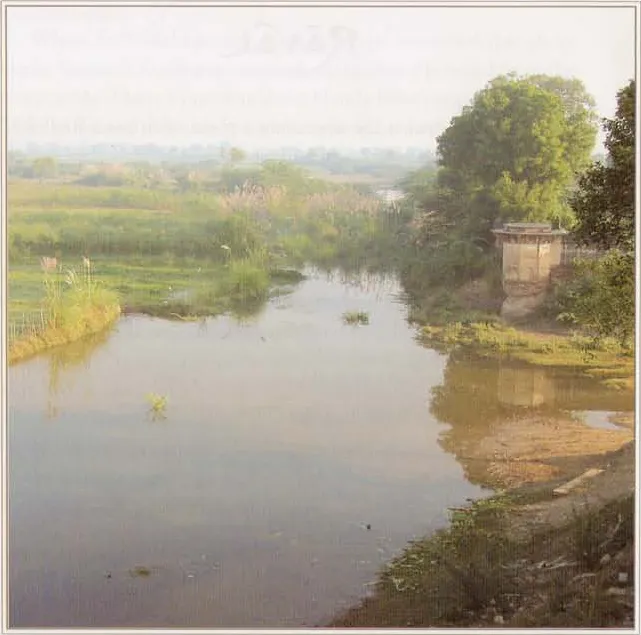
Rāval
रावलRāval (Rāvala) is a village of the Mahāvana region, across the Yamunā from Mathurā.
Questions and answers
In the Bhakti-ratnākara, he is the Vaiṣṇava of Govardhana who guides Śrīla Śrīnivāsa Ācārya and Śrīla Narottama dāsa Ṭhākura on their parikramā of Vraja. In the Fifth Wave he shows them each place and its pastime.[1, 3–7]
About twenty. They include Nanda's house and the birthplace, the cowshed, and the places of Pūtanā, the cart, the nursing, the crawling and Tṛṇāvarta. Then come Brahmāṇḍa-ghāṭa, the butter and the binding, the Yamalārjuna-tīrtha, Gopīśvara, Gopa-kūpa, the old tree and the council.[1–6]
According to the Bhakti-ratnākara, it begins at the home of Nanda and Yaśodā and the courtyard of the birth festival. It follows the infant pastimes to the Yamalārjuna-tīrtha, then turns to Śrī Caitanya and Śrīla Sanātana Gosvāmī. It ends with the council, the path to Vṛndāvana and Sakaraurī.[1 +3]
In its 1912 edition it quotes lines of the Ādi-vārāha on the Yamalārjuna-tīrtha and Gopīśvara, and Śrīla Raghunātha dāsa Gosvāmī's verse on Nanda's charity. It also quotes Śrīla Rūpa Gosvāmī's festival songs and Padyāvalī verses, and a verse of Śrīla Murāri Gupta.[3 +7]
The guidebook Śrī Vraja-maṇḍala Parikramā (2007) lists Mahāvana's places from this tour. Among them are the Yamalārjuna site, the Pūtanā site, Gopīśvara and the cowshed.[18 +5]
In his purport to Caitanya-caritāmṛta Madhya 18.67, he quotes and translates its lines on three points. They are the house of Nanda and Yaśodā in Mahāvana, Kṛṣṇa's birthplace, and Mahāvana and Gokula being one and the same.[1, 5, 9]
Sources
- Śrīla Narahari Cakravartī, Bhakti-ratnākara, Fifth Wave, 1912 ed. pp. 277-278; Grantha Mandira text v.1713-1717, 2nd ed., 1912
- Śrīla Narahari Cakravartī, Bhakti-ratnākara, Fifth Wave, 1912 ed. p. 280; Grantha Mandira text v.1746-1747, 2nd ed., 1912
- Śrīla Narahari Cakravartī, Bhakti-ratnākara, Fifth Wave (pañcama taraṅga), at Mahāvana, 1912 ed. p. 282, 2nd ed., 1912
- Śrīla Narahari Cakravartī, Bhakti-ratnākara, Fifth Wave, 1912 ed. p. 283; Grantha Mandira text v.1777-1779, 2nd ed., 1912
- Śrīla Narahari Cakravartī, Bhakti-ratnākara, Fifth Wave, 1912 ed. p. 284; Grantha Mandira text v.1787-1789, 2nd ed., 1912
- Śrīla Narahari Cakravartī, Bhakti-ratnākara, Fifth Wave, 1912 ed. p. 284; Grantha Mandira text v.1790-1793, 2nd ed., 1912
- Śrīla Narahari Cakravartī, Bhakti-ratnākara, Fifth Wave, printed p. 285: the cowherds' move from Gokula to Vṛndāvana, 2nd ed., 1912
- Śrīla Narahari Cakravartī, Bhakti-ratnākara, Fifth Wave, 1912 ed. p. 283; Grantha Mandira text v.1770-1776, 2nd ed., 1912
- Śrīla Prabhupāda, Śrī Caitanya-caritāmṛta, Madhya-līlā 18.67, purport (quoting the Bhakti-ratnākara, Fifth Wave) · vedabase.io
- Śrīla Narahari Cakravartī, Bhakti-ratnākara, Fifth Wave, 1912 ed. p. 278; Grantha Mandira text v.1727, 2nd ed., 1912
- Śrīla Narahari Cakravartī, Bhakti-ratnākara, Fifth Wave, 1912 ed. p. 285; Grantha Mandira text v.1801-1803, 2nd ed., 1912
- Śrīla Rūpa Gosvāmī, Gītāvalī, Stava-mālā, Gītāvalī, first song 'nandotsavādi' (rāga Bhairava), after the edition of Bhakti Saranga Goswami and Purushottam Das, Vrindavan, 1959
- Śrīla Raghunātha dāsa Gosvāmī, Vraja-vilāsa-stava, Stavāvalī (9) Vraja-vilāsa-stava v.89
- Śrīla Rūpa Gosvāmī, Mathurā-māhātmya v.347-349, quoting the Ādi-vārāha
- Śrīla Narahari Cakravartī, Bhakti-ratnākara, Fifth Wave, 1912 ed. p. 283; Grantha Mandira text v.1768-1769 (quotation headed 'তথাহি আদিবারাহে' on p. 282), 2nd ed., 1912
- Śrīla Narahari Cakravartī, Bhakti-ratnākara, Fifth Wave, 1912 ed. p. 285; Grantha Mandira text v.1800-1802 (the Sanskrit verse is the end of the quotation headed "Śrī-caitanya-carite caturtha-prakrame dvitīya-sarge"), 2nd ed., 1912
- Śrīla Narahari Cakravartī, Bhakti-ratnākara, Fifth Wave, 1912 ed. p. 285; Grantha Mandira text v.1808, 2nd ed., 1912
- Śrī Vraja-maṇḍala Parikramā (2007), PDF p. 272
- Śrīla Narahari Cakravartī, Bhakti-ratnākara, Fifth Wave, 1912 ed. pp. 277-278; Grantha Mandira text v.1713-1717, 2nd ed., 1912
- Śrīla Narahari Cakravartī, Bhakti-ratnākara, Fifth Wave, 1912 ed. p. 278; Grantha Mandira text v.1728-1729, 2nd ed., 1912
Show all 56 references
- Śrīla Narahari Cakravartī, Bhakti-ratnākara, Fifth Wave, 1912 ed. pp. 278-279; Grantha Mandira text v.1730, 2nd ed., 1912
- Śrīla Narahari Cakravartī, Bhakti-ratnākara, Fifth Wave, 1912 ed. p. 279, 2nd ed., 1912
- Śrīla Narahari Cakravartī, Bhakti-ratnākara, Fifth Wave, 1912 ed. p. 279; Grantha Mandira text v.1734-1735, 2nd ed., 1912
- Śrīla Narahari Cakravartī, Bhakti-ratnākara, Fifth Wave, 1912 ed. p. 280; Grantha Mandira text v.1743, 2nd ed., 1912
- Śrīla Rūpa Gosvāmī, Padyāvalī 130; quoted in the Bhakti-ratnākara 5.1736 as "131", GRETIL
- Śrī Vraja-maṇḍala Parikramā (2007), PDF p. 271
- Śrīla Narahari Cakravartī, Bhakti-ratnākara, Fifth Wave, 1912 ed. p. 279; Grantha Mandira text v.1737, 2nd ed., 1912
- Śrīla Rūpa Gosvāmī, Padyāvalī 131; quoted in the Bhakti-ratnākara 5.1738 as "132", GRETIL
- Śrīla Narahari Cakravartī, Bhakti-ratnākara, Fifth Wave, 1912 ed. p. 279; Grantha Mandira text v.1737, 2nd ed., 1912
- Śrīla Narahari Cakravartī, Bhakti-ratnākara, Fifth Wave, 1912 ed. p. 280; Grantha Mandira text v.1744-1745, 2nd ed., 1912
- Śrīla Narahari Cakravartī, Bhakti-ratnākara, Fifth Wave, 1912 ed. p. 280; Grantha Mandira text v.1746-1747, 2nd ed., 1912
- Śrīla Narahari Cakravartī, Bhakti-ratnākara, Fifth Wave, 1912 ed. p. 280; Grantha Mandira text v.1748, 2nd ed., 1912
- Śrīla Rūpa Gosvāmī, Padyāvalī 134; quoted in the Bhakti-ratnākara 5.1749 as "135", GRETIL
- Śrīla Narahari Cakravartī, Bhakti-ratnākara, Fifth Wave, 1912 ed. p. 281; Grantha Mandira text v.1755-1756, 2nd ed., 1912
- Śrīla Rūpa Gosvāmī, Padyāvalī 140, GRETIL
- Śrīla Narahari Cakravartī, Bhakti-ratnākara, Fifth Wave, 1912 ed. p. 282; Grantha Mandira text v.1762, 2nd ed., 1912
- Śrīla Narahari Cakravartī, Bhakti-ratnākara, Fifth Wave (pañcama taraṅga), at Mahāvana, 1912 ed. p. 282, 2nd ed., 1912
- Śrīla Rūpa Gosvāmī, Mathurā-māhātmya v.347-351, quoting the Ādi-vārāha
- Varāha Purāṇa, adhyāya 157, verses 21-23, Sanskrit Wikisource
- Varāha Purāṇa, chapter 157, verses 1-2, Sanskrit Wikisource
- Kṛṣṇa-caitanya-caritāmṛta, prakrama 4, sarga 6, vv.11-12
- Śrīla Narahari Cakravartī, Bhakti-ratnākara, Fifth Wave (pañcama taraṅga) vv.1770-1776, 1912 ed. p. 283, 2nd ed., 1912
- Śrīla Narahari Cakravartī, Bhakti-ratnākara, Fifth Wave vv.1790-1795, 1912 ed. p. 284, 2nd ed., 1912
- Śrī Vraja-maṇḍala Parikramā (2007), PDF p. 279
- the undated parikramā notes Mahāvana, ¶59
- Śrīla Narahari Cakravartī, Bhakti-ratnākara, Second Wave (dvitīya taraṅga), 1912 ed. p. 93, 2nd ed., 1912
- Śrīla Narahari Cakravartī, Bhakti-ratnākara, Fifth Wave, 1912 ed. pp. 283-284; Grantha Mandira text v.1779-1785, 2nd ed., 1912
- Śrī Vraja-maṇḍala Parikramā (2007), PDF p. 276
- Śrīla Narahari Cakravartī, Bhakti-ratnākara, Fifth Wave, 1912 ed. p. 283; Grantha Mandira text v.1777-1779, 2nd ed., 1912
- Śrīla Narahari Cakravartī, Bhakti-ratnākara, Fifth Wave, 1912 ed. p. 284; Grantha Mandira text v.1787-1788, 2nd ed., 1912
- Śrīla Narahari Cakravartī, Bhakti-ratnākara, Fifth Wave, 1912 ed. p. 284; Grantha Mandira text v.1788-1789, 2nd ed., 1912
- Śrīla Narahari Cakravartī, Bhakti-ratnākara, Fifth Wave, 1912 ed. p. 284; Grantha Mandira text v.1787-1789, 2nd ed., 1912
- Śrīla Narahari Cakravartī, Bhakti-ratnākara, Fifth Wave, 1912 ed. p. 285; Grantha Mandira text v.1804-1806, 2nd ed., 1912
- Śrīla Nārāyaṇa Bhaṭṭa Gosvāmī, Vraja-bhakti-vilāsa, chapter 2 v.48 ('atha gokulaliṅgāni', under the name of the Viṣṇu-purāṇa), printed p. 46; Grantha Mandira text (2) [part 12] v.48, 1st ed., publ. Bābā Kṛṣṇadāsa, Kusuma-sarovara, Saṁvat 2008
- Kṛṣṇa-caitanya-caritāmṛta, 4.6.8-9
- Kṛṣṇa-caitanya-caritāmṛta, 4.6.10
Further sources
- Bhakti-ratnākara of Śrīla Narahari Cakravartī Ṭhākura, Fifth Wave (1912 edition, printed pp. 277-285), summarised, not translated.
- Śrī Caitanya-caritāmṛta, Madhya-līlā 18.67, with Śrīla Prabhupāda's translation and purport (BBT).
- Śrīla Rūpa Gosvāmī's Mathurā-māhātmya, Padyāvalī and Gītāvalī; Śrīla Raghunātha dāsa Gosvāmī's Vraja-vilāsa-stava (Sanskrit), summarised, not translated.