How the Yamunā came to Vraja
The Garga-saṁhitā's account of her descent
In short
According to the Garga-saṁhitā, the Yamunā came to Vraja from Goloka, Kṛṣṇa's own abode. Śrī Rādhā would not be happy on earth without Vṛndāvana, the Yamunā and Govardhana. So Kṛṣṇa sent them down before His appearance. The river came down to Mount Kalinda, which gave her the name Kālindī, and flowed into Vraja-maṇḍala.[1–12]
On this page
At a glance
- The source: the Garga-saṁhitā, Vṛndāvana-khaṇḍa, chapter 3, which describes Kālindī's arrival, with Goloka-khaṇḍa 3.[1, 7]
- Why she came: Śrī Rādhā asked that Vṛndāvana, the Yamunā and Govardhana be on earth.[1]
- Her name: in the Garga-saṁhitā's telling, she is Kālindī because she rose from Mount Kalinda.[9]
- Her family in the Purāṇas (old scriptures): the daughter of the sun-god Vivasvān and the twin sister of Yama.[13–16]
- Her place in Vraja: according to the same text, near Vṛndāvana, Mathurā and Mahāvana.[11]
- Śrī Caitanya and the river: on the way to Vṛndāvana, He took every river He saw for the Kālindī.[17]
- Kālindī the queen: the sources answer differently whether the river and Kṛṣṇa's queen Kālindī are one person.[10 +5]
Why did Śrī Rādhā ask for the Yamunā?
The Garga-saṁhitā opens the story in Goloka, before Kṛṣṇa's appearance on earth. There Śrī Rādhā told Kṛṣṇa that She could find no happiness in any place that lacked Vṛndāvana, the Yamunā and Govardhana (summarised here, not translated).[1]
Nārada then tells what followed. Śrī Hari (Kṛṣṇa) Himself sent to the earth a portion of His own abode, together with Govardhana and the Yamunā.[2] The same line comes back later in the work. There the sage Sannanda answers Nanda Mahārāja's question about where Govardhana came from.[3, 4]
The text gives the size of that land in number words, veda-nāga krośas (a krośa is an old measure of distance). Its published English translation renders this as forty-seven.[2] In the Garga-saṁhitā, that land holds twenty-four forests.[1–6]
The Gauḍīya ācāryas, the teachers in the line of Śrī Caitanya, speak of the same land as eternal. Śrīla Jīva Gosvāmī quotes the Padma Purāṇa: Mathurā, the forest Vṛndāvana, the Yamunā and the cowherd boys and girls are eternal, and the Lord's descent there is eternal (summarised here, not translated).[23] The English purport to Brahma-saṁhitā 5.5 in the Gauḍīya Maṭha edition says the same. In it the Yamunā, Govardhana, Rādhā-kuṇḍa and the rest of Vraja-maṇḍala on earth lie within Gokula.[24]
How did the Yamunā come down from Goloka?
The Garga-saṁhitā gives the descent a chapter of its own. Kṛṣṇa gave the order in Goloka. The best of rivers walked round Him in respect and set out for the earth (summarised here, not translated).[7] On her way she took the rivers Virajā and Gaṅgā into herself. For this reason, the text says, people know her as the most complete of rivers and as Kṛṣṇa's chief queen.[21]
She came down through the universe with the Gaṅgā. Then the two rivers parted: the Gaṅgā went to the Himālaya, and the Yamunā to Mount Kalinda.[8]
Why is she called Kālindī?
The Garga-saṁhitā says that she is called Kālindī, Kalinda's daughter, because she rose from Mount Kalinda. She broke the hard rocks of his slopes and purified the lands she passed. Then she flowed on and reached the Khāṇḍava forest (summarised here, not translated).[9]
The Purāṇas give her a second family line. They call the Yamunā the daughter of the sun-god Vivasvān and the twin sister of Yama, the lord of death, and so she is called Yama's younger sister.[13–16] The Skanda Purāṇa tells that she fed her brother Yama on Yama-dvitīyā, and that the day became sacred for bathing in her.[25–27] Śrīla Rūpa Gosvāmī's Yamunāṣṭaka, a prayer of eight verses, praises her as the sun's daughter. She saves people from Yama's city, and the Māthura-maṇḍala, the land of Mathurā, adorns her.[16, 28]
Where does the Yamunā enter Vraja-maṇḍala?
The Garga-saṁhitā says that Kalinda's daughter wished to have the Supreme Kṛṣṇa as her husband. She took a divine form and performed austerities, and she still lives in a house her father built in the water. Then she swiftly entered Vraja-maṇḍala (summarised here, not translated).[10]
The text names the places where she settled: near Vṛndāvana, near Mathurā, beside Mahāvana, at the sandy Ramaṇa-sthala, and in Gokula.[11]
A second account of her course comes from the Padma Purāṇa's Yamunā-māhātmya. Śrīla Rūpa Gosvāmī quotes it in his Mathurā-māhātmya. With a drop of her water she freed the ascetic Yāyāvara from Indra's curse. She purified the lands of the Kurus, entered the Śūrasena country with its twelve flourishing forests, and came to rest at Keśava's abode (summarised here, not translated).[29] Śrīla Rūpa Gosvāmī quotes these verses under the heading of the boundary of the Mathurā-maṇḍala. In this way the river's course becomes the measure of the land.[29] Read more: The twelve forests of Vraja: the lists side by side →
Why did the Yamunā bow to Vraja?
The chapter ends with her love for the land. As she left Vraja, she was overwhelmed by separation from it, and with tears of love she turned to flow westwards. Then she bowed three times to Vraja-maṇḍala and went on to Prayāga, purifying the lands on her way (summarised here, not translated).[12]
There the Gaṅgā praised her. She called the Yamunā the most complete river, honoured by all the worlds, and the chief queen of Kṛṣṇa. She is hard for the tīrthas (holy places) and the gods to reach, and hard to reach even in Goloka (summarised here, not translated).[22]
How does the Garga-saṁhitā teach her worship?
The Garga-saṁhitā also gives the Yamunā a worship of her own. In its Mādhurya-khaṇḍa, the sage Saubhari teaches it to King Māndhātā at his āśrama (hermitage) on the Yamunā in Vṛndāvana. The worship has five parts: a protective prayer (kavaca), a hymn (stava), the paṭala and paddhati (the rules of her rites), and her thousand names (summarised here, not translated).[30–32]
The text joins this worship to a pastime. Durvāsā Muni, it says, gave the five-part worship to certain groups of gopīs (cowherd girls). They were born from the women of Barhiṣmatī-pura, from the apsarās (heavenly dancers) and from others. By worshipping the Yamunā in this way, they obtained Kṛṣṇa as their husband.[30] The Śrīmad-Bhāgavatam tells the unmarried gopīs' vow in its own way. They bathed in the Kālindī every day of the month and worshipped the goddess Kātyāyanī with an image made of sand from her bank.[33, 34]
Saubhari's hymn praises her mercy. Kalinda's daughter, alive with humming bees, gives the abode of Vṛndāvana even to a sinful, lustful and foolish person who quarrels with the saints. The hymn calls her the place where the gopīs, the cowherds and the cows play, her banks loud with waves, bees, peacocks and cuckoos (summarised here, not translated).[31, 32]
What do the scriptures say of the Yamunā in Vraja?
The Garga-saṁhitā's story belongs to a wider praise of the river. The Varāha Purāṇa says that in the Māthura-maṇḍala the Yamunā, Vivasvān's daughter, is a hundred times more sacred than the Gaṅgā.[15 +2] Śrīla Rūpa Gosvāmī quotes a Padma Purāṇa verse that calls her the very rasa, the Brahman of the Upaniṣads, become a river to purify the world. Another verse says that Kṛṣṇa plays in her waves (summarised here, not translated).[37, 38]
Śrīla Prabhupāda gives the practical teaching in his Kṛṣṇa book.[35 +2]
Names this place“Simply by taking a bath in the Yamunā, anyone can diminish the reactions of his sinful activities.”
Śrīla Prabhupāda, Kṛṣṇa, the Supreme Personality of Godhead, ch. 39 "Akrūra’s Return Journey and His Vision of Viṣṇuloka Within the Yamunā River" · vedabase.io
The Bhāgavatam keeps the Yamunā present through Kṛṣṇa's whole life in Vraja. On the night of His birth, the stormy river gave way to Vasudeva carrying Him, as the ocean gave way to Śrī Rāma.[14, 41] Kṛṣṇa sent away the serpent Kāliya to free her water of poison, and the rāsa dance took place on her cool sandy bank.[42–53]
When Kṛṣṇa played His flute, the Bhāgavatam says, the rivers broke their currents and held His feet with the arms of their waves. Śrīla Sanātana Gosvāmī and Śrīla Jīva Gosvāmī name them as the Kālindī and the Mānasa-gaṅgā, and Śrīla Prabhupāda says that the Yamunā's waves stop to hear the flute.[54–57] When Balarāma visited Vraja, He dragged her with His plough. Śrīla Prabhupāda writes that she still has many small branches from it.[58–64] Read more: Balarāma's visit to Vraja →
How did Śrī Caitanya see the Yamunā?
For Śrī Caitanya Mahāprabhu the Yamunā was the sign of Vṛndāvana. After He took sannyāsa (the renounced order of life), He set out in ecstasy for Vṛndāvana. He asked Śrī Nityānanda Prabhu how far it was, and Nityānanda showed Him the Gaṅgā as the Yamunā.[65–67]
prabhu kahe, — kata dūre āche vṛndāvana
teṅho kahena, — kara ei yamunā daraśana
When the Lord asked Nityānanda Prabhu how far it was to Vṛndāvana, Nityānanda replied, “Just see! Here is the river Yamunā.”
Translation: Śrīla A.C. Bhaktivedanta Swami PrabhupādaSeeing the river, He recited Śrīla Kavi-karṇapūra's prayer to her. It calls her the blissful spiritual water that gives love for Nanda's son, equal to the water of the spiritual world, and the daughter of the sun.[68, 69] Śrī Advaita Ācārya then told Him that at that spot the Gaṅgā and the Yamunā flow together, the Yamunā on the west and the Gaṅgā on the east.[66]
On the forest path to Vṛndāvana He took every river He saw for the Kālindī, and He danced and fell down in ecstatic love.[17] On the way to Mathurā He jumped into the Yamunā whenever He saw it. At Mathurā He bathed at its twenty-four ghāṭas (bathing places).[17 +5] Read more: The twenty-four ghāṭas of Mathurā →
The last book of the Caitanya-caritāmṛta tells that at Purī He once took the sea for the Yamunā and jumped into it. When He was brought out, He said that on seeing the Kālindī He had gone to Vṛndāvana. There He had seen the son of the king of Vraja at play in the water.[73, 74] His devotees at Pāṇihāṭi, absorbed in the mood of cowherd boys, likewise took the bank of the Gaṅgā for the bank of the Yamunā.[67]
Is the Yamunā the same as Queen Kālindī?
The Bhāgavatam tells of a Kālindī among Kṛṣṇa's queens, and the sources speak of her and of the river in different ways. Each account is given here, without a position of our own. In the Tenth Canto, Kṛṣṇa and Arjuna meet a girl by the Yamunā near Indraprastha. She says that she is the daughter of the sun-god, doing austerities to have Viṣṇu as her husband.[18–20]
kālindīti samākhyātā vasāmi yamunā-jale / nirmite bhavane pitrā yāvad acyuta-darśanam
I am known as Kālindī, and I live in a mansion my father built for me within the water of the Yamunā. There I will stay until I meet Lord Acyuta.
Translation: Śrīla Prabhupāda's disciples (BBT)Śrīla Prabhupāda writes in his Kṛṣṇa book that this girl was the river Yamunā in person.[18–20]
Names this placeThe beautiful girl was the river Yamunā personified. She replied, “Sir, I am the daughter of the sun god, and I am now performing penance and austerity to have Lord Viṣṇu as my husband.”
Śrīla Prabhupāda, Kṛṣṇa, the Supreme Personality of Godhead, ch. 58 "Five Queens Married by Kṛṣṇa" · vedabase.io
The Garga-saṁhitā calls the river herself Kṛṣṇa's chief queen. She performed austerities to have Him as her husband, and she lives in a house in the water that her father made.[10 +2] The commentators on the Tenth Canto speak of the Yamunā whom Balarāma dragged. They say that she was a manifestation or shadow of Śrī Kālindī, Kṛṣṇa's queen.[75–77] In the Bhāgavata-māhātmya of the Skanda Purāṇa, Kālindī is joyful among Kṛṣṇa's grieving queens. She says that Rādhikā is Kṛṣṇa's soul, and that serving Her keeps away the pain of separation.[78]
Accounts differ Whether the river Yamunā and Kṛṣṇa's queen Kālindī are one and the same.
- Śrīmad-Bhāgavatam 10.58.20-22Kālindī, daughter of the sun-god, doing austerities for Viṣṇu, lives in a house her father built in the Yamunā's water; the verses do not call her the river.
- Śrīla Prabhupāda, Kṛṣṇa book ch. 58"The beautiful girl was the river Yamunā personified."
- Garga-saṁhitā 2.3.3, 2.3.14-15, 2.3.26-27The river Kālindī/Kṛṣṇā is Kṛṣṇa's chief queen (paṭṭa-rājñī); she did austerities to have Him as husband and lives in the water-house her father made.
- Śrīla Sanātana Gosvāmī, Śrīla Jīva Gosvāmī and Śrīla Viśvanātha Cakravartī on ŚB 10.65The Yamunā who came to Balarāma is a manifestation (vibhūti) or shadow (chāyā) of Śrī Kālindī, the queen, the wife of the ocean; not Kālindī herself (Viśvanātha).
The wording of these accounts is our summary of the sources, not a published translation.
Places in this article
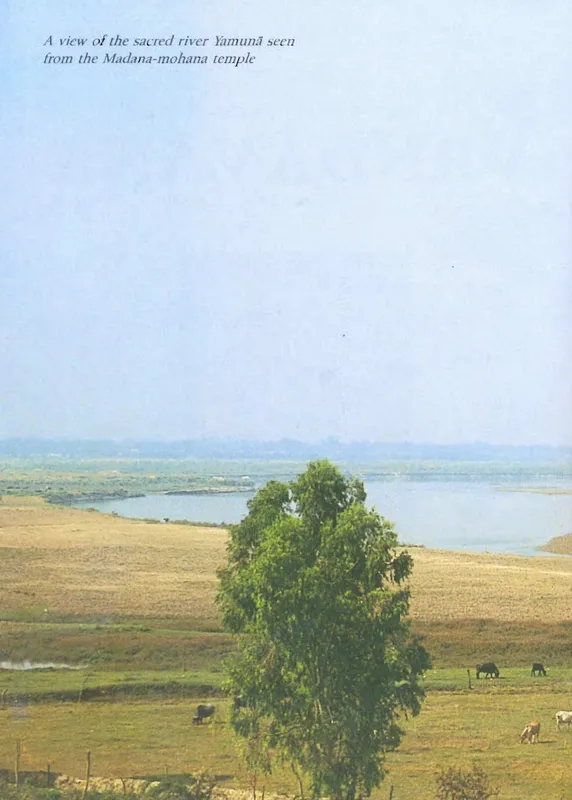
Yamunā
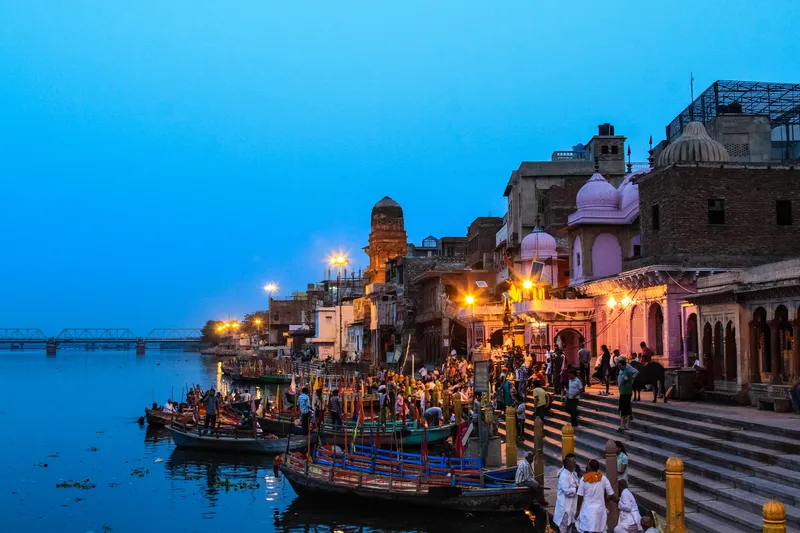
यमुनाThe Yamunā, also called the Kālindī, is the river that runs through Vraja-maṇḍala.
Vraja-maṇḍala
व्रज-मण्डलVraja-maṇḍala, the land of Vraja, is the country around Mathurā, on both banks of the Yamunā, where Kṛṣṇa spent His childhood in the cowherd settlement of Nanda Mahārāja.
Vṛndāvana (forest)
वृन्दावन (वन)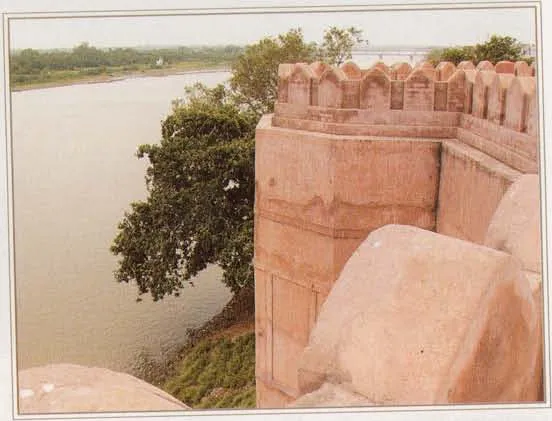
Mathurā
मथुराMathurā is the city on the Yamunā where Śrī Kṛṣṇa appeared from Devakī in the prison of King Kaṁsa.
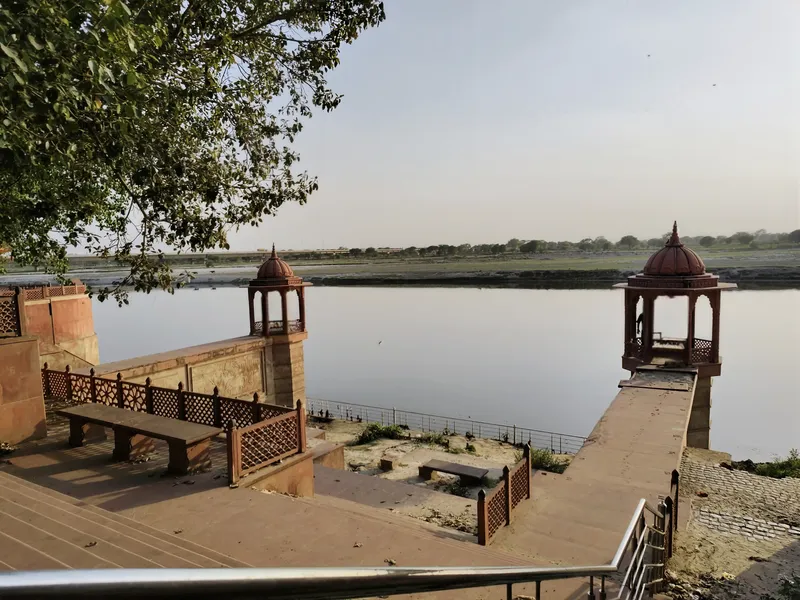
Mahāvana
महावनMahāvana, "the great forest", also called Bṛhadvana, is the forest on the eastern bank of the Yamunā where Kṛṣṇa spent His infancy.
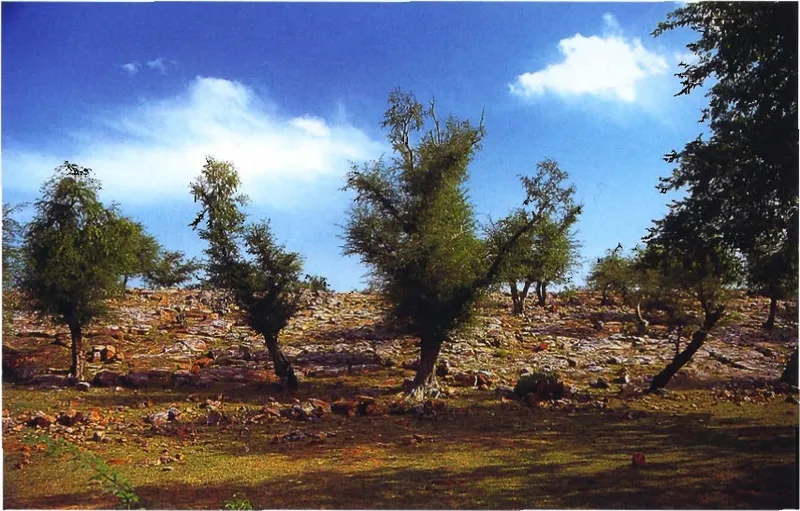
Govardhana
गोवर्धनGovardhana is the hill that Kṛṣṇa lifted with one hand and held up for seven days, so that the people and cows of Vraja could shelter under it from Indra's rain.
Viśrāma-ghāṭa
विश्राम-घाटViśrāma-ghāṭa is the bathing place on the Yamunā that the 2007 guidebook calls the principal ghāṭa of Mathurā.
Questions and answers
According to the Garga-saṁhitā, Kṛṣṇa sent her down from Goloka with Govardhana and the land of Vraja, because Śrī Rādhā would not be happy on earth without them. She came down to Mount Kalinda and flowed into Vraja-maṇḍala.[1–12]
The Garga-saṁhitā says that she is called Kālindī because she rose from Mount Kalinda.[9]
The sources answer differently. Śrīla Prabhupāda calls the girl Kṛṣṇa met by the Yamunā the river in person. The Garga-saṁhitā calls the river Kṛṣṇa's chief queen, and the commentators speak of a manifestation of Śrī Kālindī.[10 +8]
The Garga-saṁhitā says that she settled near Vṛndāvana, Mathurā and Mahāvana and at the sandy Ramaṇa-sthala. It gives no single point of entry.[11]
In the Garga-saṁhitā She tells Kṛṣṇa that She can find no happiness in a place without Vṛndāvana, the Yamunā and Govardhana.[1]
The Garga-saṁhitā tells of the descent, in the third chapters of its Goloka-khaṇḍa and Vṛndāvana-khaṇḍa. The Padma Purāṇa's Yamunā-māhātmya, as Śrīla Rūpa Gosvāmī quotes it, describes her course through the Mathurā-maṇḍala.[1 +2]
Sources
- Garga-saṁhitā, 1.3.32 (Goloka-khaṇḍa, adhyāya 3, v.32), Sanskrit Wikisource
- Garga-saṁhitā, 1.3.33 (Goloka-khaṇḍa, adhyāya 3, v.33), Sanskrit Wikisource
- Garga-saṁhitā, Vṛndāvana-khaṇḍa (2), adhyāya 2, verse 7, Sanskrit Wikisource
- Garga-saṁhitā, 2.2.8 (Vṛndāvana-khaṇḍa, adhyāya 2, v.8), Sanskrit Wikisource
- Garga-saṁhitā, 2.2.9 (Vṛndāvana-khaṇḍa, adhyāya 2, v.9), Sanskrit Wikisource
- Govardhana Hill: India's Most Sacred Mountain (2001), Rajasekhara dasa Brahmacari, PDF p. 30
- Garga-saṁhitā, 2.3.1 (Vṛndāvana-khaṇḍa, adhyāya 3 "kālindy-āgamana-varṇana", v.1), Sanskrit Wikisource
- Garga-saṁhitā, 2.3.11, Sanskrit Wikisource
- Garga-saṁhitā, 2.3.12-13, Sanskrit Wikisource
- Garga-saṁhitā, 2.3.14-15, Sanskrit Wikisource
- Garga-saṁhitā, Vṛndāvana-khaṇḍa (2) 3.16-17, Sanskrit Wikisource
- Garga-saṁhitā, 2.3.18-19, Sanskrit Wikisource
- Śrīmad-Bhāgavatam ŚB 6.6.40, GRETIL
- Śrīmad-Bhāgavatam 10.3.50, GRETIL
- Varāha Purāṇa, adhyāya 152, vv. 29-31, Sanskrit Wikisource
- Śrīla Rūpa Gosvāmī, Stava-mālā, part 35, heading and v.1, after the edition of Bhakti Saranga Goswami and Purushottam Das, Vrindavan, 1959
- Śrīla Kṛṣṇadāsa Kavirāja Gosvāmī, Śrī Caitanya-caritāmṛta, Madhya-līlā 17.56, online edition · vedabase.io
- Śrīmad-Bhāgavatam 10.58.20, GRETIL
- Śrīmad-Bhāgavatam 10.58.22, GRETIL
- Śrīla Prabhupāda, Kṛṣṇa, the Supreme Personality of Godhead, ch. 58 "Five Queens Married by Kṛṣṇa" · vedabase.io
Show all 78 references
- Garga-saṁhitā, 2.3.3, Sanskrit Wikisource
- Garga-saṁhitā, 2.3.26-27, Sanskrit Wikisource
- Śrīla Jīva Gosvāmī, Kṛṣṇa-sandarbha, GRETIL
- Śrī Brahma-saṁhitā, 5.5, online edition · vedabase.io
- Skanda Purāṇa, II.4.11.49-53, Sanskrit Wikisource
- Śrī Vraja-maṇḍala Parikramā (2007), PDF p. 36
- the undated parikramā notes Mathurā, ¶31-¶32
- Śrīla Rūpa Gosvāmī, Stava-mālā, part 35, v.5, after the edition of Bhakti Saranga Goswami and Purushottam Das, Vrindavan, 1959
- Śrīla Rūpa Gosvāmī, Mathurā-māhātmya, v.139-143
- Garga-saṁhitā, 4.15.5 (Mādhurya-khaṇḍa, adhyāya 15), Sanskrit Wikisource
- Garga-saṁhitā, 4.17.4 (Mādhurya-khaṇḍa, adhyāya 17 "Yamunā-stava"), Sanskrit Wikisource
- Garga-saṁhitā, 4.17.9, Sanskrit Wikisource
- Śrīmad-Bhāgavatam 10.22.6, GRETIL
- Śrīla Prabhupāda, Kṛṣṇa, the Supreme Personality of Godhead (Kṛṣṇa book), Chapter 22, 'Stealing the Garments of the Unmarried Gopī Girls' · vedabase.io
- Śrīla Rūpa Gosvāmī, Mathurā-māhātmya, v.281-283
- The Color Guide to Vṛndāvana (2000), Written and Photographed by Rājaśekhara dāsa Brahmacārī, PDF p. 29
- Śrīla Rūpa Gosvāmī, Mathurā-māhātmya, v.289
- Śrīla Rūpa Gosvāmī, Mathurā-māhātmya, v.294-295
- Śrīla Prabhupāda, Kṛṣṇa, the Supreme Personality of Godhead, ch. 39 "Akrūra’s Return Journey and His Vision of Viṣṇuloka Within the Yamunā River" · vedabase.io
- Padma Purāṇa, Uttara-khaṇḍa (6), adhyāya 208, vv. 40-43, Sanskrit Wikisource
- Śrīla Prabhupāda, Kṛṣṇa, the Supreme Personality of Godhead, ch. 3 "The Birth of Lord Kṛṣṇa" · vedabase.io
- Śrīmad-Bhāgavatam 10.15.47, GRETIL
- Śrīmad-Bhāgavatam 10.15.48, GRETIL
- Śrīmad-Bhāgavatam 10.16.1, GRETIL
- Śrīmad-Bhāgavatam 10.16.4, GRETIL
- Śrīmad-Bhāgavatam 10.16.67 (vedabase: Texts 65–67), GRETIL
- Śrīla Prabhupāda, Kṛṣṇa, the Supreme Personality of Godhead, ch. 16 "Subduing Kāliya" · vedabase.io
- Śrīmad-Bhāgavatam 10.29.45, GRETIL
- Śrīmad-Bhāgavatam 10.33.24, GRETIL
- Śrīla Prabhupāda, Kṛṣṇa, the Supreme Personality of Godhead (Kṛṣṇa book), chapter 32 · vedabase.io
- Śrīla Prabhupāda, Kṛṣṇa, the Supreme Personality of Godhead, ch. 33 'Description of the Rāsa Dance' · vedabase.io
- Śrīmad-Bhāgavatam 10.30.44, GRETIL
- Śrīmad-Bhāgavatam 10.32.11-12, GRETIL
- Śrīmad-Bhāgavatam 10.21.15, Bhagavata Vidya Pith edition, ed. Bhagavata Rishi and Krishna Shankar Shastri, 1996
- Śrīla Sanātana Gosvāmī: commentary on ŚB 10.21.15, Bhagavata Vidya Pith edition, ed. Bhagavata Rishi and Krishna Shankar Shastri, 1996
- Śrīla Prabhupāda, Kṛṣṇa, the Supreme Personality of Godhead (Kṛṣṇa book), Chapter 21, 'The Gopīs Attracted by the Flute' · vedabase.io
- Śrīla Prabhupāda, Bhagavad-gītā 7.6 lecture, Bombay, 25 March 1972 · vedabase.io
- Śrīmad-Bhāgavatam 10.65.25 and the first line of 10.65.26 = 10.65.24-25 on vedabase, GRETIL
- Śrīmad-Bhāgavatam 10.65.27, GRETIL
- Śrīmad-Bhāgavatam 10.65.30, GRETIL
- Śrīmad-Bhāgavatam 10.65.33, GRETIL
- Śrīla Jīva Gosvāmī: commentary on ŚB 10.65.31 in the Śrīmad-Bhāgavatam canto 10, part 7, with ten commentaries numbering (= 10.65.33 on vedabase and in Bhāgavata Purāṇa), Bhagavata Vidya Pith edition, ed. Bhagavata Rishi and Krishna Shankar Shastri, 1996
- Raghunātha dāsa Gosvāmī, Stavāvalī (9) Vraja-vilāsa-stava v.94
- Śrīla Prabhupāda, Kṛṣṇa, the Supreme Personality of Godhead, ch. 65 'Lord Balarāma Visits Vṛndāvana' · vedabase.io
- Śrīla Kṛṣṇadāsa Kavirāja Gosvāmī, Śrī Caitanya-caritāmṛta, Madhya-līlā 3.25, online edition · vedabase.io
- Śrīla Kṛṣṇadāsa Kavirāja Gosvāmī, Śrī Caitanya-caritāmṛta, Madhya-līlā 3.36, online edition · vedabase.io
- Śrīla Kṛṣṇadāsa Kavirāja Gosvāmī, Śrī Caitanya-caritāmṛta, Antya-līlā 6.90, online edition · vedabase.io
- Śrīla Kṛṣṇadāsa Kavirāja Gosvāmī, Śrī Caitanya-caritāmṛta, Madhya-līlā 3.28 (Kavi-karṇapūra, Caitanya-candrodaya-nāṭaka), online edition · vedabase.io
- Śrī Vraja-maṇḍala Parikramā (2007), PDF p. 296
- Śrīla Kṛṣṇadāsa Kavirāja Gosvāmī, Śrī Caitanya-caritāmṛta, CC Madhya-līlā 17.154, online edition · vedabase.io
- Śrīla Kṛṣṇadāsa Kavirāja Gosvāmī, Śrī Caitanya-caritāmṛta, Madhya-līlā 17.190, online edition · vedabase.io
- Śrīla Kṛṣṇadāsa Kavirāja Gosvāmī, Śrī Caitanya-caritāmṛta, CC Madhya-līlā 17.191, online edition · vedabase.io
- Śrīla Kṛṣṇadāsa Kavirāja Gosvāmī, Śrī Caitanya-caritāmṛta, Antya-līlā 18.80, online edition · vedabase.io
- Śrīla Kṛṣṇadāsa Kavirāja Gosvāmī, Śrī Caitanya-caritāmṛta, Antya-līlā 18.112, online edition · vedabase.io
- Śrīla Sanātana Gosvāmī: commentary on ŚB 10.65.27, Bhagavata Vidya Pith edition, ed. Bhagavata Rishi and Krishna Shankar Shastri, 1996
- Śrīla Jīva Gosvāmī: commentary on ŚB 10.65.24-25 in the Śrīmad-Bhāgavatam canto 10, part 7, with ten commentaries numbering (= vedabase 10.65.26-27: "pāpe tvaṁ …" and "evaṁ nirbhartsitā …"), Bhagavata Vidya Pith edition, ed. Bhagavata Rishi and Krishna Shankar Shastri, 1996
- Śrīla Viśvanātha Cakravartī: commentary on ŚB 10.65.24-25 in the Śrīmad-Bhāgavatam canto 10, part 7, with ten commentaries numbering (= vedabase 10.65.26-27), Bhagavata Vidya Pith edition, ed. Bhagavata Rishi and Krishna Shankar Shastri, 1996
- Skanda Purāṇa, Skanda Bhāgavata-māhātmya 2.11-12 (Motilal 2.11-12), Sanskrit Wikisource
Further sources
- Garga-saṁhitā, Goloka-khaṇḍa 3 and Vṛndāvana-khaṇḍa 2-3 (Sanskrit; summarised here, because only the Bhaktivedanta Book Trust's translations are quoted).
- Śrīmad-Bhāgavatam 10.58 (translation by the disciples of Śrīla Prabhupāda, BBT); Śrīla Prabhupāda, Kṛṣṇa, the Supreme Personality of Godhead, chapters 39, 58 and 65.
- Varāha, Padma and Skanda Purāṇas; Śrīla Rūpa Gosvāmī, Mathurā-māhātmya and Yamunāṣṭaka; the Canto 10 commentaries; the Garga-saṁhitā's Mādhurya-khaṇḍa 15-17: summarised, not translated.
- Śrī Caitanya-caritāmṛta, Madhya-līlā 3 and 17 and Antya-līlā 6 and 18 (translation and purports by Śrīla Prabhupāda, BBT).