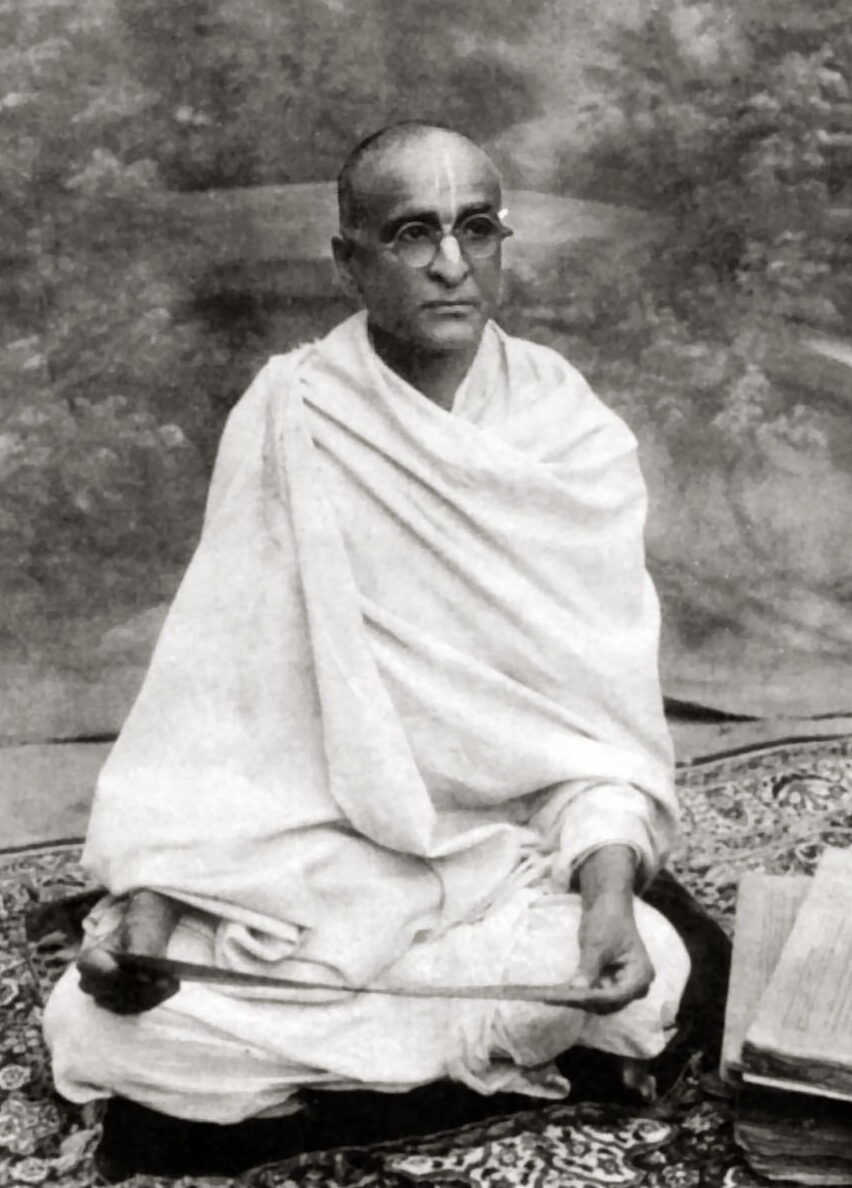
In 1922, a college friend kept urging Abhay until he agreed to go to a Calcutta rooftop to meet a sadhu. Abhay went reluctantly and full of doubt, with no intention of taking the sadhu seriously. Within minutes, without being asked, the sadhu had told him to spread Chaitanya Mahaprabhu's teaching in English. The sadhu was Srila Bhaktisiddhanta Sarasvati Thakura, founder of the Gaudiya Math. This was the beginning of their relationship. Abhay would later say that he accepted Bhaktisiddhanta as his spiritual master that same evening, though another eleven years would pass before any formal ceremony confirmed it.
| Detail | Description |
|---|---|
| Date | 1922 |
| Location | Bhaktivinod Asana, Ultadanga, Calcutta |
| Introduced by | Narendranath Mullik, college friend |
| Spiritual master met | Srila Bhaktisiddhanta Sarasvati Thakura (1874-1937) |
| Institution | Founder of the Gaudiya Math |
| Predecessor | Son of the Vaishnava reformer Bhaktivinoda Thakura |
A Reluctant Visit to Ultadanga #
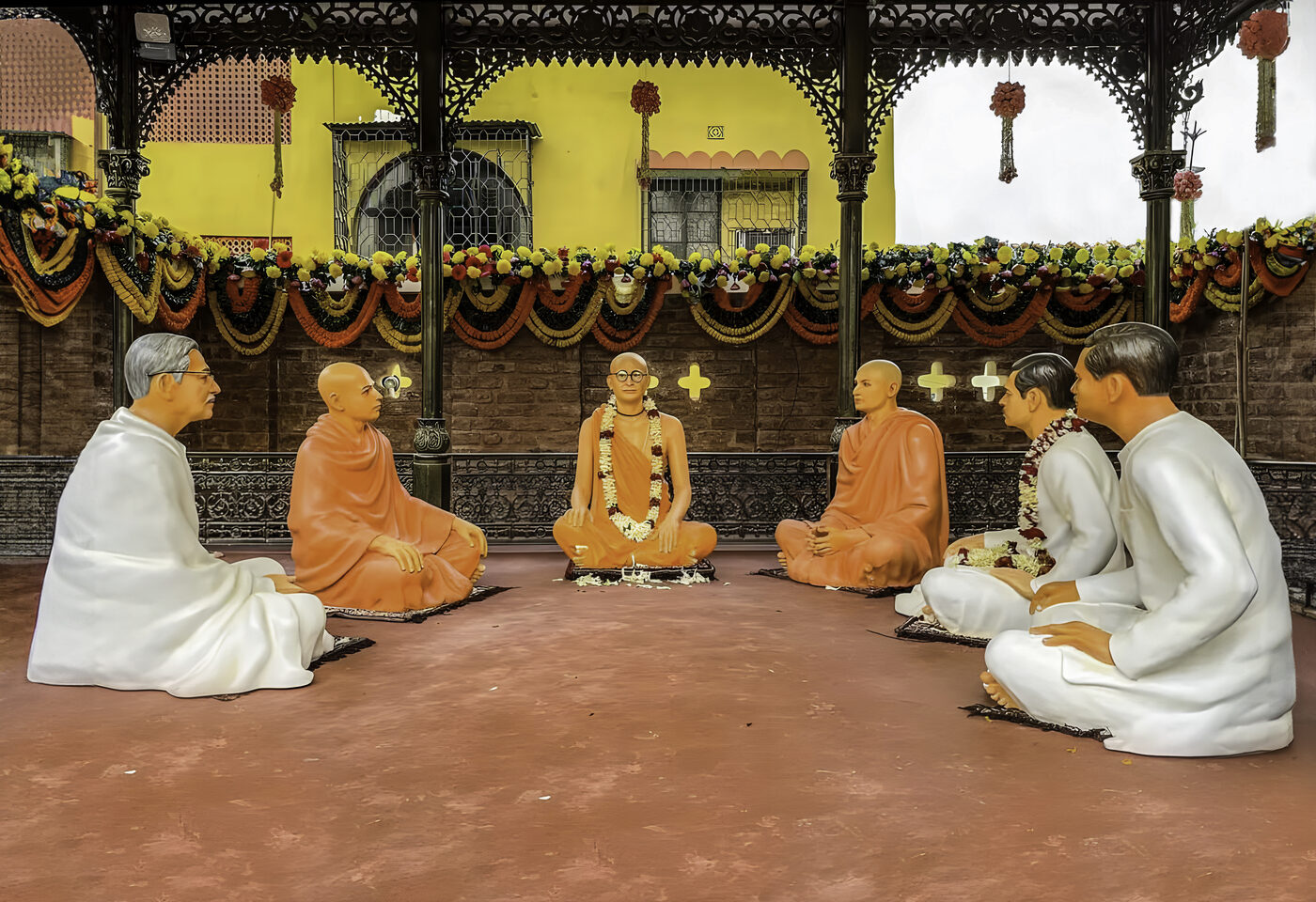
In 1922, Abhay's college friend Narendranath Mullik kept pressing him to visit a sadhu who had settled at an ashram on Ultadanga Junction Road. Several of the Mulliks had already gone and come back impressed, and Naren wanted Abhay's opinion to confirm their own. Abhay resisted. He had grown up watching a steady stream of so-called holy men pass through his father's house. Some were sincere, many were not, and a few were openly of bad character. He told Naren plainly that he had no interest in paying respects to another one. Naren insisted the man was a serious scholar, and at last Abhay gave in. He walked with Naren to a building marked Bhaktivinod Asana, the Calcutta center of the Gaudiya Math.
Why Don't You Preach in English #
The sadhu was Srila Bhaktisiddhanta Sarasvati Thakura, founder of the Gaudiya Math and the son and successor of the Vaishnava reformer Bhaktivinoda Thakura. Abhay and Naren were shown up to a rooftop where Bhaktisiddhanta sat with a few disciples and guests. Before the two young men had even finished offering their obeisances or saying a word of greeting, Bhaktisiddhanta spoke first.
You are an educated young man. Why don't you take the message of Chaitanya Mahaprabhu and spread it in English?
It was really an instruction more than a question. Bhaktisiddhanta gave it to a stranger in the first seconds of a meeting that Abhay had come to only because his friend insisted. Abhay was dressed in the white khadi worn by those who supported Gandhi. He was startled, but at once he also felt drawn in.
Abhay's Objection: Independence First #
Abhay did not let the remark pass unchallenged. He gave Bhaktisiddhanta the same argument that nationalist-minded students all over Calcutta were making. They said that a colonized people was in no position to spread its culture to the world. "Who will hear your Chaitanya's message?" he asked. "We are a dependent country. First India must become independent. How can we spread Indian culture if we are under British rule?" It was a serious question, not an attempt to provoke. It reflected exactly the view Abhay had taken in from Subhas Chandra Bose and the independence talk of his college years, described in Education and Early Influences. In this view, spiritual culture was a luxury that nations could afford only after they had won political freedom.
Bhaktisiddhanta's Answer to the Challenge #
Bhaktisiddhanta's reply, as Vaishnava biographers record it, did not dispute the facts of British rule or its injustices. Instead, he set the question aside, because it started from a wrong idea. Krishna consciousness, he said, was not a project that depended on which government happened to hold power at a given time. It addressed the eternal position of the soul. That truth did not wait for the outcome of any nation's politics. He argued that to make one's own nation the highest object of devotion, instead of one's relationship with God, was itself a form of illusion. This was so however morally good the independence cause might be. Real benefit to humanity lay in restoring people's forgotten relationship with Krishna. Political self-rule, however just a cause, could not do that by itself. He spoke partly in English and partly in Bengali. He quoted the Bhagavad-gita's instruction to surrender to the Supreme Personality of Godhead above all other duties. He also quoted the Srimad-Bhagavatam's judgment that religious practice followed for any motive less than pure devotion falls short in the end.
Defeated, and Glad of It #
Abhay had been raised in a Vaishnava household. He knew these teachings well enough to see that Bhaktisiddhanta was not making up a clever point to win a debate. Bhaktisiddhanta was restating, with unusual force and clarity, the firm conclusions of scripture and of the disciplic line he represented. He later described the effect plainly:
I was so much struck with wonder. I could understand: here is the proper person who can give a real religious idea.
He and Naren stayed talking with Bhaktisiddhanta for more than two hours before finally taking their leave. Walking back onto the dark Calcutta street afterward, Naren asked what he thought. "He's wonderful," Abhay replied. "The message of Lord Chaitanya is in the hands of a very expert person."
A Guru Accepted in the Heart #
Abhay did not take formal initiation that evening, or for more than a decade afterward. Marriage and business kept him from the kind of full commitment that the Gaudiya Math's renounced preachers had made. He recognized this inner conflict even as he walked away from that first meeting. But something had already been settled. Recalling the encounter many years later, he put it this way:
I immediately accepted him as spiritual master. Not formally, but in my heart.
This difference was important. Formal initiation, the ceremony in which Abhay would eventually receive the name Abhay Charanaravinda, was still eleven years away. That episode is covered in The Order to Preach in English. But according to the account he gave later in life, the real relationship began on the Ultadanga rooftop in 1922. There he recognized his guru in his heart, more than a decade before any outward ceremony confirmed it.
Who Was Bhaktisiddhanta Sarasvati #
Bhaktisiddhanta Sarasvati Thakura (1874-1937) was the most important Gaudiya Vaishnava reformer of his generation. He continued and extended the work of his father, Bhaktivinoda Thakura. Bhaktivinoda had spent decades winning back respect, among thinkers and in society, for a tradition that in many places had drifted into practices that gave it a bad name. Bhaktisiddhanta founded the Gaudiya Math as a network of preaching centers across India. He trained a generation of scholar-preachers regardless of their caste of birth. He held that Chaitanya Mahaprabhu's teaching was meant not for one nation or sect but for the entire world. This last conviction, more than any particular argument about politics, was what he urged on a doubtful young stranger the moment Abhay came before him. The full lineage that this meeting brought Abhay into is described on the Gaudiya Vaishnava sampradaya page.
