64 Samādhis
64 समाधि Hindi name proposed
Also called Sixty Four Samādhis, Puṣpa-samādhis of the sixty-four Gauḍīya mahantas, Sixty-Four Samādhis Garden
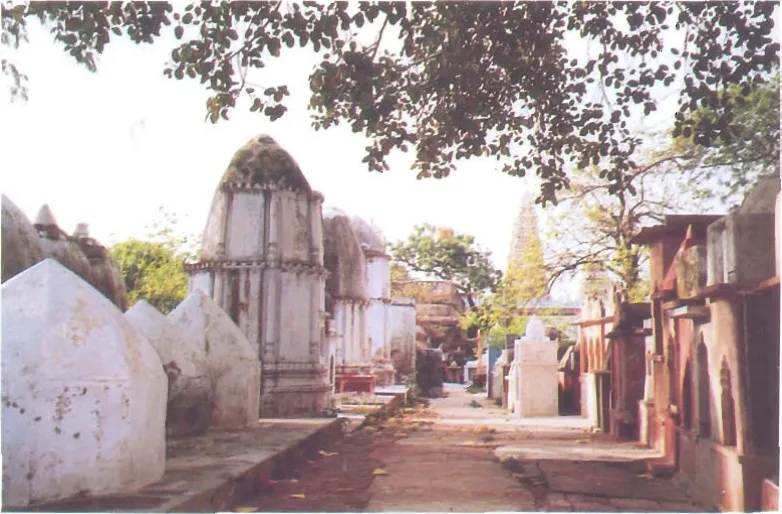
- What it is
- The 64 Samādhis is a walled garden of samādhis, memorial tombs of Vaiṣṇavas, near the old Govinda temple of Vṛndāvana.
- Visiting
- The garden lies opposite, or very close to, the old Govinda temple, according to three guidebooks.
- Places here
- Caitanya's sitting place (64 Samādhis garden), Nityānanda's sitting place (64 Samādhis garden), Kāśīśvara Paṇḍita Samādhi, Subuddhi Rāya Samādhi, Jīva Gosvāmī's samādhi (Sixty-Four Samādhis Garden) +5 more
In short
The 64 Samādhis is a walled garden of samādhis, memorial tombs of Vaiṣṇavas, near the old Govinda temple of Vṛndāvana.[1 +2] The guidebooks say that it holds memorials of sixty-four chief associates of Śrī Caitanya Mahāprabhu and Śrī Nityānanda Prabhu, and of others besides.[1 +3] According to two of them, only three samādhis hold bodily remains: those of Śrīla Raghunātha Bhaṭṭa Gosvāmī, Śrī Subuddhi Rāya and Śrī Kāśīśvara Paṇḍita.[4 +3] No scripture or Gosvāmī work names the garden; the oldest dated description found is in a Bengali book of 1920.[1 +5]
Key facts
| Kind | garden (samādhi garden) |
|---|---|
| Region · area | Vṛndāvana |
| Ācāryas | Śrīla Raghunātha Bhaṭṭa Gosvāmī, Śrī Subuddhi Rāya |
Traditional accounts
Three samādhis with remains
The Color Guide to Vṛndāvana (2000) and Vṛndāvana, the Playground of God (2010) say that three samādhis in the garden are "full" samādhis, with bodily remains: those of Śrīla Raghunātha Bhaṭṭa Gosvāmī, Śrī Subuddhi Rāya and Śrī Kāśīśvara Paṇḍita.[4 +3] The others, according to The Color Guide, are nāma-samādhis (memorials bearing a name), puṣpa-samādhis (memorials holding flowers) or smṛti-samādhis (remembrance memorials). Among them it names those of the Gosvāmīs Śrīla Rūpa, Śrīla Sanātana, Śrīla Raghunātha dāsa, Śrī Gopāla Bhaṭṭa and Śrīla Jīva, of Śrīla Lokanātha Gosvāmī, Śrīla Kṛṣṇadāsa Kavirāja Gosvāmī, Śrīla Svarūpa Dāmodara, Śrīla Rāmānanda Rāya, Śrīla Śivānanda Sena, Śrī Kāśī Miśra, Śrīla Kavi-karṇapūra and Śrīla Jāhnavā Mātā.[4 +3]
Śrīla Raghunātha Bhaṭṭa Gosvāmī
The guidebook Śrī Vraja-maṇḍala Parikramā (2007) says that his samādhi lies in the centre of the puṣpa-samādhis of the sixty-four Gauḍīya mahāntas (leading Vaiṣṇavas), opposite the temple of Śrī Govinda.[1 +5] The oldest dated descriptions found agree that it is in this walled garden. The Bengali Bhaktamāla of Kṛṣṇadāsa Bābājī (1905) places his samāja, his memorial, east of the Govinda temple at the Yogapīṭha; the Bengali Vṛndāvana-kathā (1920) says that his samādhi "was given" here.[8 +1] According to the local tradition recorded in The Color Guide, he did his bhajana, his chanting and worship, in this garden; no older source says so, and it is not certain.[5 +2] The guidebooks do not agree on what lies in the samādhi; see below.
Śrī Kāśīśvara Paṇḍita
The Bhakti-ratnākara names the samādhi of Kāśīśvara in Vṛndāvana twice. Śrīla Śrīnivāsa Ācārya and his companions bowed at it before leaving for Gauḍa, and Śrīla Rāmacandra Kavirāja saw it together with the samādhis of Śrīla Sanātana Gosvāmī and Śrīla Raghunātha Bhaṭṭa Gosvāmī. It does not say where in Vṛndāvana the samādhi stood or what it held.[13 +1] In the same book, brāhmaṇas at Mathurā tell Śrīnivāsa that Kāśīśvara passed from this world when he heard that Śrī Caitanya had left it (summarised here, not translated).[15]
Śrī Subuddhi Rāya
The Caitanya-caritāmṛta tells that Śrī Caitanya Mahāprabhu sent Śrī Subuddhi Rāya to Vṛndāvana:[4 +2]
প্রভু কহে, — ইহাঁ হৈতে যাহ’ বৃন্দাবন ।
নিরন্তর কর কৃষ্ণনামসংকীর্তন ॥ ১৯৮ ॥
prabhu kahe, — ihāṅ haite yāha’ vṛndāvana
nirantara kara kṛṣṇa-nāma-saṅkīrtana
The Lord advised him, “Go to Vṛndāvana and chant the Hare Kṛṣṇa mantra constantly.”
Translation: Śrīla A.C. Bhaktivedanta Swami PrabhupādaAccording to The Color Guide, Śrī Subuddhi Rāya's full samādhi stands where he did his bhajana, near Śrīla Raghunātha Bhaṭṭa Gosvāmī's samādhi; no older source mentions it.[4 +3]
Śrīla Prabhupāda
No statement of Śrīla Prabhupāda about this garden has been found in the works searched.
No statement of Śrīla Prabhupāda about this garden has been found in the works searched. According to the transcript of a morning walk at the Rādhā-Dāmodara temple in 1972, he explained in general what a puṣpa-samādhi is, and showed that Śrīla Rūpa Gosvāmī and Śrīla Kṛṣṇadāsa Kavirāja Gosvāmī are buried there in their bodies:[1 +2]
Names this place“Here is Kṛṣṇadāsa Kavirāja Gosvāmī entombed, and here is Rūpa Gosvāmī entombed. Later on, several other devotees, they are not entombed like them. Flowers from their body, they were placed. It is called puṣpa-samādhi. But here, the original bodies.”
Śrīla Prabhupāda, Morning Walk, Vṛndāvana, 15 October 1972 · vedabase.io
He also writes that the actual samādhi tombs of Śrīla Rūpa Gosvāmī and Śrīla Jīva Gosvāmī are at Rādhā-Dāmodara. So the samādhis of these Gosvāmīs in the garden are memorials, as the guidebooks also say.[1 +7]
Visiting today
In the garden
The garden lies opposite, or very close to, the old Govinda temple, according to three guidebooks.[1 +2] The Color Guide to Vṛndāvana (2000) prints a plan of it: a walled rectangle with rows of cells along the sides and a numbered row of samādhis across the upper part.[25]
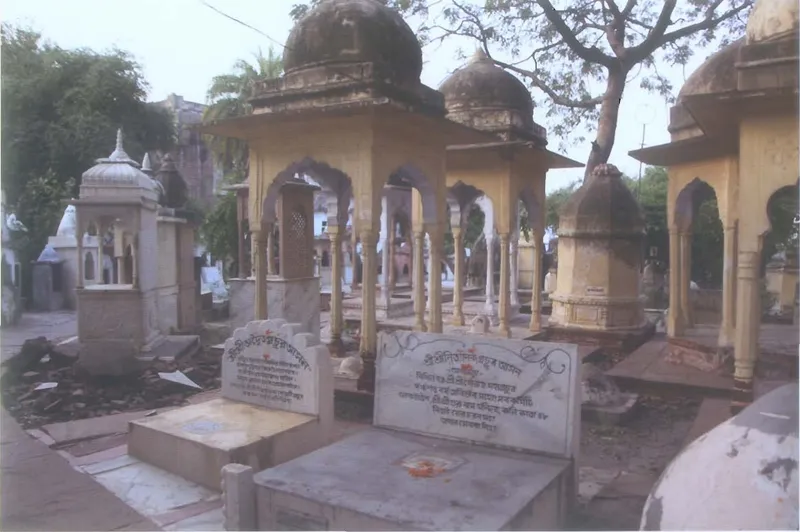
- Nāma-samādhis of Śrī Caitanya and Śrī Nityānanda: near the entrance, according to Vṛndāvana, the Playground of God (2010), which photographs them as upright marble tablets with Bengali inscriptions on low platforms. No other source mentions them.[4 +1]
- Sitting place of Śrī Caitanya and sitting place of Śrī Nityānanda: two spots marked only on The Color Guide's plan, with a memorial of Śrīla Gaurīdāsa Paṇḍita between them. The book's text does not explain them, and no older source connects Śrī Caitanya or Śrī Nityānanda with this garden. Whether they are the nāma-samādhis of the other guidebook is not known.[4 +3]
- Samādhis of the six Gosvāmīs: Vṛndāvana, the Playground of God photographs them. The Color Guide counts those of the Gosvāmīs Śrīla Rūpa, Śrīla Sanātana, Śrīla Raghunātha dāsa, Śrī Gopāla Bhaṭṭa and Śrīla Jīva among the memorials, while Śrīla Raghunātha Bhaṭṭa Gosvāmī's is a full samādhi.[4 +1] According to Śrīla Prabhupāda and Śrī Vraja-maṇḍala Parikramā (2007), their main samādhis are elsewhere: Śrīla Rūpa Gosvāmī's and Śrīla Jīva Gosvāmī's at Rādhā-Dāmodara, Śrīla Sanātana Gosvāmī at the old Madana-mohana temple, Śrī Gopāla Bhaṭṭa Gosvāmī near Rādhā-Ramaṇa, and, according to The Color Guide to Vṛndāvana (2000), Śrīla Raghunātha dāsa Gosvāmī at Rādhā-kuṇḍa.[1 +2]
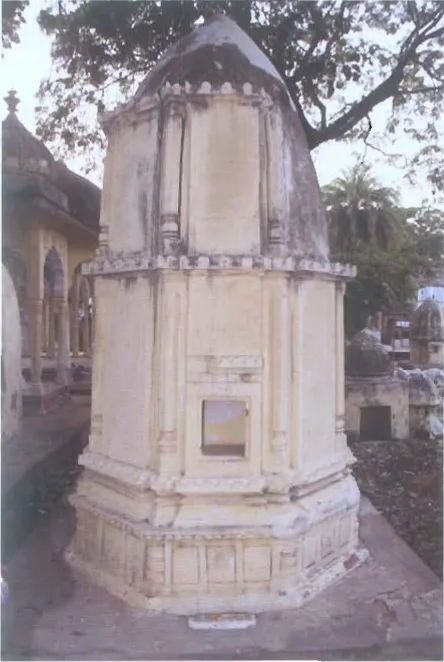
- Samādhi of Śrīla Jīva Gosvāmī: a monument that Vṛndāvana, the Playground of God captions with his name; read with the book's text, it is a memorial. Śrīla Jīva Gosvāmī's samādhi with his body is at Rādhā-Dāmodara.[1 +9]
- Samādhi of Śrīla Sanātana Gosvāmī: cell 5 of The Color Guide's plan, between those of Śrīla Raghunātha Bhaṭṭa Gosvāmī and Śrīla Rūpa Gosvāmī. The book counts it among the memorials; which kind is not stated. No other guidebook mentions it, and the guidebooks put his tomb beside the old Madana-mohana temple.[1 +7]
Location
| Where it is | 64·Samādhis plan (no north arrow or scale): a rectangular wall with an opening in the right side; rows of unnumbered cells along all four sides; a numbered row of cells 1-12 across the upper part; 'Venu Kupa' in the top left corner; a large block in the lower right corner labelled 'Temple'[29] |
|---|
Places at 64 Samādhis
10 places
- ↳Caitanya's sitting place (64 Samādhis garden)baiṭhaka›
- ↳Nityānanda's sitting place (64 Samādhis garden)baiṭhaka›
- ↳Kāśīśvara Paṇḍita Samādhisamādhi›
- ↳Subuddhi Rāya Samādhisamādhi›
- ↳Jīva Gosvāmī's samādhi (Sixty-Four Samādhis Garden)samādhi›
- ↳Nāma-samādhis of Lord Caitanya and Lord Nityānandasamādhi›
- ↳Raghunātha Bhaṭṭa Gosvāmī's samādhi (Sixty-Four Samādhis Garden)samādhi›
- ↳Samādhis of the six Gosvāmīs (Sixty-Four Samādhis Garden)samādhi (group)›
- ↳Veṇu-kūpa (Vṛndāvana)well›
- ↳Sanātana Gosvāmī's samādhi (64-Samādhis garden)samādhi›
Nearby places
Rādhā-Govinda Mandira (Vṛndāvana, old)
Pictures
2 pictures
History
The oldest dated description of the garden found is in the Bengali Vṛndāvana-kathā of 1920. It calls the garden "the samāja of the sixty-four mohāntas": a walled field of samādhis on the far side of the Govindajī temple, beside the temple of the Seṭhs, which the same book identifies as the temple of Śrī Raṅganāthajī (Raṅgajī Mandira).[7 +1] Its list of the samādhis differs from the guidebooks': it names Śrīla Raghunātha Bhaṭṭa Gosvāmī, Śrī Śrīvāsa, Śrīla Murāri Gupta, Śrīla Śivānanda Sena, Śrīla Jagadīśa Paṇḍita, Śrīla Vṛndāvana dāsa Ṭhākura, Śrī Sundarānanda Ṭhākura, Śrīla Rāya Rāmānanda and Śrīla Kavi-karṇapūra.[7 +1] Its author doubts that all of them hold bodies, since Vaiṣṇavas bury either the body or the ashes. No source gives the builder of the memorials or a date.[7 +1]
Where the sources differ
What lies in Śrīla Raghunātha Bhaṭṭa Gosvāmī's samādhi, and whether he has a second samādhi at Rādhā-kuṇḍa, the sources tell …
What lies in Śrīla Raghunātha Bhaṭṭa Gosvāmī's samādhi, and whether he has a second samādhi at Rādhā-kuṇḍa, the sources tell differently; their accounts are set out on the page of his samādhi.[1 +5]
Accounts differ Who is commemorated in the garden besides the sixty-four mahantas.
- Śrī Vraja-maṇḍala Parikramā (2007)Also the samādhis of the six cakravartīs and eight kavirājas.
- The Color Guide to Vṛndāvana (2000) / the undated parikramā notes VṛndāvanaNāma/puṣpa/smṛti samādhis of the Gosvāmīs and of Śrīla Svarūpa Dāmodara, Candraśekhara, Rāmānanda Rāya, Śivānanda Sena, Kāśī Miśra, Śikhi Māhiti, Śrīla Kavi-karṇapūra, Vāsudeva Ghoṣa, Rāghava Paṇḍita, Murāri Caitanya, Choṭa Haridāsa, Śrīla Jāhnavā Mātā, Kolāvecā Śrīdhara and others.
- Vṛndāvana, the Playground of God (2010)Nāma-samādhis of Śrī Caitanya and Nityānanda near the entrance; 'more than 64 samādhis'.
- Pulinbihārī Datta, Vṛndāvana-kathā (1920), p. 210Samādhis of Śrīla Raghunātha Bhaṭṭa, Śrīvāsa, Śrīla Murāri Gupta, Śivānanda Sena, Jagadīśa Paṇḍita, Śrīla Vṛndāvana dāsa, Sundarānanda Ṭhākura, Rāya Rāmānanda, Paramānanda Sena (Śrīla Kavi-karṇapūra) and other Gauḍīya Vaiṣṇavas; whether all of them hold bodies is doubtful, since Vaiṣṇavas bury either the body or the ashes. Śrīla Kāśīśvara Paṇḍita and Śrī Subuddhi Rāya are not named.
Where Śrī Subuddhi Rāya lived and did his bhajana after Śrī Caitanya sent him to Vraja: guidebooks say that he did his bhajana here, where his samādhi is, while the Caitanya-caritāmṛta and the Bhakti-ratnākara tell of his life in Mathurā. The accounts are set side by side on the page Śrī Subuddhi Rāya's samādhi.[4 +4]
Where the well Veṇu-kūpa is: two guidebooks place it in a corner of this garden, which is not certain, older sources elsewhere, near the Raṅgajī temple or east of the Yogapīṭha. The accounts are set side by side on the Veṇu-kūpa page.[1 +5]
References
29 references
- Śrī Vraja-maṇḍala Parikramā (2007), PDF p. 345
- The Colour Guide to Rādhā-kuṇḍa (1999), Rājaśekhara dāsa Brahmacārī, PDF p. 98
- Vṛndāvana, the Playground of God (2010), Bhakti Caitanya Svāmī, PDF p. 194
- Vṛndāvana, the Playground of God (2010), Bhakti Caitanya Svāmī, PDF p. 193
- The Color Guide to Vṛndāvana (2000), Written and Photographed by Rājaśekhara dāsa Brahmacārī, PDF p. 148
- the undated parikramā notes Vṛndāvana, ¶274
- Vṛndāvana-kathā, chapter 18 (aṣṭādaśa pariccheda), section 'চৌষট্টি মোহান্তের সমাজ', printed p. 210
- Vṛndāvana-kathā, chapter 7 (saptama pariccheda), the section on Raghunātha Bhaṭṭa, printed p. 106
- The Color Guide to Vṛndāvana (2000), Written and Photographed by Rājaśekhara dāsa Brahmacārī, PDF p. 149
- the undated parikramā notes Vṛndāvana, ¶278
- Śrī Śrī Bhaktamāla grantha, printed p. 350, right-hand column, in the book's description of Vṛndāvana's sights (after the Yoga-pīṭha temple of Govinda and Govinda's door-keeper Hanumān)
- Śrīla Prabhupāda, Śrī Caitanya-caritāmṛta, Ādi-līlā 10.158, purport · vedabase.io
- Śrīla Narahari Cakravartī, Bhakti-ratnākara, Sixth Wave (ṣaṣṭha taraṅga), printed p. 481 (1912 ed.), 2nd ed., 1912
- Śrīla Narahari Cakravartī, Bhakti-ratnākara, Ninth Wave (navama taraṅga), 1912 ed. p. 576, 2nd ed., 1912
- Śrīla Narahari Cakravartī, Bhakti-ratnākara, Fourth Wave (caturtha taraṅga), printed pp. 132-133 (1912 ed.), 2nd ed., 1912
- Śrīla Kṛṣṇadāsa Kavirāja Gosvāmī, Śrī Caitanya-caritāmṛta, Madhya-līlā 25.198, online edition · vedabase.io
- The Color Guide to Vṛndāvana (2000), Written and Photographed by Rājaśekhara dāsa Brahmacārī, PDF p. 150
- the undated parikramā notes Vṛndāvana, ¶283
- Śrīla Prabhupāda, Morning Walk, Vṛndāvana, 15 October 1972 · vedabase.io
- Śrīla Prabhupāda, Śrīmad-Bhāgavatam, 2.2.5, purport · vedabase.io
Show all 29 references
- Vṛndāvana, the Playground of God (2010), Bhakti Caitanya Svāmī, PDF p. 53
- Vṛndāvana, the Playground of God (2010), Bhakti Caitanya Svāmī, PDF p. 54
- The Color Guide to Vṛndāvana (2000), Written and Photographed by Rājaśekhara dāsa Brahmacārī, PDF p. 165
- the undated parikramā notes Vṛndāvana, ¶112
- The Color Guide to Vṛndāvana (2000), Written and Photographed by Rājaśekhara dāsa Brahmacārī, PDF p. 166
- Vṛndāvana, the Playground of God (2010), Bhakti Caitanya Svāmī, PDF p. 192
- Śrīla Prabhupāda, Morning Walk, Vṛndāvana, 15 October 1972 · vedabase.io
- The Color Guide to Vṛndāvana (2000), Written and Photographed by Rājaśekhara dāsa Brahmacārī, PDF p. 61
- The Color Guide to Vṛndāvana (2000), Written and Photographed by Rājaśekhara dāsa Brahmacārī, p. 152