Akrūra-ghāṭa
अक्रूर-घाट Hindi name proposed
Also called Brahma-hrada
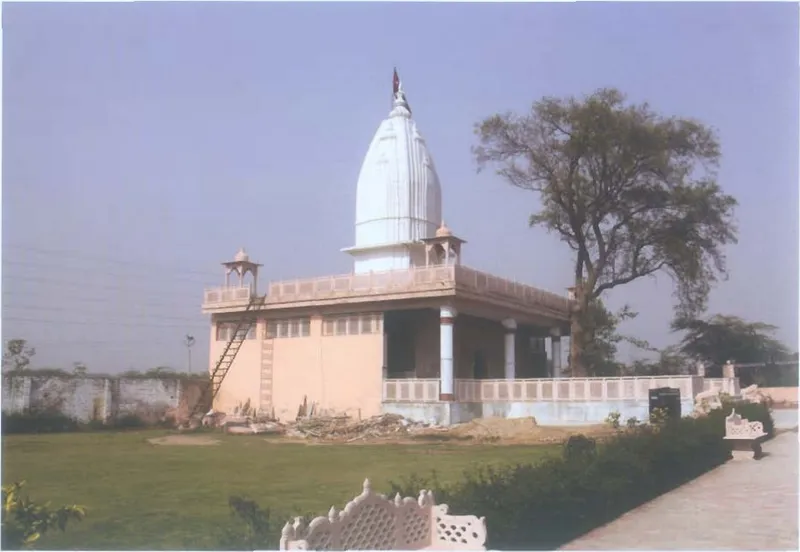
- What it is
- Akrūra-ghāṭa, also called Akrūra-tīrtha, is a bathing place on the old bank of the Yamunā, on the road between Vṛndāvana and Mathurā.
- Visiting
- Śrī Vraja-maṇḍala Parikramā (2007) places Akrūra-ghāṭa four miles north of Mathurā and one mile south of Vṛndāvana, with the village of Akrūra-gaon nearby.
- Places here
- Yajña-sthala
In short
Akrūra-ghāṭa, also called Akrūra-tīrtha, is a bathing place on the old bank of the Yamunā, on the road between Vṛndāvana and Mathurā.[1] Here, the Caitanya-caritāmṛta says, Akrūra saw Vaikuṇṭha in the water, and the people of Vraja saw Goloka.[1 +2] Śrīmad-Bhāgavatam tells how Akrūra, driving Kṛṣṇa and Balarāma to Mathurā, bathed in a pool of the river and saw Them, and then the Lord on Ananta Śeṣa, under the water; it does not name the place.[4 +5] Śrī Caitanya Mahāprabhu made Akrūra-tīrtha His residence during His visit to Vṛndāvana.[10 +6]
Key facts
| Kind | ghāṭa |
|---|---|
| Region · area | Vṛndāvana |
| Also part of | Yamunā |
| Ācāryas | Śrī Caitanya Mahāprabhu, Śrīla Jīva Gosvāmī, Śrīla Śrīnivāsa Ācārya, Śrīla Narottama dāsa Ṭhākura |
Why it is glorified
The Varāha Purāṇa gives a whole chapter to the power of the Akrūra-tīrtha.
The Varāha Purāṇa gives a whole chapter to the power of the Akrūra-tīrtha. It calls the place the king of tīrthas (holy bathing places), says that there has never been and will never be a greater tīrtha, and promises the merit of the Rājasūya and Aśvamedha sacrifices to one who bathes here at a solar eclipse. Rites here on the full moon of Kārttika, it says, deliver one's family and forefathers.[17 +2] The chapter does not tell Akrūra's vision; its story is about a merchant named Sudhana.[17 +2]
The same Purāṇa counts Akrūra among the tīrthas of Mathurā that equal Kurukṣetra, and among those a hundred times greater; Śrīla Rūpa Gosvāmī quotes these verses in his Mathurā-māhātmya for bathing at eclipses.[17 +4] The Bhakti-ratnākara quotes a verse it gives as from the Saura Purāṇa: the Akrūra-tīrtha is very dear to Hari, and a bath here on the full moon, especially in Kārttika, frees one from birth and death.[23 +2]
The Nārada Purāṇa names Akrūra among the holy places of Vṛndāvana.[26 +1] Śrīla Nārāyaṇa Bhaṭṭa Gosvāmī's Vraja-bhakti-vilāsa gives a prayer to be said twelve times while bathing at Akrūra-ghāṭa. It addresses the tīrtha as the giver of Viṣṇu's world, which gave liberation to Akrūra, and promises the sight of Hari.[28 +1]
Divine pastimes
Akrūra's vision
Śrīmad-Bhāgavatam (10.39–10.41) tells the stop on the road from Vraja to Mathurā. Kṛṣṇa, Balarāma and Akrūra reached the Kālindī, the Yamunā, on the swift chariot. Kṛṣṇa touched the water and drank some, and the chariot was moved near a grove of trees. Akrūra then went to a pool in the river to bathe.[4 +5]
nimajjya tasmin salile japan brahma sanātanam / tāv eva dadṛśe 'krūro rāma-kṛṣṇau samanvitau
While immersing himself in the water and reciting eternal mantras from the Vedas, Akrūra suddenly saw Balarāma and Kṛṣṇa before him.
Translation: Śrīla Prabhupāda's disciples (BBT)Puzzled, Akrūra came out and saw the two brothers on the chariot as before. He went in again and now saw Ananta Śeṣa, and on His lap the four-armed Lord with His associates, and he offered the prayers of the next chapter. When the Lord withdrew the vision, Akrūra finished his duties and returned to the chariot, and at the end of the day they reached Mathurā. The Bhāgavatam never names the place.[4 +7]
tasyotsaṅge ghana-syāmaṃ pīta-kauśeya-vāsasam / puruṣaṃ catur-bhujaṃ śāntam padma-patrāruṇekṣaṇam
Akrūra then saw the Supreme Personality of Godhead lying peacefully on the lap of Lord Ananta Śeṣa. The complexion of that Supreme Person was like a dark-blue cloud. He wore yellow garments and had four arms and reddish lotus-petal eyes.
Translation: Śrīla Prabhupāda's disciples (BBT)The Canto 10 commentators name it (summarised here, not translated). Śrīla Sanātana Gosvāmī calls the Akrūra-tīrtha on the bank of the Yamunā well known (prasiddha), twelve krośas (an old measure of distance) from Nanda's house, which the chariot reached at midday. Śrīla Jīva Gosvāmī calls the pool Ananta-tīrtha. Both say that the garden outside Mathurā where the cowherds waited lay very near the Akrūra-tīrtha, and that Akrūra reached it only at the end of the day because his vision had kept him so long.[2 +9] The Viṣṇu Purāṇa tells the same stop differently, also without naming the place; there Akrūra sees Śeṣa and the four-armed Kṛṣṇa at his first immersion.[40] Read more: Akrūra's vision in the Yamunā →
The cowherds' vision at Brahma-hrada
After Kṛṣṇa brought Nanda back from the world of Varuṇa, He showed the cowherd men His own abode. The Bhāgavatam says that He took them to Brahma-hrada, the "lake of Brahman", where Akrūra had seen it:[22 +3]
iti sañcintya bhagavān mahā-kāruṇiko hariḥ / darśayām āsa lokaṃ svaṃ gopānāṃ tamasaḥ param
… te tu brahma-hradam nītā magnāḥ kṛṣṇena coddhṛtāḥ / dadṛśur brahmaṇo lokaṃ yatrākrūro 'dhyagāt purā
The cowherd men were brought by Lord Kṛṣṇa to the Brahma-hrada, made to submerge in the water, and then lifted up. From the same vantage point that Akrūra saw the spiritual world, the cowherd men saw the planet of the Absolute Truth.
Translation: Śrīla Prabhupāda's disciples (BBT)According to Śrīla Jīva Gosvāmī, Brahma-hrada is the Akrūra-tīrtha, so that this place has two pastimes. In his Kṛṣṇa-sandarbha and Gopāla-campū he writes that the cowherds were immersed here, lifted out and brought to Vṛndāvana, where they saw Goloka; Kṛṣṇa chose this tīrtha to make its greatness known (summarised here, not translated).[22 +3] The other commentators read Brahma-hrada differently; see below. In Śrīla Rūpa Gosvāmī's Stava-mālā Kṛṣṇa shows His kinsmen the highest world in "a divine lake" and leads them home, to show that no world is more charming than the Vṛndāvana forest; Śrīla Baladeva Vidyābhūṣaṇa's commentary on the hymn takes the lake to be the Akrūra-tīrtha.[44 +1] Śrīla Jīva Gosvāmī and Śrīla Viśvanātha Cakravartī Ṭhākura date the cowherds' vision to the full moon of Kārttika, when Kṛṣṇa was seven; the Bhāgavatam itself gives no date.[46 +2] Read more: The cowherds' vision at Brahma-hrada →
Śrī Caitanya Mahāprabhu at Akrūra-tīrtha
The Caitanya-caritāmṛta (Madhya 18) tells that Śrī Caitanya Mahāprabhu, seeing the crowds in Mathurā, moved to Akrūra-tīrtha:[10 +3]
লোকের সংঘট্ট দেখি মথুরা ছাড়িয়া ।
একান্তে ‘অক্রূর তীর্থে’ রহিলা আসিয়া ॥ ৭০ ॥
lokera saṅghaṭṭa dekhi mathurā chāḍiyā
ekānte ‘akrūra-tīrthe’ rahilā āsiyā
Seeing a great crowd assemble at Mathurā, Śrī Caitanya Mahāprabhu left and went to Akrūra-tīrtha. He remained there in a solitary place.
Translation: Śrīla A.C. Bhaktivedanta Swami PrabhupādaFrom here He went to Vṛndāvana by day and bathed at Kāliya-hrada and Praskandana. He sat chanting the holy name under the old tamarind tree at Imlītalā and came back to Akrūra-tīrtha at noon for His meal.[10 +10] So many people living at Akrūra came to see Him that He went to Vṛndāvana to chant in a solitary place. He stayed some days at Akrūra-tīrtha and delivered everyone there by giving the holy name and love of Kṛṣṇa.[10 +4]
One day He sat at the bathing ghāṭa and thought of what had happened there:[1 +2]
এই ঘাটে অক্রূর বৈকুণ্ঠ দেখিল ।
ব্রজবাসী লোক ‘গোলোক’ দর্শন কৈল ॥ ১৩৬ ॥
ei ghāṭe akrūra vaikuṇṭha dekhila
vrajavāsī loka ‘goloka’ darśana kaila
Śrī Caitanya Mahāprabhu thought, “At this bathing place, Akrūra saw Vaikuṇṭha, the spiritual world, and all the inhabitants of Vraja saw Goloka Vṛndāvana.”
Translation: Śrīla A.C. Bhaktivedanta Swami PrabhupādaAccording to the Caitanya-caritāmṛta, remembering how Akrūra had stayed in the water, Mahāprabhu jumped into the river and stayed under. His servant Kṛṣṇadāsa cried out, and Balabhadra Bhaṭṭācārya pulled Him out; Balabhadra then decided to take Him away from Vṛndāvana to Prayāga.[54 +1]
Traditional accounts
Śrīla Prabhupāda explains in the Kṛṣṇa book (chapter 46), following the decision of expert devotees, that Kṛṣṇa, in His original …
Śrīla Prabhupāda explains in the Kṛṣṇa book (chapter 46), following the decision of expert devotees, that Kṛṣṇa, in His original identity, returned with Nanda Mahārāja and stayed in Vṛndāvana in His bhāva expansion.[56] The Canto 10 commentators teach that Kṛṣṇa of Vraja never leaves Vṛndāvana and that another manifestation went to Mathurā, but none of them names the place where the two parted.[57 +4] The guidebook Śrī Vraja-maṇḍala Parikramā (2007) says that, according to the Gauḍīya Gosvāmīs, Kṛṣṇa the son of Nanda and Balarāma the son of Rohiṇī came with Akrūra only as far as Akrūra-ghāṭa, the boundary of Vṛndāvana, and stayed on in Vṛndāvana unseen; the sons of Vasudeva went on to Mathurā.[61]
According to the local tradition recorded in the same guidebook, in ancient times Śānta Ṛṣi performed a sacrifice here for King Bṛhadsena; the book gives no source, and the account is not certain.[22]
The Gosvāmīs and ācāryas
According to the Bhakti-ratnākara, Śrīla Rāghava Paṇḍita Gosvāmī of Govardhana showed the Akrūra-tīrtha to Śrīla Śrīnivāsa Ācārya …
According to the Bhakti-ratnākara, Śrīla Rāghava Paṇḍita Gosvāmī of Govardhana showed the Akrūra-tīrtha to Śrīla Śrīnivāsa Ācārya and Śrīla Narottama dāsa Ṭhākura on their walk through Vraja. He told them the merit of bathing here and pointed out the village of Akrūra, where Śrī Caitanya Mahāprabhu had stayed in a solitary place because of the crowds in Vṛndāvana.[23 +2] Śrīla Prabhupāda quotes this couplet in his purport to Caitanya-caritāmṛta Madhya 18.70.[14 +2]
Śrīla Prabhupāda
In his account of Śrī Caitanya's life Śrīla Prabhupāda writes …
In his account of Śrī Caitanya's life Śrīla Prabhupāda writes:[14 +2]
Names this place“As long as He remained at Vṛndāvana, He made His headquarters at Akrūra-ghāṭa.”
Śrīla Prabhupāda, Śrīmad-Bhāgavatam, Canto 1, Introduction (the life of Śrī Caitanya Mahāprabhu) · vedabase.io
In his purport to Caitanya-caritāmṛta Madhya 18.135 he places the tīrtha and tells both its pastimes:[1]
Names this place“Akrūra-tīrtha is located on the road between Vṛndāvana and Mathurā. … When Kṛṣṇa and Balarāma took Their baths, Akrūra saw the entire world of Vaikuṇṭha within the water. The inhabitants of Vṛndāvana also saw the Vaikuṇṭha planets within the water.”
Śrīla Prabhupāda, Śrī Caitanya-caritāmṛta, Madhya-līlā 18.135, purport · vedabase.io
He also lists Akrūra-tīrtha as the eighteenth of the twenty-four bathing places of Vraja, where Kṛṣṇa, Balarāma and Akrūra all bathed on the way to Mathurā.[67 +1] Whether Kṛṣṇa and Balarāma bathed here is told differently in the sources; see below.
Visiting today
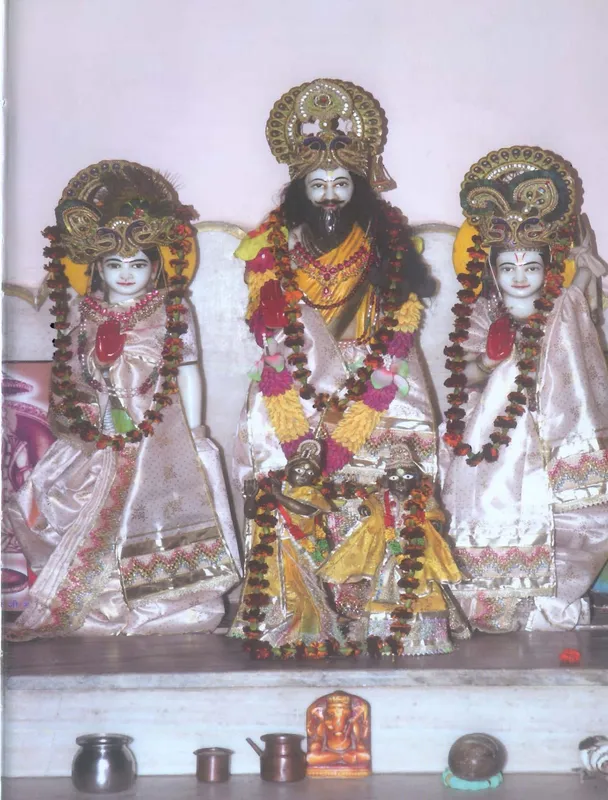
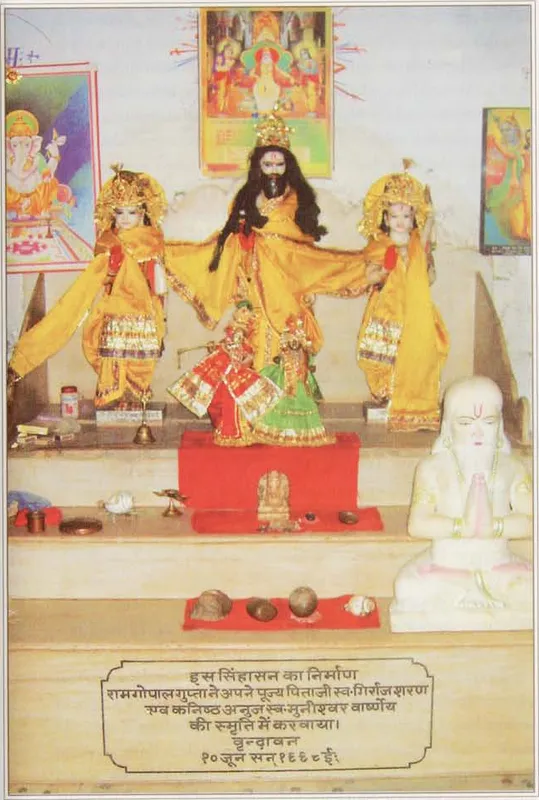
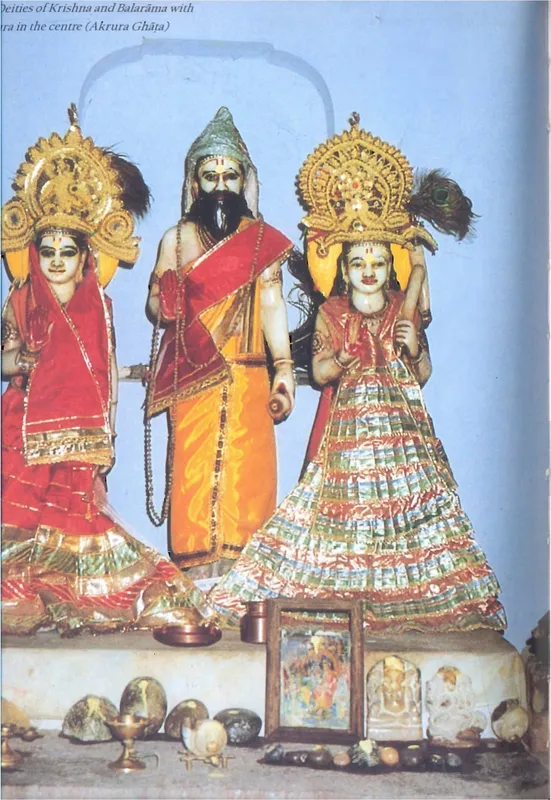
Śrī Vraja-maṇḍala Parikramā (2007) places Akrūra-ghāṭa four miles north of Mathurā and one mile south of Vṛndāvana, with the village of Akrūra-gaon nearby.[37] The guidebooks describe a temple with Deities of Kṛṣṇa and Balarāma and Akrūra standing between Them. The Yamunā once flowed past it but has moved about a kilometre away, to the west according to The Color Guide.[55 +3] The same 2007 guidebook speaks of an injunction to bathe here at a solar eclipse, which the Varāha Purāṇa gives.[17 +3]
Location
| Where it is | the river 'has moved some distance away'[70] the Yamunā is now about one kilometer to the West[71] |
|---|
Places at Akrūra-ghāṭa
1 places
Nearby places
Vṛndāvana · Mathurā · Akrūra-gaon · Yamunā
Pictures
5 pictures
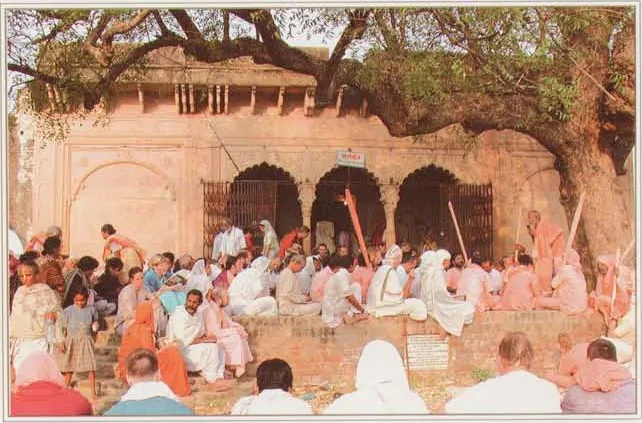
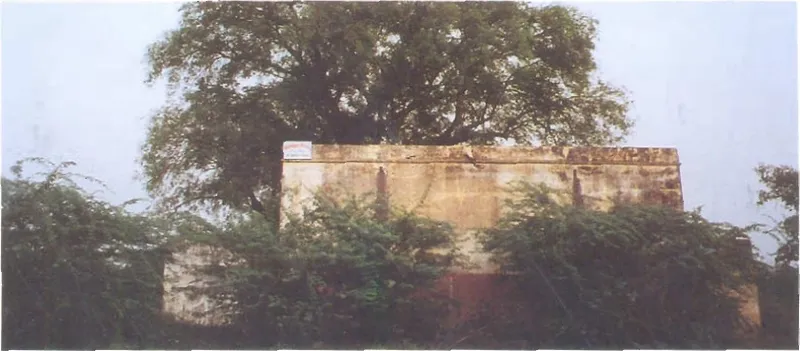
History
The Color Guide to Vṛndāvana (2000) dates Śrī Caitanya's stay at Akrūra-ghāṭa to 1515; the Caitanya-caritāmṛta gives no year.[12 +3]
The Bengali Vṛndāvana-kathā (1920) says that all the steps and buildings of Śrī Caitanya's time had fallen into ruin. A short time before, a merchant, whom it does not name, had built a small temple on the old foundation, with images of Śrī Kṛṣṇa, Baladeva and Akrūra. Of the old buildings only a small, nearly ruined temple of a five-faced Hanumān remained, and the Yamunā had moved far away.[64] In 1987 the historian A. W. Entwistle recorded two small temples here, of Akrūra-bihārī and of Gopīnātha, and reported that the second was said to have been founded by Bīr Singh Deo of Orchhā; he gives no date or record.[65]
Where the sources differ
What Akrūra saw in the water.
Accounts differ What Akrūra saw in the water.
- Śrīmad-Bhāgavatam 10.39.41 ff. (BBT translation) and Śrīla Prabhupāda's Kṛṣṇa book ch. 39Balarāma and Kṛṣṇa, then Balarāma as Śeṣa Nāga and Kṛṣṇa as the four-armed Lord (Viṣṇuloka).
- Caitanya-caritāmṛta Madhya 18.136At this ghat Akrūra saw Vaikuṇṭha (and the Vrajavāsīs saw Goloka).
- Garga-saṁhitā Mathurā-khaṇḍa 5.5.4–7On Śeṣa's lap he saw Goloka with Govardhana, the Yamunā and the Vṛndāvana forest, and Kṛṣṇa with Rādhā in the rāsa circle.
- Śrī Vraja-maṇḍala Parikramā (2007)Instead of his worshipful Sanātana Brahma (four-armed Viṣṇu) he saw Rāma and Kṛṣṇa, and was convinced They are the complete Sanātana Brahma.
Accounts differ Whether Kṛṣṇa and Balarāma bathed at the stop on the road to Mathurā.
- Śrīmad-Bhāgavatam 10.39.39 (BBT translation, Śrīla Prabhupāda's disciples)Kṛṣṇa touched the river's water for purification and drank some; then the chariot was moved near a grove of trees and He climbed back on with Balarāma. No bath is mentioned.
- Śrīla Sanātana Gosvāmī and Śrīla Jīva Gosvāmī on ŚB 10.39.39'upaspṛśya' means that the Lord, getting down from the chariot, first sipped water (ācamana); He drank because of the fatigue of the road.
- Śrīla Prabhupāda, Kṛṣṇa book ch. 39 and CC Madhya 18.135 purportKṛṣṇa and Balarāma took Their baths in the river (Kṛṣṇa book); 'When Kṛṣṇa and Balarāma took Their baths, Akrūra saw the entire world of Vaikuṇṭha within the water' (CC purport).
- Śrīla Prabhupāda, ŚB 4.8.42 purportAt Akrūra-tīrtha 'all of them took bath in this ghāṭa'.
Accounts differ What 'Brahma-hrada' (ŚB 10.28.16) is: a pool of the Yamunā (the Akrūra-tīrtha) or Brahman likened to a lake.
- Śrīla Jīva Gosvāmī (Laghu-toṣaṇī, second reading; Krama-sandarbha; Kṛṣṇa-sandarbha 116) and Śrīla Baladeva Vidyābhūṣaṇa (on ŚB 10.28.16, and in his ṭīkā on the Stava-mālā: 'the divine lake, the Akrūra-tīrtha')The Akrūra-tīrtha (Jīva gives the Brahman reading first in his Laghu-toṣaṇī).
- Bṛhat-krama-sandarbha (attributed to Śrīla Jīva Gosvāmī)The pool of the Yamunā in which Akrūra, submerged, saw Nārāyaṇa on Śeṣa and then Śrī Kṛṣṇa.
- Śrīla Śrīdhara Svāmī on ŚB 10.28.16; VaṁśīdharaFirst Brahman itself, called a lake; or else the Yamunā pool of Akrūra's vision named Brahma-hrada, a reading that needs a displaced word order and an assumption not well known. Vaṁśīdhara prefers the pool.
- Śrīla Sanātana Gosvāmī on ŚB 10.28.16Vaikuṇṭha, the great treasury; or a pool in which they bathed, outside Vraja-bhūmi, which he does not name.
The wording of these accounts is our summary of the sources, not a published translation.
Accounts differ Where and what the cowherd men saw after Nanda's rescue.
- Śrīmad-Bhāgavatam 10.28.16Brought to Brahma-hrada, submerged and lifted out, they saw 'the world of Brahman' where Akrūra saw (place of the vision not stated more exactly).
- Śrīla Jīva Gosvāmī, Kṛṣṇa-sandarbha 116 and Gopāla-campūLifted out of the Akrūra-tīrtha and brought to the middle of Vṛndāvana, they saw Goloka there — not in the water as Akrūra did.
- Caitanya-caritāmṛta Madhya 18.136At this bathing place the Vrajavāsīs saw Goloka.
- Śrīla Prabhupāda, CC Madhya 18.135 purportThe inhabitants of Vṛndāvana also saw the Vaikuṇṭha planets within the water.
Accounts differ Why Śrī Caitanya stayed and ate at Akrūra: the crowds of Mathurā, the crowds of Vṛndāvana, or (later) the crowds of Akrūra itself.
- Caitanya-caritāmṛta Madhya 18.70Seeing a great crowd assemble at Mathurā, He left and stayed at Akrūra-tīrtha in a solitary place.
- Caitanya-caritāmṛta Madhya 18.78-80He returned to Akrūra at noon for His meal; because the people of Akrūra came in crowds, He went to Vṛndāvana to chant in a solitary place until noon.
- Bhakti-ratnākara, Fifth Wave (printed pp. 289, 317) and Eleventh Wave (p. 665, Śrīla Jīva Gosvāmī's words)He stayed in seclusion in the village of Akrūra; because of the crowds of people in Vṛndāvana He came here (to Akrūra) and took His meals.
- Śrīla Prabhupāda, CC Madhya 18 chapter summarySeeing a great crowd in Mathurā, He moved His residence near Akrūra-ghāṭa and went every day to Vṛndāvana.
Accounts differ Śrī Caitanya's daily routine at Akrūra-ghāṭa as the guidebooks tell it.
- Caitanya-caritāmṛta Madhya 18.74, 18.78He went to Vṛndāvana by day, returned at noon for lunch (18.78) or in the evening for His meal (18.74).
- Śrī Vraja-maṇḍala Parikramā (2007)At night He stayed at Akrūra-ghāṭa; at dawn He sat at Imlītalā-ghāṭa and chanted until the afternoon.
- Vṛndāvana-Dhāma Ki Jaya! (c. 1986)He spent the afternoons and evenings at Akrūra-ghāṭa.
- The Color Guide to Vṛndāvana (2000)Every day He visited the holy places and returned in the evening.
More on this place
Akrūra's vision in the Yamunā · The cowherds' vision at Brahma-hrada
References
71 references
- Śrīla Prabhupāda, Śrī Caitanya-caritāmṛta, Madhya-līlā 18.135, purport · vedabase.io
- Śrīla Kṛṣṇadāsa Kavirāja Gosvāmī, Śrī Caitanya-caritāmṛta, Madhya-līlā 18.135, online edition · vedabase.io
- Śrīla Kṛṣṇadāsa Kavirāja Gosvāmī, Śrī Caitanya-caritāmṛta, Madhya-līlā 18.136, online edition · vedabase.io
- Śrīmad-Bhāgavatam 10.39.38, GRETIL
- Śrīmad-Bhāgavatam 10.39.39, GRETIL
- Śrīmad-Bhāgavatam 10.39.40, GRETIL
- Śrīmad-Bhāgavatam 10.39.41, GRETIL
- Śrīmad-Bhāgavatam 10.39.42–43, GRETIL
- Śrīmad-Bhāgavatam 10.39.44–45, GRETIL
- Śrīla Kṛṣṇadāsa Kavirāja Gosvāmī, Śrī Caitanya-caritāmṛta, Madhya-līlā 18.70, online edition · vedabase.io
- Śrīla Kṛṣṇadāsa Kavirāja Gosvāmī, Śrī Caitanya-caritāmṛta, Madhya-līlā 18.74, online edition · vedabase.io
- Śrīla Kṛṣṇadāsa Kavirāja Gosvāmī, Śrī Caitanya-caritāmṛta, Madhya-līlā 18.78, online edition · vedabase.io
- Śrīla Kṛṣṇadāsa Kavirāja Gosvāmī, Śrī Caitanya-caritāmṛta, Madhya-līlā 18.128, online edition · vedabase.io
- Śrīla Prabhupāda, Śrīmad-Bhāgavatam, Canto 1, Introduction (the life of Śrī Caitanya Mahāprabhu) · vedabase.io
- Śrīla Prabhupāda, Śrī Caitanya-caritāmṛta, Madhya-līlā 18.70, purport · vedabase.io
- Śrīla Prabhupāda, Śrī Caitanya-caritāmṛta, Madhya-līlā, Chapter 18, chapter summary · vedabase.io
- Varāha Purāṇa, adhyāya 155 ('akrūra-tīrtha-prabhāva'), verses 3–6, Sanskrit Wikisource
- Varāha Purāṇa, adhyāya 155, verses 1–2 (chapter heading), Sanskrit Wikisource
- Varāha Purāṇa, adhyāya 155, verses 71–75 and colophon, Sanskrit Wikisource
- Varāha Purāṇa, adhyāya 168, verses 14b–18a, Sanskrit Wikisource
Show all 71 references
- Śrīla Rūpa Gosvāmī, Mathurā-māhātmya vv.437-439, quoting the Ādi-varāha
- Śrī Vraja-maṇḍala Parikramā (2007), PDF p. 286
- Śrīla Narahari Cakravartī, Bhakti-ratnākara, Fifth Wave, printed p. 289 (1912 ed.): verses quoted from the Saura Purāṇa and the Ādi-varāha, then the couplets on Mahāprabhu's stay, 2nd ed., 1912
- Śrīla Narahari Cakravartī, Bhakti-ratnākara, Fifth Wave (pañcama taraṅga), printed p. 288 (1912 ed.), 2nd ed., 1912
- Śrīla Rūpa Gosvāmī, Mathurā-māhātmya v.424-425, quoting the Saura Purāṇa
- Nārada Purāṇa, Uttara-bhāga, adhyāya 80, vv.77-81
- Nārada Purāṇa, Uttara-bhāga, adhyāya 80, verses 6–9
- Śrīla Nārāyaṇa Bhaṭṭa, Vraja-bhakti-vilāsa, adhyāya 10, v.78 (the book's own number), printed p. 228, 1st ed., publ. Bābā Kṛṣṇadāsa, Kusuma-sarovara, Saṁvat 2008
- Śrī Vraja-maṇḍala Parikramā (2007), PDF p. 288
- Śrīmad-Bhāgavatam 10.41.2–3, GRETIL
- Śrīmad-Bhāgavatam 10.41.6 and 10.41.8, GRETIL
- Śrīmad-Bhāgavatam 10.39.46, GRETIL
- Śrīla Sanātana Gosvāmī: commentary on ŚB 10.39.38, Bhagavata Vidya Pith edition, ed. Bhagavata Rishi and Krishna Shankar Shastri, 1996
- Śrīla Sanātana Gosvāmī: commentary on ŚB 10.41.6, Bhagavata Vidya Pith edition, ed. Bhagavata Rishi and Krishna Shankar Shastri, 1996
- Śrīla Jīva Gosvāmī: commentary on ŚB 10.39.40, Bhagavata Vidya Pith edition, ed. Bhagavata Rishi and Krishna Shankar Shastri, 1996
- Śrī Vraja-maṇḍala Parikramā (2007), PDF p. 226
- Śrī Vraja-maṇḍala Parikramā (2007), PDF p. 284
- Vṛndāvana-Dhāma Ki Jaya! (c. 1986), by Dhruva Mahārāja dāsa, PDF p. 76
- Śrīla Sanātana Gosvāmī: commentary on ŚB 10.38.24, Bhagavata Vidya Pith edition, ed. Bhagavata Rishi and Krishna Shankar Shastri, 1996
- Viṣṇu Purāṇa, 5.18.33–36, GRETIL
- Śrīmad-Bhāgavatam 10.28.14 and 10.28.16, GRETIL
- Śrīla Jīva Gosvāmī, Kṛṣṇa-sandarbha, anuccheda 116 (on ŚB 10.28.14–17), GRETIL
- Śrīla Jīva Gosvāmī, Gopāla-campū, Uttara-campū, pūraṇa 29, section [82], GRETIL
- Śrīla Rūpa Gosvāmī, Stava-mālā, part 26 v.28-29 of the text (the Chando'ṣṭādaśaka hymns; v.29 as numbered there), after the edition of Bhakti Saranga Goswami and Purushottam Das, Vrindavan, 1959
- Śrīla Viśvanātha Cakravartī: commentary on ŚB 10.28.17, Bhagavata Vidya Pith edition, ed. Bhagavata Rishi and Krishna Shankar Shastri, 1996
- Śrīla Viśvanātha Cakravartī Ṭhākura: commentary on ŚB 10.29.1
- Śrīla Jīva Gosvāmī: commentary on ŚB 10.45.3, Bhagavata Vidya Pith edition, ed. Bhagavata Rishi and Krishna Shankar Shastri, 1996
- Śrīla Prabhupāda, Kṛṣṇa, the Supreme Personality of Godhead (Kṛṣṇa book), Chapter 29, 'The Rāsa Dance: Introduction' · vedabase.io
- Śrīla Kṛṣṇadāsa Kavirāja Gosvāmī, Śrī Caitanya-caritāmṛta, Madhya-līlā 18.79, online edition · vedabase.io
- Śrīla Kṛṣṇadāsa Kavirāja Gosvāmī, Śrī Caitanya-caritāmṛta, Madhya-līlā 18.71, online edition · vedabase.io
- Śrīla Prabhupāda, Śrīmad-Bhāgavatam, Canto 1, Introduction, Introduction (life of Śrī Caitanya Mahāprabhu) · vedabase.io
- Śrīla Kṛṣṇadāsa Kavirāja Gosvāmī, Śrī Caitanya-caritāmṛta, Madhya-līlā 18.75, online edition · vedabase.io
- Śrīla Kṛṣṇadāsa Kavirāja Gosvāmī, Śrī Caitanya-caritāmṛta, CC Madhya-līlā 18.77, online edition · vedabase.io
- Śrīla Kṛṣṇadāsa Kavirāja Gosvāmī, Śrī Caitanya-caritāmṛta, Madhya-līlā 18.137, online edition · vedabase.io
- Vṛndāvana, the Playground of God (2010), Bhakti Caitanya Svāmī, PDF p. 244
- Śrīla Prabhupāda, Kṛṣṇa, the Supreme Personality of Godhead (Kṛṣṇa book), Chapter 46, 'Uddhava Visits Vṛndāvana' · vedabase.io
- Śrīla Sanātana Gosvāmī: commentary on ŚB 10.39.37, Bhagavata Vidya Pith edition, ed. Bhagavata Rishi and Krishna Shankar Shastri, 1996
- Vaṁśīdhara: commentary on ŚB 10.3.51, Bhagavata Vidya Pith edition, ed. Bhagavata Rishi and Krishna Shankar Shastri, 1996
- Śrīla Sanātana Gosvāmī: commentary on ŚB 10.5.1, Bhagavata Vidya Pith edition, ed. Bhagavata Rishi and Krishna Shankar Shastri, 1996
- Śrīla Rūpa Gosvāmī, Laghu-bhāgavatāmṛta, 1.5.461 (quoting the Yāmala), GRETIL
- Śrī Vraja-maṇḍala Parikramā (2007), PDF p. 285
- The Color Guide to Vṛndāvana (2000), Written and Photographed by Rājaśekhara dāsa Brahmacārī, PDF p. 155
- The Color Guide to Vṛndāvana (2000), Written and Photographed by Rājaśekhara dāsa Brahmacārī, PDF p. 22
- Vṛndāvana-kathā, chapter 16 (ṣoḍaśa pariccheda), printed p. 190; continued on p. 192
- A. W. Entwistle, §66.42 'Akrur Ghat' (in §66 'Vrindaban'), printed p. 418, Egbert Forsten, Groningen, 1987
- Śrīla Narahari Cakravartī, Bhakti-ratnākara, Fifth Wave (pañcama taraṅga), printed p. 289 (1912 edition), 2nd ed., 1912
- Śrīla Prabhupāda, Śrīmad-Bhāgavatam, 4.8.42, purport · vedabase.io
- Śrīla Prabhupāda, Śrīmad-Bhāgavatam 4.8.42, purport (the list, as reprinted with numbers)
- Vṛndāvana-Dhāma Ki Jaya! (c. 1986), by Dhruva Mahārāja dāsa, PDF p. 77
- Vṛndāvana, the Playground of God (2010), Bhakti Caitanya Svāmī, p. 242
- The Color Guide to Vṛndāvana (2000), Written and Photographed by Rājaśekhara dāsa Brahmacārī, p. 141