Brahma-kuṇḍa (Govardhana)
ब्रह्म-कुण्ड (गोवर्धन) Hindi name proposed
Also called Brahmā-kuṇḍa, Brahmā Lake
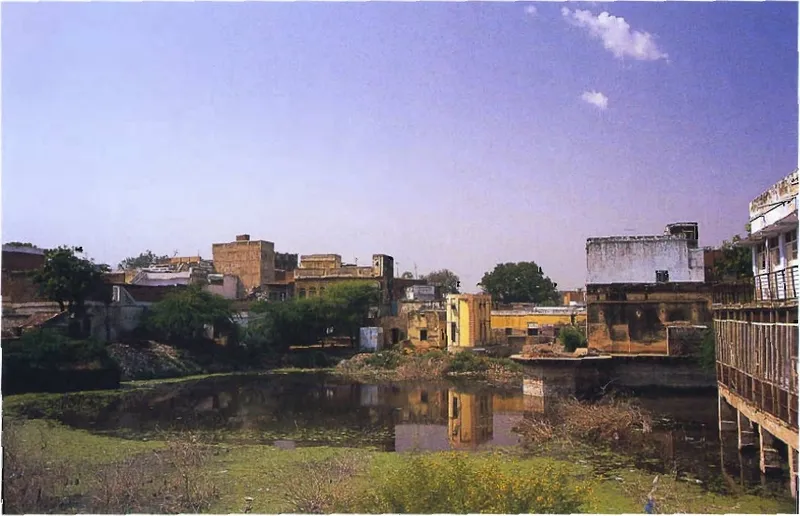
- What it is
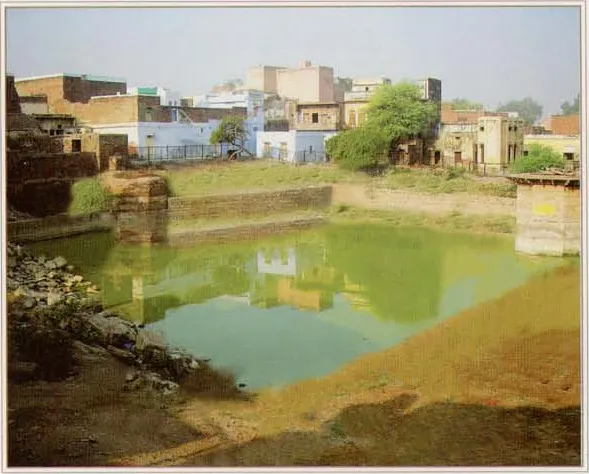
- Brahma-kuṇḍa is a kuṇḍa (sacred pond) in the town of Govardhana, which the guidebooks place below the temple of the goddess Manasā-devī on the south bank of Mānasī-gaṅgā.
- Visiting
- Govardhana Hill (2001) and Śrī Vraja-maṇḍala Parikramā (2007) both place the kuṇḍa below a temple of the goddess on the south bank of Mānasī-gaṅgā.
- Parikramā
- Govardhana parikramā, station 13
- Places here
- Kuṇḍas of Yamarāja, Varuṇa, Kuvera and Indra (Brahma-kuṇḍa)
In short
Brahma-kuṇḍa is a kuṇḍa (sacred pond) in the town of Govardhana, which the guidebooks place below the temple of the goddess Manasā-devī on the south bank of Mānasī-gaṅgā.[1 +1] The Caitanya-caritāmṛta tells that Śrī Caitanya Mahāprabhu bathed here on the day He reached Govardhana and took the meal that Balabhadra Bhaṭṭācārya cooked at the kuṇḍa.[3 +1] Śrīla Raghunātha dāsa Gosvāmī names the Brahma lake among the lakes that encircle Govardhana.[5 +1] According to the Vraja-bhakti-vilāsa, the kuṇḍa arose when Brahmā bathed Hari, Kṛṣṇa, with mantras of the Sāma-veda; the Bhāgavatam names no lake for Brahmā's worship of Kṛṣṇa, and the other sources give different reasons for it.[7 +4]
Key facts
| Kind | kuṇḍa |
|---|---|
| Region · area | Govardhana · Govardhana (town) |
| On the parikramā | Govardhana parikramā, station 13 · the route |
| Ācāryas | Śrī Caitanya Mahāprabhu, Śrī Nityānanda Prabhu, Śrīla Raghunātha dāsa Gosvāmī, Śrīla Śrīnivāsa Ācārya, Śrīla Nārāyaṇa Bhaṭṭa Gosvāmī |
Why it is glorified
Śrīla Rūpa Gosvāmī's Mathurā-māhātmya, under the heading of the Brahma-kuṇḍa at Govardhana, gives a verse that it takes from the …
Śrīla Rūpa Gosvāmī's Mathurā-māhātmya, under the heading of the Brahma-kuṇḍa at Govardhana, gives a verse that it takes from the Mathurā-khaṇḍa: one should bathe there in Brahma-kuṇḍa, where Brahmā pleased Hari and where the lakes of Indra and the other guardians of the directions arose (summarised here, not translated).[12 +2] He follows it with the Varāha Purāṇa's verses on a lake at Govardhana with four tīrthas (holy bathing places) around it, Indra's on the east, Yama's on the south, Varuṇa's on the west and Kubera's on the north, in whose midst the Lord sports. The Purāṇa itself does not name the lake.[12 +2]
In the Bhakti-ratnākara, Śrīla Śrīnivāsa Ācārya's guide shows him the kuṇḍa, whose glory, he says, is boundless, with charming tīrthas on its four sides, as the Purāṇas proclaim; then he quotes the same two passages.[12 +1]
The Vraja-bhakti-vilāsa's list of the holy spots of Govardhana names the hill, the temple of Harideva upon it, Mānasī-gaṅgā, Brahma-kuṇḍa and the temple of the goddess Manasā, in that order.[16]
Divine pastimes
Brahmā's worship of Kṛṣṇa
Śrīmad-Bhāgavatam (10.13–14) tells how Brahmā stole Kṛṣṇa's calves and cowherd friends and, a year later, came back and saw Him in Vṛndāvana, still looking for the calves. Brahmā fell at His feet and bathed them with tears of joy; after his prayers, in which he asked Kṛṣṇa to excuse his offence, he walked around Him three times and went back to his own abode. The Bhāgavatam names no lake and no Govardhana in this account.[8 +3]
dṛṣṭvā tvareṇa nija-dhoraṇato 'vatīrya pṛthvyāṃ vapuḥ kanaka-daṇḍam ivābhipātya / spṛṣṭvā catur-mukuṭa-koṭibhir aṅghri-yugmaṃ natvā mud-aśru-sujalair akṛtābhiṣekam
After seeing this, Lord Brahmā hastily got down from his swan carrier, fell down like a golden rod and touched the lotus feet of Lord Kṛṣṇa with the tips of the four crowns on his heads. Offering his obeisances, he bathed the feet of Kṛṣṇa with the water of his tears of joy.
Translation: Śrīla A.C. Bhaktivedanta Swami PrabhupādaThe commentators take this bath as the washing of Kṛṣṇa's feet with tears, and none of them names a lake (summarised here, not translated).[17]
The Bhāgavatam also tells that after Kṛṣṇa had lifted Govardhana, Surabhi, the mother of the cows, bathed Him with her milk "as ordered by Lord Brahmā", and Indra bathed Him with water of the heavenly Gaṅgā; it does not say that Brahmā came.[18 +2] Śrīla Sanātana Gosvāmī, Śrīla Jīva Gosvāmī and Śrīla Baladeva Vidyābhūṣaṇa say that he did not come, because he feared an offence as before; Śrīla Viśvanātha Cakravartī Ṭhākura has Surabhi say that Brahmā, remembering his own earlier offence, sent her instead. Śrīla Jīva Gosvāmī places that bath at the spot called Śakra-kuṇḍa or Govinda-kuṇḍa (summarised here, not translated).[21 +1] In Śrīla Kavi-karṇapūra's Ānanda-vṛndāvana-campū, however, Brahmā comes to Govardhana after Indra's apology, worships Kṛṣṇa and has Surabhi and the sages bathe Him; this book names no lake either.[23] Read more: The lifting of Govardhana Hill, Indra's homage and the name Govinda →
Śrīla Nārāyaṇa Bhaṭṭa Gosvāmī's Vraja-bhakti-vilāsa says that where Brahmā and the other gods came down to earth, Brahmā performed Hari's abhiṣeka, a ceremonial bath, with praises and with mantras of the Sāma-veda, for the fulfilment of all aims, and from it Brahma-kuṇḍa arose. It gives a prayer for bathing in the kuṇḍa, which it says is from the Kūrma Purāṇa (summarised here, not translated). The guidebooks give other reasons for Brahmā's worship, so the accounts differ:[7]
Accounts differ How and why Brahma-kuṇḍa came to be
- Vraja-bhakti-vilāsa, printed p. 113Brahmā and the gods came; Brahmā performed Hari's abhiṣeka with praises and Sāma-veda mantras for the fulfilment of all aims, and Brahma-kuṇḍa arose
- Bhakti-ratnākara, 1912 p. 204, quoting a 'Mathurā-khaṇḍa'Brahma-kuṇḍa arose here where Hari was pleased by Brahmā, and the lakes of Indra and the other guardians of the directions arose
- Śrī Vraja-maṇḍala Parikramā (2007) and the undated parikramā notes GovardhanaBrahmā came to seek forgiveness for stealing the calves and cowherd boys; his abhiṣeka water became Brahma-kuṇḍa
- Govardhana Hill: India's Most Sacred Mountain (2001)after Indra's abhiṣeka (following the lifting of the hill) all the demigods headed by Brahmā performed Kṛṣṇa's abhiṣeka, creating Brahma-kuṇḍa
The wording of these accounts is our summary of the sources, not a published translation.
Śrī Caitanya Mahāprabhu at Brahma-kuṇḍa
The Caitanya-caritāmṛta (Madhya 18) tells that on the day Śrī Caitanya Mahāprabhu came to the village of Govardhana and saw the Deity of Harideva, Balabhadra Bhaṭṭācārya cooked at Brahma-kuṇḍa, and Mahāprabhu bathed there and took His meal. That night He stayed in the Harideva temple.[3 +1] Read more: Harideva of Govardhana: the Deity, Śrī Caitanya's visit and the temple →
bhaṭṭācārya ‘brahma-kuṇḍe’ pāka yāñā kaila
brahma-kuṇḍe snāna kari’ prabhu bhikṣā kaila
At Brahma-kuṇḍa, the Bhaṭṭācārya cooked food, and the Lord, after taking His bath at Brahma-kuṇḍa, accepted His lunch.
Translation: Śrīla A.C. Bhaktivedanta Swami PrabhupādaIn Śrīla Murāri Gupta's life of Śrī Caitanya, His guide shows Him five kuṇḍas on Govardhana, Brahmā's among them. The verse does not say which kuṇḍa it means, so it is not certain that it is this one.[24]
The Gosvāmīs and ācāryas
- Śrīla Raghunātha dāsa Gosvāmī names the Brahma lake among the best lakes that shine around Govardhana in his Vraja-vilāsa-stava (verse 79), and among the kuṇḍas around the hill in his Govardhanāśraya-daśaka (verse 3); neither verse tells a pastime of the lake.[5 +1]
- In Śrīla Rūpa Gosvāmī's play Dāna-keli-kaumudī, Campakalatā points out a place on the hilltop adorned with the kuṇḍa of Brahmā, and Citrā says that the Nārāyaṇa named Hari-rāya lives right there. The play does not say whether this is the present Brahma-kuṇḍa (summarised here, not translated).[12 +1]
Songs
Śrīla Raghunātha dāsa Gosvāmī's Govardhanāśraya-daśaka: the verse below names the kuṇḍa of Brahmā among the kuṇḍas that shine all …
Śrīla Raghunātha dāsa Gosvāmī's Govardhanāśraya-daśaka: the verse below names the kuṇḍa of Brahmā among the kuṇḍas that shine all around Govardhana, always dearer to Hari than the best holy waters headed by the heavenly Gaṅgā.[5 +1]
svar-dhuny-ādi-vareṇya-tīrtha-gaṇato hṛdyāny ajasraṁ hareḥ
sīri-brahma-harāpsaraḥ-priyaka-tat-śrī-dāna-kuṇḍāny api
prema-kṣema-ruci-pradāni parito bhrājanti yasya vrati
kas taṁ manya-munīndra-varṇita-guṇaṁ govardhanaṁ nāśrayet
Visiting today
Govardhana Hill (2001) and Śrī Vraja-maṇḍala Parikramā (2007) both place the kuṇḍa below a temple of the goddess on the south bank of Mānasī-gaṅgā. The first calls her Mānasī Devī, the presiding Deity of Mānasī-gaṅgā; the second calls her Manasā-devī and identifies her with Yogamāyā.[1 +1]
Two guidebooks say that four smaller kuṇḍas, of Indra on the east, Yama on the south, Varuṇa on the west and Kubera on the north, once stood around Brahma-kuṇḍa and have now disappeared.[1 +2]
Govardhana Hill (2001) also says that the kuṇḍa had fallen into disrepair and was not looked after; this may have changed since.[1]
Location
| Where it is | Overlooked by the Mānasī Devī temple[26] below the temple of Manasā-devī on the southern bank of Mānasī-gaṅgā[27] |
|---|---|
| On the numbered Govardhana chart | 21 (printed as “Brahma Kunda”)[28] |
Places at Brahma-kuṇḍa (Govardhana)
1 places
Nearby places
Manasā-devī Mandira · Mānasī-gaṅgā
Pictures
1 pictures
Where the sources differ
Accounts differ Which kuṇḍa the four tīrthas of Indra, Yama, Varuṇa and Kubera surround
- Bhakti-ratnākara, 1912 p. 204Brahma-kuṇḍa has tīrthas on its four sides, quoting the Varāha verses on the lake with Indra's, Yama's, Varuṇa's and Kubera's tīrthas
- Govardhana Hill: India's Most Sacred Mountain (2001) and the undated parikramā notes Govardhanafour smaller kuṇḍas of Yamarāja, Varuṇa, Kuvera and Indra formerly stood around Brahma-kuṇḍa
- Varāha Purāṇa 164.2-4an unnamed lake (hrada) at Govardhana with the four tīrthas on its four sides
- Vraja-bhakti-vilāsa, printed p. 47lists Brahma-kuṇḍa early in its Govardhana list and names the Aindravatī, Yama, Vāruṇa and Kauberiṇī tīrthas (east, south, west, north) only at the end, after the Pañcatīrtha kuṇḍa in the Indradhvaja forest, without connecting them with Brahma-kuṇḍa
Accounts differ How Brahmā worshipped Kṛṣṇa after stealing the calves and cowherd boys, and where
- Śrīmad-Bhāgavatam 10.13.59–62, 10.14.10, 10.14.41in Vṛndāvana, where Kṛṣṇa was searching for the calves, Brahmā fell at His feet and bathed them with tears of joy; in his prayers he asked Kṛṣṇa to excuse his offence; then he circumambulated Kṛṣṇa three times, bowed and returned to his abode; no lake, no Govardhana, no Sāma-veda mantras
- commentators on ŚB 10.13.62 (Śrīdhara, Sanātana, Viśvanātha, Baladeva)the abhiṣeka is the bathing of His two feet with tears; Sanātana also: an abhiṣeka of Śrī Vṛndāvana
- Śrīla Prabhupāda, Kṛṣṇa book ch. 13–14Brahmā washed Kṛṣṇa's lotus feet with his tears, offered prayers, circumambulated Him three times and returned to Brahmaloka
- Śrī Vraja-maṇḍala Parikramā (2007) and the undated parikramā notes Govardhanaseeing Kṛṣṇa in a good mood, Brahmā came to Govardhana to seek forgiveness for stealing the calves and cowherd boys, bathed Kṛṣṇa (abhiṣeka) and glorified Him with Sāma-veda mantras; the water became Brahma-kuṇḍa
The wording of these accounts is our summary of the sources, not a published translation.
Accounts differ Order of Mahāprabhu's bath in Mānasa-gaṅgā, His darśana of Harideva and His stop at Brahma-kuṇḍa
- Caitanya-caritāmṛta, Madhya 18.17-22 and 18.32He came to Govardhana village and saw Harideva, danced, took His bath and meal at Brahma-kuṇḍa, spent the night in Harideva's temple, and bathed in Mānasa-gaṅgā the next morning before the parikramā
- Govardhana Hill: India's Most Sacred Mountain (2001)Mahāprabhu first bathed in Mānasī-gaṅgā and then saw Harideva (as Śrīla Rūpa Gosvāmī's Mathurā-māhātmya recommends), and 'it is said' He then rested at Brahma-kuṇḍa
- Varāha Purāṇa 164.11 and Bhakti-ratnākara (1912 p. 205)for the pilgrim: bathe in Mānasa-gaṅgā, see Hari (Bhakti-ratnākara: Harideva) at Govardhana, then go round Annakūṭa-Govardhana (a prescribed order, not an account of Mahāprabhu)
More on this place
The lifting of Govardhana Hill, Indra's homage and the name Govinda · Harideva of Govardhana: the Deity, Śrī Caitanya's visit and the temple
References
28 references
- Govardhana Hill: India's Most Sacred Mountain (2001), Rajasekhara dasa Brahmacari, PDF p. 79
- Śrī Vraja-maṇḍala Parikramā (2007), PDF p. 119
- Śrīla Kṛṣṇadāsa Kavirāja Gosvāmī, Śrī Caitanya-caritāmṛta, CC Madhya-līlā 18.21, online edition · vedabase.io
- Śrīla Prabhupāda, Śrī Caitanya-caritāmṛta, Madhya-līlā 18.21, translation · vedabase.io
- Śrīla Raghunātha dāsa Gosvāmī, Vraja-vilāsa-stava, verse 79
- Śrīla Raghunātha dāsa Gosvāmī, Govardhanāśraya-daśaka, verse 3
- Śrīla Nārāyaṇa Bhaṭṭa, Vraja-bhakti-vilāsa, Govardhana section, printed p. 113, after mantra 4, 1st ed., publ. Bābā Kṛṣṇadāsa, Kusuma-sarovara, Saṁvat 2008
- Śrīmad-Bhāgavatam 10.13.62, GRETIL
- Śrīmad-Bhāgavatam 10.14.41, GRETIL
- Śrīla Prabhupāda, Kṛṣṇa, the Supreme Personality of Godhead (Kṛṣṇa book), Chapter 13, 'The Stealing of the Boys and Calves by Brahmā' · vedabase.io
- Śrīla Prabhupāda, Kṛṣṇa, the Supreme Personality of Godhead (Kṛṣṇa book), Chapter 14, 'Prayers Offered by Lord Brahmā to Lord Kṛṣṇa' · vedabase.io
- Śrīla Rūpa Gosvāmī, Mathurā-māhātmya vv.413-415, under 'tatrastha-brahma-kuṇḍasya' (of the Brahma-kuṇḍa there, in the Govardhana section)
- Śrīla Narahari Cakravartī, Bhakti-ratnākara, Fifth Wave, 1912 ed. p. 204, 2nd ed., 1912
- Śrīla Rūpa Gosvāmī, Dāna-keli-kaumudī, Prakrit prose of Campakalatā and Citrā before v.23, after the undated edition published by Krishna Das of Kusum Sarovar
- Varāha Purāṇa, adhyāya 164 (Annakūṭa-parikrama-prabhāva), verses 2-4, Sanskrit Wikisource
- Śrīla Nārāyaṇa Bhaṭṭa, Vraja-bhakti-vilāsa, list of the sacred spots (liṅga) of Govardhana, printed p. 47, section 50, 1st ed., publ. Bābā Kṛṣṇadāsa, Kusuma-sarovara, Saṁvat 2008
- Śrīla Sanātana Gosvāmī: commentary on ŚB 10.13.62, Bhagavata Vidya Pith edition, ed. Bhagavata Rishi and Krishna Shankar Shastri, 1996
- Śrīmad-Bhāgavatam 10.27.21, GRETIL
- Śrīmad-Bhāgavatam 10.27.22–23, GRETIL
- Śrīla Prabhupāda, Kṛṣṇa, the Supreme Personality of Godhead (Kṛṣṇa book), Chapter 27, 'Prayers by Indra, the King of Heaven' · vedabase.io
Show all 28 references
- Śrīla Jīva Gosvāmī: commentary on ŚB 10.27.21, Bhagavata Vidya Pith edition, ed. Bhagavata Rishi and Krishna Shankar Shastri, 1996
- Śrīla Jīva Gosvāmī: commentary on ŚB 10.27.24, Bhagavata Vidya Pith edition, ed. Bhagavata Rishi and Krishna Shankar Shastri, 1996
- Śrīla Kavi-karṇapūra Gosvāmī, Ānanda-vṛndāvana-campū, the abhiṣeka of Kṛṣṇa after Indra's apology
- Kṛṣṇa-caitanya-caritāmṛta of Murāri Gupta, prakrama 4, sarga 8, v.16
- the undated parikramā notes Govardhana, ¶56
- Govardhana Hill: India's Most Sacred Mountain (2001), Rajasekhara dasa Brahmacari, p. 64
- Śrī Vraja-maṇḍala Parikramā (2007), p. 212-213
- Numbered list of the Govardhana sites (key of the Govardhana chart)