Garuḍa-Govinda
गरुड़-गोविन्द
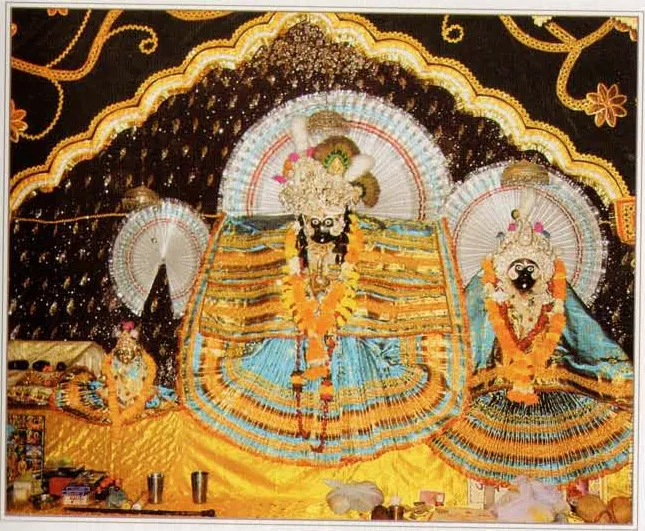
- What it is
- Garuḍa-Govinda is a temple near the village of Śakaṭīkarā (Chaṭīkarā).
- Visiting
- Śrī Vraja-maṇḍala Parikramā (2007) places the temple near Śakaṭīkarā and says that pilgrims have darśana there of Govindajī with Śrīdāmā in the role of Garuḍa.
In short
Garuḍa-Govinda is a temple near the village of Śakaṭīkarā (Chaṭīkarā). According to the Bhakti-ratnākara, Kṛṣṇa's friend Śrīdāmā played the part of Garuḍa, the eagle carrier of Lord Viṣṇu, and Govinda, in a four-armed form, rode on his shoulders; that is why the place has its name.[1 +4] The Bhakti-ratnākara supports this with a verse of Śrīla Rūpa Gosvāmī that tells the game without naming a place.[1 +1] In Śrīmad-Bhāgavatam's carrying game it is the other way round: the defeated Kṛṣṇa carried Śrīdāmā.[6 +2]
Key facts
| Kind | temple |
|---|---|
| Region · area | Madhuvana · Śakaṭīkarā |
| Ācāryas | Śrīla Rūpa Gosvāmī, Śrīla Narahari Cakravartī Ṭhākura, Śrīla Rāghava Paṇḍita Gosvāmī of Govardhana, Śrīla Narottama dāsa Ṭhākura, Śrīla Śrīnivāsa Ācārya |
Why it is glorified
The Nārada Purāṇa ends its list of the holy places of Vṛndāvana with Akrūra, Tārkṣya-govinda ("Govinda with Garuḍa", Tārkṣya …
The Nārada Purāṇa ends its list of the holy places of Vṛndāvana with Akrūra, Tārkṣya-govinda ("Govinda with Garuḍa", Tārkṣya being a name of Garuḍa) and Bahulāraṇyaka. It tells no pastime and gives no position for Tārkṣya-govinda, and no source identifies it with this temple beyond the shared name.[9]
Divine pastimes
Śrīdāmā as Garuḍa
In his Laghu-bhāgavatāmṛta, Śrīla Rūpa Gosvāmī explains that the pastimes of Kṛṣṇa's forms in Mathurā and Dvārakā were also shown inside Vraja in His childhood games. When Śrīdāmā took the part of Garuḍa, Kṛṣṇa too became four-armed, and when the boys played the Ādityas, the twelve sun-gods, He shone with twelve arms (summarised here, not translated). The verse names no place.[1 +1]
The Bhakti-ratnākara (Fifth Wave) quotes this verse for Garuḍa-Govinda. It says that here Śrīdāmā became Garuḍa and played in joy, the four-armed Govinda rode on his shoulders, and the beauty of the two was so great that the place was named after them (summarised here, not translated).[1 +4]
The carrying game of the Bhāgavatam
Śrīmad-Bhāgavatam (10.18) tells a different game, played on the way to the banyan Bhāṇḍīraka: the losers carried the winners, and Kṛṣṇa, defeated, carried Śrīdāmā. It does not tell a game in which Śrīdāmā, as Garuḍa, carried Kṛṣṇa.[6 +2] Read more: The Bhāṇḍīra banyan →
uvāha kṛṣṇo bhagavān śrīdāmānaṃ parājitaḥ / vṛṣabhaṃ bhadrasenas tu pralambo rohiṇī-sutam
Defeated, the Supreme Lord Kṛṣṇa carried Śrīdāmā. Bhadrasena carried Vṛṣabha, and Pralamba carried Balarāma, the son of Rohiṇī.
Translation: Śrīla Prabhupāda's disciples (BBT)Śrīla Prabhupāda tells the same game in his Kṛṣṇa book:[8]
General teaching (does not name the place)“The Supreme Personality of Godhead, Kṛṣṇa, being defeated, had to carry Śrīdāmā on His back, and Bhadrasena carried Vṛṣabha.”
Śrīla Prabhupāda, Kṛṣṇa, the Supreme Personality of Godhead (Kṛṣṇa book), Chapter 18, 'Killing the Demon Pralambāsura' · vedabase.io
Traditional accounts
Śrī Priyādāsa's verse commentary in the Hindi Bhaktamāla (1904; kavitta 434) tells of the devotee Viṭṭhaladāsa, who left home at …
Śrī Priyādāsa's verse commentary in the Hindi Bhaktamāla (1904; kavitta 434) tells of the devotee Viṭṭhaladāsa, who left home at night, came to Chaṭīkarā and stayed there absorbed in the service of Garuḍa-Govinda.[10]
According to Vṛndāvana-Dhāma Ki Jaya! (c. 1986), the deity was installed by Vajranābha and is a form of Viṣṇu with twelve hands; the undated parikramā notes Kumudavana say that Vajranābha, king of Mathurā, is said to have established it about a hundred years after Kṛṣṇa's disappearance. No older source for this installation has been found.[11 +1]
The Gosvāmīs and ācāryas
According to the Bhakti-ratnākara, Śrīla Rāghava Paṇḍita Gosvāmī of Govardhana showed Garuḍa-Govinda to Śrīla Śrīnivāsa Ācārya …
According to the Bhakti-ratnākara, Śrīla Rāghava Paṇḍita Gosvāmī of Govardhana showed Garuḍa-Govinda to Śrīla Śrīnivāsa Ācārya and Śrīla Narottama dāsa Ṭhākura on their tour of Vraja, right after the place of Śakaṭārohaṇa, and then went back with them to the parikramā path.[1]
Visiting today
Śrī Vraja-maṇḍala Parikramā (2007) places the temple near Śakaṭīkarā and says that pilgrims have darśana there of Govindajī with Śrīdāmā in the role of Garuḍa.[3 +1] The guidebooks do not agree on the form of the Deity or on where the temple is (see below).
Location
| Where it is | Near Śakaṭīkarā[20] at the spot where Lord Vishnu's eagle carrier Garuda used to come to offer his prayers to Vrindavana[16] |
|---|
Nearby places
Śakaṭīkarā
Pictures
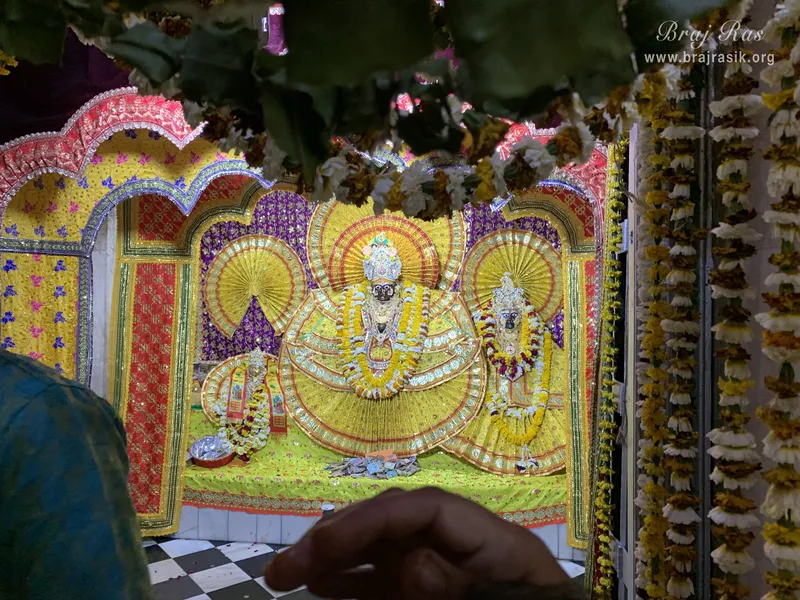
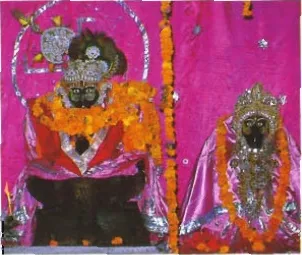
2 pictures
History
The earliest dated description found is that of F. S. Growse (1883). He described the shrine at Chaṭīkarā as a small, plain building in a grove of small kadamba trees, with a black stone image of Govinda mounted on Garuḍa, and a cave close by reached by a winding flight of steps. The shrine had no endowment. Most pilgrims came on the eighth day of the bright half of Śrāvaṇa, with the Pāñc-tīrtha fair that set out from Viśrānti-ghāṭa (Viśrāma-ghāṭa) in Mathurā, and two more fairs were held on the day after Holī and at the full moon of Jyeṣṭha.[13 +1]
In 1987 the historian A. W. Entwistle described Garuḍa-Govinda, a short way off the highway near Chaṭīkarā, as a temple of the Nimbārka sampradāya with an image of a twelve-armed Kṛṣṇa seated on Garuḍa, and named the same two fairs after Holī and in Jyeṣṭha. No source gives a date of founding.[3 +1]
Where the sources differ
Whether Kṛṣṇa's form at Garuḍa-Govinda is four-armed, as in Śrīla Rūpa Gosvāmī's verse and the Bhakti-ratnākara, or twelve-armed …
Whether Kṛṣṇa's form at Garuḍa-Govinda is four-armed, as in Śrīla Rūpa Gosvāmī's verse and the Bhakti-ratnākara, or twelve-armed, as two guidebooks and Entwistle describe the image.
Accounts differ The form of Kṛṣṇa at Garuḍa-Govinda: four-armed or twelve-armed.
- Śrīla Rūpa Gosvāmī, Laghu-bhāgavatāmṛta 1.5.374four-armed when Śrīdāmā became Garuḍa; twelve-armed in a game with the Ādityas
- Bhakti-ratnākara (printed p.188)the four-armed Govinda rode on Śrīdāmā-Garuḍa
- Vṛndāvana-Dhāma Ki Jaya! (c. 1986), the undated parikramā notes Kumudavana and Entwistle (1987, p.396)a twelve-armed form riding Garuḍa (the image in the temple)
What Saubhari Muni's curse forbade Garuḍa. Śrīmad-Bhāgavatam limits it to the lake of Kāliya, while the undated notes Kumudavana extend it to the whole Yamunā and say that Garuḍa therefore prayed to Vṛndāvana from this spot.[16 +3]
Accounts differ What Saubhari's curse forbade Garuḍa.
- Śrīmad-Bhāgavatam 10.17.11entering 'this lake' (the Kāliya lake) and eating the fish there
- the undated parikramā notes Kumudavanacoming anywhere near the Yamunā, so that Garuḍa could not enter Seva-kuñja and prayed from Garuḍa-Govinda
Accounts differ Where Garuḍa-Govinda is said to be.
- Śrī Vraja-maṇḍala Parikramā (2007)near Śakaṭīkarā (Chaṭṭīkarā)
- the undated parikramā notes Kumudavanaat Chatikara
- Vṛndāvana-Dhāma Ki Jaya! (c. 1986)listed among the holy places 'in or near the town of Vṛndāvana'
- Bhakti-ratnākara (printed p.188)shown right after Śakaṭārohaṇa in Ṣaṣṭhīkarāṭavī
More on this place
The Bhāṇḍīra banyan
References
20 references
- Śrīla Narahari Cakravartī, Bhakti-ratnākara, Fifth Wave, printed p.188 (1912 ed.): Garuḍa-Govinda, 2nd ed., 1912
- Śrīla Rūpa Gosvāmī, Laghu-bhāgavatāmṛta, 1.5.374, GRETIL
- Śrī Vraja-maṇḍala Parikramā (2007), PDF p. 71
- Vṛndāvana-Dhāma Ki Jaya! (c. 1986), by Dhruva Mahārāja dāsa, PDF p. 62
- the undated parikramā notes Kumudavana, ¶51
- Śrīmad-Bhāgavatam 10.18.22, GRETIL
- Śrīmad-Bhāgavatam 10.18.24, GRETIL
- Śrīla Prabhupāda, Kṛṣṇa, the Supreme Personality of Godhead (Kṛṣṇa book), Chapter 18, 'Killing the Demon Pralambāsura' · vedabase.io
- Nārada Purāṇa, Uttara-bhāga 80.77, the end of the list of Vṛndāvana's holy places (80.72-77)
- Bhakta-māla, kavitta 434, printed p.852
- Vṛndāvana-Dhāma Ki Jaya! (c. 1986), by Dhruva Mahārāja dāsa, PDF p. 61
- the undated parikramā notes Kumudavana, ¶53
- Mathurá (1883), F. S. Growse, B.C.S., M.A. Oxon., C.I.E. (as the title page gives him, p. 180
- Mathurá (1883), F. S. Growse, B.C.S., M.A. Oxon., C.I.E. (as the title page gives him, p. 181
- A. W. Entwistle, §61 (Jait, Chhatikara, Garud Govind), printed p.396, Egbert Forsten, Groningen, 1987
- the undated parikramā notes Kumudavana, ¶50
- Śrīmad-Bhāgavatam 10.17.9, GRETIL
- Śrīmad-Bhāgavatam 10.17.11, GRETIL
- Śrīla Prabhupāda, Kṛṣṇa, the Supreme Personality of Godhead (Kṛṣṇa book), Chapter 17, 'Extinguishing the Forest Fire' · vedabase.io
- Śrī Vraja-maṇḍala Parikramā (2007), p. 116-117