Jaṭilā's house
जटिला की हवेली Hindi name proposed
Also called Jaṭilā kī Havelī
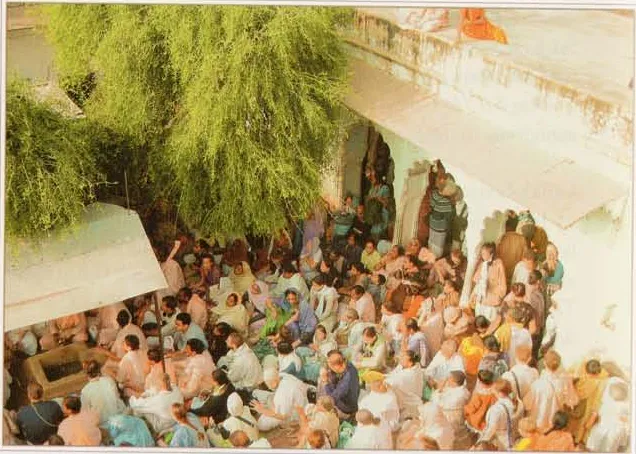
- What it is
- Jaṭilā's house, called Jaṭilā kī Havelī, stands on a high hillock in the western part of Jāvaṭa, with Deities of Jaṭilā, her daughter Kuṭilā and her son Abhimanyu, and a temple of Śrī Rādhā-Kāntajī.
- Visiting
- Śrī Vraja-maṇḍala Parikramā (2007) places Jaṭilā's house on a high hillock in the western part of Jāvaṭa, with Deities of Jaṭilā, Kuṭilā and Abhimanyu, and prints photographs of the images and of the …
- Places here
- Rādhā-Kāntajī Mandira (Jāvaṭa)
In short
Jaṭilā's house, called Jaṭilā kī Havelī, stands on a high hillock in the western part of Jāvaṭa, with Deities of Jaṭilā, her daughter Kuṭilā and her son Abhimanyu, and a temple of Śrī Rādhā-Kāntajī. This is how the guidebook Śrī Vraja-maṇḍala Parikramā (2007) describes it.[1 +3] In Kṛṣṇa's pastimes it is the household in which Śrī Rādhā lives as Abhimanyu's wife in name only. The Bhakti-ratnākara, which calls it Abhimanyu's house, says that by the power of Yogamāyā Abhimanyu cannot touch even Her shadow, and that Her friends bring Kṛṣṇa here without the family knowing.[1 +4] Śrīla Rūpa Gosvāmī and Śrīla Prabhupāda set several playful pastimes in this house.[9 +6]
Key facts
| Kind | house |
|---|---|
| Region · area | Jāvaṭa |
| Ācāryas | Śrīla Rāghava Paṇḍita Gosvāmī of Govardhana, Śrīla Śrīnivāsa Ācārya, Śrīla Narottama dāsa Ṭhākura, Śrīla Narahari Cakravartī Ṭhākura, Śrīla Rūpa Gosvāmī |
Divine pastimes
Mornings in Jaṭilā's household
Śrīla Kṛṣṇadāsa Kavirāja Gosvāmī's Govinda-līlāmṛta describes the morning in this household as part of Rādhā and Kṛṣṇa's daily pastimes. At dawn the old Mukharā, Śrī Rādhā's grandmother, comes eagerly to her granddaughter's house, and Jaṭilā asks her to see that the daughter-in-law is bathed and dressed every day for the worship of the sun, for the welfare of the cows and of her son. The Sanskrit commentary printed with the poem places the house in the village named Yāvaṭa (summarised here, not translated).[5 +3] Next, Mother Yaśodā sends Kundalatā to Jaṭilā to ask that Rādhā come and cook at Nanda's house, since Kṛṣṇa eats Her cooking with great relish; after some hesitation Jaṭilā sends Her.[17]
The butter thief in Jaṭilā's house
Śrīmad-Bhāgavatam (10.8) tells how the gopīs complained to Yaśodā that Kṛṣṇa came to their houses, let the calves loose and stole curd, butter and milk. It names no house.[18 +1]
“Our dear friend Yaśodā, your son sometimes comes to our houses before the milking of the cows and releases the calves, and when the master of the house becomes angry, your son merely smiles. Sometimes He devises some process by which He steals palatable curd, butter and milk, which He then eats and drinks. When the monkeys assemble, He divides it with them, and when the monkeys have their bellies so full that they won’t take more, He breaks the pots.
Translation: Śrīla A.C. Bhaktivedanta Swami PrabhupādaŚrīla Rūpa Gosvāmī's Bhakti-rasāmṛta-sindhu gives one such theft as an example of laughter: Kṛṣṇa tells His friends to steal the yogurt without fear, since Jaṭilā is asleep, and the old lady, who is only pretending, cannot hold back her laughter. In The Nectar of Devotion Śrīla Prabhupāda sets this "in the house of Jaṭilā".[10 +2]
Kṛṣṇa as Abhimanyu
The same book of Śrīla Rūpa Gosvāmī tells how Kṛṣṇa, dressed exactly like Abhimanyu, told Jaṭilā that the son coming home was Kṛṣṇa in disguise, so that she drove out her own son; Śrīla Prabhupāda's retelling sets this in Abhimanyu's house.[13 +2] In Śrīla Rūpa Gosvāmī's drama Lalita-mādhava (Act 4), Jaṭilā's house (jaṭilā-gṛha) has a garden of pāṭalī trees beside it; warned that Mādhava will come in Abhimanyu's form, Jaṭilā sees her own son at the door, takes him for Kṛṣṇa and drags him before witnesses until she sees her mistake (summarised here, not translated).[9 +5] The sources tell this episode in different ways.
Accounts differ Where and how Jaṭilā took her real son Abhimanyu for Kṛṣṇa in disguise.
- Śrīla Rūpa Gosvāmī, Lalita-mādhava, Act 4 (after v.31)Jaṭilā, warned by the parrots that Mādhava will come to her house in Abhimanyu's guise, sees her son at the door from afar, brings Gārgī, Bhāruṇḍā and Kundalatā as witnesses and drags him by the hand, then sees her mistake; Kṛṣṇa is hiding near the pāṭalī garden beside Jaṭilā's house.
- Śrīla Rūpa Gosvāmī, Bhakti-rasāmṛta-sindhu 4.1.19, and Śrīla Prabhupāda, The Nectar of Devotion ch. 45Kṛṣṇa, dressed as Abhimanyu and already in Abhimanyu's house, tells Jaṭilā that the son coming home is Kṛṣṇa; she drives out her real son.
- the undated parikramā notes Yāvaṭa ('from other sources')At the gateway of the village Jaṭilā and Kuṭilā, armed with sticks, drive Abhimanyu away as Kṛṣṇa in disguise; Kṛṣṇa then comes as Abhimanyu and sends Rādhārāṇī to worship at the Maṅgala-devī temple.
Kṛṣṇa's disguises
According to the Bhakti-ratnākara, Śrīla Rāghava Paṇḍita Gosvāmī told Śrīla Śrīnivāsa Ācārya that in Yābaṭa (Jāvaṭa) Kṛṣṇa meets Śrī Rādhā with great delight, and that Jaṭilā and Kuṭilā cannot see through His cleverness.[5 +2] The book then quotes songs of His disguises: He comes into the village as a flower-seller calling out garlands for sale, as a young woman who goes with Kundalatā and bows at Jaṭilā's feet, and as a brāhmaṇa who has fasted for the moon-worship and asks for alms from the daughter-in-law's hand (summarised here, not translated).[5 +5] A song credited to Śrīla Govinda dāsa Kavirāja in the song book tells of Him coming to Jaṭilā's door as a silent yogī.[29]
Śrī Vraja-maṇḍala Parikramā (2007) tells three more stories of Kṛṣṇa coming to the house: as a brāhmaṇa student, hidden in a chest of gifts from Yaśodā, and through Subala, who looks like Śrī Rādhā and changes clothes with Her. No earlier source for these stories was found.[1 +3] The likeness of Subala and Śrī Rādhā is older: Śrīla Rūpa Gosvāmī's Vidagdha-mādhava has Jaṭilā take Rādhā for Subala, and Śrīla Raghunātha dāsa Gosvāmī names Rādhā as the one who shares Subala's likeness, though neither tells the guidebook's story.[31 +1]
The Bhakti-ratnākara also says that Kṛṣṇa, expert in the calls of the cuckoo and other birds, used such signals to meet Śrī Rādhā at Abhimanyu's house; the page of Beriyā tells this pastime and where the sources place it.[5 +2]
Traditional accounts
According to the Bhakti-ratnākara (Fifth Wave), Śrīla Rāghava Paṇḍita Gosvāmī showed Śrīla Śrīnivāsa Ācārya the village of Yāvaṭa …
According to the Bhakti-ratnākara (Fifth Wave), Śrīla Rāghava Paṇḍita Gosvāmī showed Śrīla Śrīnivāsa Ācārya the village of Yāvaṭa and said: see Abhimanyu's house here, where Rāi (Śrī Rādhā) sports with Her sakhīs. Abhimanyu stays among his cows and cowherds, Jaṭilā and Kuṭilā are always busy with housework, and Mukharā, happy to see her granddaughter, speaks softly to Jaṭilā (summarised here, not translated).[1 +6] The book speaks of Abhimanyu's house; the name Jaṭilā's house (Jaṭilā kī Havelī) is the 2007 guidebook's.[1 +4]
In his Bengali Bhaktamāla (1905), Kṛṣṇadāsa Bābājī describes Abhimanyu's house at Yāvaṭa as built of jewels and gems, with wealth and cows beyond counting.[33]
Rādhikā's royal palace
Śrī Vraja-maṇḍala Parikramā (2007) speaks of a palace at Jāvaṭa that Śrī Rādhā's father, King Vṛṣabhānu, built for Her, but the older sources describe Her home at Jāvaṭa differently.[34 +2] In his Vraja-rīti-cintāmaṇi (1.83–84), Śrīla Viśvanātha Cakravartī Ṭhākura places the village called Yāvaṭa at the edge of the north-east corner of Nandīśvara, the hill of Nandagrāma. He calls it the town that Vṛṣabhānu built for his daughter, where from the top of Her house She looks at Her beloved, and He looks at Her from above His own home (summarised here, not translated). He speaks of a town and of Her house in it, not of a palace.[34] The Bhakti-ratnākara calls the house where She lives with Her sakhīs Abhimanyu's house, as told above, where Her grandmother Mukharā is delighted to see her granddaughter, and the Govinda-līlāmṛta (2.42) has Mukharā come there at daybreak, with the printed commentary placing the house at Yāvaṭa (see the mornings above and Mukharā's pathway).[35 +2]
Śrīla Prabhupāda
In The Nectar of Devotion (chapter 45), Śrīla Prabhupāda tells two pastimes of this household as examples of laughing ecstasy.
In The Nectar of Devotion (chapter 45), Śrīla Prabhupāda tells two pastimes of this household as examples of laughing ecstasy. The first is set in the house of Jaṭilā:[10 +2]
Names this place“One day when Kṛṣṇa was engaged in stealing butter and yogurt in the house of Jaṭilā, He assured His friends”
Śrīla Prabhupāda, The Nectar of Devotion, Chapter 45, 'Laughing Ecstasy' (vihasita), summarising Bhakti-rasāmṛta-sindhu 4.1.20-21 · vedabase.io
The second is set in Abhimanyu's house, and Śrīla Prabhupāda calls Abhimanyu Śrī Rādhā's "so-called husband":[13 +2]
Names this place“One day Abhimanyu, the so-called husband of Rādhārāṇī, was returning home, and at that time he could not see that Kṛṣṇa was there in his house.”
Śrīla Prabhupāda, The Nectar of Devotion, Chapter 45, 'Laughing Ecstasy' (hasita), summarising Bhakti-rasāmṛta-sindhu 4.1.18-19 · vedabase.io
Songs
A song in the song book that glorifies Yābaṭa and Abhimanyu's house, where Rāi always stays with Her sakhīs, names Narottama dāsa …
A song in the song book that glorifies Yābaṭa and Abhimanyu's house, where Rāi always stays with Her sakhīs, names Narottama dāsa in its last verse; the song book gives no author for it, so its card is not shown until the credit is checked.[38]
Visiting today
Śrī Vraja-maṇḍala Parikramā (2007) places Jaṭilā's house on a high hillock in the western part of Jāvaṭa, with Deities of Jaṭilā, Kuṭilā and Abhimanyu, and prints photographs of the images and of the house.[1 +2]
Rādhā-Kāntajī Mandira
The same guidebook says that a temple of Śrī Rādhā-Kāntajī is now also in Jaṭilā's house, and prints a photograph of the Deity; the undated parikramā notes Yāvaṭa call it the Rādhākānta temple of the village. Neither gives a date or a founder, and none was found.[1 +2] In 1987 the historian A. W. Entwistle described the temple of Rādhā-Kānta as a Gauḍīya temple, with images of Kṛṣṇa, Rādhā, Jaṭilā, Kuṭilā and Abhimanyu, in a building like a small fort that stands over the village mound. Whether this is still so today has not been checked.[3]
Location
| Where it is | in the western part of the village (Jāvaṭa), on a high hillock[39] |
|---|
Places at Jaṭilā's house
2 places
Also described on this page
Where the sources differ
Whose house or palace Śrī Rādhā lives in at Jāvaṭa, and who built it. The 2007 guidebook's palace built by Vṛṣabhānu has no position or present state in the book, and the same book sets Rādhikā's rooms in Jaṭilā's house.[6]
Accounts differ Whose house or palace Rādhikā lives in at Jāvaṭa, and who built it.
- Śrī Vraja-maṇḍala Parikramā (2007)A royal palace that Mahārāja Vṛṣabhānu built for his daughter, where She lived with Her girlfriends.
- Śrīla Viśvanātha Cakravartī, Vraja-rīti-cintāmaṇi 1.83-84Yāvaṭa is the town Vṛṣabhānu built for his daughter, with Her house (mandira) in it.
- Bhakti-ratnākara, Fifth Wave vv.1071-1076Abhimanyu's house (ālaya), where Rāi lives with Her sakhīs.
- Govinda-līlāmṛta 2.42 with Śrīla Vṛndāvana Cakravartī's ṭīkāMukharā comes to the house (gṛha) of her granddaughter Śrī Rādhā in the village of Yāvaṭa (no builder named).
The wording of these accounts is our summary of the sources, not a published translation.
References
39 references
- Śrī Vraja-maṇḍala Parikramā (2007), PDF p. 217
- Śrī Vraja-maṇḍala Parikramā (2007), PDF p. 218
- A. W. Entwistle, §47 'Jao', printed p. 386, Egbert Forsten, Groningen, 1987
- the undated parikramā notes Yāvaṭa, Pastimes of Jatila by Srila Prabhupada (NOD), ¶3
- Śrīla Narahari Cakravartī, Bhakti-ratnākara, Fifth Wave (pañcama taraṅga), printed p. 232: Rāghava Paṇḍita shows Yāvaṭa to Śrīnivāsa, 2nd ed., 1912
- Śrī Vraja-maṇḍala Parikramā (2007), PDF p. 215
- Śrī Vraja-maṇḍala Parikramā (2007), PDF p. 220
- the undated parikramā notes Yāvaṭa, Pastimes of Jatila by Srila Prabhupada (NOD), ¶72
- Śrīla Rūpa Gosvāmī, Lalita-mādhava, Act 4, prose after v.31
- Śrīla Rūpa Gosvāmī, Bhakti-rasāmṛta-sindhu, 4.1.21, example of vihasita, GRETIL
- Śrīla Prabhupāda, The Nectar of Devotion, Chapter 45, 'Laughing Ecstasy' (vihasita), summarising Bhakti-rasāmṛta-sindhu 4.1.20-21 · vedabase.io
- the undated parikramā notes Yāvaṭa, Pastimes of Jatila by Srila Prabhupada (NOD), ¶19
- Śrīla Rūpa Gosvāmī, Bhakti-rasāmṛta-sindhu, 4.1.19, example of hasita, GRETIL
- Śrīla Prabhupāda, The Nectar of Devotion, Chapter 45, 'Laughing Ecstasy' (hasita), summarising Bhakti-rasāmṛta-sindhu 4.1.18-19 · vedabase.io
- the undated parikramā notes Yāvaṭa, Pastimes of Jatila by Srila Prabhupada (NOD), ¶18
- Śrīla Kṛṣṇadāsa Kavirāja Gosvāmī, Govinda-līlāmṛta, sarga 2, vv.42-44 with the ṭīkā on v.42
- Śrīla Kṛṣṇadāsa Kavirāja Gosvāmī, Govinda-līlāmṛta, sarga 3, vv.15 and 18, after the editions of Haridas Das and Haridas Shastri
- Śrīmad-Bhāgavatam 10.8.29, Bhagavata Vidya Pith edition, ed. Bhagavata Rishi and Krishna Shankar Shastri, 1996
- Śrīla Prabhupāda, Kṛṣṇa, the Supreme Personality of Godhead, Chapter 8, 'Vision of the Universal Form' · vedabase.io
- Śrīmad-Bhāgavatam 10.8.29, Bhagavata Vidya Pith edition, ed. Bhagavata Rishi and Krishna Shankar Shastri, 1996
Show all 39 references
- Śrīla Rūpa Gosvāmī, Ujjvala-nīlamaṇi, 1.18, introduced 'yathā padyāvalyām (205)', GRETIL
- Padyāvalī (anthology compiled by Śrīla Rūpa Gosvāmī), verse 205, GRETIL
- Śrīla Rūpa Gosvāmī, Vidagdha-mādhava, Act 6, opening prose before v.6.1 (text segment labelled '(6) … after v.5')
- Śrīla Narahari Cakravartī, Bhakti-ratnākara, Fifth Wave (pañcama taraṅga), printed p. 234: Rāghava Paṇḍita on Kṛṣṇa's meetings with Rādhikā in Yāvaṭa, 2nd ed., 1912
- Śrīla Narahari Cakravartī, Bhakti-ratnākara, Fifth Wave, printed p. 241: Kṛṣṇa's signals at Abhimanyu's house, with the 'Padyāvalī' verse, 2nd ed., 1912
- Śrīla Narahari Cakravartī, Bhakti-ratnākara, Fifth Wave, printed p. 235; a song ('gīte yathā … kvacid api samaye yathā rāga') (second half) and v.1109, 2nd ed., 1912
- Śrīla Narahari Cakravartī, Bhakti-ratnākara, Fifth Wave, printed p. 238; a song in rāga Gaurī ('kvacicca gaurī'), 2nd ed., 1912
- Śrīla Narahari Cakravartī, Bhakti-ratnākara, Fifth Wave, printed p. 240; a song in rāga Gaurī ('punaḥ gaurī'), 2nd ed., 1912
- Go Rakha Jagai Singa Dhvani (Govinda Dāsa Kavirāja (as the song book credits it)) · song book
- Śrī Vraja-maṇḍala Parikramā (2007), PDF p. 216
- Śrīla Rūpa Gosvāmī, Vidagdha-mādhava, Act 5, prose with v.5.54 and the act's colophon (text segment labelled '(5) … v.5')
- Śrīla Raghunātha dāsa Gosvāmī, Stavāvalī (13) v.12
- Śrī Śrī Bhaktamāla grantha, printed p. 327, right column, 'atha yāvaṭa', first two couplets
- Śrīla Viśvanātha Cakravartī Ṭhākura, Vraja-rīti-cintāmaṇi, sarga 1 (prathamaḥ sargaḥ) vv.83-84
- Śrīla Narahari Cakravartī, Bhakti-ratnākara, Fifth Wave (pañcama taraṅga) vv.1071-1073a, printed p. 232: Rāghava Paṇḍita shows Śrīnivāsa Yāvaṭa, 2nd ed., 1912
- Śrīla Narahari Cakravartī, Bhakti-ratnākara, Fifth Wave (pañcama taraṅga) v.1076, printed p. 232, 2nd ed., 1912
- Śrīla Kṛṣṇadāsa Kavirāja Gosvāmī, Govinda-līlāmṛta, sarga 2, v.42 and its ṭīkā
- Jaya Jaya Madana Gopāla Baṁśī Dhārī (Narottama dāsa Ṭhākura (as the song book credits it)) · song book
- Śrī Vraja-maṇḍala Parikramā (2007), p. 408-409