By the end of the 1930s, the Gaudiya Vaishnava community had shaped A.C. Bhaktivedanta's spiritual life for well over a decade. Its members saw that he was more than an ordinary disciple. In 1939 a group of elders and scholars honored him with a formal title. Five years later, working entirely alone and in the middle of a world war, he took up the responsibility that this title carried. He launched a magazine. It has been printed ever since, on and off at first and later continuously.
| Detail | Description |
|---|---|
| Title conferred | 1939, by elders of the Gaudiya Vaishnava community |
| Meaning | Bhakti ("devotion") plus vedanta ("the culmination of Vedic knowledge") |
| Magazine founded | 14 February 1944, Calcutta |
| First issue | 44 pages, printed despite a wartime paper shortage |
| His role | Sole writer, editor, financier, printer-contact, and distributor |
| Status today | Still published by his followers, in a range of languages |
The Title Bhaktivedanta #
In 1939, A.C. Bhaktivedanta was still a working pharmaceutical businessman in Calcutta. He supported a family and gave his free hours to writing, lecturing, and helping the Gaudiya Math press. That year, elders within the Gaudiya Vaishnava community honored him with the title "Bhaktivedanta." The word joins bhakti, meaning devotion, with vedanta, meaning the culmination, or highest point, of Vedic knowledge. The title recognized two things those elders had already seen in him. He had a scholar's grasp of Sanskrit philosophy, and with it the discipline of a practicing devotee. He kept the title for the rest of his life, and he eventually placed it before the sannyasa name he received two decades later.
Answering a Standing Order #
Along with the title, he still had an older duty that was not yet fulfilled. For years Bhaktisiddhanta Sarasvati had urged him to carry Chaitanya Mahaprabhu's teachings to the English-speaking world. Shortly before his own passing in 1937, Bhaktisiddhanta had told him directly, "You try to preach whatever you have learned from me in English, and that will do good to you and the people who will hear you." By the early 1940s his guru was gone, and after his guru's death the Gaudiya Math itself was splitting into rival groups. So A.C. Bhaktivedanta had no organized press behind him. He had to decide on his own how to carry out that instruction. His answer was to start a magazine from nothing, in his own front room.
A Magazine Born in Wartime Calcutta #
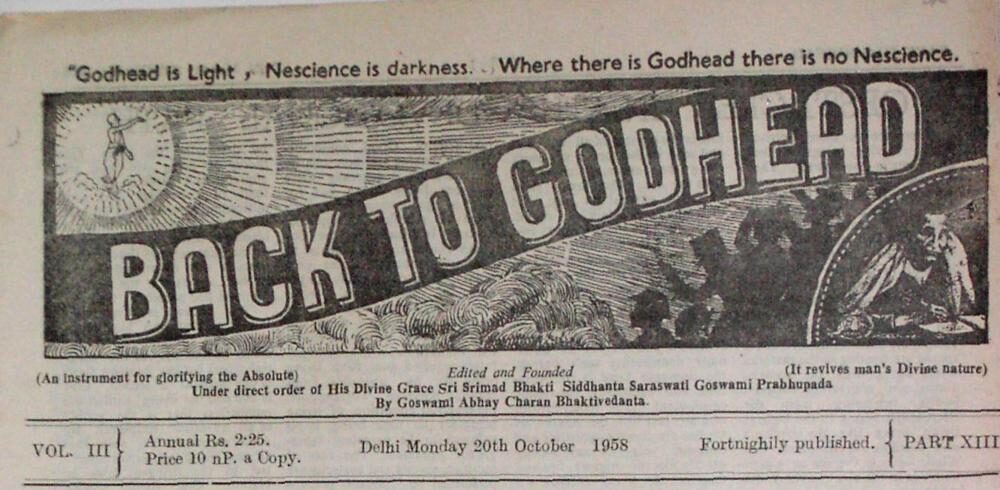
On 14 February 1944, the anniversary of Bhaktisiddhanta Sarasvati's appearance day, A.C. Bhaktivedanta launched the first issue of Back to Godhead. It was an English-language fortnightly presenting the teachings of Chaitanya Mahaprabhu. He had planned, written, and typed the manuscript himself on a manual typewriter. Then he ran into a wartime paper shortage. It was so severe that at first his chosen printer could not supply him at all. In the end he got permission to print a first issue of forty-four pages. The title stated its argument plainly. The purpose of human life is to turn the mind back toward Krishna, back toward Godhead. The first issue took on subjects as large as the causes of war and why material happiness is an illusion. He wrote it while Calcutta itself was under wartime blackout and, at times, air raids.
Stopped, Then Revived #
The magazine's money ran out almost at once. After only two issues, A.C. Bhaktivedanta had to stop printing for lack of money. He did not restart it for eight years. In February 1952, after moving his family to Allahabad, he began it again, but it soon stopped once more. At Jhansi, he tried to establish the League of Devotees with his first disciple, Acharya Prabhakar. But there he had no money to print it. He revived it only in 1956, in Delhi. Looking back on those years, he later wrote plainly to a disciple, "I was printing this paper and almost distributing free, and some of them were paying me subscription and some of them not. But I was trying my best at my cost" (letter to Rayarama, 12 June 1968).
No Staff, No Funding, No Shortcuts #
Whichever city he was working from, the work was always the same. He wrote nearly every article, edited the copy, dealt with printers, and then distributed the finished issues himself. There was no sales force. When he later printed and sold the magazine in Delhi, he would go from tea stall to tea stall, sometimes spending an hour or more just to sell a single copy. Whenever sales did not cover the costs, he bore the loss himself. He did this for most of two decades before he ever set foot in America. There, too, he would have to build a movement from nothing.
A Fortnightly That Became a Worldwide Institution #
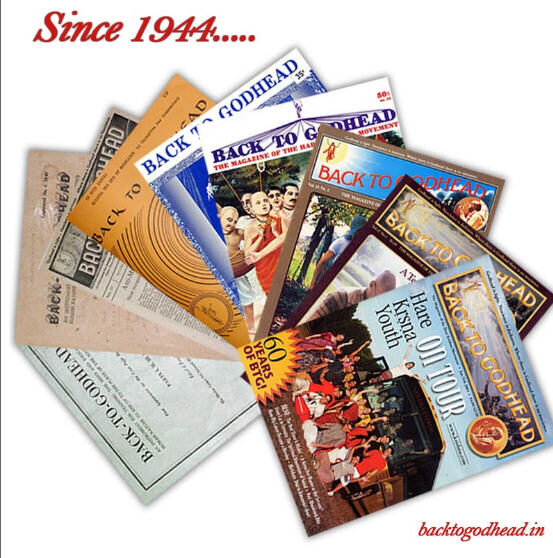
Back to Godhead survived every one of these interruptions. His followers started it once more in October 1966, soon after he founded his mission in New York. They printed the early American issues on a second-hand mimeograph machine, a simple kind of copier. Since then they have kept it in continuous print, and it is now issued in a range of languages. He never lost sight of what he wanted it to become. "I am awaiting for the day when this paper will take the shape of Life Magazine or similar other magazines, in the matter of its popularity," he wrote in 1968. Two years later he stated the goal even more strongly, saying that it "should be published not in hundreds and thousands, but in millions." The magazine is still one of the better-known parts of the large body of literature he built over his lifetime. These works are listed today on the Prabhupada books page. It began as one man's fortnightly. Again and again it stopped for lack of funds, and each time the same man's persistence started it again. In the end it outlasted every difficulty that threatened to end it.
