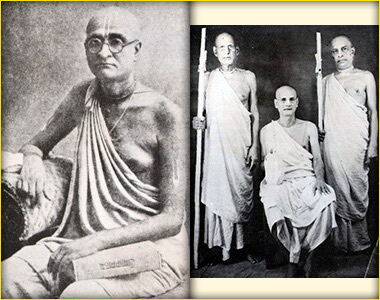
On 17 September 1959, A.C. Bhaktivedanta formally entered the renounced order of life, sannyasa. He took vows that would mark him for the rest of his days as a swami, not a householder. By then he was sixty-three. He had been in vanaprastha for nearly a decade, and for years he had been translating the Srimad-Bhagavatam, mostly alone. So this step was not really a sudden turn. His life was already stripped down to the essentials, and sannyasa made it stricter still. Vaishnava biographers trace the immediate decision to a dream. But the ceremony itself tells just as much about the man taking the vows, and so does a small, deliberate choice he made about his own name that day.
| Detail | Description |
|---|---|
| Date | 17 September 1959 |
| Location | Keshavaji Gaudiya Math, Mathura |
| Officiating godbrother | Bhakti Prajnan Keshava |
| Sannyasa name received | Bhaktivedanta Swami |
| Name he actually adopted | A.C. Bhaktivedanta Swami |
What Sannyasa Means in This Tradition #
Vedic society traditionally recognizes four ashramas, or stages of life: brahmacharya, the celibate student years; grihastha, married household life; vanaprastha, retirement from household duties; and sannyasa, complete renunciation. Sannyasa is the final and most demanding of these stages. It is a formal, public vow to give up home, family ties, and material possessions entirely. The sannyasi takes on the saffron cloth and a new name, which marks the break with the life that came before. In the Gaudiya Vaishnava tradition specifically, sannyasa is not mainly about going away to live alone. It carries a duty to preach. A sannyasi is expected to spend whatever years remain to him spreading Krishna consciousness as widely as his strength allows. He does not withdraw from the world. He goes out into it with nothing left to protect.
A Dream of Bhaktisiddhanta Sarasvati #
By 1959, Bhaktisiddhanta Sarasvati had been gone for more than two decades. Vaishnava biographers record that A.C. Bhaktivedanta, then in his early sixties, had a recurring dream. In it his departed spiritual master appeared to him as A.C. Bhaktivedanta had known him in life, a tall and scholarly sannyasi. Again and again Bhaktisiddhanta Sarasvati motioned toward the saffron cloth of the renounced order, showing that the time had come. On waking, A.C. Bhaktivedanta thought carefully about what the dream meant. He understood that he would be able to accomplish his spiritual master's mission only once he had taken sannyasa himself. He also understood that his earlier attempts, including the failed League of Devotees in Jhansi, had come before the time was right. Whatever one may think about dreams, this one had an immediate and practical effect on him. He moved to act on it without spending a long time deciding. Most disciples of his generation approached this step only after years of preparation, or at a much younger age.
The Ceremony at Keshavaji Gaudiya Math #
A.C. Bhaktivedanta turned to his godbrother Bhakti Prajnan Keshava. By then Keshava headed his own branch of the divided Gaudiya Math, the Keshavaji Gaudiya Math in Mathura. Keshava accepted the request without hesitation. On 17 September 1959, at that math, Keshava performed the sannyasa ceremony for A.C. Bhaktivedanta. He formally admitted him into the renounced order and gave him the name Bhaktivedanta Swami. The two men had studied under the same guru. Now one of them was sending the other into the last and most demanding stage of that guru's path. Vaishnava biographers also record a smaller, stranger detail from that same day. After the ceremony, A.C. Bhaktivedanta was gored by a bull in the marketplace. He chose to see the injury not as misfortune but as a kind of purification, marking his entry into the renounced order.
Why He Kept the Initials A.C. #
By custom, a new sannyasi sets aside his earlier name and takes the one given at the ceremony. A.C. Bhaktivedanta did not fully do this. His initials, A.C., stood for Abhay Charanaravinda. Bhaktisiddhanta Sarasvati had given him this name at his own initiation decades before. The name marked the beginning of his personal relationship with his guru. He did not let that name disappear into a new title. Instead, he placed the initials in front of his sannyasa name, becoming A.C. Bhaktivedanta Swami. He explained the choice as a matter of humility, and biographers have recorded his explanation. Even at this highest step of renunciation, he did not want the new title to look as though it stood on its own, cut off from the guru who had first named him. Keeping "A.C." kept that connection clearly visible in his own signature for the rest of his life. It was a small act. In effect, it said that whatever he had become still came from what his spiritual master had first made of him.
Bhaktivedanta Swami, Not Yet Prabhupada #
From 1959 onward, he was properly addressed as Bhaktivedanta Swami. He would carry this name through the remaining years in India and the first years of his mission in the West. "Prabhupada," the title of respect by which his followers know him today, would not come into common use among his disciples until 1968. Sannyasa cleared the way for what came next, in practical ways as much as spiritual ones. Three years later he would take up residence at the Radha-Damodar temple in Vrindavan to complete his translation of the Srimad-Bhagavatam. Within six years of taking these vows, he would be standing on the deck of a cargo ship bound for America. He was going to fulfil the order that had first come from Bhaktisiddhanta Sarasvati. Even in his own signature, he still refused to leave his guru behind. His full guru lineage and the wider Gaudiya sampradaya into which he was accepted are traced on the Prabhupada sampradaya page.
