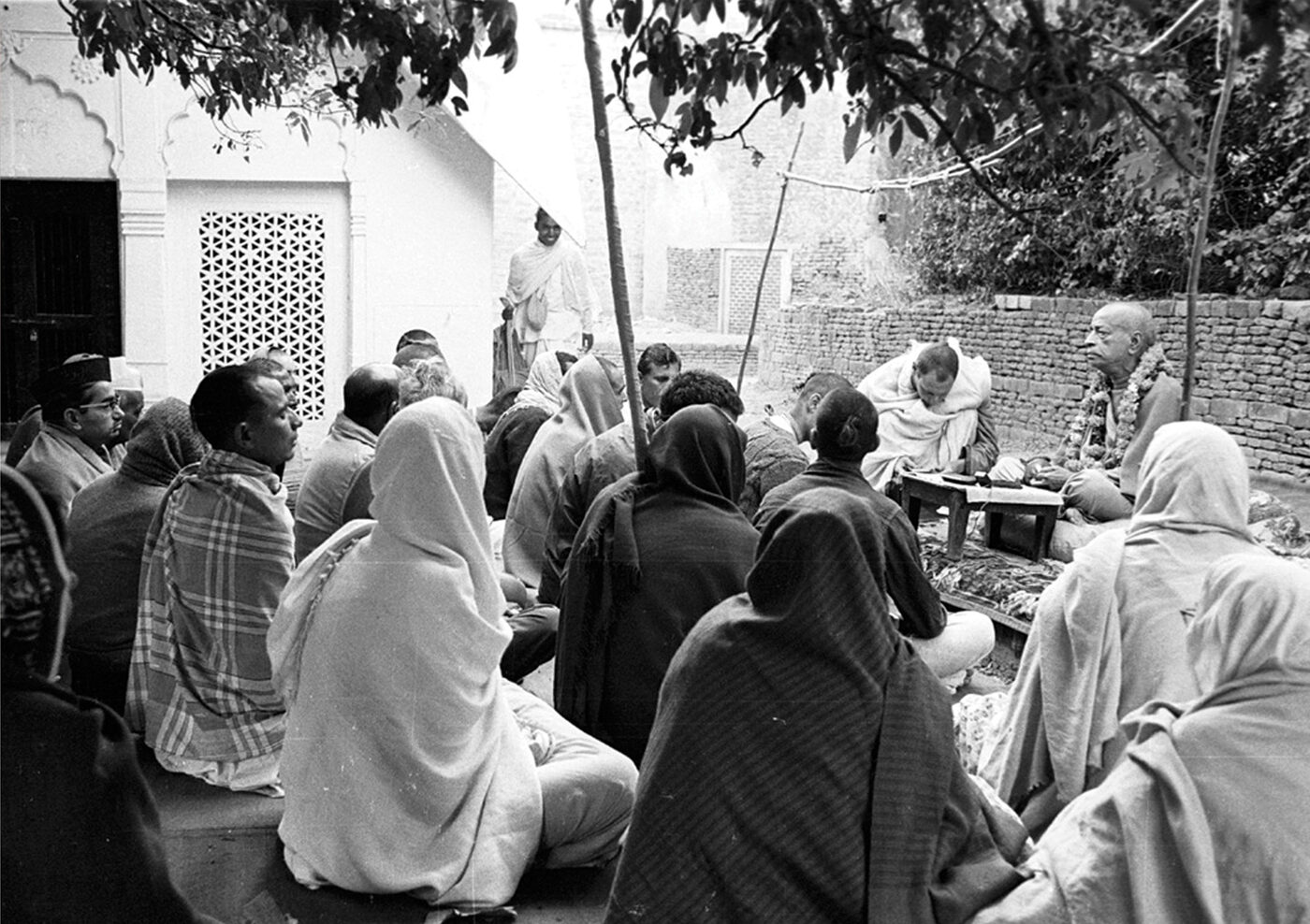
The teaching behind Prabhupada's twenty-six qualities of a Vaishnava is explained on another page. Here the question is simpler: what was he really like to be around? For a religious founder, an unusually large amount of first-hand material about this has survived. There are recorded lectures, hundreds of letters, and thousands of pages of written-down conversations. Much of it was recorded on tape by disciples who felt, rightly, that they were with someone whose words were worth recording.
| Detail | Description |
|---|---|
| Morning walk conversations | Recorded in many cities, 1968-1977 |
| "Life Comes From Life" discussions | With disciples Svarupa Damodara and Sadaputa, mid-1970s |
| Nightly writing routine | Rose near 1:00 a.m. to translate before the day's duties began |
| Disciples initiated in his lifetime | Nearly 5,000 |
The Morning Walk as Classroom #
Wherever he was in the world, Prabhupada took an hour-long walk early each morning. Disciples learned to treat it as the best hour of the day to ask him something. These walks were recorded and written down in city after city over nearly a decade. The talks range across Darwinism, the nature of consciousness, current events, and the failures of Western medicine. They also cover whatever a visiting scientist or scholar walking alongside him happened to raise. No topic was too small and none too large. A question about the stock market could be followed a few minutes later by a question about the soul, and he answered both in the same manner, without changing his tone.
Life Comes From Life #
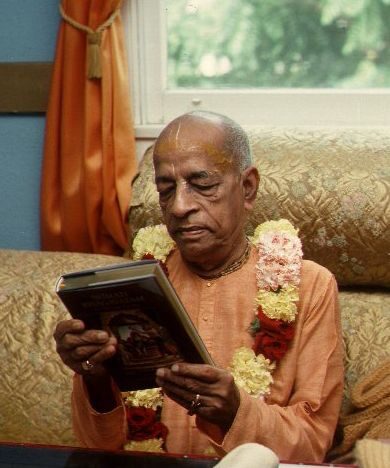
In the morning-walk and room conversations, one argument came up again and again, and it dealt very directly with the science of his time. Prabhupada challenged the claim that life could have come by chance from non-living matter. Two of his own disciples, Svarupa Damodara, a molecular biologist, and Sadaputa, a mathematician, spent years working with him on this question. In time they put their exchanges together in the book Life Comes From Life. One such session was a slideshow discussion recorded in Washington, D.C. on 3 July 1976. In it, Sadaputa explained the mathematical odds against life forming by itself by chance. Prabhupada then pressed a point he made in many forms elsewhere. Mind and consciousness, he said, cannot be explained as nothing more than the matter that is said to have produced them. And a universe run only by chance is no explanation at all.
The Chance Theory Is the Grace of God #
That same conversation also shows a side of him that is easy to miss in written accounts: a quick, quiet sense of humor. Disciples who lived with him describe this humor as always present in his teaching. Prabhupada read aloud a remark by the mathematician Carl Friedrich Gauss. Gauss described a proof coming to him suddenly, "not on account of my painful effort, but by the grace of God," and Prabhupada turned the scientist's own words against the argument for chance:
"So the chance theory is the grace of God... because if God sees that the rascal is trying for so many years, 'All right, give him a chance.'"
The transcript notes laughter in the room. It is a small moment, but it is real and exactly recorded. It also shows something about how he taught. He did not refuse to use an opponent's terms. Instead, he took those terms and turned them around against the opponent's own argument.
Discipline Before Dawn #
All of this conversation, teaching, and writing cost him great effort. For most of his years in the West, Prabhupada rose at around one o'clock each morning to translate and comment on the Srimad-Bhagavatam and his other books. He worked in the hours before the temple woke. Then he gave the rest of the day to disciples, visitors, and the affairs of a fast-growing international society. His health was often uncertain in his later life. But associates who watched this routine for years did not say that he was careless about his health. They said he firmly refused to let anything, even rest, come before the writing he considered the essential work of his life.
Firmness and Patience #
His standards were strict, but he did not shut people out. In 1976, at ISKCON's annual gathering in Mayapur, the Governing Body Commission passed resolutions that sharply limited the role of women and married householders in the society. Most members of the Commission at that time were sannyasis. Prabhupada heard both sides of the dispute and then overruled his own commission, calling the resolutions "fanaticism" and ordering them withdrawn. As so often with him, his reasoning was both blunt and welcoming to all:
"I cannot discriminate — man, woman, child, rich, poor, educated, or foolish. Let them all come, and let them take Krishna consciousness."
This helps correct any picture of him as only severe. He was strict enough to overturn a decision his own senior disciples had already passed. At the same time, he insisted that the door stay open to everyone.
A Companion Portrait #
None of this is a theological account of who Prabhupada was. That account, built from his twenty-six recorded qualities as a Vaishnava teacher, is given on the qualities page. The conversations and letters add something simpler. Anyone willing to read a morning-walk transcript or a private letter can get a sense of a real person. He was curious, disciplined, sometimes funny, and rarely in doubt about what he had come to the West to do.
