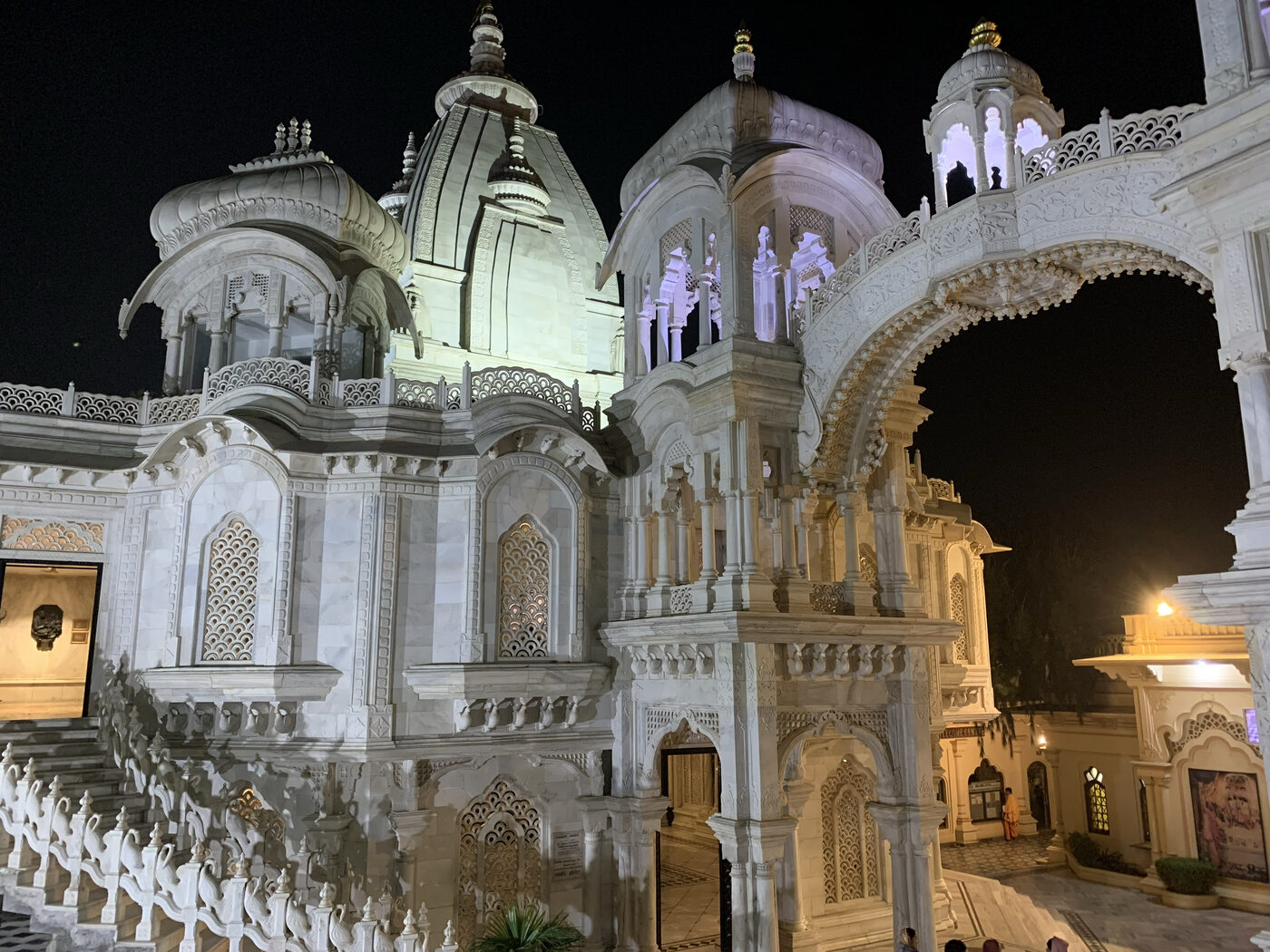
Prabhupada spent the last months of his life at the Krishna-Balaram Mandir in Vrindavan, the temple he himself had established. He was surrounded there by disciples who had come from every part of the world he had spent a decade crossing. His death, when it came, was not sudden, and he had prepared for it. For years he had been putting in place the institutions and the people meant to carry the mission forward without him. His final months were as much about finishing that work as about his own failing health.
| Detail | Description |
|---|---|
| Governing Body Commission established | 1970, twelve senior disciples |
| Eleven ritviks (representatives of the acharya) named to initiate on his behalf | Letter of 9 July 1977, Vrindavan, approved by Srila Prabhupada |
| Death | 14 November 1977, about 7:30 p.m. |
| Place | Krishna-Balaram Mandir, Vrindavan |
| Age at death | 81 |
| Samadhi | Built by followers in the temple courtyard |
A Commission Formed While He Was Still Active #
Prabhupada established the Governing Body Commission (GBC) in 1970, seven years before his death. At that time he was still travelling constantly and was in reasonably good health. The GBC was a group of twelve senior disciples given the duty of overseeing ISKCON's activities worldwide. The timing mattered. The society had grown from one storefront to temples on five continents. It could not go on forever running on the daily, personal instructions of a single founder. Prabhupada set up the GBC as ordinary careful planning for the future, not as an arrangement made on his deathbed. It was meant to work during his lifetime as much as after it. For years afterward he continued to step in directly in GBC affairs. At one point he suspended the entire commission, when he judged that its members were gathering authority into their own hands in ways he had not approved. This shows that from the beginning the GBC was a working part of his own management, not simply a plan for after his departure.
Drafting a Will, June 1977 #
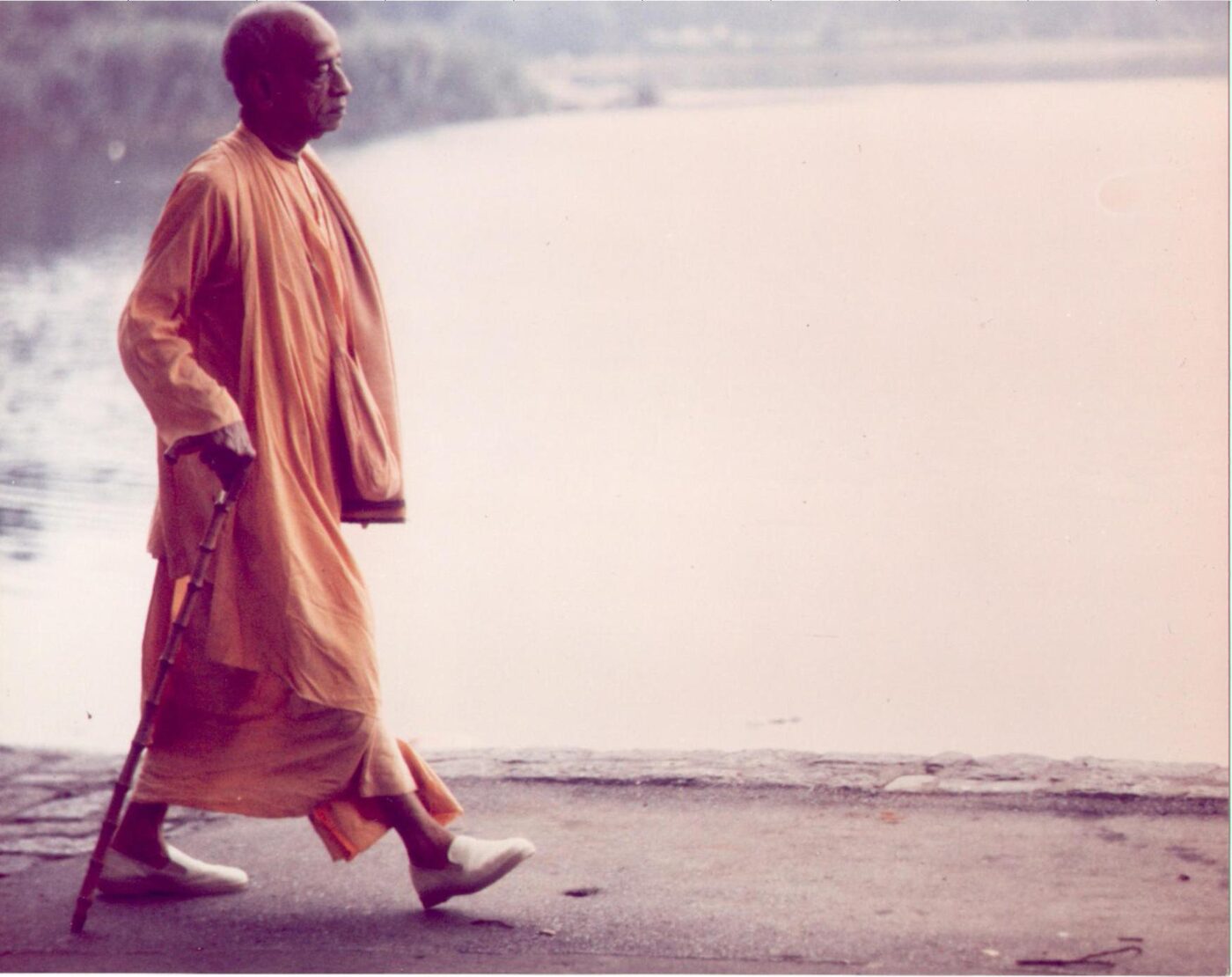
By June 1977, with his health failing, Prabhupada turned to the practical business of putting his affairs in writing. In a recorded conversation at Vrindavan that month, he worked through the wording of his will with several disciples. He insisted that the document should avoid legal words like "trust" and "trustees," because they might cause tax problems for the society as it was already organized. When one disciple suggested "supreme managers" instead, and another offered "ultimate executors," the discussion had some lighter moments, even on this serious occasion. In the end they settled on wording that named the Governing Body Commission as the society's ultimate managing authority over its temples and properties.
Eleven Ritviks: The Letter of 9 July 1977 #
On 9 July 1977, four months before his departure, a letter from Vrindavan to all GBC members and temple presidents, written by his secretary Tamala Krishna Goswami and marked "Approved: A.C. Bhaktivedanta Swami," set out the arrangement Srila Prabhupada had made for initiations. He named eleven senior disciples to act as "ritvik - representative of the acarya, for the purpose of performing initiations, both first initiation and second initiation": Kirtanananda Swami, Satsvarupa dasa Gosvami, Jayapataka Swami, Tamala Krsna Gosvami, Hrdayananda Gosvami, Bhavananda Gosvami, Hansadutta Swami, Ramesvara Swami, Harikesa Swami, Bhagavan dasa Adhikari and Jayatirtha dasa Adhikari. Temple presidents "may henceforward send recommendation for first and second initiation" to whichever of these representatives was nearest, and the representatives "may accept the devotee as an initiated disciple of Srila Prabhupada." The letter is explicit about whose disciples the new devotees are: "The newly initiated devotees are disciples of His Divine Grace A.C. Bhaktivedanta Swami Prabhupad, the above eleven senior devotees acting as His representative." In this letter Srila Prabhupada named ritviks to initiate on his behalf; it names no one as a guru to succeed him.
Declining Health at Vrindavan #
Through the second half of 1977, Prabhupada's health grew steadily worse. He stayed mostly in his room at the Krishna-Balaram Mandir, with disciples constantly attending him. As far as he was able, he continued to instruct those around him, dictate letters, and comment on his translation work, even as his physical strength failed. By his disciples' account, he had escaped death more than once in earlier years. They took this to be by Krishna's grace and by the strength of his own will to keep preaching. But by the autumn of 1977 he had begun deliberately preparing his followers for the end, instead of resisting it. Vaishnava biographers record a conversation from around this time. A young disciple's daughter had died in Vrindavan a few months earlier, and he was asked whether she had gone back to Godhead. Prabhupada answered that anyone who leaves the body in Vrindavan is liberated. Once November came, his own followers understood this remark as speaking of his own passing as well.
The Final Weeks #
There was a late plan to take Prabhupada by bullock cart to Govardhana Hill for the Govardhana-puja festival. It was cancelled the night before. Two of his disciples, Tamala Krishna and Bhavananda, had come to his bedside, clearly upset about the state of the road and the harm the journey might do to him. "You request me not to go?" Prabhupada asked, and he agreed at once to stay. Before this, he had spent the evening with a visiting renounced Vaishnava, Niskincana Krishnadasa Babaji, chanting and talking quietly in Bengali. When Tamala Krishna admitted that Prabhupada's care for them "simply deepens our attachment every moment," Prabhupada answered simply, "It is my duty," and then he turned to the Babaji and added, "just see how much affection they have for me." On the evening of 14 November 1977, his attending physician asked him whether there was anything he wanted. Prabhupada answered faintly, in Hindi, kuch ichha nahin: "I have no desire." He died in his room at the Krishna-Balaram Mandir at about 7:30 that evening, at the age of eighty-one, after a long illness.
The Samadhi in the Temple Courtyard #
Following Gaudiya Vaishnava custom, Prabhupada's disciples laid his body to rest within the grounds of the Krishna-Balaram Mandir. Over the site in the temple courtyard they built a marble samadhi, a memorial shrine. It is still a place of daily worship and pilgrimage in Vrindavan today, and one of several such shrines to him around the world. The story told here, from a single storefront in New York to more than a hundred temples on six continents, comes to its close in this place. A fuller year-by-year account of his life is available elsewhere.
