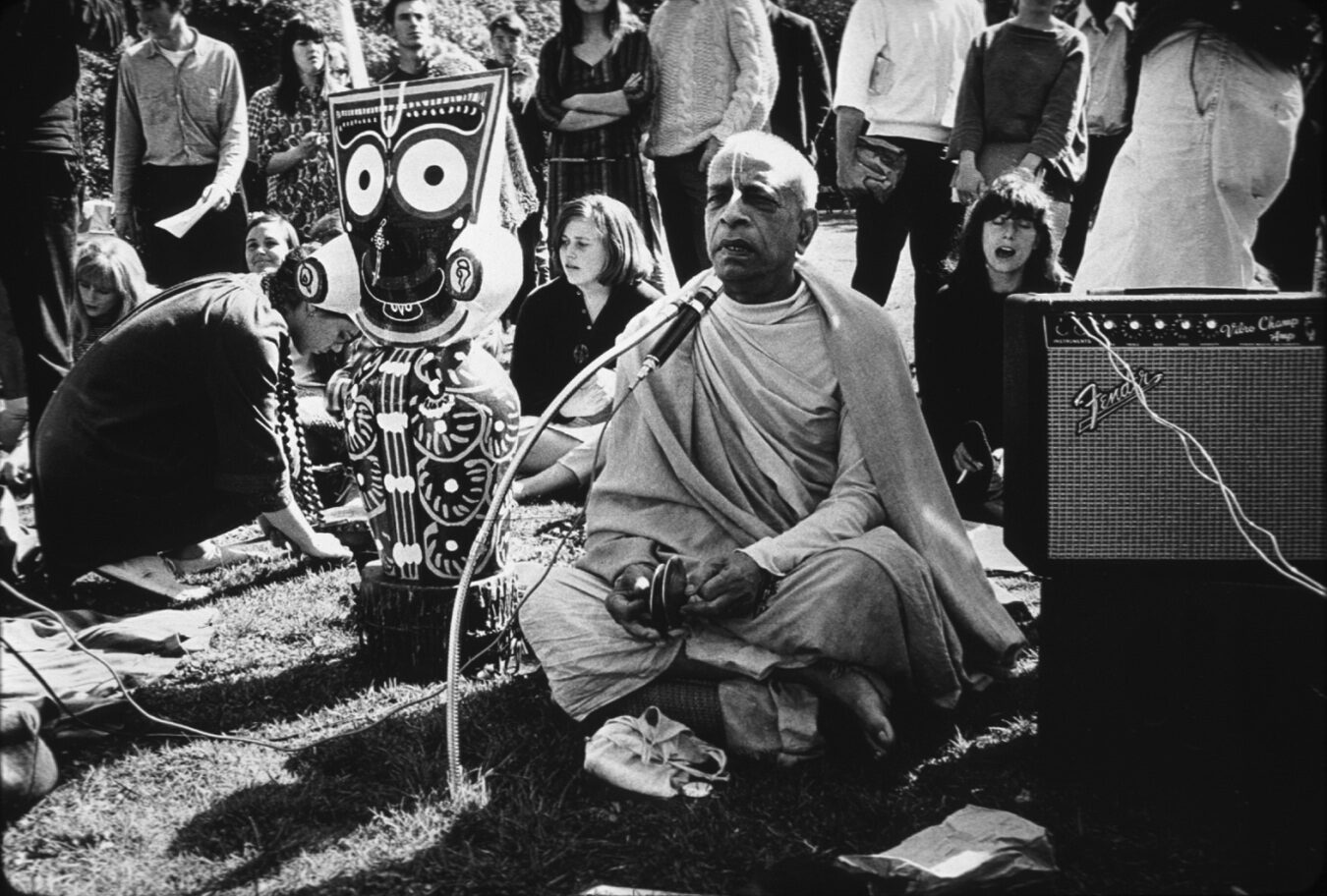
By the summer of 1966, Bhaktivedanta Swami had been in New York for the better part of a year, chanting under a tree in Tompkins Square Park and lecturing from a rented storefront on the Lower East Side. What had begun as one elderly Vaishnava monk with a trunk of books was starting to draw a following of young Americans. The next two years turned that following into an institution, then into a movement with outposts on both American coasts.
| Detail | Description |
|---|---|
| ISKCON incorporated | July 1966, New York |
| First temple | 26 Second Avenue, "Matchless Gifts," Lower East Side |
| Krishna Consciousness album | December 1966, released on the Happening label |
| Bhagavad-gita As It Is completed | Mid-January 1967 |
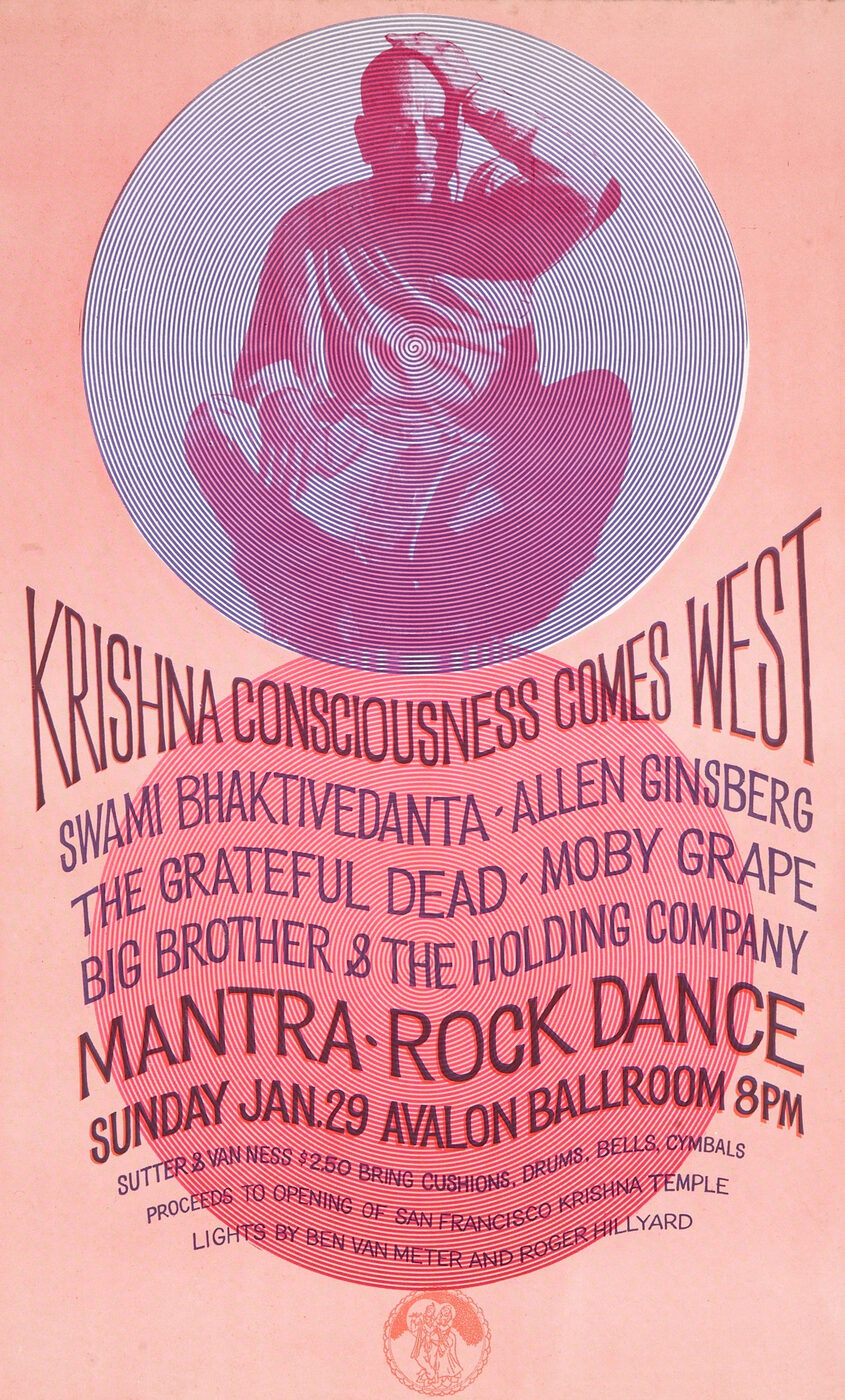
| Mantra-Rock Dance | 1967, Avalon Ballroom, San Francisco, roughly 3,000 attendees |
| First Western Ratha-yatra | San Francisco, 1967, a flatbed truck standing in for Puri's chariots |
| "Prabhupada" adopted as name | From mid-1968 |
Incorporating the Society #
In July 1966, Bhaktivedanta Swami formally incorporated, or legally registered, the International Society for Krishna Consciousness in New York. The storefront at 26 Second Avenue, a former curiosity shop called Matchless Gifts, had already been serving as an informal temple for months. It held evening classes on the Bhagavad-gita and kirtan of the Hare Krishna mantra. A Sunday kirtan under a tree in nearby Tompkins Square Park had already drawn a small crowd and a mention in The New York Times, which reported fifty followers clapping and swaying "to find ecstasy." Registering the society gave it a legal name and a founding document. But at first daily life changed very little. There was still one small room, and a handful of young Americans learning to sit through a lecture. And there was one teacher who was determined that the society would exist in more than name only.
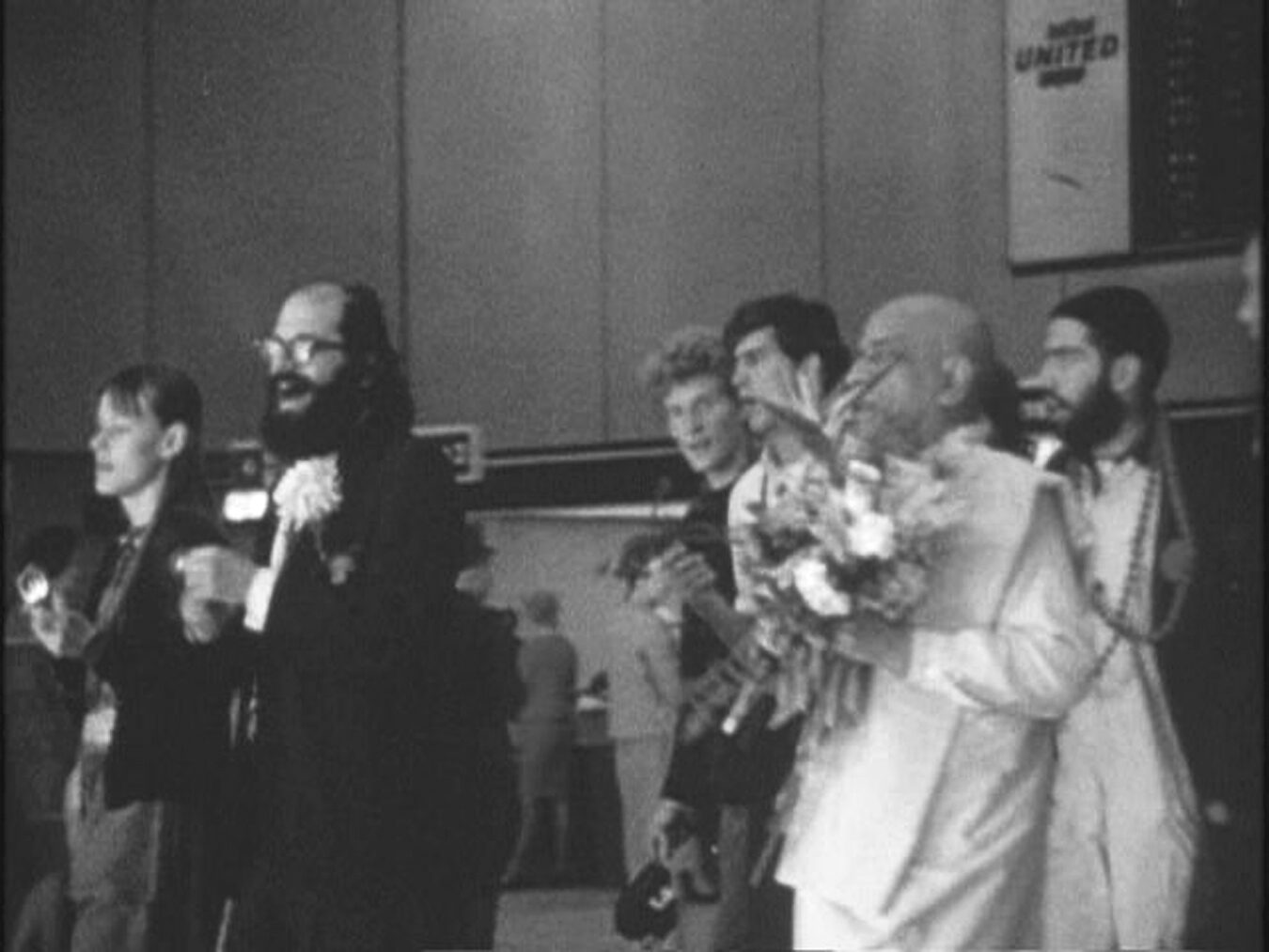
Bhaktivedanta Swami asked those who wanted formal initiation to accept four regulative principles, a discipline sharply at odds with the counterculture around them:
- No eating of meat, fish, or eggs
- No gambling
- No intoxicants, including tea, coffee, alcohol, and drugs
- No sex outside of marriage
Along with the vow came a daily commitment to chant sixteen rounds of the Hare Krishna mantra on a strand of 108 beads. Nineteen people accepted initiation on these terms in the first year alone.
An Album on the Happening Label #
In December 1966, Bhaktivedanta Swami recorded an album of Krishna kirtan together with a short spoken introduction. It was released as Krishna Consciousness by a small record label called "Happening." By any business standard it was a small production. But it carried the maha-mantra beyond the Lower East Side and spread it among the young people of the counterculture of that time. At that moment the movement had almost no other way to reach people who had never walked past the storefront. So the album helped the movement in its earliest spread.
Teaching by Example #
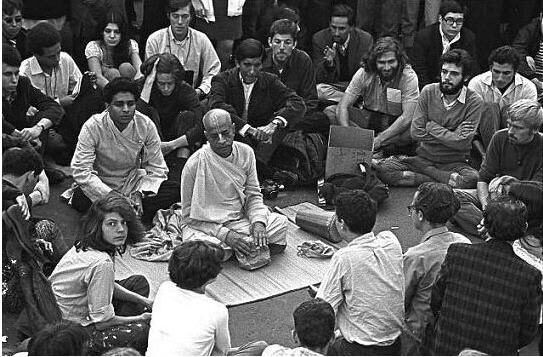
He had only a few followers and almost no organization, so Bhaktivedanta Swami taught everything himself, in person. He showed his first disciples how to cook and offer food to Krishna, how to collect donations, and how to chant the maha-mantra on the street instead of waiting for people to come to them. He also put them to work on his own writing. They typed his manuscript for the second canto of the Srimad-Bhagavatam as he produced it. In this practical way the society's first habits and customs were formed, before any of them were written into a rulebook.
Completing Bhagavad-gita As It Is #
By mid-January 1967, Bhaktivedanta Swami had finished his translation and commentary on the Bhagavad-gita, a project he had carried with him from Vrindavan to New York. There was still no publisher. There was no guarantee that any publishing company would take on a full Gita with long explanations from an unknown swami running a storefront mission. Still, he asked one of his new disciples to find a publisher. This started a search that in time placed the manuscript with the Macmillan Company. Macmillan brought out a shortened Bhagavad-gita As It Is in 1968. Four years later, it brought out the complete edition, with every verse and purport included.
A Second Temple in Haight-Ashbury #
In 1967, the society opened a second center, this one in San Francisco. It was in the middle of the Haight-Ashbury district, at the time when that area was most famous for its counterculture. The location proved very important for the movement's growth. A community there had already rejected the world around it and was searching for something spiritual in its place. Now, a few blocks from its own gathering places, it found a real temple with a real teacher. San Francisco quickly became a second center alongside New York. It was here that the public view of the movement changed most sharply.
The Mantra-Rock Dance #
To draw attention and raise funds for the new San Francisco temple, Bhaktivedanta Swami's disciples organized a concert at the Avalon Ballroom. It brought together his own kirtan and performances by the Grateful Dead and other rock bands of the time. The Mantra-Rock Dance drew an estimated 3,000 people. The storefront mission in New York could hardly have imagined such an audience a year earlier. For many who attended, it was their first sight of the elderly monk chanting the Hare Krishna mantra. For the local press, it made the temple, for a short time, the most talked-about address in the neighborhood.
San Francisco's First Ratha-yatra #
Later that year, Bhaktivedanta Swami's San Francisco followers organized the first Ratha-yatra festival held in the West. Every year in Puri, the deities of Jagannatha are carried through the streets on three huge wooden chariots. In San Francisco, a flatbed truck fitted with four pillars and a canopy took the place of those chariots. In a way, it was a return to his own childhood. Vaishnava biographers record that Abhay had staged his own miniature version of the same festival as a six-year-old in Calcutta, persuading his father to have a small chariot built for him. More than sixty years later, he brought the real festival to the opposite side of the world, even though its first American form was modest. Ratha-yatra would go on to become one of ISKCON's best-known public events in cities everywhere. The fuller story of the society's spread across the globe continues from here.
From Swamiji to Prabhupada #
Through 1967 and into 1968, his followers addressed Bhaktivedanta Swami simply as "the Swami" or "Swamiji." From the middle of 1968 onward they began instead to call him "Prabhupada," a title of respect traditionally reserved for a teacher at whose feet even other teachers sit. The new form of address showed how far the mission had come since the storefront. He was no longer only a swami visiting from India. He was now the founder-acharya of a fast-growing worldwide society, and his disciples knew him by the title that history would remember.
