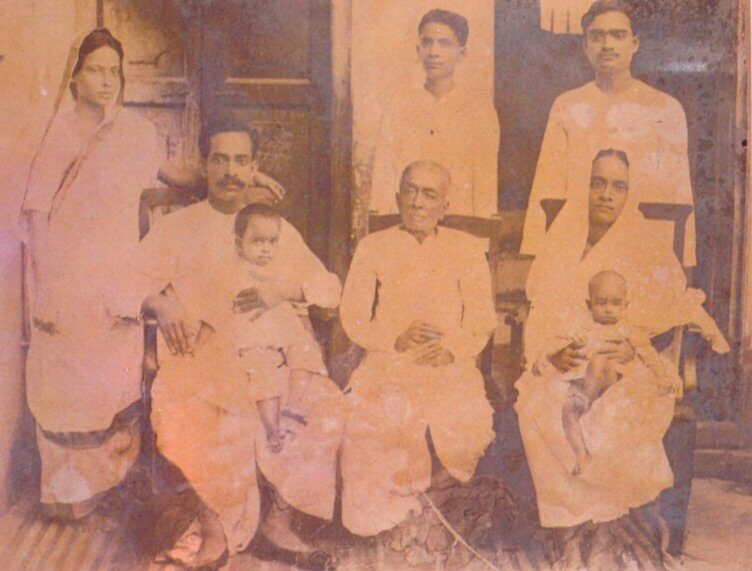
In 1918, while still a student, Abhay was married by his father's arrangement to Radharani Datta, also from an aristocratic Calcutta family. The marriage would later produce five children. It ran alongside a pharmaceutical career that took the family from Calcutta to Allahabad. In this way Abhay built an ordinary life of family and business. But all through it, he kept thinking privately about one meeting, which had already begun to change his sense of what mattered most.
| Detail | Description |
|---|---|
| Married | 1918, while a college student |
| Wife | Radharani Datta |
| Children | Five, born over the course of the marriage |
| First employer | Bose's Laboratory, Calcutta |
| Own business | Prayag Pharmacy, Allahabad, from 1923 |
An Arranged Marriage in 1918 #
In 1918, while still a student at Scottish Church College, Abhay was married to Radharani Datta in a match arranged entirely by his father. Gour Mohan spent a long time considering suitable families before he chose the Dattas. They were an aristocratic family connected to the Mulliks, the same merchant relatives who supported the neighborhood's Radha-Govinda temple. Radharani was eleven years old at the time of the marriage. This followed the custom of the time, which was to arrange a daughter's marriage well before puberty. The couple would not begin living together as husband and wife until several years later. Over the following years the marriage produced five children.
A Reluctant Bridegroom #
By his own later account, Abhay had not been keen on his father's choice. He had privately considered another match. He obeyed Gour Mohan out of duty to his father, not out of affection. For some time afterward he remained open with his father about his unhappiness. At one point he explored whether he might take a second wife, which society then allowed. Gour Mohan discouraged him directly. He told his son that it was Krishna's mercy that his wife did not entirely please him. Too much attachment to family life, he said, would only work against his future progress in spiritual life. Abhay accepted his father's advice, and the marriage continued on those terms. It was a working household partnership, not a romantic one. In time the household came to include his aging father, a widowed sister, and her son.
Bose's Laboratory and a Trusted Hand #
In 1920 Abhay had given up his college diploma as a gesture of support for Gandhi's non-cooperation movement. Now he needed a job, and it was Gour Mohan who found one for him. Dr. Kartick Chandra Bose was a family friend and a surgeon. He was one of the first Indians to manufacture medicines that, until then, only European firms had made. He took Abhay on as a department manager at his Calcutta firm, Bose's Laboratory. At first Abhay knew little about the business, and some longtime employees resented having a young manager placed above them. But Dr. Bose personally spoke up for him and trusted him with accounts worth tens of thousands of rupees. Abhay spent his early twenties here, handling account books and shipments, not scripture. In these same years, in 1922, he first met the man who would become his spiritual master. That meeting is described in Meeting His Spiritual Master.
Prayag Pharmacy in Allahabad #
In 1923 Dr. Bose proposed that Abhay become his sales agent for northern India. The two chose Allahabad as his base. It was a well-connected railway centre at the meeting place of the Ganges, Yamuna, and Sarasvati rivers. Abhay moved his young family there and opened a small medicine shop, Prayag Pharmacy. It sold medicines and tinctures made by Bose's Laboratory. He brought in a local doctor, who wrote prescriptions that Abhay then filled, and the two of them shared the income. Business was steady enough that Abhay bought a car. For several years he traveled constantly by train across northern India to find new customers, and he gave most of his energy to growing the pharmacy's business.
Customers Named Nehru #
Motilal Nehru and his son Jawaharlal were among the regular customers at Prayag Pharmacy. At that time they were rising figures in the Congress movement, and they lived in the wealthy part of Allahabad. Abhay noted that Jawaharlal always preferred Western-manufactured medicines to Indian ones. Once Jawaharlal asked him for a political donation, and Abhay gave it as a matter of ordinary courtesy. The detail is small, but it tells us something. For a decade, the future founder of a worldwide Vaishnava mission lived as an ordinary small-town pharmacist. He filled prescriptions for the family that would one day lead independent India. At that time there was no sign yet of what either man's life would become.
Business by Day, Krishna Consciousness Within #
Abhay kept strict Vaishnava eating rules throughout these years, even while traveling. When business required it, he dressed in an ordinary Western shirt and trousers. Still, at hotels he refused meat, onions, garlic, and mushrooms, though the hotels assumed a traveling salesman would not object. Colleagues who knew him at the time remembered a business-minded man who spoke often of family expenses and profit margins. Yet he also kept a small home temple. But Abhay had not forgotten the meeting on a Calcutta rooftop in 1922. He kept thinking back on it during his long train journeys between accounts. The pharmacy years did not really take him away from that meeting. Instead, the meeting slowly worked on him against the pull of his ordinary family and business life. In time this tension would be resolved in formal discipleship, as told in The Order to Preach in English.
