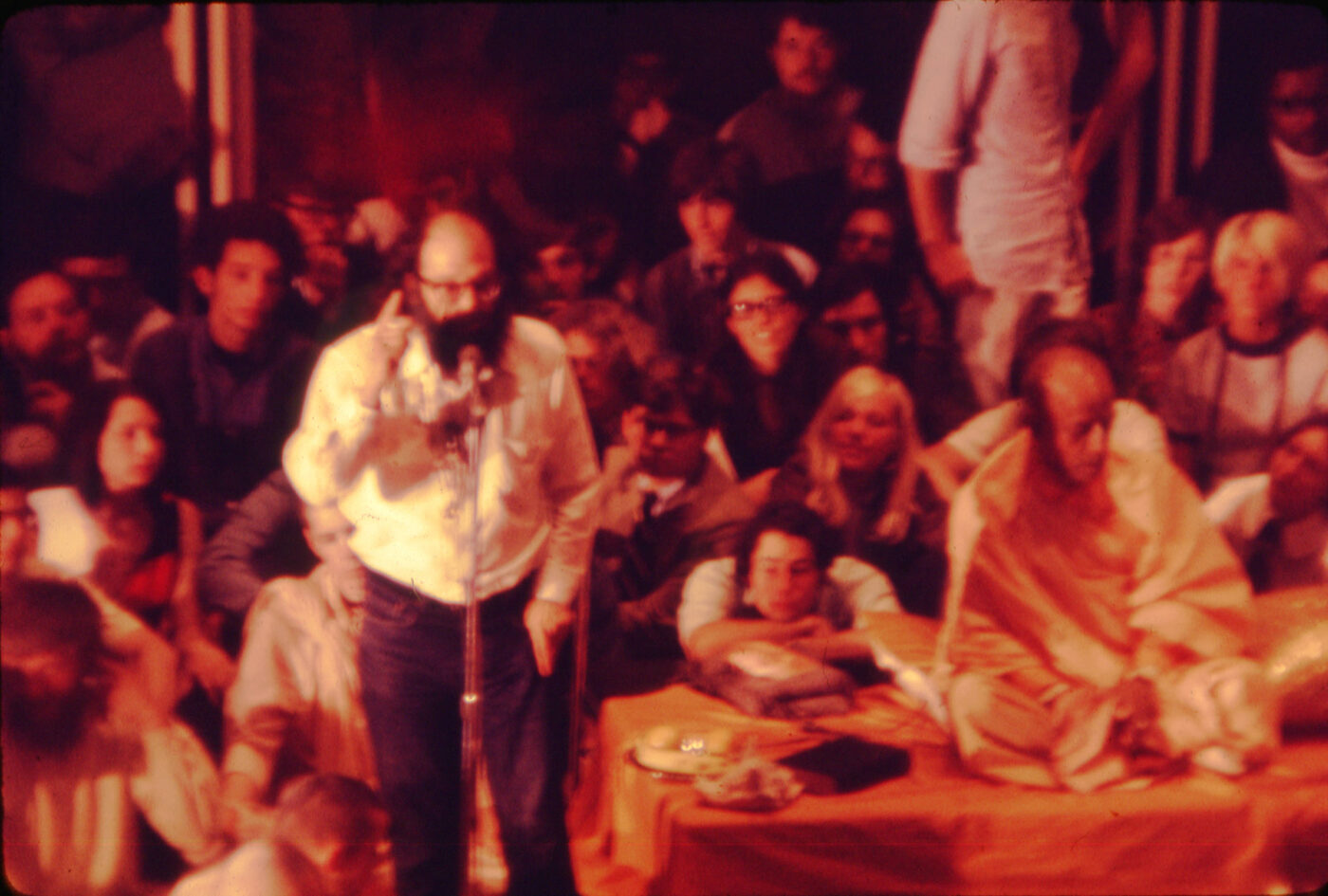
With temples established on both American coasts, Prabhupada turned outward. Over the next decade he sent disciples to open centers on every inhabited continent. He himself travelled constantly to visit them. He installed deities, trained leaders, and met anyone who might help carry Krishna consciousness further, from rock musicians to heads of government. What follows is not one single story. It is a tour of the world, region by region, following a movement that grew almost as fast as one man could keep up with it.
| Detail | Description |
|---|---|
| London temple opened | 1968, by three married couples sent from America |
| "Hare Krishna Mantra" single | August 1969, Apple Records, produced by George Harrison |
| First-day sales / UK chart peak | 70,000 copies sold the first day; reached No. 11 |
| Bhaktivedanta Manor | Donated 1973, a 17-acre estate near London formerly called Piggotts Manor |
| First visit to Kenya | 1970 |
| Visit to Moscow | 20-25 June 1971 |
| Bhaktivedanta Book Trust founded | 1972 |
A Temple in London #
In 1968, Prabhupada sent three married couples among his disciples to open a temple in London. Dressed in their robes and saris, they began chanting the Hare Krishna mantra regularly on the city's streets. It worked exactly as it had in New York and San Francisco: passersby stopped, and then newspapers noticed. Headlines like "Krishna Chant Startles London" and "Happiness is Hare Krishna" made the young London center well known within its first year.
George Harrison and the Radha Krishna Temple #
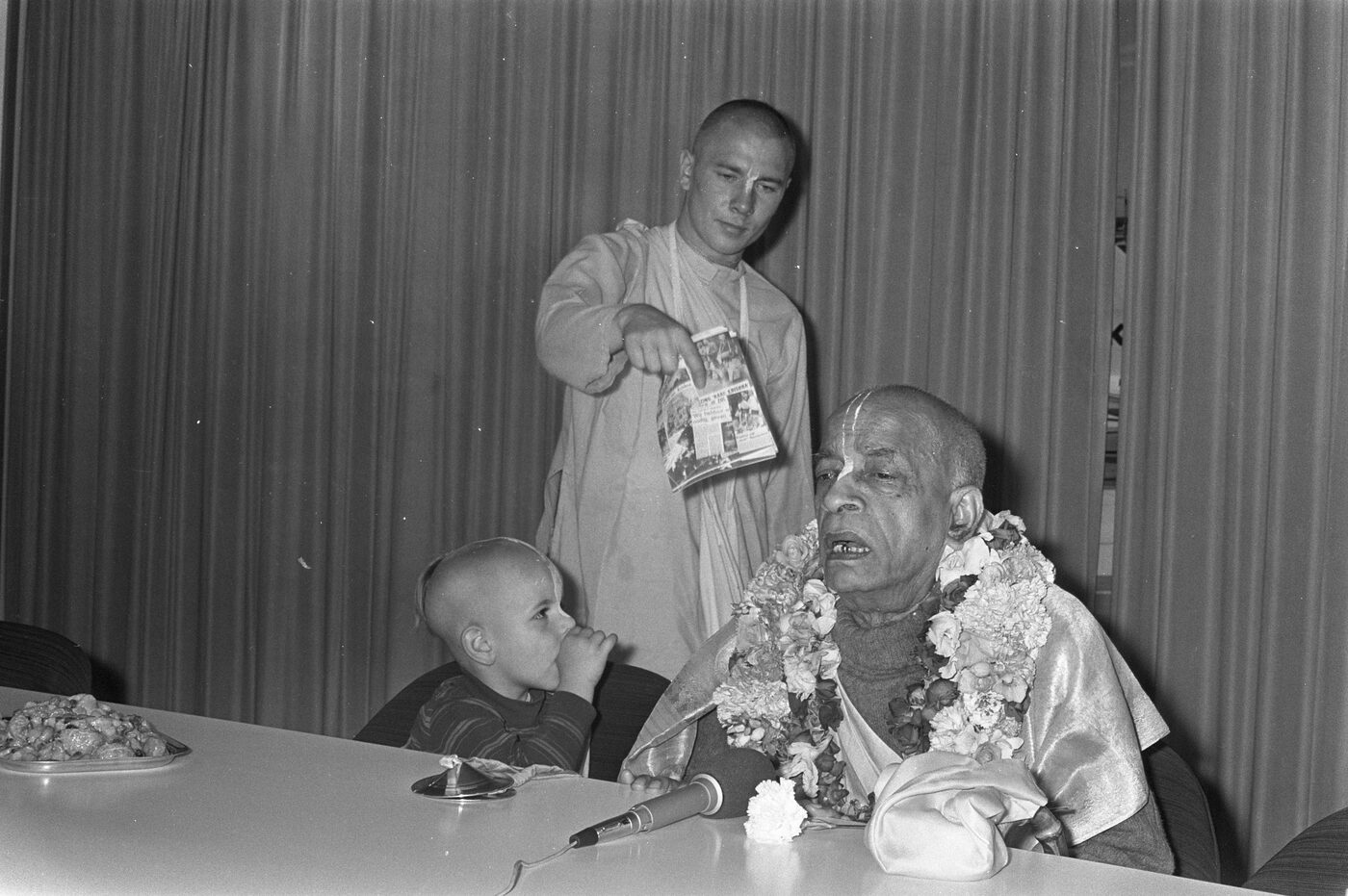
The London temple's most important connection was with George Harrison of the Beatles. Harrison had already come to know the maha-mantra through Prabhupada's earlier New York recording. In August 1969, Harrison produced a single of the Hare Krishna mantra sung by the London disciples, who recorded under the name The Radha Krishna Temple. He released it on the Beatles' own Apple Records label. The single sold 70,000 copies on its first day, climbed to number 11 on the British charts, and put the disciples on the BBC's Top of the Pops four separate times. It also entered the music charts in Germany, the Netherlands, France, Sweden, Yugoslavia, and Czechoslovakia, as well as South Africa and Japan. This was a surprising reach for a devotional chant that had no tune written for radio.
Meeting the Beatles #
In December 1969, encouraged by the single's success, the London disciples met the Beatles in person, when the group was at the height of its fame. At Apple's own press conference, Harrison told reporters that the Hare Krishna mantra was not a pop song at all. He said it was an ancient chant that awakened spiritual bliss in anyone who sang and heard it. In 1969 it was unusual for a rock star to say this publicly. The following year, 1970, Harrison produced a further single with the disciples, "Govinda," and in May 1971 a full album, The Radha Krishna Temple. He also sponsored the publication of Prabhupada's book Krishna, the Supreme Personality of Godhead. He paid for printing it as a full-color book. Without his help, neither the society nor an unknown publisher would have taken that risk.
A Gift Called Bhaktivedanta Manor #
Harrison's help reached its high point in 1973. That year he gave the society a 17-acre estate northwest of London, which had been known as Piggotts Manor. Devotees turned the property into a temple and ashram and renamed it Bhaktivedanta Manor in Prabhupada's honor. It is still one of ISKCON's best-known centers outside India. It is a country estate, given by a rock musician to a swami whom he had never expected to meet when he first sang along to a record.
Across Continental Europe #
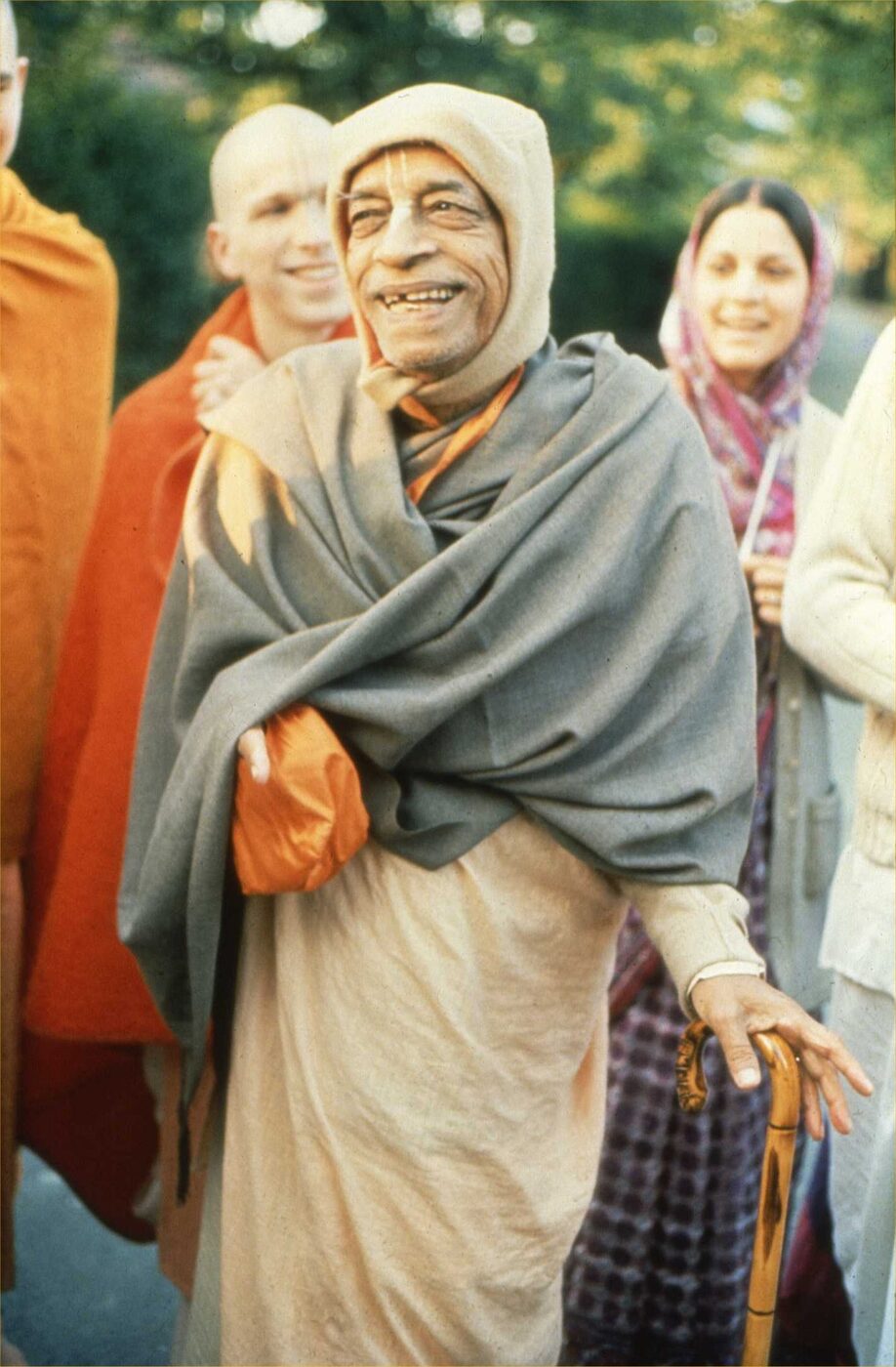
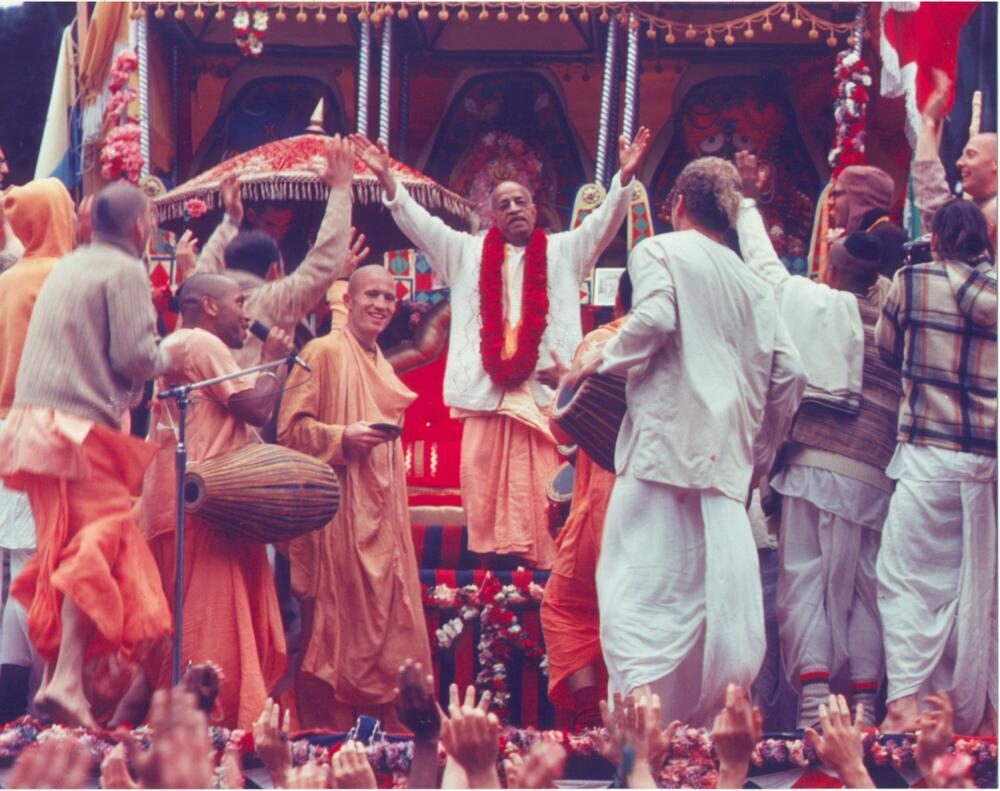
London became a base for Prabhupada's travels in Europe. Over the following years he travelled again and again through Germany, France, Italy, Sweden, Switzerland, and the Netherlands. He led kirtan, installed deities in new temples, and met scholars, religious leaders, and anyone else curious enough to come and meet him. Each visit followed roughly the same pattern that had worked in New York and London: chanting in public, a lecture, a temple left a little stronger than he had found it, and then travel on to the next city.
First Journeys to Africa #
Prabhupada made his first visit to Kenya in 1970, the earliest of several. He found that the disciples he had sent there had been running spiritual programs mainly for the local Indian community. He insisted that the mission should also reach out to Africans directly. On one occasion in Nairobi, he was scheduled to speak at an Indian Radha-Krishna temple in a mostly African part of the city. He ordered the doors to be thrown open. The hall filled with local residents, and he held kirtan and spoke to them as he would to any other audience. He later visited Mauritius and South Africa as well, and sent disciples to open missions in Nigeria and Zambia.
Into the Soviet Union #
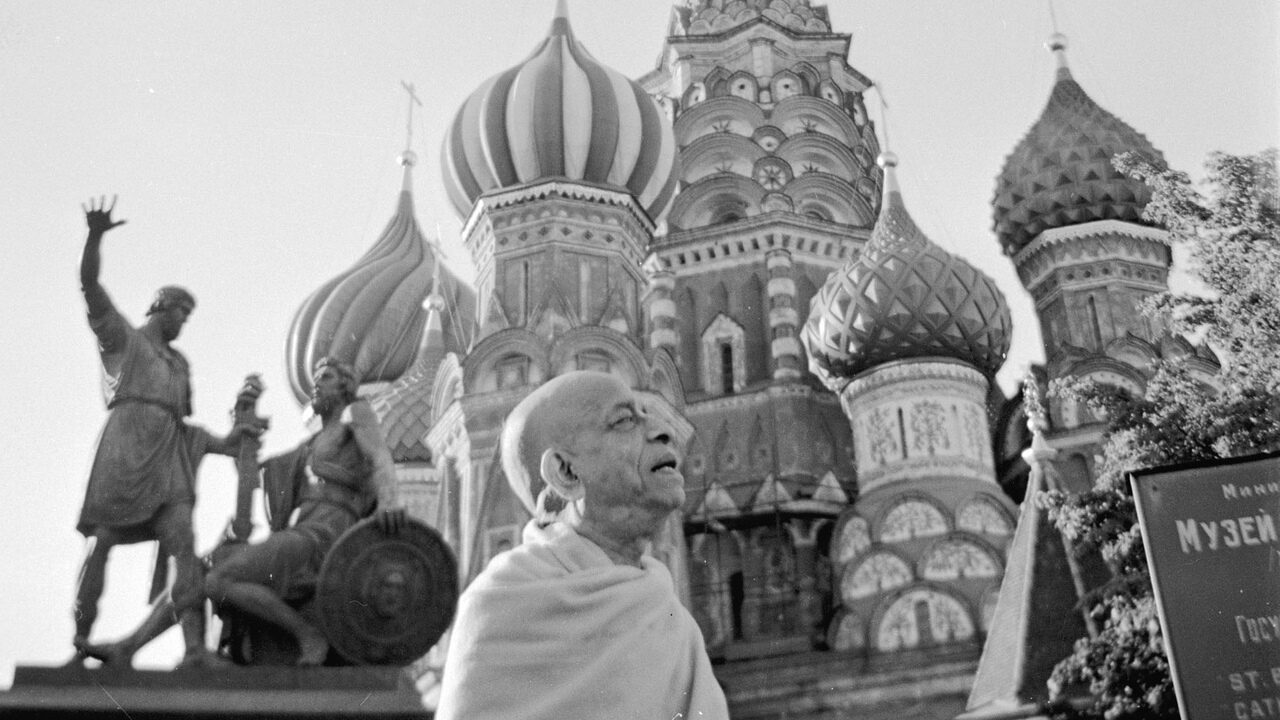
Prabhupada spent five days in Moscow, from 20 to 25 June 1971. This visit marked the start of Krishna consciousness in the Soviet Union. The Soviet state had no room for new religious movements, and during the visit he managed to meet only two Soviet citizens. One was an academic named Grigory Kotovsky. The other was a twenty-three-year-old Muscovite, Anatoly Pinyaev, who was introduced to him through the son of an Indian diplomat stationed in the city. Pinyaev went on to become the first Soviet Hare Krishna devotee. He translated Prabhupada's Bhagavad-gita into Russian and secretly distributed hand-copied editions. Because of this work, he was later forced to spend years shut up in a Soviet psychiatric hospital.
Mayapur and Vrindavan #
From 1970 onward, Prabhupada turned much of his personal attention back to India. He arrived with a party of Western sannyasis and other disciples, and spent much of the next seven years establishing temples in Bombay, Hyderabad, and elsewhere. Two centers mattered most. The first was Mayapur, in West Bengal, the birthplace of Chaitanya Mahaprabhu. There he built what would become ISKCON's world headquarters. The second was Vrindavan, where he established the Krishna-Balaram Mandir. Indians were used to seeing their own culture imitate the West. Now they saw the opposite happening on Indian soil: American and European monks in robes. The sight made a strong impression, even far beyond the society's own membership.
The Bhaktivedanta Book Trust #
In 1972, Prabhupada founded the Bhaktivedanta Book Trust to manage the publication and worldwide distribution of his own writings. For the first time, the Trust gave the movement a steady organization to keep his books in print as fast as his writing required. It is still the official publisher of everything he wrote.
Circling the Globe #
In the last twelve years of his life, Prabhupada circled the world more than a dozen times. He moved almost without rest between the temples he had founded and the ones he still meant to found. The personal side of that busy schedule is easier to see in his conversations and letters than in any list of cities visited. But the list itself gives some idea of what twelve years of continuous travel really meant for a man in his seventies: London, Nairobi, Moscow, Mayapur, and dozens of places in between.
