In 1950, A.C. Bhaktivedanta stepped back from the responsibilities of household and business life and accepted vanaprastha. In Vedic society, this is the traditional retired order that comes between the life of a householder and full renunciation. But what followed was not a quiet retirement. The next fifteen years brought setbacks, one venture that collapsed, and finally the enormous task, done mostly alone, of translating the main scripture of Gaudiya Vaishnavism into English.
| Detail | Description |
|---|---|
| Order accepted | Vanaprastha, 1950 |
| Residence | Vrindavan, with occasional trips to Delhi |
| Editorial work | Gaudiya Patrika magazine, for godbrother Bhakti Prajnan Keshava |
| Failed venture | The League of Devotees, Jhansi, 1952 |
| Residence, 1962-1965 | Radha-Damodar temple, Vrindavan |
| Work undertaken | English translation and commentary on the 18,000-verse Srimad-Bhagavatam |
| First Canto published | Three volumes, in 1962, 1964, and 1965 |
Entering Vanaprastha (1950) #
Vanaprastha releases a person from the daily duties of maintaining a household so that the final years of life can be turned toward spiritual practice and preparation. A.C. Bhaktivedanta took up this order in 1950 and moved to Vrindavan, the town devotees regard as the site of Krishna's earthly pastimes, living simply and without the business affairs that had occupied him for decades. He continued to commute occasionally to Delhi, but Vrindavan, not Calcutta, was now his base.
Editing the Gaudiya Patrika #
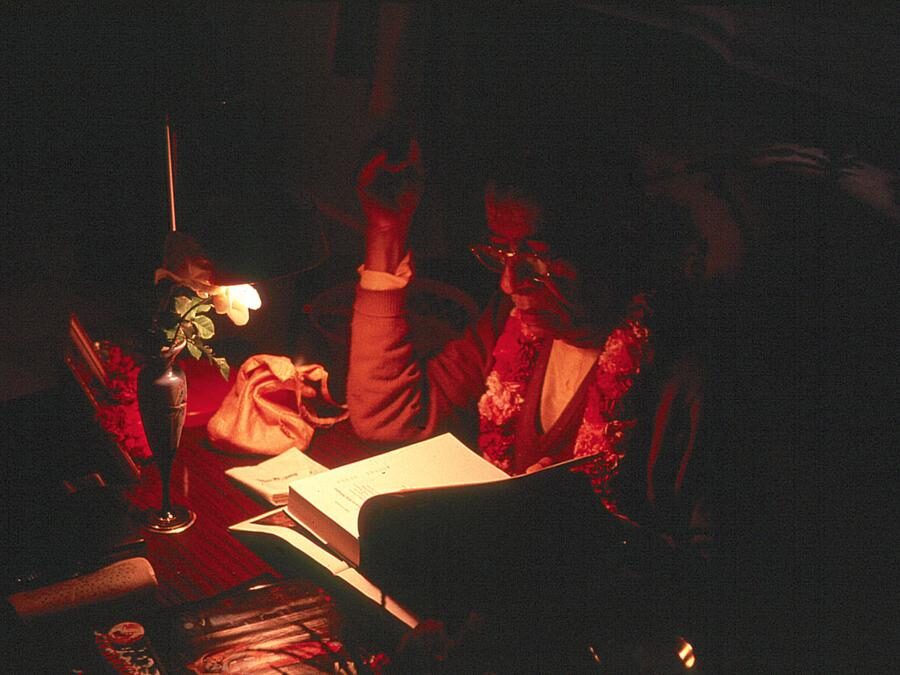
In nearby Mathura, he wrote for and edited the Gaudiya Patrika, a magazine published by his godbrother Bhakti Prajnan Keshava. He used the same natural gift for editing that he had already shown with Back to Godhead a few years earlier. But now he used it for a godbrother's magazine instead of his own. This work kept him connected to the wider community of Bhaktisiddhanta Sarasvati's disciples, which had broken into groups. He stayed connected in this way even though he lived outside all of their institutions.
The League of Devotees in Jhansi (1952) #
In 1952, A.C. Bhaktivedanta attempted something more ambitious. He wanted to build an organized society of devotees in Jhansi, a city in central India. It was meant to carry Chaitanya Mahaprabhu's teachings on a larger and more organized scale. He found real interest among a handful of young Ayurvedic students and physicians. One of them, Prabhakar Misra, became his first initiated disciple under the name Acharya Prabhakar. He picked out a building, the Bharati Bhavan complex, that could serve as the society's home. But he could never raise the funds to secure it. The small circle of well-wishers around him had neither the money nor the time to keep the project going. He later summarized the effort himself:
That League of Devotees – I was alone. There were some students, but they were not so active. I was doing everything.
From there the venture fell apart. The provincial governor's wife ran a women's welfare society in Jhansi. She pushed to have the Bharati Bhavan building given to her own organization instead. A.C. Bhaktivedanta had no funds and no legal right to oppose this, so he had to leave. The League of Devotees collapsed within about two years of its founding. He moved on with no fixed institution, no income, and, for a time, no settled place to live.
A Quiet Room at Radha-Damodar (1962) #
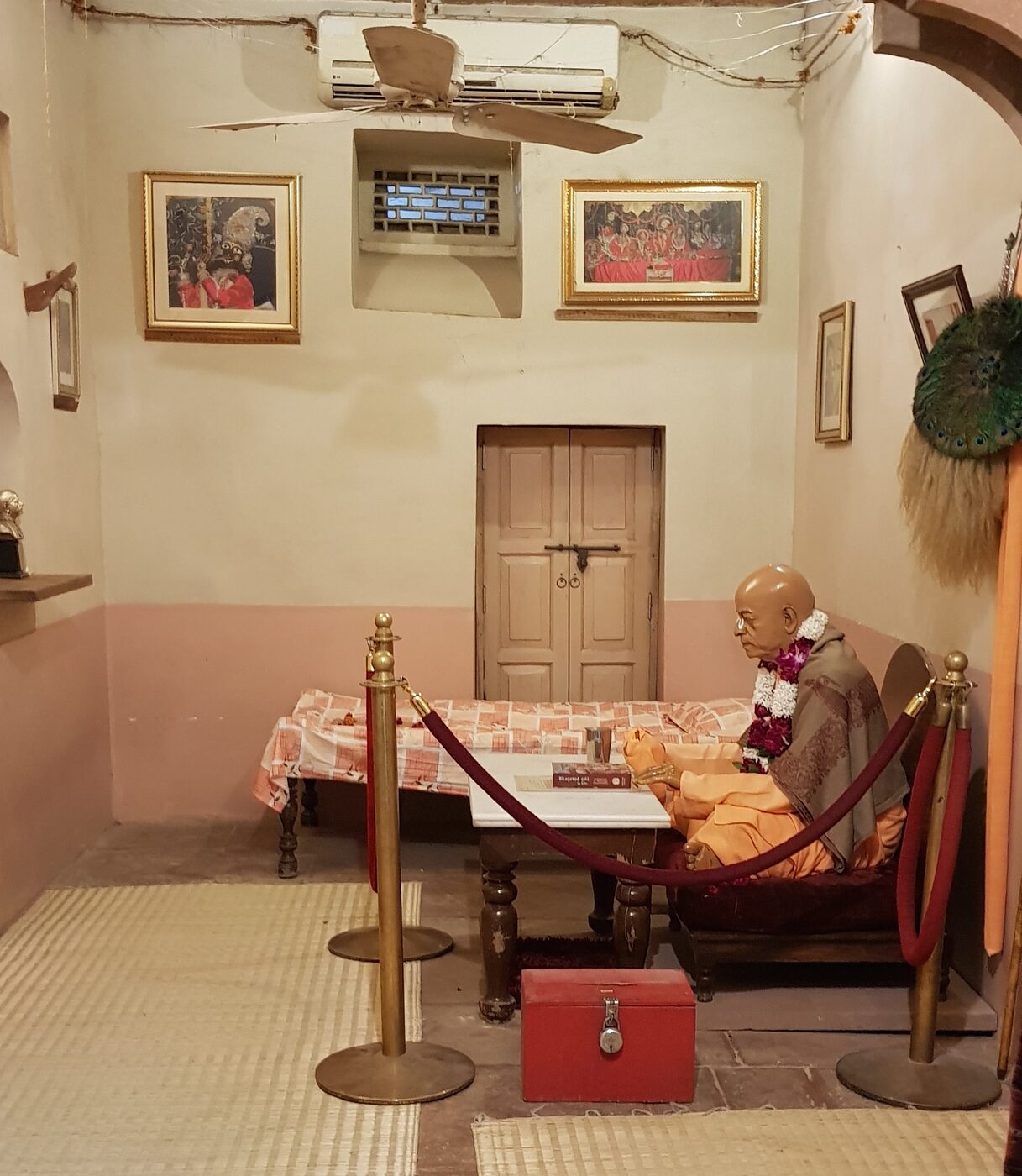
After Jhansi, A.C. Bhaktivedanta returned to Vrindavan for good. From 1962 he lived at the Radha-Damodar temple, where he took a small room. There, largely alone, he began the task that would fill the rest of the decade. He began translating the central scripture of Gaudiya Vaishnavism into English, a language in which almost none of his godbrothers had written.
Translating an 18,000-Verse Scripture #
The Srimad-Bhagavatam, also called the Bhagavata Purana, is the foundational text of Gaudiya Vaishnavism. It has some 18,000 verses of Sanskrit narrative and philosophy, in twelve cantos. Translating it into English verse by verse, with a full explanatory commentary, was already a very difficult task for a scholar. He was doing it with no organization supporting him, no paid assistants, and no promise of readers. This made it more like an act of faith. He worked through the text carefully, step by step, from his room at Radha-Damodar. He produced not just a translation but also purports. Later these purports would make his editions of Vaishnava scripture understandable to readers who had no background in Sanskrit or Indian philosophy. The same body of work is now gathered on the Prabhupada books page.
Printing the First Canto Against the Odds #
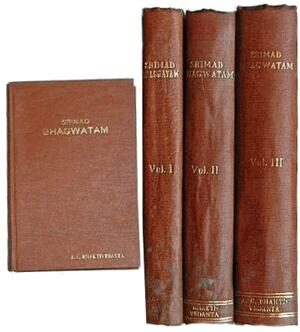
Translating the text was only half the struggle. Printing it was the other half. He had shown self-reliance in paying for Back to Godhead two decades earlier, and he showed the same self-reliance now. He traveled in search of donors. He gathered statements of approval from figures such as the publisher Hanuman Prasad Poddar and the philosopher-statesman Sarvepalli Radhakrishnan. When he approached possible supporters, he used these statements as proof of the work's value. Volume One of the First Canto appeared in 1962. It took a little over two years in total to complete the canto's other two volumes, which were published in 1964 and 1965 as funds allowed. One of those who helped along the way was Sumati Morarjee, the head of a shipping line. At one point she gave him a contribution toward his printing costs in exchange for a copy of the finished work. Her name would matter again within a few years, in a very different setting.
These three volumes were more than a scholarly achievement. Soon after the third volume appeared, two hundred sets of them would travel with him to America on a cargo ship, packed into a steel trunk. By weight, they were the largest single possession that he carried across the ocean.
