The Varāha Deity of Mathurā and its journey from Kapila to Śatrughna
मथुरा के वराह विग्रह: कपिल से शत्रुघ्न तक की यात्रा
In short
The Varāha Deity of Mathurā is the image of Lord Varāha, the boar incarnation. The Varāha Purāṇa, an old scripture, tells its history in its Kapila-varāha chapter. The sage Kapila worshipped Him and gave Him to Indra. Rāvaṇa took Him to Laṅkā, Śrī Rāma took Him to Ayodhyā, and Śatrughna installed Him in Mathurā.[1–6]
On this page
At a glance
- The source: the Varāha Purāṇa, chapter 163, on the glory of the Kapila-varāha. The Garga-saṁhitā tells it in short.[1–8]
- The journey: from Kapila to Indra, to Rāvaṇa, to Śrī Rāma in Ayodhyā, and to Śatrughna in Mathurā.[1–6]
- His place in Mathurā: Varāha's own image stands on the southern petal of the city's lotus, looking like the form of Keśava.[9–13]
- His duty: the Garga-saṁhitā calls the Kapila-varāha the chief minister of Mathurā.[7, 8]
- Two temples: the guidebooks show a black Ādi-varāha and a white Śveta-varāha behind the Dvārakādhīśa temple in Māṇika-choka.[14–18]
- The colours: Śrīla Prabhupāda explains that the Boar who lifted the earth was white, and the Boar who killed Hiraṇyākṣa was red.[19, 20]
Where did the Varāha Deity of Mathurā come from?
The Varāha Purāṇa has chapters on the glories of Mathurā, and one of them is on the Kapila-varāha. In it Lord Varāha Himself speaks. In the Kṛta-yuga (the first age), He says, a king named Māndhātā pleased Him with devotion. He gave the king this image, and Māndhātā worshipped it every day. When Lavaṇa was killed, the image was established in Mathurā (summarised here, not translated).[1, 9]
The chapter then tells a second line of the story. A brāhmaṇa sage named Kapila was devoted to Varāha. He created the auspicious Varāha image in his mind and worshipped it daily. Indra worshipped Kapila, and Kapila, pleased, gave him the divine Varāha (summarised here, not translated).[1, 2] The chapter does not say how Māndhātā's image and Kapila's are related.[1–6]
From Indra's heaven to Laṅkā
Rāvaṇa conquered Indra and entered his jewelled palace. There he saw the Kapila-varāha. He fell to the ground, bewildered by Him, and prayed for protection. The Purāṇa says that because of Rāvaṇa's devotion the Deity became light. Rāvaṇa placed Him on the Puṣpaka chariot, brought Him to Laṅkā, installed Him in his own house and worshipped Him (summarised here, not translated).[3, 4]
From Laṅkā to Ayodhyā
After Rāvaṇa's death, Śrī Rāma told Vibhīṣaṇa that He wanted nothing of Laṅkā's wealth. He wanted only the Deity that had come from Indra's world. He would worship the Varāha form every day and take Him to Ayodhyā. Vibhīṣaṇa gave Him the divine Kapila (summarised here, not translated).[5]
Śrī Rāma installed the Deity in Ayodhyā and worshipped Him. After a thousand and ten years He sent Śatrughna to kill the demon Lavaṇa.[6]
Who installed Him in Mathurā?
When Śrī Rāma heard that Lavaṇa had been killed, He offered Śatrughna a boon. Śatrughna asked for this Deity.[21] Śrī Rāma gave Him with a blessing on Mathurā. Blessed is that land, blessed the city of Mathurā, and blessed its people, who always see Kapila. When He is seen, touched and worshipped every day, He removes all sins (summarised here, not translated).[22]
Śatrughna took the Deity to Mathurā and installed Him there. The Purāṇa closes with the words that in this way the Lord came to be in Mathurā.[23] How Śatrughna killed Lavaṇa and founded the city belongs to the story of Madhuvana and Mathurā itself.[6] Read more: Madhuvana, Dhruva and the founding of Mathurā →
The Garga-saṁhitā tells the same history in a few verses. The brāhmaṇa Kapila received the Varāha Deity from the Lord Himself and gave Him to Indra. Rāvaṇa praised Him and took Him on the Puṣpaka to Laṅkā. Śrī Rāma brought Him to Ayodhyā, and Śatrughna installed Him in Mathurā. There this Kapila-varāha, served by all the people, is known as the city's chief minister (summarised here, not translated).[7, 8]
The two Purāṇas and the guidebooks do not agree on how the Deity first came into human hands. Their accounts are set side by side here:
Accounts differ How the Varāha Deity first came into human hands.
- Varāha Purāṇa 163.22-26Varāha gave the image to King Māndhātā in Kṛta-yuga; the sage Kapila created the Varāha image in his mind and worshipped it.
- Garga-saṁhitā 5.25.4The brāhmaṇa Kapila received it from the Lord Himself.
- Śrī Vraja-maṇḍala Parikramā (2007), the undated parikramā notes Mathurā, Vṛndāvana-Dhāma Ki Jaya! (c. 1986)The sage Kapila, a worshipper of Ādi-varāha (Vṛndāvana-Dhāma Ki Jaya! (c. 1986): Kapila gave the Deity to Indra), with no mention of Māndhātā.
Varāha on the southern petal of Mathurā's lotus
The Varāha Purāṇa describes Mathurā as a lotus with a Deity on each petal. Govinda stands on the north and the Lord called Viśrānti on the east. On the south, Varāha says, stands His own image of divine form.[10] That image is large and fair, and it looks like the form of Keśava. Whoever sees it rejoices with Brahmā (summarised here, not translated).[9–13]
Śrīla Rūpa Gosvāmī quotes these verses in his Mathurā-māhātmya, his collection of verses on Mathurā's glory. At the end of the work he names Varāha among Mathurā's chief Deities, with Keśava in the centre, and with Svayambhū, Padmanābha, Dīrgha-viṣṇu, Gataśrama, Govinda and Hari.[12, 24] The Bhakti-ratnākara of Śrīla Narahari Cakravartī Ṭhākura says that Śrī Varāhadeva adorns the southern petal, and that by His mercy people gain every perfection.[9 +3]
The Varāha Purāṇa ends its chapter with the merit of darśana, the sacred seeing of the Deity. Right after the installation, it says that always seeing Śveta, the white one, gives the result of offering piṇḍa (food offered for the ancestors) at Gayā. It adds that Varāha's light is at Viśrānti at sunrise, at Dīrgha-viṣṇu at noon, and on Keśava in the Keśavadeva temple in the fourth part of the day. The text does not say whether Śveta here means the Kapila-varāha.[23]
Why are there white and black Varāha Deities?
The Bhāgavatam tells of two deeds of Lord Varāha. While Brahmā was thinking how to lift the sunken earth, a tiny boar came out of his nostril.[25]
ity abhidhyāyato nāsā- vivarāt sahasānagha / varāha-toko niragād aṅguṣṭha-parimāṇakaḥ
O sinless Vidura, all of a sudden, while Brahmā was engaged in thinking, a small form of a boar came out of his nostril. The measurement of the creature was not more than the upper portion of a thumb.
Translation: Śrīla A.C. Bhaktivedanta Swami PrabhupādaThe Bhāgavatam then tells how Lord Boar easily took the earth on His tusks and lifted it out of the water. He also killed the demon Hiraṇyākṣa, who tried to fight Him.[26] Later Vidura says that he has heard that the original demon Hiraṇyākṣa was killed by the same Lord in the form of the Boar.[20] In his purport (his explanation of the verse), Śrīla Prabhupāda explains that the two deeds belong to two different millenniums, and he gives their colours.[19, 20]
General teaching (does not name the place)“In both millenniums there was a boar incarnation of the Lord, but in the Svāyambhuva millennium He lifted the earth from within the water of the universe, whereas in the Cākṣuṣa millennium He killed the first demon, Hiraṇyākṣa. In the Svāyambhuva millennium He assumed the color white, and in the Cākṣuṣa millennium He assumed the color red.”
Śrīla Prabhupāda, Śrīmad-Bhāgavatam, 3.14.2, purport · vedabase.io
Śveta-varāha, the white boar, is also the name of the present day of Brahmā. Śrīla Rūpa Gosvāmī calls the present kalpa (a day of Brahmā) Śveta-vārāha. Śrīla Prabhupāda, following Śrīla Jīva Gosvāmī, speaks of the Śveta-varāha millennium.[27, 28] In another purport he writes that the Śveta-varāha appearance of the Lord is the first birthday of Brahmā.[29]
Śrīla Rūpa Gosvāmī's Laghu-bhāgavatāmṛta says that Varāha appeared twice in this kalpa. In the Svāyambhuva period He came from Brahmā's nostril to lift the earth, and in the Cākṣuṣa period He came from the waters. He is remembered with two colours, dark like a rain-cloud and pale like the moon. The book does not say which form has which colour (summarised here, not translated).[30]
The guidebooks name the two forms differently from these texts. They call the black one Kṛṣṇa-varāha and the white one Nṛ-varāha. Their account is set beside the scriptural ones here:
Accounts differ The two Varāha appearances and their names.
- Śrī Vraja-maṇḍala Parikramā (2007), the undated parikramā notes MathurāKṛṣṇa-varāha (= Ādi-varāha) came from Brahmā's nostril in Svāyambhuva Manu's period (Brāhma-kalpa) and lifted the Earth; Śveta-varāha (Nṛ-varāha) came from the ocean in Cākṣuṣa Manu's period and killed Hiraṇyākṣa.
- Śrīla Prabhupāda, ŚB 3.13.16 purport (after Śrīla Jīva Gosvāmī)The chapter in which the boar comes from Brahmā's nostril (3.13.18) belongs to the Śveta-varāha millennium, with Cākṣuṣa-millennium topics also discussed.
- Śrīla Rūpa Gosvāmī, Laghu-bhāgavatāmṛta 1.4.28The present kalpa is called Śveta-vārāha.
Where else is Varāha remembered in Mathurā?
The Varāha Purāṇa links Varāha with Mathurā in one more place, in its chapter on Asi-kuṇḍa. It says that Varāha came to Mathurā to protect the tīrthas (holy bathing places) from King Vimati. He killed the king with His divine sword, and with the sword's tip He made a great kuṇḍa (sacred pond). So it is called Asi-kuṇḍa, the pool of the sword (summarised here, not translated).[31]
The same chapter makes a promise to the pilgrim. Whoever bathes at Asi-kuṇḍa and sees the four images at the Varāha tīrtha (Varāha, Nārāyaṇa, Vāmana and a fourth form) gains the fruit of all Mathurā's tīrthas. The Bhakti-ratnākara repeats it. Neither text says whether this Varāha image has any relation to the Kapila-varāha.[32–40]
Who came to see Varāha in Mathurā?
According to the Bhakti-ratnākara, Śrī Jāhnavā-devī bathed at Viśrāma-ghāṭa and then saw the Deities Varāha and Keśava in Mathurā, before going on to Vṛndāvana. The text does not say which Varāha Deity she saw.[41] Read more: The temples at Śrī Kṛṣṇa's birthplace in Mathurā →
The guidebook Vṛndāvana-Dhāma Ki Jaya! says that Śrīla Bhaktisiddhānta Sarasvatī Ṭhākura visited the temple on a Vraja-maṇḍala parikramā (a walking pilgrimage round Vraja) that he led. The visit rests on that guidebook alone.[18]
Which temple has the Deity: Ādi-varāha or Śveta-varāha?
The guidebooks describe two Varāha temples behind the Dvārakādhīśa temple in Māṇika-choka. One has a black Deity, called Kṛṣṇa-varāha or Ādi-varāha, and one has a white Deity, Śveta-varāha. Vṛndāvana-Dhāma Ki Jaya! calls the Ādi-varāha probably the oldest Deity in the area.[14–18] Vṛndāvana-Dhāma Ki Jaya! (c. 1986) adds that the white Deity was then in a private house down a side-street, and could be seen from the street when the curtain was open.[14 +3]
The guidebooks do not agree on which of the two has the Kapila history. Śrī Vraja-maṇḍala Parikramā (2007) and another set of notes tell it of the black Ādi-varāha. Vṛndāvana-Dhāma Ki Jaya! tells it under the Ādi-varāha temple but names the Deity Śveta-varāha.[8 +4] The Varāha Purāṇa calls the Deity the Kapila-varāha and gives no colour for the image. Right after the installation, it praises seeing Śveta.[23]
Accounts differ Which Varāha Deity of Mathurā the Kapila history belongs to.
- Śrī Vraja-maṇḍala Parikramā (2007) and the undated parikramā notes MathurāTo the black Deity, Kṛṣṇa-varāha or Ādi-varāha, worshipped by the sage Kapila.
- Vṛndāvana-Dhāma Ki Jaya! (c. 1986)Told under the Ādi-varāha temple, but the Deity is called Śveta-varāha and Kapila-varāha: 'Lord Śveta-varāha has been there ever since'.
- Varāha Purāṇa 163 (Kapila-varāha-māhātmya)Calls the Deity 'Kapila-vārāha' (v. 32) and 'Kapila' (vv. 50, 61); right after the installation (v. 66) it praises seeing 'Śveta'; the southern-petal image is 'resembling Keśava' (v. 21); no colour is given for the Kapila image.
- Garga-saṁhitā 5.25.8'Kapila-vārāha', Mathurā's chief minister (no colour given).
According to the guidebooks, Śatrughna asked for the Deity before he set out against Lavaṇa, and Śrī Rāma worshipped Him for 110 years. The Purāṇa says otherwise on both points.[6 +4]
Accounts differ When Śatrughna asked Rāma for the Varāha Deity.
- Śrī Vraja-maṇḍala Parikramā (2007), the undated parikramā notes MathurāBefore leaving Ayodhyā to kill Lavaṇa.
- Varāha Purāṇa 163.57-59After Lavaṇa had been killed, when Rāma offered him a boon.
- Vṛndāvana-Dhāma Ki Jaya! (c. 1986)He brought the Deity with him when he went to Madhupurī to defeat the demons.
Accounts differ How long Rāma worshipped the Deity in Ayodhyā.
- Vṛndāvana-Dhāma Ki Jaya! (c. 1986)110 years.
- Varāha Purāṇa 163.51A thousand years passed, and ten more (varṣa-sahasraṁ daśottaram) before He sent Śatrughna against Lavaṇa.
The wording of these accounts is our summary of the sources, not a published translation.
Places in this article
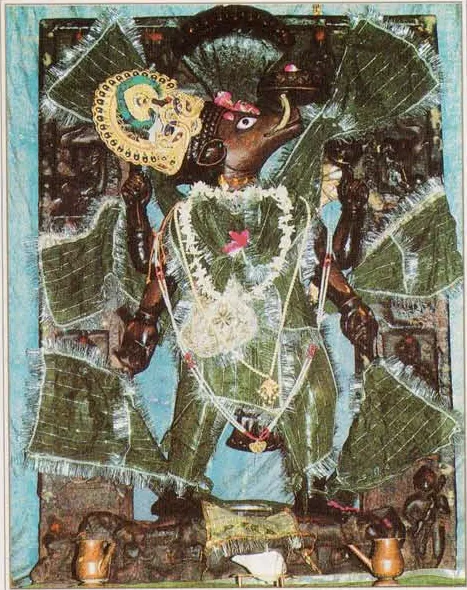
Ādi-varāha Mandira
आदि-वराह मन्दिरThe Ādi-varāha Mandira, also called the Kṛṣṇa-varāha temple, is one of two temples of Lord Varāha, the boar incarnation, behind the Dvārakādhīśa temple in the Māṇika-chok …
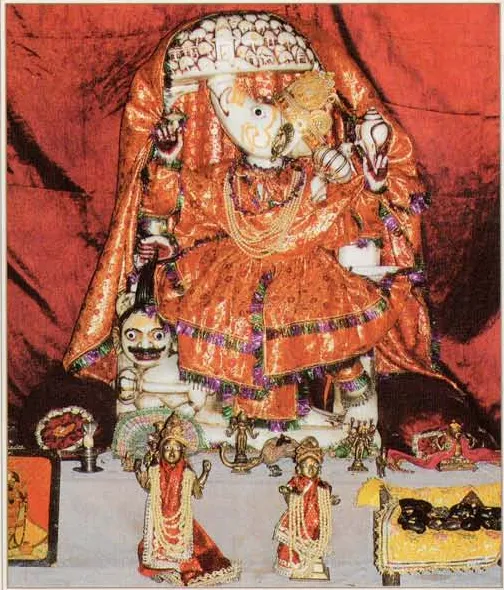
Śveta-varāha Mandira
श्वेत-वराह मन्दिरThe Śveta-varāha Mandira holds the white Deity of Lord Varāha, the boar incarnation, behind the Dvārakādhīśa temple in the Māṇika-choka quarter of Mathurā.
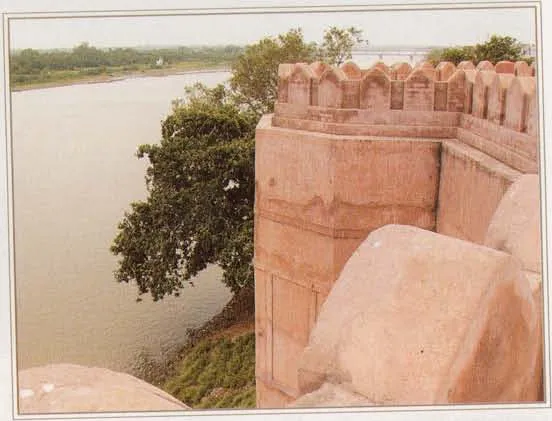
Mathurā
मथुराMathurā is the city on the Yamunā where Śrī Kṛṣṇa appeared from Devakī in the prison of King Kaṁsa.
Keśavadeva Mandira
केशवदेव मन्दिर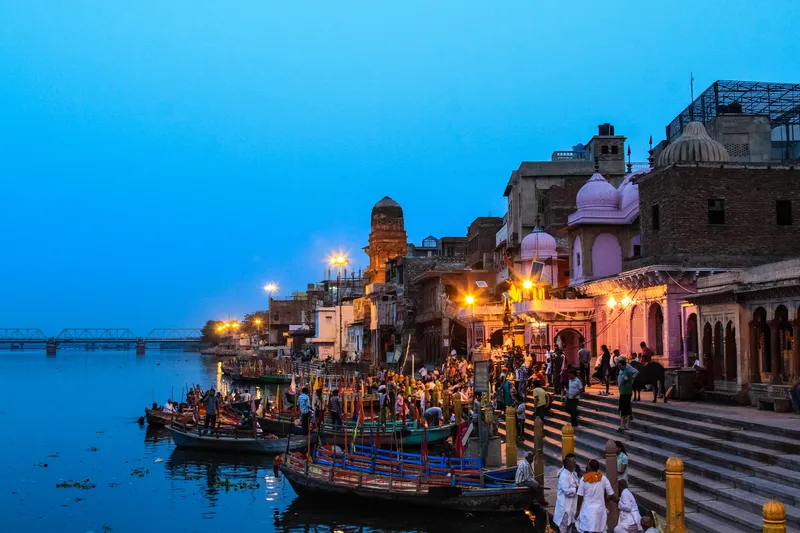
Viśrāma-ghāṭa
विश्राम-घाटViśrāma-ghāṭa is the bathing place on the Yamunā that the 2007 guidebook calls the principal ghāṭa of Mathurā.
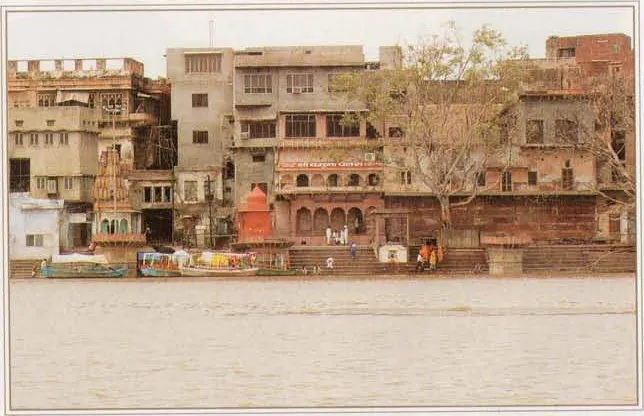
Asi-kuṇḍa
असि-कुण्डAsi-kuṇḍa, the "sword pond", is a bathing place on the Yamunā in Mathurā, near Viśrāma-ghāṭa; today it is also called Askuṇḍa-ghāṭa.
Questions and answers
According to the Varāha Purāṇa, the sage Kapila worshipped the Varāha image and gave it to Indra. Rāvaṇa took it to Laṅkā, Śrī Rāma brought it to Ayodhyā, and Śatrughna installed it in Mathurā.[1–6]
Śatrughna, Śrī Rāma's brother. In the Varāha Purāṇa he asks for the Deity as a boon after killing Lavaṇa, and installs Him in Mathurā.[21, 23]
The guidebooks differ. One tells the history of the black Ādi-varāha, and another names the Deity Śveta-varāha. The Varāha Purāṇa gives no colour for the image.[14 +5]
Śrīla Prabhupāda explains that Varāha appeared in two millenniums: white when He lifted the earth, and red when He killed Hiraṇyākṣa. Śrīla Rūpa Gosvāmī says that Varāha is remembered with two colours, cloud-dark and moon-white.[19 +2]
He says that there was a boar incarnation in both the Svāyambhuva and the Cākṣuṣa millenniums. In the first He lifted the earth from the water; in the second He killed Hiraṇyākṣa.[19]
Yes. According to the Bhakti-ratnākara, she saw the Deities Varāha and Keśava in Mathurā before going on to Vṛndāvana. It does not say which Varāha temple.[41]
Sources
- Varāha Purāṇa, adhyāya 163, verses 23-25, Sanskrit Wikisource
- Varāha Purāṇa, adhyāya 163, verses 26-28, Sanskrit Wikisource
- Varāha Purāṇa, adhyāya 163, verses 32-33, Sanskrit Wikisource
- Varāha Purāṇa, adhyāya 163, verses 44-45, Sanskrit Wikisource
- Varāha Purāṇa, adhyāya 163, verses 48-50, Sanskrit Wikisource
- Varāha Purāṇa, adhyāya 163, verses 51-52, Sanskrit Wikisource
- Garga-saṁhitā, Mathurā-khaṇḍa (5) 25.4-6, Sanskrit Wikisource
- Garga-saṁhitā, Mathurā-khaṇḍa (5) 25.7-8, Sanskrit Wikisource
- Varāha Purāṇa, adhyāya 163, verses 20-22, Sanskrit Wikisource
- Varāha Purāṇa, adhyāya 163, verses 18-20, Sanskrit Wikisource
- Śrī Vraja-maṇḍala Parikramā (2007), PDF p. 30
- Śrīla Rūpa Gosvāmī, Mathurā-māhātmya, v.156-158 (continuing the lotus)
- Śrīla Narahari Cakravartī, Bhakti-ratnākara, Fifth Wave, printed p. 163 (1912 ed.), 2nd ed., 1912
- Śrī Vraja-maṇḍala Parikramā (2007), PDF p. 56
- Śrī Vraja-maṇḍala Parikramā (2007), PDF p. 57
- the undated parikramā notes Mathurā, ¶44
- Vṛndāvana-Dhāma Ki Jaya! (c. 1986), by Dhruva Mahārāja dāsa, PDF p. 20
- Vṛndāvana-Dhāma Ki Jaya! (c. 1986), by Dhruva Mahārāja dāsa, PDF p. 21
- Śrīla Prabhupāda, Śrīmad-Bhāgavatam, 3.14.2, purport · vedabase.io
- Śrīmad-Bhāgavatam ŚB 3.14.2, GRETIL
Show all 44 references
- Varāha Purāṇa, adhyāya 163, verses 57-59, Sanskrit Wikisource
- Varāha Purāṇa, adhyāya 163, verses 60-62, Sanskrit Wikisource
- Varāha Purāṇa, adhyāya 163, verses 64-66, Sanskrit Wikisource
- Śrīla Rūpa Gosvāmī, Mathurā-māhātmya, v.444-446 (the chief Deities of Māthura; closing verses)
- Śrīmad-Bhāgavatam 3.13.18, GRETIL
- Śrīmad-Bhāgavatam 3.13.31, GRETIL
- Śrīla Rūpa Gosvāmī, Laghu-bhāgavatāmṛta, 1.4.28, GRETIL
- Śrīla Prabhupāda, Śrīmad-Bhāgavatam, 3.13.16, purport · vedabase.io
- Śrīla Prabhupāda, Śrīmad-Bhāgavatam, 3.11.35, purport · vedabase.io
- Śrīla Rūpa Gosvāmī, Laghu-bhāgavatāmṛta 1.3.10-13, GRETIL
- Varāha Purāṇa, 166.18-20 (the Earth's question is 166.1; chapter colophon 'asikuṇḍaprabhāvo nāma'), Sanskrit Wikisource
- Varāha Purāṇa, 166.24-28, Sanskrit Wikisource
- Varāha Purāṇa, 166.29-30, Sanskrit Wikisource
- Varāha Purāṇa, 174.6-7, Sanskrit Wikisource
- Varāha Purāṇa, 176.69-71, Sanskrit Wikisource
- Śrīla Rūpa Gosvāmī, Mathurā-māhātmya v.278-279, heading 'asi-kuṇḍasya'; index: ĀdivarāhaP
- Varāha Purāṇa, adhyāya 168, verses 14b–18a, Sanskrit Wikisource
- Śrīla Narahari Cakravartī, Bhakti-ratnākara, Fifth Wave, 1912 ed. pp. 179-180, 2nd ed., 1912
- Śrīla Narahari Cakravartī, Bhakti-ratnākara, Fifth Wave, 1912 ed. p. 175, 2nd ed., 1912
- Śrīla Narahari Cakravartī, Bhakti-ratnākara, Fifth Wave, 1912 ed. p. 165, 2nd ed., 1912
- Śrīla Narahari Cakravartī, Bhakti-ratnākara, Eleventh Wave (ekādaśa taraṅga), 1912 ed. p. 664; verses 96-97 in the Grantha Mandira text numbering, 2nd ed., 1912
- the undated parikramā notes Mathurā, ¶51
- Śrī Vraja-maṇḍala Parikramā (2007), PDF p. 62
- Śrī Vraja-maṇḍala Parikramā (2007), PDF p. 63
Further sources
- Varāha Purāṇa, Mathurā-māhātmya, chapter 163 (Kapila-varāha-māhātmya), and Garga-saṁhitā, Mathurā-khaṇḍa 25 (Sanskrit): summarised, not translated.
- Śrīmad-Bhāgavatam, Third Canto, 3.11.35, 3.13.16-18 and 3.14.2, translations and purports by Śrīla Prabhupāda.
- Śrīla Rūpa Gosvāmī, Mathurā-māhātmya and Laghu-bhāgavatāmṛta; Bhakti-ratnākara, Fifth and Eleventh Waves: summarised.
- Guidebooks: Śrī Vraja-maṇḍala Parikramā (2007) and Vṛndāvana-Dhāma Ki Jaya! (c. 1986), for the two temples.