Nanda-ghāṭa
नन्द-घाट Hindi name proposed
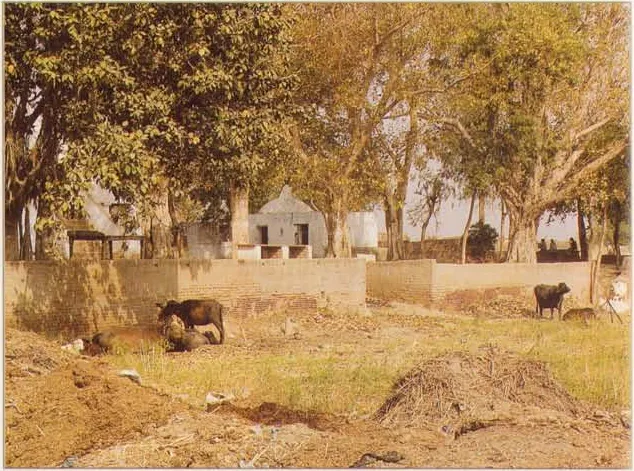
- What it is
- Nanda-ghāṭa is a bathing place on the Yamunā.
- Visiting
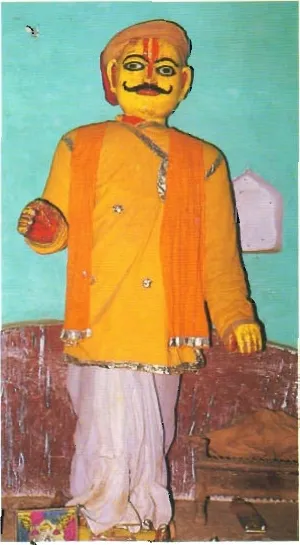
- Vṛndāvana-Dhāma Ki Jaya! (c. 1986) prints a photograph captioned as the Deity of Nanda Mahārāja at Nanda-ghāṭa; it gives no temple name or date, and what stands at the ghāṭa today has not been …
- Places here
- Jīva Gosvāmī's cave
In short
Nanda-ghāṭa is a bathing place on the Yamunā. The guidebook Śrī Vraja-maṇḍala Parikramā (2007) places it two miles south of Gopī-ghāṭa and one mile south-east of Akṣayavaṭa.[1 +3] The Bhakti-ratnākara sets here the pastime that Śrīmad-Bhāgavatam tells without naming the place: after his Ekādaśī fast, Nanda Mahārāja went into the Yamunā to bathe, a servant of Varuṇa, the lord of the waters, carried him off, and Kṛṣṇa brought him back.[5 +5] The same book tells that the young Śrīla Jīva Gosvāmī once lived here unknown, in a hut of leaves.[11 +3]
Key facts
| Kind | ghāṭa |
|---|---|
| Region · area | Jāvaṭa |
| Also part of | Yamunā |
| Ācāryas | Śrīla Jīva Gosvāmī, Śrīla Sanātana Gosvāmī, Śrīla Rūpa Gosvāmī, Śrīla Rāghava Paṇḍita Gosvāmī of Govardhana, Śrīla Śrīnivāsa Ācārya |
Divine pastimes
Kṛṣṇa brings Nanda back from Varuṇa
Śrīmad-Bhāgavatam (10.28) tells that Nanda Mahārāja fasted on Ekādaśī, worshipped the Lord, and entered the water of the Kālindī, the Yamunā, on Dvādaśī to bathe. Because he went in at night, at a time that belongs to the demons, a servant of Varuṇa seized him and took him to his master.[6 +4]
taṃ gṛhītvānayad bhṛtyo varuṇasyāsuro 'ntikam / avajñāyāsurīṃ velāṃ praviṣṭam udakaṃ niśi
Because Nanda Mahārāja entered the water in the dark of night, disregarding that the time was inauspicious, a demoniac servant of Varuṇa seized him and brought him to his master.
Translation: Śrīla Prabhupāda's disciples (BBT)The cowherd men, not seeing Nanda, cried out to Kṛṣṇa and Rāma. Kṛṣṇa understood that His father had been taken and went to Varuṇa's court. Varuṇa worshipped Him and begged pardon for his foolish servant, and Kṛṣṇa brought His father home, to the joy of all their relatives.[6 +4]
evaṃ prasāditaḥ kṛṣṇo bhagavān īśvareśvaraḥ / ādāyāgāt sva-pitaraṃ bandhūnāṃ cāvahan mudam
Śukadeva Gosvāmī said: Thus satisfied by Lord Varuṇa, Śrī Kṛṣṇa, the Supreme Personality of Godhead, Lord of lords, took His father and returned home, where their relatives were overjoyed to see them.
Translation: Śrīla Prabhupāda's disciples (BBT)The Bhāgavatam names the river but not the place on its bank. Commenting on ŚB 10.28.3, Śrīla Viśvanātha Cakravartī Ṭhākura and Śrīla Baladeva Vidyābhūṣaṇa say that Kṛṣṇa came to the guards who had gone with Nanda, saw where His father had gone under, and dived from that very bank to Varuṇa (summarised here, not translated).[6 +1]
In his Kṛṣṇa book Śrīla Prabhupāda tells that Nanda wanted to bathe before sunrise but went a little too early:[16 +1]
General teaching (does not name the place)“The fact was that Nanda Mahārāja wanted to take a bath in the river Yamunā early in the morning before the sunrise, but somehow or other he was a little too early, and he bathed at an inauspicious time.”
Śrīla Prabhupāda, Kṛṣṇa, the Supreme Personality of Godhead (Kṛṣṇa book), Chapter 28 (the time of Nanda's bath) · vedabase.io
The sources give the hour of the bath differently:[6 +6]
Accounts differ At what time Nanda Mahārāja entered the Yamunā on Dvādaśī.
- Śrīmad-Bhāgavatam 10.28.1-2On Dvādaśī, 'at night' (niśi), disregarding (or not knowing) the asuras' time (āsurī velā).
- Śrīla Śrīdhara Svāmī on 10.28.2Dvādaśī lasted only a moment, so for his pāraṇa he entered the water at night, after midnight and before dawn, following the rule quoted.
- Śrīla Jīva Gosvāmī, Gopāla-campū Pūrva 20.2Only a remnant of Dvādaśī was left for the pāraṇa, so he entered the Kalindī while much of the night still remained, by the force of a special rule.
- Śrīla Prabhupāda, Kṛṣṇa book ch. 28'early in the morning of the next day, Dvādaśī'; 'before the sunrise, but somehow or other he was a little too early'.
After Nanda's return Kṛṣṇa showed the cowherd men His own abode. The Bhāgavatam places that vision at the Brahma-hrada, the lake where Akrūra later had his vision (Akrūra-ghāṭa), not at the place of Nanda's bath, and Śrīla Prabhupāda's Kṛṣṇa book says the same.[18 +1] Read more: The cowherds' vision at Brahma-hrada →
Traditional accounts
According to the Bhakti-ratnākara (Fifth Wave) of Śrīla Narahari Cakravartī Ṭhākura, Śrīla Rāghava Paṇḍita Gosvāmī showed Śrīla …
According to the Bhakti-ratnākara (Fifth Wave) of Śrīla Narahari Cakravartī Ṭhākura, Śrīla Rāghava Paṇḍita Gosvāmī showed Śrīla Śrīnivāsa Ācārya "this Nanda-ghāṭa", where Nanda and others bathed in the Yamunā, and told him the pastime of Varuṇa's messenger. He added that because Nanda felt fear (bhaya) here, Vajranābha founded a village named Bhaya (summarised here, not translated).[5 +2] Śrī Vraja-maṇḍala Parikramā (2007) gives this name, Bhaya-gaon, to the nearby village of Bhaiyā.[20]
Śrī Vraja-maṇḍala Parikramā (2007) and the undated parikramā notes Nanda-ghāṭa add that when Kṛṣṇa returned with Nanda, they met the Vrajavāsīs again at this place; the Bhāgavatam and the Bhakti-ratnākara do not say so.[1 +3]
The Bhakti-ratnākara's Thirteenth Wave tells that Śrīla Vīracandra Prabhu, on his pilgrimage of Vraja, came to Nanda-ghāṭa after Bhāṇḍīravaṭa and went on to Cīra-ghāṭa and Bhadravana. The book names the places on his route and tells no pastime of his here.[21]
In the song book, the hymn "Obeisance 62" of the Kṛṣṇa-līlā-stava follows this chapter of the Bhāgavatam and praises Kṛṣṇa as the one who searched for His father under the water and was worshipped by Varuṇa.[22] Another song of the song book hails Nanda-ghāṭa together with Akṣayavaṭa and Cīra-ghāṭa by the Yamunā.[23]
The Gosvāmīs and ācāryas
According to the Bhakti-ratnākara, Śrīla Rāghava Paṇḍita Gosvāmī brought Śrīla Śrīnivāsa Ācārya and Śrīla Narottama dāsa Ṭhākura …
Śrīla Jīva Gosvāmī at Nanda-ghāṭa
According to the Bhakti-ratnākara, Śrīla Rāghava Paṇḍita Gosvāmī brought Śrīla Śrīnivāsa Ācārya and Śrīla Narottama dāsa Ṭhākura back to Nanda-ghāṭa and told them that Śrī Jīva had lived here, in this solitary place, completely unknown. Śrīla Rūpa Gosvāmī had sent him away from Vṛndāvana until his mind was steady, after he had refuted Śrī Vallabha Bhaṭṭa, who had offered to correct the opening verses of Śrī Rūpa's Bhakti-rasāmṛta-sindhu. Jīva stayed here in a hut of leaves, fasting, until Śrīla Sanātana Gosvāmī heard of him from the villagers, found him and reported to Śrī Rūpa, who had him brought back and nursed him himself. "This is his hut," Śrīla Rāghava Paṇḍita told Śrīnivāsa (summarised here, not translated).[11 +4]
The modern guidebooks tell the story differently and call the place Śrīla Jīva Gosvāmī's cave; the full account, with the versions side by side, is on the page of Śrīla Jīva Gosvāmī's cave.[11 +3]
Visiting today
Vṛndāvana-Dhāma Ki Jaya! (c. 1986) prints a photograph captioned as the Deity of Nanda Mahārāja at Nanda-ghāṭa; it gives no temple name or date, and what stands at the ghāṭa today has not been checked on the spot.[25]
Location
| Where it is | 2 miles south of Gopī-ghāṭa; 1 mile south-east of Akṣayavaṭa[26] on the Yamunā[27] |
|---|
Places at Nanda-ghāṭa
1 places
Nearby places
Gopī-ghāṭa (Tapovana) · Akṣayavaṭa (near Rāma-ghāṭa) · Bhaiyā · Vatsavana (near Nanda-ghāṭa)
Pictures
2 pictures
References
27 references
- Śrī Vraja-maṇḍala Parikramā (2007), PDF p. 243
- Śrī Vraja-maṇḍala Parikramā (2007), PDF p. 244
- the undated parikramā notes Nanda-ghāṭa, ¶5
- the undated parikramā notes Nanda-ghāṭa, ¶9
- Śrīla Narahari Cakravartī, Bhakti-ratnākara, Fifth Wave (pañcama taraṅga), printed p. 269: Rāghava Paṇḍita shows Nanda-ghāṭa to Śrīnivāsa, 2nd ed., 1912
- Śrīmad-Bhāgavatam 10.28.1, GRETIL
- Śrīmad-Bhāgavatam 10.28.2, GRETIL
- Śrīmad-Bhāgavatam 10.28.3, GRETIL
- Śrīmad-Bhāgavatam 10.28.7, GRETIL
- Śrīmad-Bhāgavatam 10.28.9, GRETIL
- Śrīla Narahari Cakravartī, Bhakti-ratnākara, Fifth Wave, printed p. 271: the party returns to Nanda-ghāṭa; Jīva Gosvāmī's stay begins, 2nd ed., 1912
- Śrīla Narahari Cakravartī, Bhakti-ratnākara, Fifth Wave, printed p. 272: Vallabha Bhaṭṭa, the debate, and Rūpa Gosvāmī's instruction, 2nd ed., 1912
- Śrīla Narahari Cakravartī, Bhakti-ratnākara, Fifth Wave, printed p. 273: Jīva's austerity at Nanda-ghāṭa; Sanātana Gosvāmī finds him, 2nd ed., 1912
- Śrīla Narahari Cakravartī, Bhakti-ratnākara, Fifth Wave, printed p. 274: Jīva brought back and nursed; the digvijayī; 'this is his hut', 2nd ed., 1912
- Sārārtha-darśinī (Śrīla Viśvanātha Cakravartī Ṭhākura): commentary on ŚB 10.28.3, Bhagavata Vidya Pith edition, ed. Bhagavata Rishi and Krishna Shankar Shastri, 1996
- Śrīla Prabhupāda, Kṛṣṇa, the Supreme Personality of Godhead (Kṛṣṇa book), Chapter 28, 'Releasing Nanda Mahārāja from the Clutches of Varuṇa' · vedabase.io
- Śrīla Prabhupāda, Kṛṣṇa, the Supreme Personality of Godhead (Kṛṣṇa book), Chapter 28 (the time of Nanda's bath) · vedabase.io
- Śrīmad-Bhāgavatam 10.28.16, GRETIL
- Śrīla Prabhupāda, Kṛṣṇa, the Supreme Personality of Godhead (Kṛṣṇa book), Chapter 28 (the cowherds' vision) · vedabase.io
- Śrī Vraja-maṇḍala Parikramā (2007), PDF p. 245
Show all 27 references
- Śrīla Narahari Cakravartī, Bhakti-ratnākara, Thirteenth Wave (trayodaśa taraṅga), printed p. 1025: Vīracandra Prabhu's tour of Vraja, 2nd ed., 1912
- Obeisance 62 (Sanātana Gosvāmī (as the song book credits it; book 'Krsna Lila Stava', chapter headed 'Śrīmad Bhāgavatam Canto 10, Chapter 28')) · song book
- Jaya Jaya Madana Gopāla Baṁśī Dhārī (Narottama dāsa Ṭhākura (as the song book credits it)) · song book
- Gopāla-campū, Pūrva-campū (20) 'varuṇa-lokāloka-camatkāra-tiraskāraka-golokāvalokanam', ¶[2]
- Vṛndāvana-Dhāma Ki Jaya! (c. 1986), by Dhruva Mahārāja dāsa, PDF p. 59
- Śrī Vraja-maṇḍala Parikramā (2007), p. 460-461
- Vṛndāvana-Dhāma Ki Jaya! (c. 1986), by Dhruva Mahārāja dāsa, p. 39