Raghunātha dāsa Gosvāmī's bhajana-kuṭī
रघुनाथ दास गोस्वामी की भजन-कुटी
Also called Śrīla Raghunātha Dāsa Gosvāmī bhajan-kutir
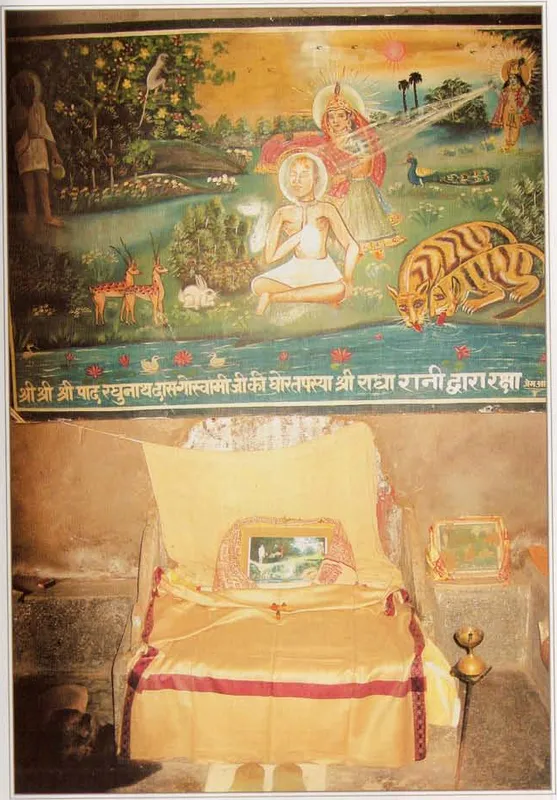
- What it is
- Śrīla Raghunātha dāsa Gosvāmī's bhajana-kuṭī, his hut for chanting and prayer, stands between Rādhā-kuṇḍa and Śyāma-kuṇḍa, next to the kuṭīs of Śrī Gopāla Bhaṭṭa Gosvāmī and Śrīla Viśvanātha …
- Visiting
- Śrī Vraja-maṇḍala Parikramā (2007) places the kuṭī on the north-eastern side of Rādhā-kuṇḍa, east of Śrī Gopāla Bhaṭṭa Gosvāmī's kuṭī, on the bank of Śyāma-kuṇḍa; The Colour Guide (1999) puts Śrīla …
In short
Śrīla Raghunātha dāsa Gosvāmī's bhajana-kuṭī, his hut for chanting and prayer, stands between Rādhā-kuṇḍa and Śyāma-kuṇḍa, next to the kuṭīs of Śrī Gopāla Bhaṭṭa Gosvāmī and Śrīla Viśvanātha Cakravartī Ṭhākura. Today a cement building stands where his leaf-hut was.[1 +4] The Caitanya-caritāmṛta tells that he bathed in Rādhā-kuṇḍa three times a day, and Śrīla Prabhupāda writes that he lived there for most of his long life and that the place of his devotional service still exists.[3 +9] According to the Bhakti-ratnākara, he lived under a tree until Śrīla Sanātana Gosvāmī saw a tiger pass him and told him to live in a hut.[3 +2]
Key facts
| Kind | bhajana-kuṭīra |
|---|---|
| Region · area | Rādhā-kuṇḍa |
| Also part of | Rādhā-kuṇḍa (village), Śyāma-kuṇḍa (Rādhā-kuṇḍa) |
| Ācāryas | Śrīla Raghunātha dāsa Gosvāmī, Śrīla Sanātana Gosvāmī, Śrīla Śrīnivāsa Ācārya, Śrīla Narottama dāsa Ṭhākura, Śrī Jāhnavā Mātā |
Traditional accounts
How the hut began
According to the Bhakti-ratnākara, Śrīla Raghunātha dāsa Gosvāmī stayed under a tree day and night and never wished to make a hut. One day Śrīla Sanātana Gosvāmī came from Vṛndāvana to Śrī Gopāla Bhaṭṭa Gosvāmī's lodging there and went to bathe at Mānasa-pāvana-ghāṭa. He saw a tiger drinking the water, and the tiger went back into the forest passing close to Śrīla Raghunātha dāsa Gosvāmī, who sat absorbed in meditation. Śrīla Sanātana Gosvāmī then told him with affection to live in a hut from now on. The hut was begun that same day, and from then on, for the good of others, he lived in it by Śrīla Sanātana Gosvāmī's order (summarised here, not translated).[3 +5]
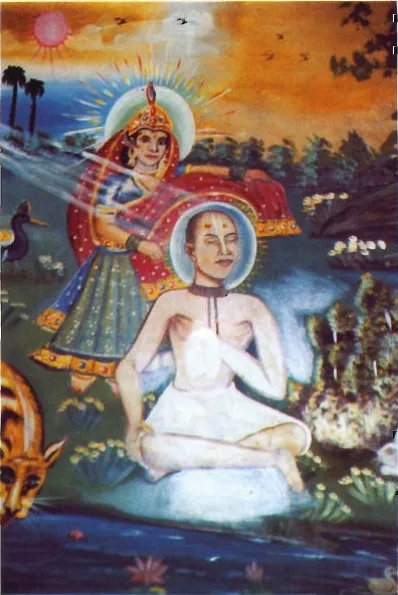
The modern guidebooks tell more. The Colour Guide to Rādhā-kuṇḍa (1999) and the undated parikramā notes Rādhā-kuṇḍa say that Śrīla Sanātana Gosvāmī twice had a vision near him: Kṛṣṇa stood guard while two tigers drank from the kuṇḍa, and on another day Rādhā shaded him from the midday sun with Her veil. Only then, they say, did he accept a kuṭī. No older text for either vision has been found, so these stories are not certain.[19 +4] The guidebooks also differ on who built the hut (see below).
Where he first lived
Śrī Vraja-maṇḍala Parikramā (2007) says that after he came from Purī he first lived at Lagmohana-kuṇḍa and later did his bhajana on the banks of Rādhā-kuṇḍa; the undated parikramā notes Rādhā-kuṇḍa say that he first lived under the trees around the kuṇḍas. No source has been found for Lagmohana-kuṇḍa as his first home, so it is not certain; the Bhakti-ratnākara agrees that he lived under a tree before the hut.[2 +3]
His daily talks and the Govardhana-śilā
The Caitanya-caritāmṛta says that for three hours a day he spoke about Śrī Caitanya Mahāprabhu, but gives no time or place. The Colour Guide sets these talks in the late afternoon by Śyāma-kuṇḍa, and the parikramā notes at his kuṭī; neither detail has been found in an older source, so these details are not certain.[5 +2]
According to an appendix printed with the 1907 edition of the Narottama-vilāsa, which calls itself "the author's introduction", the Govardhana-śilā, the stone from Govardhana, that Śrī Caitanya Mahāprabhu gave him was served after him by Śrīla Kṛṣṇadāsa Kavirāja Gosvāmī, then by a Mukunda dāsa, who in his old age gave it to Kṛṣṇapriyā Ṭhākurāṇī, a resident of Rādhā-kuṇḍa.[27 +1]
The Gosvāmīs and ācāryas
After Śrī Caitanya Mahāprabhu's departure, the Caitanya-caritāmṛta tells, Śrīla Raghunātha dāsa Gosvāmī came to Vṛndāvana meaning …
His life at the kuṇḍa
After Śrī Caitanya Mahāprabhu's departure, the Caitanya-caritāmṛta tells, Śrīla Raghunātha dāsa Gosvāmī came to Vṛndāvana meaning to give up his life by jumping from Govardhana Hill, but Śrīla Rūpa Gosvāmī and Śrīla Sanātana Gosvāmī kept him with them as their third brother.[29 +3] In Purī he had understood Mahāprabhu's gift of a stone from Govardhana as the gift of a place near Govardhana, and the gift of a garland of guñjā berries as shelter at Śrī Rādhā's feet.[28 +1]
“śilā diyā gosāñi samarpilā ‘govardhane’
guñjā-mālā diyā dilā ‘rādhikā-caraṇe’ ”
“By offering me the govardhana-śilā, Śrī Caitanya Mahāprabhu has offered me a place near Govardhana Hill, and by offering me the garland of conchshells, He has offered me shelter at the lotus feet of Śrīmatī Rādhārāṇī.”
Translation: Śrīla A.C. Bhaktivedanta Swami PrabhupādaThe same book describes his day in Vraja: at least a hundred thousand holy names, a thousand obeisances to the Lord and two thousand to Vaiṣṇavas, three hours of talks on Śrī Caitanya, service to Rādhā and Kṛṣṇa within his mind day and night, less than two hours of sleep, and only a little buttermilk for food.[26 +4]
tina sandhyā rādhā-kuṇḍe apatita snāna
vraja-vāsī vaiṣṇave kare āliṅgana māna
Śrī Raghunātha dāsa Gosvāmī took three baths daily in the Rādhā-kuṇḍa lake. As soon as he found a Vaiṣṇava residing in Vṛndāvana, he would embrace him and give him all respect.
Translation: Śrīla A.C. Bhaktivedanta Swami PrabhupādaIn his own words he counts Rādhā-kuṇḍa and Govardhana among what he received by his guru's mercy, and in his vows he writes that he lives at the kuṇḍa of the Queen, Śrī Rādhā, and at the best of hills (both summarised here, not translated).[38 +1] Read more: Śrīla Raghunātha dāsa Gosvāmī's life at Rādhā-kuṇḍa →
The leaf-cup and the milk-rice
According to the Bhakti-ratnākara, his rule was one leaf-cup of buttermilk a day. A Vrajavāsī named Dāsa once made him a larger cup from a leaf brought from Sakhī-sthalī, the village of Candrāvalī; when he heard the name, he threw the cup away, and after a while calmly told the man not to go there.[12 +1] The same book tells that he once ate milk-rice prasāda in his mind and fell ill with heaviness. Physicians brought by Śrī Viṭṭhalanātha found that he had eaten milk and rice, and he admitted that he had eaten it in his mind (summarised here, not translated).[12 +3]
His visitors
The Bhakti-ratnākara tells of many who came to him at the kuṇḍa (summarised here, not translated):[12 +4]
- On his first visit, the book says, Śrīla Śrīnivāsa Ācārya, sent by Śrīla Jīva Gosvāmī, was received with great favour by him, Śrīla Rāghava Paṇḍita and Śrīla Kṛṣṇadāsa Kavirāja Gosvāmī.[7 +3]
- It tells that when Śrīla Śrīnivāsa Ācārya and Śrīla Narottama dāsa Ṭhākura bowed to him, he rose, though very weak, and embraced them.[41]
- Before Śrīla Śrīnivāsa Ācārya left for Bengal, he came to take leave and was embraced and given permission for the journey; the book describes the Gosvāmī then as very thin, eating once in two or four days and weeping in separation from Śrīla Svarūpa Dāmodara, Śrīla Rūpa Gosvāmī and Śrīla Sanātana Gosvāmī.[7 +2]
- Śrīla Rāmacandra Kavirāja, it says, bathed in the two kuṇḍas and bowed to him, and he embraced him in tears.[18]
- When Śrīla Jāhnavā-devī came, he was chanting slowly on a solitary bank of the kuṇḍa, and Śrīla Kṛṣṇadāsa Kavirāja Gosvāmī went ahead to tell him of her arrival.[10 +1]
Śrīla Prabhupāda
Śrīla Prabhupāda writes in his purport to the Caitanya-caritāmṛta …
Śrīla Prabhupāda writes in his purport to the Caitanya-caritāmṛta:[6 +5]
Names this place“He lived a long time, residing for most of his life at Rādhā-kuṇḍa. The place where Raghunātha dāsa Gosvāmī performed his devotional service still exists by Rādhā-kuṇḍa.”
Śrīla Prabhupāda, Śrī Caitanya-caritāmṛta, Ādi-līlā 10.91, purport · vedabase.io
He also said that at Rādhā-kuṇḍa Śrīla Raghunātha dāsa Gosvāmī ate only a little butter every second or third day and spent day and night chanting and writing books.[8 +1] In 1976 he said that Śrīla Raghunātha dāsa Gosvāmī showed how to live at Rādhā-kuṇḍa:[37 +1]
Names this place“Raghunātha dāsa Gosvāmī showed how to live in Rādhā-kuṇḍa. Saṅkhyā-pūrvaka-nāma-gāna-natibhiḥ kālāvasānī-kṛtau. He was circumambulating Rādhā-kuṇḍa, falling down, making a mark. That is Rādhā-kuṇḍa vāsī.”
Śrīla Prabhupāda, Room Conversation, Bombay, 16 August 1976 · vedabase.io
Songs
In verse 9 of his Sva-niyama-daśaka Śrīla Raghunātha dāsa Gosvāmī vows to keep himself only with things produced in Vraja, to …
In verse 9 of his Sva-niyama-daśaka Śrīla Raghunātha dāsa Gosvāmī vows to keep himself only with things produced in Vraja, to live at Śrī Rādhā's kuṇḍa and Govardhana, and to die by that dear lake.[39 +1]
Śrīla Prabhupāda quoted a line of Śrīla Śrīnivāsa Ācārya's Ṣaḍ-gosvāmy-aṣṭaka, on the Gosvāmīs' counted chanting and obeisances, when he said (1976) that Śrīla Raghunātha dāsa Gosvāmī showed how to live at Rādhā-kuṇḍa.[37 +1]
saṅkhyā-pūrvaka-nāma-gāna-natibhiḥ kālāvasānī-kṛtau
nidrāhāra-vihārakādi-vijitau cātyanta-dīnau ca yau
rādhā-kṛṣṇa-guṇa-smṛter madhurimānandena sammohitau
vande rūpa-sanātanau raghu-yugau śrī-jīva-gopālakau
Visiting today
Śrī Vraja-maṇḍala Parikramā (2007) places the kuṭī on the north-eastern side of Rādhā-kuṇḍa, east of Śrī Gopāla Bhaṭṭa Gosvāmī's kuṭī, on the bank of Śyāma-kuṇḍa; The Colour Guide (1999) puts Śrīla Viśvanātha Cakravartī Ṭhākura's kuṭī right next to it. The present building is of cement, on the site of the leaf-hut.[1 +4] The same guidebook places the samādhis of three Gosvāmīs between this kuṭī and Śrī Gopāla Bhaṭṭa Gosvāmī's.[3 +1] His own samādhi has its own page.
Nearby places
Viśvanātha Cakravartī Ṭhākura's bhajana-kuṭī · Kṛṣṇadāsa Kavirāja Gosvāmī's bhajana-kuṭī (Rādhā-kuṇḍa) · Gopāla Bhaṭṭa Gosvāmī's bhajana-kuṭī (Rādhā-kuṇḍa) · Teen Gosvāmī Samādhi
- ↔Viśvanātha Cakravartī Ṭhākura's bhajana-kuṭībhajana-kuṭīra›
- ↔Kṛṣṇadāsa Kavirāja Gosvāmī's bhajana-kuṭī (Rādhā-kuṇḍa)bhajana-kuṭīra›
- ↔Gopāla Bhaṭṭa Gosvāmī's bhajana-kuṭī (Rādhā-kuṇḍa)bhajana-kuṭīra›
- ↔Teen Gosvāmī Samādhisamādhi›
- ↔Rādhā-kuṇḍakuṇḍa›
- ↔Gopāla Bhaṭṭa Gosvāmī's bhajana-kuṭī (Saṅket)bhajana-kuṭīra›
Pictures
1 pictures
History
The historian A. W. Entwistle (1987) reports a record of 1545 in which Śrīla Raghunātha dāsa Gosvāmī bought land from the village council at Rādhā-kuṇḍa to dump the earth dug out of the kuṇḍa. It concerns the kuṇḍa, not the hut, and the record itself has not been independently examined.[13] He also reports a document of 1637 that names the dwellings of Śrīla Raghunātha dāsa Gosvāmī and Śrīla Kṛṣṇadāsa Kavirāja Gosvāmī at Rādhā-kuṇḍa; the original document has not been independently examined. As Entwistle reports it, it does not say where they stood or whether they are the present kuṭīs.[14]
Where the sources differ
What Śrīla Sanātana Gosvāmī saw before Śrīla Raghunātha dāsa Gosvāmī accepted a hut: one tiger in the Bhakti-ratnākara; a tiger …
What Śrīla Sanātana Gosvāmī saw before Śrīla Raghunātha dāsa Gosvāmī accepted a hut: one tiger in the Bhakti-ratnākara; a tiger and a tigress in Śrī Vraja-maṇḍala Parikramā; two tigers with Kṛṣṇa standing guard, and Rādhā shading him, in The Colour Guide and the parikramā notes.
Accounts differ What Śrīla Sanātana Gosvāmī saw before Raghunātha accepted a hut
- Bhakti-ratnākara, Fifth Wave (1912 printed p. 196)one tiger drinking at Mānasa-pāvana ghāṭa, passing near the meditating Raghunātha; no vision of Kṛṣṇa or Rādhā
- Śrī Vraja-maṇḍala Parikramā (2007)a tiger and a tigress walked past Raghunātha, drank from the nearby kuṇḍa and returned
- The Colour Guide to Rādhā-kuṇḍa (1999) (pp. 99-101 printed) and the undated parikramā notes Rādhā-kuṇḍatwo tigers drank while Kṛṣṇa stood guard; on another day Rādhā shaded him from the sun; only after both visions did he accept a kuṭī
Who built the first hut: by Śrīla Sanātana Gosvāmī's order, builder not named, in the Bhakti-ratnākara; Śrīla Sanātana Gosvāmī with some devotees, Śrīla Sanātana Gosvāmī, or local people in the guidebooks.
Accounts differ Who built Śrīla Raghunātha dāsa's first kuṭī
- Bhakti-ratnākara, Fifth Wave (1912 printed p. 197)the hut was begun the same day, by Śrīla Sanātana's order; the builder is not named
- The Colour Guide to Rādhā-kuṇḍa (1999)Sanātana, with the help of some devotees, made a small thatched cottage
- Śrī Vraja-maṇḍala Parikramā (2007)Sanātana had a leaf-hut built for him
- the undated parikramā notes Rādhā-kuṇḍaa simple bhajana-kuṭī was built by some of the locals for his protection
What he ate while living at Rādhā-kuṇḍa: the sources give buttermilk, a leaf-cup of buttermilk, something once in two or four days, or a little butter every other day.
Accounts differ What Śrīla Raghunātha dāsa ate while living at Rādhā-kuṇḍa
- Śrī Caitanya-caritāmṛta Ādi 10.98he gave up food and drink except two or three palas of buttermilk (translation: 'a few drops of buttermilk')
- Bhakti-ratnākara, Fifth Wave (1912 printed p. 197)his rule was to drink one leaf-cup (donā) of buttermilk
- Bhakti-ratnākara, Sixth Wave (1912 printed p. 468)when Śrīnivāsa took leave of him before going to Gauḍa, he ate something once in two or four days ('করয়ে ভক্ষণ কিছু দুই চারি দিনে')
- Śrīla Prabhupāda, Calcutta 2 Sep 1970; Chicago 6 Jul 1975; Vṛndāvana 17 Sep 1975a little butter every alternate day, or after two days ('about ten grains or twenty grains')
Where Śrīla Sanātana Gosvāmī questioned the verse on Śrī Rādhā's braid: near this kuṭī, according to one passage of Śrī Vraja-maṇḍala Parikramā, though this is not certain and no older source is known to say so; at Govinda-ghāṭa in The Colour Guide; elsewhere on the bank in older tellings.[1 +5] Read more: Śrīla Sanātana Gosvāmī's vision of Śrī Rādhā's braid →
Accounts differ Where Śrīla Sanātana Gosvāmī questioned the serpent simile of the Cāṭu-puṣpāñjali and where he then saw Rādhā
- Śrī Vraja-maṇḍala Parikramā (2007)Sanātana and Rūpa sat near Śrīla Raghunātha dāsa Gosvāmī's bhajana-kuṭī on the north-eastern side of Rādhā-kuṇḍa; Sanātana saw the girl on the swing at Jhūlana-talā, west of the kuṇḍa
- Śrī Vraja-maṇḍala Parikramā (2007)it was at Govinda-ghāṭa, on the eastern bank of Rādhā-kuṇḍa, that Sanātana saw Rādhikā on a swing
- The Colour Guide to Rādhā-kuṇḍa (1999) (pp. 160-161 printed)Śrīla Sanātana, Śrīla Rūpa and Śrīla Raghunātha dāsa were sitting at Govinda-ghāṭa (eastern bank, neem tree) when Sanātana voiced his doubt; at noon the same day he saw the girl on the swing there
- the undated parikramā notes Rādhā-kuṇḍaSanātana came to visit Rūpa and Śrīla Raghunātha dāsa at Rādhā-kuṇḍa; after bathing he saw the cowherd girls 'a little distance from Radhakund' (no spot named); the story stands under the heading 'Madana Mohana Mandir / Sanatana Goswami Baithaka', whose gives Śrīla Sanātana's favourite japa spot near the meeting of the kuṇḍas on the bank of Śyāma-kuṇḍa
More on this place
Śrīla Raghunātha dāsa Gosvāmī's life at Rādhā-kuṇḍa · Śrīla Sanātana Gosvāmī's vision of Śrī Rādhā's braid
References
54 references
- Śrī Vraja-maṇḍala Parikramā (2007), PDF p. 89
- Śrī Vraja-maṇḍala Parikramā (2007), PDF p. 91
- Śrī Vraja-maṇḍala Parikramā (2007), PDF p. 92
- The Colour Guide to Rādhā-kuṇḍa (1999), Rājaśekhara dāsa Brahmacārī, PDF p. 112
- the undated parikramā notes Rādhā-kuṇḍa, ¶56
- Śrīla Kṛṣṇadāsa Kavirāja Gosvāmī, Śrī Caitanya-caritāmṛta, Ādi-līlā 10.101, online edition · vedabase.io
- Śrīla Prabhupāda, Śrī Caitanya-caritāmṛta, Ādi-līlā 10.91, purport · vedabase.io
- Śrīla Prabhupāda, Vaiṣṇava Calendar Description conversation, Calcutta, 2 September 1970 · vedabase.io
- Śrīla Raghunātha dāsa Gosvāmī, Vilāpa-kusumāñjali, verse 97
- Śrīla Narahari Cakravartī, Bhakti-ratnākara, Eleventh Wave, 1912 ed. printed p. 667, 2nd ed., 1912
- Śrīla Narahari Cakravartī, Bhakti-ratnākara, Fourth Wave, 1912 ed. p. 145, 2nd ed., 1912
- Śrīla Narahari Cakravartī, Bhakti-ratnākara, Fifth Wave, 1912 ed. printed p. 197, 2nd ed., 1912
- A. W. Entwistle, ch. 5 §7 'The Six Goswamis and other contemporary Gaudiya devotees', printed p. 148, Egbert Forsten, Groningen, 1987
- A. W. Entwistle, ch. 8 gazetteer entry '12 Radhakund', printed p. 340, Egbert Forsten, Groningen, 1987
- Śrīla Narahari Cakravartī, Bhakti-ratnākara, Fifth Wave, 1912 ed. printed p. 196, 2nd ed., 1912
- Śrīla Narahari Cakravartī, Bhakti-ratnākara, Eleventh Wave, 1912 ed. printed p. 668, 2nd ed., 1912
- Śrīla Narahari Cakravartī, Bhakti-ratnākara, Sixth Wave, 1912 ed. printed p. 468, 2nd ed., 1912
- Śrīla Narahari Cakravartī, Bhakti-ratnākara, Ninth Wave, 1912 ed. p. 576, 2nd ed., 1912
- The Colour Guide to Rādhā-kuṇḍa (1999), Rājaśekhara dāsa Brahmacārī, PDF p. 103
- The Colour Guide to Rādhā-kuṇḍa (1999), Rājaśekhara dāsa Brahmacārī, PDF p. 104
Show all 54 references
- the undated parikramā notes Rādhā-kuṇḍa, ¶59
- the undated parikramā notes Rādhā-kuṇḍa, ¶61
- Vṛndāvana-Dhāma Ki Jaya! (c. 1986), by Dhruva Mahārāja dāsa, PDF p. 34
- the undated parikramā notes Rādhā-kuṇḍa, ¶57
- The Colour Guide to Rādhā-kuṇḍa (1999), Rājaśekhara dāsa Brahmacārī, PDF p. 108
- Śrīla Kṛṣṇadāsa Kavirāja Gosvāmī, Śrī Caitanya-caritāmṛta, Ādi-līlā 10.100, online edition · vedabase.io
- Śrīla Narahari Cakravartī, Narottama-vilāsa, appendix, printed p. 126: left-hand column, the last eight lines; right-hand column lines 9-11 and 19-20, 1st ed., Baṅgābda 1314
- Śrīla Kṛṣṇadāsa Kavirāja Gosvāmī, Śrī Caitanya-caritāmṛta, CC Antya-līlā 6.307, online edition · vedabase.io
- Śrīla Kṛṣṇadāsa Kavirāja Gosvāmī, Śrī Caitanya-caritāmṛta, CC Ādi-līlā 10.94, online edition · vedabase.io
- Śrīla Kṛṣṇadāsa Kavirāja Gosvāmī, Śrī Caitanya-caritāmṛta, Ādi-līlā 10.96, online edition · vedabase.io
- The Colour Guide to Rādhā-kuṇḍa (1999), Rājaśekhara dāsa Brahmacārī, PDF p. 90
- the undated parikramā notes Rādhā-kuṇḍa, ¶42
- The Colour Guide to Rādhā-kuṇḍa (1999), Rājaśekhara dāsa Brahmacārī, PDF p. 91
- Śrīla Kṛṣṇadāsa Kavirāja Gosvāmī, Śrī Caitanya-caritāmṛta, Ādi-līlā 10.98, online edition · vedabase.io
- Śrīla Kṛṣṇadāsa Kavirāja Gosvāmī, Śrī Caitanya-caritāmṛta, Ādi-līlā 10.99, online edition · vedabase.io
- Śrīla Kṛṣṇadāsa Kavirāja Gosvāmī, Śrī Caitanya-caritāmṛta, Ādi-līlā 10.102, online edition · vedabase.io
- The Colour Guide to Rādhā-kuṇḍa (1999), Rājaśekhara dāsa Brahmacārī, PDF p. 102
- Śrīla Raghunātha dāsa Gosvāmī, Muktā-carita, invocation, fourth verse, GRETIL
- Śrīla Raghunātha dāsa Gosvāmī, Sva-niyama-daśaka v.9 (Grantha Mandira Stavāvalī, section (12))
- The Colour Guide to Rādhā-kuṇḍa (1999), Rājaśekhara dāsa Brahmacārī, PDF p. 106
- Śrīla Narahari Cakravartī, Bhakti-ratnākara, Fifth Wave, 1912 ed. printed p. 198, 2nd ed., 1912
- The Colour Guide to Rādhā-kuṇḍa (1999), Rājaśekhara dāsa Brahmacārī, PDF p. 107
- Śrīla Narahari Cakravartī, Bhakti-ratnākara, Sixth Wave, 1912 ed. printed p. 469, 2nd ed., 1912
- Śrīla Prabhupāda, Śrīmad-Bhāgavatam 6.1.22 lecture, Chicago, 6 July 1975 · vedabase.io
- Śrīla Prabhupāda, Room Conversation, Bombay, 16 August 1976 · vedabase.io
- Gurau Mantre Nāmni Prabhuvara (Sva-niyama-daśakam) (Raghunātha dāsa Gosvāmī (as the song book credits it)) · song book
- Śrī Vraja-maṇḍala Parikramā (2007), PDF p. 102
- Śrī Vraja-maṇḍala Parikramā (2007), PDF p. 90
- Śrī Vraja-maṇḍala Parikramā (2007), PDF p. 97
- The Colour Guide to Rādhā-kuṇḍa (1999), Rājaśekhara dāsa Brahmacārī, PDF p. 164
- the undated parikramā notes Rādhā-kuṇḍa, ¶119
- Śrīla Rūpa Gosvāmī, Cāṭu-puṣpāñjali, verse 1
- The Colour Guide to Rādhā-kuṇḍa (1999), Rājaśekhara dāsa Brahmacārī, p. 98
- Vṛndāvana-Dhāma Ki Jaya! (c. 1986), by Dhruva Mahārāja dāsa, p. 16