Uddhava-kuṇḍa
उद्धव-कुण्ड Hindi name proposed
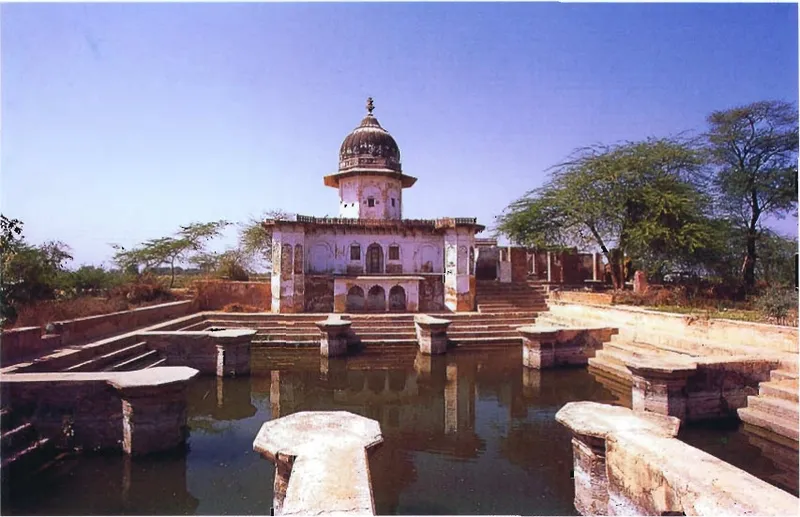
- What it is
- Uddhava-kuṇḍa is a pond beside the Govardhana parikramā path, just west of Kusuma-sarovara.
- Visiting
- Śrī Vraja-maṇḍala Parikramā (2007) places Uddhava-kuṇḍa exactly west of Kusuma-sarovara, on the right side of the parikramā path.
- Parikramā
- Govardhana parikramā, station 42
- Places here
- Rādhā-Kṛṣṇa Mandira (Uddhava-kuṇḍa)
In short
Uddhava-kuṇḍa is a pond beside the Govardhana parikramā path, just west of Kusuma-sarovara.[1 +2] It bears the name of Uddhava, who stayed in Vraja for months to comfort the gopīs and prayed to become a bush, creeper or herb of Vṛndāvana so that the dust of their feet would fall on him; Śrīmad-Bhāgavatam tells this without naming any place in Vraja.[4 +5] According to Śrī Vraja-maṇḍala Parikramā (2007), Mahārāja Vajranābha manifested the kuṇḍa.[1 +2] The Bhakti-ratnākara ends its round of Govardhana at the place where Uddhava sat and told Kṛṣṇa's pastimes to the queens of Dvārakā, but it names no kuṇḍa there.[12 +1]
Key facts
| Kind | kuṇḍa |
|---|---|
| Region · area | Govardhana |
| On the parikramā | Govardhana parikramā, station 42 · the route |
Divine pastimes
Uddhava in Vraja
Śrīmad-Bhāgavatam (10.47) tells that Uddhava, whom Kṛṣṇa had sent from Mathurā with His message, stayed in Vraja for several months, removing the gopīs' sorrow by singing of Kṛṣṇa's pastimes, and that as he saw the rivers, forests, hills and valleys of Vraja he reminded its people of Kṛṣṇa.[7 +3] Seeing the gopīs' love, he prayed:[4 +2]
āsām aho caraṇa-reṇu-juṣām ahaṃ syāṃ
vṛndāvane kim api gulma-latauṣadhīnām
yā dustyajaṃ sva-janam ārya-pathaṃ ca hitvā
bhejur mukunda-padavīṃ śrutibhir vimṛgyām
The gopīs of Vṛndāvana have given up the association of their husbands, sons and other family members, who are very difficult to give up, and they have forsaken the path of chastity to take shelter of the lotus feet of Mukunda, Kṛṣṇa, which one should search for by Vedic knowledge. Oh, let me be fortunate enough to become one of the bushes, creepers or herbs in Vṛndāvana, for the gopīs trample them and bless them with the dust of their lotus feet.
Translation: Śrīla A.C. Bhaktivedanta Swami PrabhupādaHe then offered his respects again and again to the dust of the feet of the women of Nanda's Vraja. The Bhāgavatam names Vṛndāvana and Nanda's Vraja, but no place within them.[4 +1]
The commentators add details (summarised here, not translated). Śrīla Sanātana Gosvāmī says that Uddhava stayed ten or eleven months, and Śrīla Śrīdhara Svāmī that at each river, forest and hill he made the people of Vraja remember Kṛṣṇa with questions about His pastimes; seeing the places of Kṛṣṇa's pastimes in the company of His dear devotees, Śrīla Sanātana Gosvāmī adds, gives the highest bliss.[7 +3] On Uddhava's prayer, Śrīla Sanātana Gosvāmī and Śrīla Jīva Gosvāmī say that he names Vṛndāvana because the gopīs are always there, and that out of humility his prayer comes down to asking to be grass. Śrīla Viśvanātha Cakravartī Ṭhākura says that he wished to be grass on the paths by which the gopīs go out to meet Kṛṣṇa every night, so that they would step on his head. None of them names a place within Vṛndāvana.[4 +2]
Śrīla Raghunātha dāsa Gosvāmī's Vraja-vilāsa-stava (verse 99) honours Uddhava, who left Kṛṣṇa's feet and lived in Vraja for ten months, again and again reviving the cowherd village with talks of Kṛṣṇa (summarised here, not translated).[18] In his Prīti-sandarbha Śrīla Jīva Gosvāmī writes that by a kāma-vyūha, a form that fulfils his desire, Uddhava also attains his goal, Kṛṣṇa, in Vraja, as his prayer shows (summarised here, not translated).[19] The Bhakti-ratnākara shows the places of Uddhava's stay at Nandīśvara, Nandagrāma, where he spoke on yoga, consoled Nanda and the others and stayed for some days; it does not connect that stay with Govardhana or with this kuṇḍa.[12 +2]
Uddhava and the queens near Govardhana
The Skanda Purāṇa's Bhāgavata-māhātmya tells of a later meeting. Kālindī, the Yamunā, told Kṛṣṇa's grieving queens that Uddhava lives near Govardhana Hill, at Sakhī-sthala, in the form of sprouts and creepers, because he longs for their dust (the gopīs', as G. V. Tagare's translation reads it), and that they should hold a kīrtana festival with Vajra near Kusuma-saras to meet him.[21]
गोवर्द्धनगिरिनिकटे सखीस्थले तद्रजःकामः ।। तत्रत्याङ्कुरवल्लीरूपेणास्ते स उद्धवो नूनम् ॥ 24 ॥ आत्मोत्सवरूपत्वं हरिणा तस्मै समर्पितं नियतम् ।। तस्मात्तत्र स्थित्वा कुसुमसरःपरिसरे सवज्राभिः ॥ 25 ॥
govarddhanagirinikaṭe sakhīsthale tadrajaḥkāmaḥ
tatratyāṅkuravallīrūpeṇāste sa uddhavo nūnam
24
ātmotsavarūpatvaṁ hariṇā tasmai samarpitaṁ niyatam
tasmāttatra sthitvā kusumasaraḥparisare savajrābhiḥ || 25 ||
The festival was held at Kusuma-saras, the flower lake, in Sakhī-sthala, not far from Govardhana, and as all looked on, Uddhava came out of the grass, bushes and creepers and was worshipped.[22 +1] Uddhava then said that, though he had gone to Badarī, he lives in the creepers of Vraja and always stays, by his own wish, at Nārada-kuṇḍa. He held a month-long recitation of the Śrīmad-Bhāgavatam in Vṛndāvana near Govardhana, during which Kṛṣṇa's pastimes became manifest and the queens were freed from the pain of separation.[24 +2] The text never names Uddhava-kuṇḍa.[21]
The Bhakti-ratnākara ends its round of Govardhana, after Sakhī-sthalī and before Rādhā-kuṇḍa, at the place where Uddhava sat and spoke of Kṛṣṇa to the queens of Dvārakā; it names no kuṇḍa there. That this place is today's Uddhava-kuṇḍa is suggested only by the order of the route, which a modern guidebook shares.[12 +1] Read more: Uddhava among the creepers: the queens' kīrtana →
Traditional accounts
According to Śrī Vraja-maṇḍala Parikramā (2007), Mahārāja Vajranābha manifested Uddhava-kuṇḍa under the guidance of Śāṇḍilya and …
According to Śrī Vraja-maṇḍala Parikramā (2007), Mahārāja Vajranābha manifested Uddhava-kuṇḍa under the guidance of Śāṇḍilya and other sages, and the undated parikramā notes Govardhana repeat this. The Skanda Purāṇa says in general that Vajra, by Śāṇḍilya's grace, found and named the places of Kṛṣṇa's pastimes and made kuṇḍas and wells, but it names no kuṇḍa.[1 +2]
The undated parikramā notes Uddhava-kuṇḍa (Uddhava-līlā), whose author is not named, say that Uddhava gave discourses here and brought Kṛṣṇa's beloved devotees to the kuṇḍa to discuss His pastimes from the Śrīmad-Bhāgavatam.[12 +3] Govardhana Hill (2001) says that Govardhana Hill has sunk into the ground at Uddhava-kuṇḍa and can no longer be seen there, and that Kusuma-sarovara was once on the other side of the hill.[2 +1]
Śrīla Prabhupāda
No statement of Śrīla Prabhupāda about the kuṇḍa itself has been found in the works searched.
No statement of Śrīla Prabhupāda about the kuṇḍa itself has been found in the works searched. Explaining Uddhava's prayer in general, he writes:[5]
General teaching (does not name the place)“Observing the unalloyed devotion and love of the gopīs for Kṛṣṇa, Uddhava desired to become a creeper, a blade of grass or an herb in Vṛndāvana so that sometimes the gopīs would trample him and he would receive the dust of their lotus feet on his head.”
Śrīla Prabhupāda, Śrī Caitanya-caritāmṛta, Antya-līlā 7.47, purport · vedabase.io
In the Kṛṣṇa book he names Govardhana Hill among the sights of Vṛndāvana that inspired Uddhava to tell Kṛṣṇa's pastimes:[9]
General teaching (does not name the place)“Vṛndāvana’s natural atmosphere, with the presence of the river Yamunā, its nice orchards of trees decorated with various fruits, Govardhana Hill, caves, blooming flowers – all combined to inspire Uddhava to narrate Kṛṣṇa’s pastimes.”
Śrīla Prabhupāda, Kṛṣṇa, the Supreme Personality of Godhead (Kṛṣṇa book), Chapter 47, 'Delivery of the Message of Kṛṣṇa to the Gopīs' · vedabase.io
Visiting today
Śrī Vraja-maṇḍala Parikramā (2007) places Uddhava-kuṇḍa exactly west of Kusuma-sarovara, on the right side of the parikramā path. Govardhana Hill (2001) puts it a few hundred metres from Kusuma-sarovara and says that a path on the left side of the building leads down to the kuṇḍa and to a small temple.[1 +2]
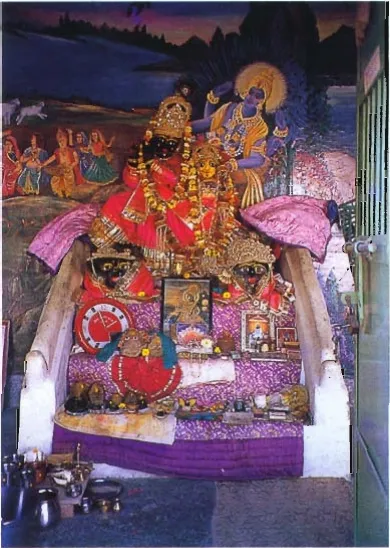
That temple, the Rādhā-Kṛṣṇa Mandira, has Deities of Rādhā and Kṛṣṇa. According to the local tradition recorded in the same book, They were installed five thousand years ago by Vajranābha, Kṛṣṇa's great-grandson; no inscription or dated record of the temple has been found, so this is not certain.[2 +3]
Location
| Where it is | 'only a few hundred meters from Kusuma-sarovara'; path 'On the left side of the building'[35] Govardhana map: '40', small square inside the loop, left side; Town map: arrow 'To Uddhava-kuṇḍa' pointing north-east[36] |
|---|---|
| On the numbered Govardhana chart | 68 (printed as “Uddhava Kund”)[37] |
Places at Uddhava-kuṇḍa
1 places
Nearby places
Kusuma-sarovara · Puṣpa Vana
Pictures
1 pictures
Where the sources differ
Where Uddhava is said to live in Vraja as grass or creepers, and where the queens' kīrtana took place, as the texts and the guidebooks tell it.[2 +7]
Accounts differ Where Uddhava lives in Vraja as grass or creepers, and where the queens' kīrtana with him took place
- Skanda Purāṇa, Bhāgavata-māhātmya 2.6.2.24-35near Govardhana Hill, at Sakhī-sthala, as sprouts and creepers; the festival at Kusuma-saras (the 'flower lake') in Sakhī-sthala, not far from Govardhana, where he came out of the grass, bushes and creepers
- Skanda Purāṇa, Bhāgavata-māhātmya 2.6.3.49-50Uddhava says that, though gone to Badarī, he stays here among the creepers of Vraja, and so remains for ever, by his own choice, at the Nārada-kuṇḍa here.
- Bhakti-ratnākara, Fifth Wave (1912 ed. pp. 199, 210)Kusuma-sarovara: the Couple's flower-picking, no Uddhava; the place where Uddhava sat and spoke Kṛṣṇa-kathā to the beloveds of Dvārakā is shown at the end of the circuit, after Sakhī-sthalī and before Rādhā-kuṇḍa (no kuṇḍa named)
- Śrī Vraja-maṇḍala Parikramā (2007)'Uddhavajī always resides nearby here [Uddhava-kuṇḍa] as grass and shrubs'; the Skanda's saṅkīrtana took place here and 'Uddhava pacified the queens at this place'
Accounts differ What happened in the queens' kīrtana with Uddhava, and whether Arjuna took part
- Śrī Vraja-maṇḍala Parikramā (2007) (citing the Skanda Purāṇa's Śrīmad-Bhāgavatam Māhātmya)Vajranābha came here with the queens; in the loud saṅkīrtana Kṛṣṇa's associates appeared one by one, the associates of Dvārakā sang and danced, Arjuna danced and played the mṛdaṅga, Uddhava emerged from the grass and danced, and Kṛṣṇa appeared with Rādhikā and the sakhīs and then disappeared; Uddhava pacified the queens here
- Skanda Purāṇa, Bhāgavata-māhātmya 2.6.2.28-35 and 2.6.3.66-71Parīkṣit had the festival held at Kusuma-saras; the pastimes appeared as if directly (sākṣād iva); Uddhava came out of the plants and was worshipped; later, during Uddhava's month-long Bhāgavata recitation near Govardhana, Kṛṣṇa's pastimes became manifest and the queens went to their own abode. Arjuna is not named in the festival.
- Padma Purāṇa 6.198.60 (Padma Bhāgavata-māhātmya 6.86)in a kīrtana at the Kumāras' Bhāgavata recitation near Gaṅgā-dvāra, Arjuna formed the rāgas, Indra played the drum (mṛdaṅga) and Uddhava the cymbals
More on this place
Uddhava among the creepers: the queens' kīrtana
References
37 references
- Śrī Vraja-maṇḍala Parikramā (2007), PDF p. 134
- Govardhana Hill: India's Most Sacred Mountain (2001), Rajasekhara dasa Brahmacari, PDF p. 150
- the key of the numbered Govardhana chart, ¶71
- Śrīmad-Bhāgavatam 10.47.61, GRETIL
- Śrīla Prabhupāda, Śrī Caitanya-caritāmṛta, Antya-līlā 7.47, purport · vedabase.io
- Śrīla Prabhupāda, Kṛṣṇa, the Supreme Personality of Godhead, Chapter 47 · vedabase.io
- Śrīmad-Bhāgavatam 10.47.54, GRETIL
- Śrīmad-Bhāgavatam 10.47.56, GRETIL
- Śrīla Prabhupāda, Kṛṣṇa, the Supreme Personality of Godhead (Kṛṣṇa book), Chapter 47, 'Delivery of the Message of Kṛṣṇa to the Gopīs' · vedabase.io
- the undated parikramā notes Govardhana, ¶154
- Skanda Purāṇa, Vaiṣṇava-khaṇḍa (2), Śrīmad-bhāgavata-māhātmya (section 6), adhyāya 2, verses 4-6, Sanskrit Wikisource
- Śrīla Narahari Cakravartī, Bhakti-ratnākara, Fifth Wave, 1912 ed. p. 210, 2nd ed., 1912
- Śrīla Narahari Cakravartī, Bhakti-ratnākara, Fifth Wave, 1912 ed. p. 199, 2nd ed., 1912
- Śrīmad-Bhāgavatam 10.47.63, GRETIL
- Śrīdhara Svāmī, Vaṁśīdhara, Śrīla Sanātana Gosvāmī: commentary on ŚB 10.47.56, Bhagavata Vidya Pith edition, ed. Bhagavata Rishi and Krishna Shankar Shastri, 1996
- Śrīla Sanātana Gosvāmī, Śrīla Jīva Gosvāmī: commentary on ŚB 10.47.61, Bhagavata Vidya Pith edition, ed. Bhagavata Rishi and Krishna Shankar Shastri, 1996
- Śrīla Viśvanātha Cakravartī Ṭhākura, Śrīla Jīva Gosvāmī: commentary on ŚB 10.47.63, Bhagavata Vidya Pith edition, ed. Bhagavata Rishi and Krishna Shankar Shastri, 1996
- Śrīla Raghunātha dāsa Gosvāmī, Stavāvalī, Vraja-vilāsa-stava v.99 v.99)
- Śrīla Jīva Gosvāmī, Ṣaṭ-sandarbha, Prīti-sandarbha, anuccheda 217, GRETIL
- Śrīla Narahari Cakravartī, Bhakti-ratnākara, Fifth Wave, 1912 ed. pp. 229-230, 2nd ed., 1912
Show all 37 references
- Skanda Purāṇa, 2.6.2.24-25 (Bhāgavata-māhātmya, adhyāya 2, verses 24-25), Sanskrit Wikisource
- Skanda Purāṇa, 2.6.2.30-31 (Bhāgavata-māhātmya, adhyāya 2, verses 30-31), Sanskrit Wikisource
- Skanda Purāṇa, 2.6.2.32-35 and the colophon of adhyāya 2, Sanskrit Wikisource
- Skanda Purāṇa, Vaiṣṇava-khaṇḍa (2), Śrīmad-bhāgavata-māhātmya (section 6), adhyāya 3, verses 49-50, Sanskrit Wikisource
- Skanda Purāṇa, 2.6.3.66-67 (Bhāgavata-māhātmya, adhyāya 3, verses 66-67), Sanskrit Wikisource
- Skanda Purāṇa, 2.6.3.68-71 (Bhāgavata-māhātmya, adhyāya 3, verses 68-71), Sanskrit Wikisource
- UDDHAVA KUNDA (UDDHAVA LILA), ¶2
- UDDHAVA KUNDA (UDDHAVA LILA), ¶12
- Govardhana Hill: India's Most Sacred Mountain (2001), Rajasekhara dasa Brahmacari, PDF p. 52
- Skanda Purāṇa, Vaiṣṇava-khaṇḍa (2), Bhāgavata-māhātmya, adhyāya 2, verses 4-6, Sanskrit Wikisource
- Śrīla Kṛṣṇadāsa Kavirāja Gosvāmī, Śrī Caitanya-caritāmṛta, CC Madhya-līlā 4.41, online edition · vedabase.io
- Śrīla Prabhupāda, Śrī Caitanya-caritāmṛta, Madhya-līlā 4.1, purport · vedabase.io
- Śrī Vraja-maṇḍala Parikramā (2007), PDF p. 135
- Vṛndāvana-Dhāma Ki Jaya! (c. 1986), by Dhruva Mahārāja dāsa, PDF p. 36
- Govardhana Hill: India's Most Sacred Mountain (2001), Rajasekhara dasa Brahmacari, p. 136
- Śrī Vraja-maṇḍala Parikramā (2007), p. 194-195
- Numbered list of the Govardhana sites (key of the Govardhana chart)