Vṛṣabhānu-kuṇḍa (Varṣāṇā)
वृषभानु-कुण्ड (बरसाना) Hindi name proposed
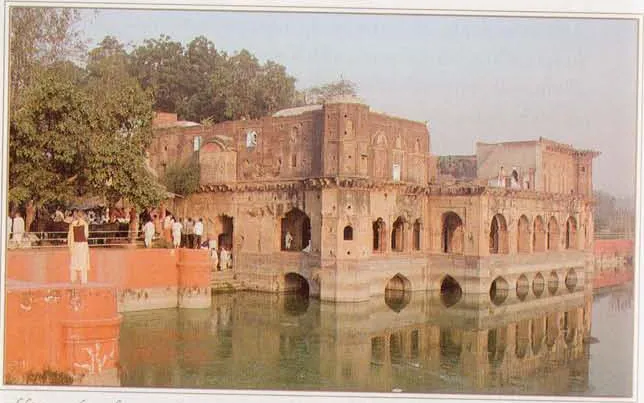
- What it is
- Vṛṣabhānu-kuṇḍa is a pond on the east side of Varṣāṇā.
- Visiting
- Śrī Vraja-maṇḍala Parikramā counts Vṛṣabhānu-kuṇḍa, in the east, among the four ponds around Varṣāṇā, with Kīrtidā-kuṇḍa near it to the north-east.
In short
Vṛṣabhānu-kuṇḍa is a pond on the east side of Varṣāṇā. According to the guidebook Śrī Vraja-maṇḍala Parikramā (2007), Mahārāja Vṛṣabhānu, Śrī Rādhā's father, bathed in it every morning, and it is named after him.[1 +1] Śrīla Nārāyaṇa Bhaṭṭa Gosvāmī's Vraja-bhakti-vilāsa calls the lake where Vṛṣabhānu bathed daily Bhānu-sarovara, and the Bhakti-ratnākara names a lake called Bhānukhora east of the town.[3 +2] One Bengali text gives both names to one pond, but the sources do not agree whether Vṛṣabhānu-kuṇḍa and Bhānu-sarovara are the same.[6] The guidebooks also tell of Rādhā's appearance on a lotus here and of Kṛṣṇa's play in its water.[1 +5]
Key facts
| Kind | kuṇḍa |
|---|---|
| Region · area | Varṣāṇā |
| Ācāryas | Śrīla Narahari Cakravartī Ṭhākura, Śrīla Rāghava Paṇḍita Gosvāmī of Govardhana, Śrīla Śrīnivāsa Ācārya, Śrīla Nārāyaṇa Bhaṭṭa Gosvāmī |
Traditional accounts
Vṛṣabhānu's bathing place
Śrī Vraja-maṇḍala Parikramā says that Vṛṣabhānu bathed in this kuṇḍa every morning and chanted his daily mantras here.[1 +1] The Vraja-bhakti-vilāsa (ch. 4, verse 67) says of the lake where Vṛṣabhānu took his daily bath that bathing there removes the faults of body, mind and speech, and that a gift made there gives a hundredfold result. Its prayer for bathing, which it cites from the Viṣṇu-dharmottara, honours the lake as made by Vṛṣabhānu Mahārāja, the king of the cowherds (summarised here, not translated).[3 +3]
यत्रैव वृषभानुश्च नित्यस्नानं चकारह । यत्रैव कृतदोषाश्च कायमानसवाचकाः ॥ स्नपनात्तेऽपि नश्यन्ति दानं शतगुणं फलं । ततो भानुसरोवरस्नानाचमन प्रार्थनमन्त्रः । विष्णुधर्मोत्तरे— निर्धूतकिल्विषायैव गोपराजकृताय ते । वृषभानुमहाराजकृताय सरसे नमः ॥ इति मन्त्रं शतावृत्या मज्जनाचमनैर्नमन् । सर्वान्कामानवाप्नोति धनधान्यसुखैर्युतः ॥ कृष्णदर्शनमाप्नोति मुक्तिभागी भवेन्नरः । नित्यमेव कृताद्दोषान्मुच्यते नात्र संशयः ॥ ६७ ॥
yatraiva vṛṣabhānuśca nityasnānaṁ cakāraha
yatraiva kṛtadoṣāśca kāyamānasavācakāḥ
snapanātte'pi naśyanti dānaṁ śataguṇaṁ phalaṁ
tato bhānusarovarasnānācamana prārthanamantraḥ
viṣṇudharmottare— nirdhūtakilviṣāyaiva goparājakṛtāya te
vṛṣabhānumahārājakṛtāya sarase namaḥ
iti mantraṁ śatāvṛtyā majjanācamanairnaman
sarvānkāmānavāpnoti dhanadhānyasukhairyutaḥ
kṛṣṇadarśanamāpnoti muktibhāgī bhavennaraḥ
nityameva kṛtāddoṣānmucyate nātra saṁśayaḥ || 67 ||
The same book calls this lake both Bhānu-sarovara and Vṛṣabhānu-saras. It places beside it the Mahārudra (Śiva) Vrajeśvara, whom Vṛṣabhānu and the other cowherds installed, and Kīrti-saras, the pond of Rādhā's mother, on its left.[4 +2]
Bhānukhora
In the Fifth Wave of the Bhakti-ratnākara, Śrīla Rāghava Paṇḍita Gosvāmī of Govardhana, guiding Śrīla Śrīnivāsa Ācārya, says: see Bhānukhora, east of Vṛṣabhānupura, a lake of very cool water and endless beauty; people now call it Bhānukhora, and its name was formerly Bhānu-sarovara (summarised here, not translated).[5] The same name is also used for a different lake at Rādhā-kuṇḍa, Bhānukhora.[5]
বৃষভানুপুর পূর্ব্বে দেখ ভানুখোর । অতি স্নিগ্ধ সলিল শোভার নাই ওর ॥ … ভানুখোর পিলুখোর এবে লোকে কয় । ভানু পিলু সরোবর পূর্ব্বে নাম হয় ॥
bṛṣabhānupura pūrbbe dekha bhānukhora
ati snigdha salila śobhāra nāi ora
… bhānukhora pilukhora ebe loke kaẏa
bhānu pilu sarobara pūrbbe nāma haẏa ||
The Bengali Bhaktamāla of Kṛṣṇadāsa Bābājī (1905) says that in the east of Vṛṣabhānupura is Vṛṣabhānu-kuṇḍa, by name Bhānukhora, with the kuṇḍa of Rādhā's mother, whom it calls Kṛttikā, on its left. It is the only text found that gives both names to one pond.[6] The introduction to the Hindi edition of the Vraja-bhakti-vilāsa lists Bhānukhora among the holy places of Varṣāṇā that were manifested through Śrīla Nārāyaṇa Bhaṭṭa Gosvāmī; this is a modern editor's report, and his own book does not say so.[15] Whether these names all mean this kuṇḍa, the sources do not agree:
Accounts differ Whether Vṛṣabhānu-kuṇḍa and Bhānu-sarovara (Bhānukhora) are one pond.
- Vraja-bhakti-vilāsa ch. 4 vv.67 and 69, with its Hindi translation; ch. 2 v.47 (citing the Padma)the lake where Vṛṣabhānu took his daily bath, made by Vṛṣabhānu Mahārāja, is Bhānu-sarovara, also called the Vṛṣabhānu-saras, with the Mahārudra Vrajeśvara (Vajreśvara) beside it and Kīrti-saras on its left; the Hindi calls the bathing place Bhānukhora
- Bhakti-ratnākara, Fifth Wave, printed p. 220Bhānukhora, formerly called Bhānu-sarovara, lies east of Vṛṣabhānupura; it does not mention Vṛṣabhānu's bath
- the Bengali Bhaktamāla of Kṛṣṇadāsa Bābājī (1905)In the east is Vṛṣabhānu-kuṇḍa, by name Bhānukhora; the kuṇḍa of Kṛttikā-mātā shines on its left — one pond with both names
- Śrī Vraja-maṇḍala Parikramā (2007)Vṛṣabhānu-kuṇḍa 'in the east', where Vṛṣabhānu bathed every morning, named after him, with Kīrtidā-kuṇḍa (Kīrti-sarovara) near it to the north-east; separately, right after its Vraja-bhakti-vilāsa quotation, 'Bhānu-sarovara is also nearby, and on its bank is Vrajeśvara … On its left side is Kīrti-sarovara', and 'Near Bhānu-sarovara is the deity of devādhideva Mahādeva'; it never says whether the two names mean one pond
The wording of these accounts is our summary of the sources, not a published translation.
Śrī Rādhā on the lotus
Śrī Vraja-maṇḍala Parikramā and the undated parikramā notes Mahāvana say that in some ages Vṛṣabhānu, while bathing, found the newborn Rādhikā on a lotus flower in Vṛṣabhānu-kuṇḍa, and in other ages on a lotus of a hundred petals in the Yamunā at Rāval. No scripture or Gosvāmī text has been found that tells the finding in this kuṇḍa.[1 +4] The Padma Purāṇa (Brahma-khaṇḍa) tells Her appearance differently: She appeared by day, on the eighth day of the bright fortnight of Bhādra, on Vṛṣabhānu's sacrificial ground, and was seen when the ground was being cleared; it mentions no lotus and no pond.[16]
Varṣāṇā and Rāval each have a tradition of Śrī Rādhā's appearance. Śrīla Raghunātha dāsa Gosvāmī's Vraja-vilāsa-stava and the Bhakti-ratnākara give Rāval as the place where She appeared.[17 +1] The sources are set out on the pages of Varṣāṇā and Rāval, and the accounts that differ here are shown below.[1 +5] Read more: The appearance of Śrī Rādhā: the traditions of Rāvala and Varṣāṇā →
Accounts differ How and where Śrī Rādhā appeared to Vṛṣabhānu: on a lotus in Vṛṣabhānu-kuṇḍa or in the Yamunā, on his sacrificial ground, or born in his house.
- Śrī Vraja-maṇḍala Parikramā (2007), Vṛṣabhānu-kuṇḍa entry'in a different era' Vṛṣabhānu found Rādhikā in this kuṇḍa while bathing, 'a newly-born baby girl playing on a lotus flower in the water'
- Śrī Vraja-maṇḍala Parikramā (2007), Rāval entry; the undated parikramā notes Mahāvana (repeats it)at Rāval Vṛṣabhānu, bathing in the Yamunā early in the morning, found Her on a lotus of a hundred petals; 'Sometimes Śrīmatī Rādhikā appears in Varsānā', on a lotus in Vṛṣabhānu-kuṇḍa; the difference is put down to different eras
- Padma Purāṇa, Brahma-khaṇḍa 7.40–42She appeared by day on the eighth of the bright half of Bhādra on Vṛṣabhānu's sacrificial ground and was seen when it was being cleared for the sacrifice; the king took Her to his queen; no lotus or pond
- Brahma-vaivarta Purāṇa, Kṛṣṇa-janma-khaṇḍa 3.116 and 17.143–144She took birth in Vṛṣabhānu's house in Gokula, as the daughter of Vṛṣabhānu and Kalāvatī, not born from a womb (ayoni-sambhavā)
The wording of these accounts is our summary of the sources, not a published translation.
Play in the water
According to the local tradition recorded in Śrī Vraja-maṇḍala Parikramā (2007), Śrīmatī Rādhikā sometimes bathed and played in this kuṇḍa with Her sakhīs (girl companions), and Kṛṣṇa joined their play in the water. No scripture or Gosvāmī text has been found that tells this play at the kuṇḍa.[2]
The Bhāgavatam (10.33.22–23) tells a water play of Kṛṣṇa with the gopīs after the rāsa dance, in the Yamunā: the laughing gopīs splash Him, and He plays like the king of elephants. It does not name this kuṇḍa.[19 +3]
tābhir yutaḥ śramam apohitum aṅga-saṅga- ghṛṣṭa-srajaḥ sa kuca-kuṅkuma-rañjitāyāḥ
gandharva-pālibhir anudruta āviśad vāḥ śrānto gajībhir ibha-rāḍ iva bhinna-setuḥ ||
To dispel the fatigue of the gopīs, Kṛṣṇa entered the water of the Yamunā, followed swiftly by bees who were singing like the best of the Gandharvas. He appeared like a lordly elephant entering the water to relax in the company of his consorts.
Translation: Śrīla Prabhupāda's disciples (BBT)Visiting today
Śrī Vraja-maṇḍala Parikramā counts Vṛṣabhānu-kuṇḍa, in the east, among the four ponds around Varṣāṇā, with Kīrtidā-kuṇḍa near it to the north-east.[1 +1] It says that jiyala trees surround the kuṇḍa.[2] In 1987 Entwistle found on the west side of the tank Bhānokhar a water palace, a temple of Caturbhuja of the Nimbārka sampradāya and a temple of Brajeśvar Mahādev, with the cenotaphs opposite and Kīrti-kuṇḍa next to it on the north-east; the tank then lay opposite the bus station on the road to Govardhana.[26 +1]
Location
Nearby places
Varṣāṇā · Kīrtidā-kuṇḍa
History
The historians write about a tank at Varṣāṇā called Bhānokhar. Their words apply to this kuṇḍa only if Bhānokhar is Vṛṣabhānu-kuṇḍa, which the sources above leave open.[23 +2]
Growse (1883) writes that the tank was restored and given the shape it had in his day, with broad flights of steps and towers at the sides, by Rūp Rām, a Kaṭārā brāhmaṇa of the earlier eighteenth century. He described beside it the cenotaphs of Rūp Rām and two relatives, a three-storeyed pleasure-house on the water, and a smaller reservoir named after Rādhā's mother; he adds that a later owner had damaged the tank by removing many of its slabs.[24 +1] Mītal (1966) also credits Rūprām Kaṭārā, with the high masonry wall, turrets and chhatris around the tank.[23] Entwistle (1987) reported, after Führer, an inscription on a pillar in the tank which, as he read its date, puts Rūp Rām's work in AD 1744; Entwistle gives the date only from Führer's report and his own reading of its era, so it is not certain.[26]
According to Entwistle, a verse attributed to the poet Nehī Nāgarīdās, who settled at Varṣāṇā in the late sixteenth century, already names Bhānokhar, together with Vilāsa-garh, Sāṅkarī-khor and Gahvaravana. Entwistle knew the verse only from other books that quote it.[27]
More on this place
The appearance of Śrī Rādhā: the traditions of Rāvala and Varṣāṇā
References
29 references
- Śrī Vraja-maṇḍala Parikramā (2007), PDF p. 171
- Śrī Vraja-maṇḍala Parikramā (2007), PDF p. 172
- Śrīla Nārāyaṇa Bhaṭṭa, Vraja-bhakti-vilāsa, ch. 4 v.67 (Bhānu-sarovara), printed p. 103, 1st ed., publ. Bābā Kṛṣṇadāsa, Kusuma-sarovara, Saṁvat 2008
- Śrīla Nārāyaṇa Bhaṭṭa, Vraja-bhakti-vilāsa, ch. 4 vv.67 and 69, Hindi translation on printed p. 103, 1st ed., publ. Bābā Kṛṣṇadāsa, Kusuma-sarovara, Saṁvat 2008
- Śrīla Narahari Cakravartī, Bhakti-ratnākara, Fifth Wave, 1912 ed. p. 220, 2nd ed., 1912
- Śrī Śrī Bhaktamāla grantha, ṣaḍviṁśa-mālā, printed p. 337, left column
- Śrī Vraja-maṇḍala Parikramā (2007), PDF p. 280
- Śrī Vraja-maṇḍala Parikramā (2007), PDF p. 281
- the undated parikramā notes Mahāvana, ¶106
- the undated parikramā notes Mahāvana, ¶107
- Śrīla Nārāyaṇa Bhaṭṭa, Vraja-bhakti-vilāsa, ch. 2 v.47, printed p. 46, 1st ed., publ. Bābā Kṛṣṇadāsa, Kusuma-sarovara, Saṁvat 2008
- Śrīla Nārāyaṇa Bhaṭṭa, Vraja-bhakti-vilāsa, ch. 4 v.69, first couplet (Vrajeśvara beside the Vṛṣabhānu-saras), printed p. 103, 1st ed., publ. Bābā Kṛṣṇadāsa, Kusuma-sarovara, Saṁvat 2008
- Śrīla Nārāyaṇa Bhaṭṭa, Vraja-bhakti-vilāsa, ch. 4 v.67 (Bhānu-sarovara), printed p. 103, 1st ed., publ. Bābā Kṛṣṇadāsa, Kusuma-sarovara, Saṁvat 2008
- Śrīla Narahari Cakravartī, Bhakti-ratnākara, Fifth Wave, 1912 ed. p. 220, 2nd ed., 1912
- Vraja-bhakti-vilāsa, introduction, 1st ed., publ. Bābā Kṛṣṇadāsa, Kusuma-sarovara, Saṁvat 2008
- Padma Purāṇa, Brahma-khaṇḍa 7.40–42, Sanskrit Wikisource
- Śrīla Raghunātha dāsa Gosvāmī, Vraja-vilāsa-stava, Stavāvalī (9) Vraja-vilāsa-stava v.90
- Śrīla Narahari Cakravartī, Bhakti-ratnākara, Fifth Wave, 1912 ed. p. 285; Grantha Mandira text v.1809–1810, 2nd ed., 1912
- Śrīmad-Bhāgavatam 10.33.22
- Śrīmad-Bhāgavatam 10.33.23
Show all 29 references
- Śrīla Viśvanātha Cakravartī Ṭhākura: commentary on ŚB 10.33.22
- Śrīla Prabhupāda, Kṛṣṇa, the Supreme Personality of Godhead (Kṛṣṇa book), chapter 33, 'Description of the Rāsa Dance' · vedabase.io
- Prabhudayāl Mītal, section 'Braj-yātrā', entry 'भानोखर', printed p. 120
- Mathurá (1883), F. S. Growse, B.C.S., M.A. Oxon., C.I.E. (as the title page gives him
- Muttra (1911), D. L. Drake-Brockman, I.C.S. (edited and compiled), p. 235
- A. W. Entwistle, §37 item 2 'Bhanokhar', printed p. 371, Egbert Forsten, Groningen, 1987
- A. W. Entwistle, §37 'Barsana', printed p. 370, Egbert Forsten, Groningen, 1987
- Śrī Vraja-maṇḍala Parikramā (2007), PDF p. 180
- A. W. Entwistle, §37 item 2 'Bhanokhar' (continued), printed p. 372, Egbert Forsten, Groningen, 1987