Paiṭhā-grāma
पैठा-ग्राम Hindi name proposed
Also called Paiṭhā
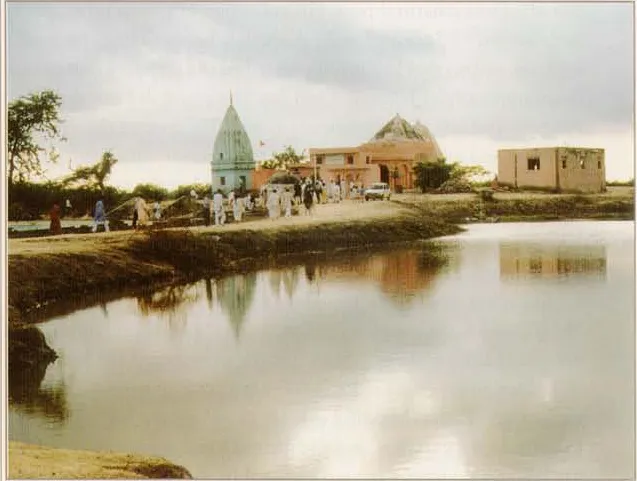
- What it is
- Paiṭhā is a village of the Govardhana area, two miles south of Pārāsaulī, according to the guidebook Śrī Vraja-maṇḍala Parikramā (2007).
- Visiting
- Vṛndāvana-Dhāma Ki Jaya! (c. 1986) places the site of the four-armed pastime a short distance from Govinda-kuṇḍa, but off the parikramā path.
- Parikramā
- Govardhana parikramā, station 24
In short
Paiṭhā is a village of the Govardhana area, two miles south of Pārāsaulī, according to the guidebook Śrī Vraja-maṇḍala Parikramā (2007).[1 +1] According to the Bhakti-ratnākara, Kṛṣṇa disappeared from the rāsa dance in the forest here and appeared before the searching gopīs with four arms; when Śrī Rādhā saw Him, the two extra arms entered (paiṭhe) His body, and the village is named after this.[3] The Caitanya-caritāmṛta tells this pastime of a spring rāsa at Govardhana without naming the village, and Śrīla Rūpa Gosvāmī teaches from it that Rādhā's love makes Kṛṣṇa two-armed.[4 +5]
Key facts
| Kind | village |
|---|---|
| Region · area | Govardhana |
| On the parikramā | Govardhana parikramā, station 24 · the route |
| Ācāryas | Śrīla Rūpa Gosvāmī, Śrīla Kṛṣṇadāsa Kavirāja Gosvāmī, Śrīla Narahari Cakravartī Ṭhākura, Śrīla Śrīnivāsa Ācārya, Śrīla Bhaktisiddhānta Sarasvatī Ṭhākura |
Divine pastimes
Kṛṣṇa leaves the rāsa
Śrīmad-Bhāgavatam (10.29.48–10.32.2) tells how Kṛṣṇa disappeared from the rāsa dance to curb the gopīs' pride, how they searched the forest and found the footprints of one gopī whom He had taken to a secluded place, and how He left her too when she grew proud. The gopīs went back to the bank of the Kālindī, the Yamunā, and sang of Him, and Kṛṣṇa appeared before them again, smiling, in a yellow garment and a garland. The Bhāgavatam tells no four-armed form and names no village.[10 +5]
tāsāṃ tat-saubhaga-madaṃ vīkṣya mānaṃ ca keśavaḥ / praśamāya prasādāya tatraivāntaradhīyata
Lord Keśava, seeing the gopīs too proud of their good fortune, wanted to relieve them of this pride and show them further mercy. Thus He immediately disappeared.
Translation: Śrīla Prabhupāda's disciples (BBT)Śrīla Viśvanātha Cakravartī Ṭhākura explains (summarised here, not translated) that Rādhā, the foremost of the gopīs, had become jealous and angry (māninī), and that Kṛṣṇa disappeared taking Her with Him, to curb the pride of the others and to pacify Her. The Gauḍīya commentators read the gopīs' words in 10.30.28 as giving Her name, and Śrīla Prabhupāda's Kṛṣṇa book calls the gopī whom Kṛṣṇa took alone Rādhārāṇī.[11 +2]
The four-armed form
The Caitanya-caritāmṛta (Ādi 17.282–293) tells a pastime of the spring rāsa at Govardhana. Kṛṣṇa disappeared, having made a sign to Rādhā, and hid in a bush. When the gopīs found Him, He took the four-armed form of Nārāyaṇa; they bowed to that form and went on. But before Rādhā He could not keep the four arms.[4 +3]
বসন্তকালে রাসলীলা করে গোবর্ধনে ।
অন্তর্ধান কৈলা সঙ্কেত করি’ রাধা–সনে ॥ ২৮২ ॥
vasanta-kāle rāsa-līlā kare govardhane
antardhāna kailā saṅketa kari’ rādhā-sane
During the season of springtime, when the rāsa dance was going on, suddenly Kṛṣṇa disappeared from the scene, indicating that He wanted to be alone with Śrīmatī Rādhārāṇī.
Translation: Śrīla A.C. Bhaktivedanta Swami Prabhupādaলুকাইলা দুই ভুজ রাধার অগ্রেতে ।
বহু যত্ন কৈলা কৃষ্ণ, নারিল রাখিতে ॥ ২৯১ ॥
lukāilā dui bhuja rādhāra agrete
bahu yatna kailā kṛṣṇa, nārila rākhite
In front of Śrīmatī Rādhārāṇī, Śrī Kṛṣṇa had to hide the two extra arms. He tried His best to keep four arms before Her, but He was completely unable to do so.
Translation: Śrīla A.C. Bhaktivedanta Swami PrabhupādaŚrīla Rūpa Gosvāmī states the principle in his Ujjvala-nīlamaṇi: though Hari may playfully show four arms, the love of the Queen of Vṛndāvana makes Him two-armed. He gives this pastime as the example, in a verse that the Caitanya-caritāmṛta also quotes:[3 +5]
rāsārambha-vidhau nilīya vasatā kuñje mṛgākṣī-gaṇair dṛṣṭaṃ gopayituṃ svam uddhura-dhiyā yā suṣṭhu sandarśitā
rādhāyāḥ praṇayasya hanta mahimā yasya śriyā rakṣituṃ sā śakyā prabhaviṣṇunāpi hariṇā nāsīc catur-bāhutā
“Prior to the rāsa dance, Lord Kṛṣṇa hid Himself in a grove just to have fun. When the gopīs came, their eyes resembling those of deer, by His sharp intelligence He exhibited His beautiful four-armed form to hide Himself. But when Śrīmatī Rādhārāṇī came there, Kṛṣṇa could not maintain His four arms in Her presence. This is the wonderful glory of Her love.”
Translation: Śrīla A.C. Bhaktivedanta Swami PrabhupādaIn Śrīla Rūpa Gosvāmī's play Lalita-mādhava (6.15), Viśākhā says that the gopīs' love shrank when Kṛṣṇa showed them a four-armed form of Viṣṇu, for their love is for the son of the king of the cowherds; the commentary printed with the play sets this in the rāsa. The Caitanya-caritāmṛta quotes the verse as well (Ādi 17.281).[2 +3] In Śrīla Raghunātha dāsa Gosvāmī's Muktā-carita, Lalitā recalls that at the great festival of the spring rāsa, in a bower of a forest section named Praviṣṭaka near the supreme rāsa-sthalī (place of the rāsa), Kṛṣṇa by trickery showed a four-armed form to deceive the gopīs. The name Praviṣṭaka is formed from praviṣṭa, "entered", but no source says that it is Paiṭhā.[21]
How the village got its name
According to the Bhakti-ratnākara, Śrīla Śrīnivāsa Ācārya's guide showed him the village of Paiṭha on their round of Govardhana and told how it got its name. In the rāsa Kṛṣṇa disappeared in this forest; the gopīs wandered in search of Him; Kṛṣṇa appeared before them with four arms, and when Rāi (Rādhā) saw Him, two arms entered His body. The book quotes Śrīla Rūpa Gosvāmī's two verses and closes that this is why the name Paiṭha is known among the people; a footnote explains paiṭhe as "enters".[1 +2]
Śrī Vraja-maṇḍala Parikramā (2007) adds that Kṛṣṇa met Śrīmatī Rādhārāṇī again at Paiṭhā, and says that this spring rāsa stands apart because it shows Rādhikā's superiority over the other gopīs. The Caitanya-caritāmṛta and the Bhakti-ratnākara do not tell this meeting.[1 +1] The guidebook refers here to Śrī Caitanya Mahāprabhu's words in the Caitanya-caritāmṛta (Madhya 8.102–103): Kṛṣṇa stole Rādhā away from the rāsa because of the other gopīs, and since He gave them up for Her, His love for Her is intense. That passage does not call the rāsa a spring rāsa or name a place.[23 +1] Read more: The spring rāsa at Govardhana: Pārāsaulī, Candra-sarovara and Paiṭhā →
Śrīla Prabhupāda
Śrīla Prabhupāda mentions Paiṭha as a landmark.
Śrīla Prabhupāda mentions Paiṭha as a landmark. Giving Śrīla Bhaktisiddhānta Sarasvatī Ṭhākura's information about Govinda-kuṇḍa, he writes that Aniyora lies a little distance from the village of Paiṭha:[28]
Names this place“Śrīla Bhaktisiddhānta Sarasvatī Ṭhākura gives the following information about Govinda-kuṇḍa. There is a village named Āniyora on Govardhana Hill, a little distance from the village of Paiṭha.”
Śrīla Prabhupāda, Śrī Caitanya-caritāmṛta, Madhya-līlā 18.37, purport · vedabase.io
He told the four-armed pastime itself in a lecture in Bombay on 1 April 1974, without naming a place, to show that devotees are attracted by different features of the one Lord:[29]
General teaching (does not name the place)“Sometimes it so happened that Kṛṣṇa disappeared from the rāsa dance and the gopīs were very much eager to find out Kṛṣṇa again. So when they were too much eager to see Kṛṣṇa, where He is, Kṛṣṇa appeared as Nārāyaṇa, four-handed Nārāyaṇa. The gopīs saw nārāyaṇa-mūrti but did not become attracted by Him.”
Śrīla Prabhupāda, Lecture on Bhagavad-gītā 4.12, Appearance Day of Lord Rāmacandra, Bombay, 1 April 1974 · vedabase.io
Explaining the four-armed pastime in a purport to the Caitanya-caritāmṛta, he names no place (a general reference):[1 +5]
General teaching (does not name the place)“The gopīs were not made happy even by seeing the four-armed form of Nārāyaṇa. Yet they offered their respects to the Supreme Personality of Godhead and begged from Him the benediction of achieving the association of Kṛṣṇa. Such is the ecstatic feeling of the gopīs.”
Śrīla Prabhupāda, Śrī Caitanya-caritāmṛta, Ādi-līlā 17.288, purport · vedabase.io
Visiting today
Vṛndāvana-Dhāma Ki Jaya! (c. 1986) places the site of the four-armed pastime a short distance from Govinda-kuṇḍa, but off the parikramā path.[1 +1] Śrī Vraja-maṇḍala Parikramā (2007) names four places of darśana in Paiṭhā: the lake Nārāyaṇa-sarovara, the kadamba tree Aiṁṭhā-kadamba, and two ponds, Khīra-sāgara and Balabhadra-kuṇḍa. It tells no story of any of them and does not connect Nārāyaṇa-sarovara with Kṛṣṇa's four-armed Nārāyaṇa form.[23]
Location
| Where it is | two miles south of Pārāsaulī[30] Govardhana map: dot '22' right of the hill, beside a road running down to the right[31] |
|---|
Places at Paiṭhā-grāma
5 places
Also described on this page
Also listed here
- Aiṁṭhā-kadamba tree
- Balabhadra-kuṇḍa (Paiṭhā) kuṇḍa
- Khīra-sāgara (Paiṭhā) kuṇḍa
- Nārāyaṇa-sarovara (Paiṭhā) sarovara
Nearby places
Pārāsaulī · Govinda-kuṇḍa (Govardhana) · Candra-sarovara
History
According to the local tradition recorded in the guidebook Vṛndāvana-Dhāma Ki Jaya! (c. 1986), the four-armed (catur-bhuja) Deity in Paiṭhā was installed by Vajranābha; no other source mentions this installation, so it is not certain.[22] In 1883 the historian F. S. Growse found the later temple of Catur-bhuja already in ruins and judged that it was probably built on the foundations of an older one.[25 +1] In 1987 the historian A. W. Entwistle found the temple of Caturbhujajī, with a large image of four-armed Kṛṣṇa, served by priests of the Gauḍīya sampradāya; whether this is still so is not certain.[26]
Catur-bhuja
Catur-bhuja, "the four-armed one", is a name printed in the numbered key to a chart of Govardhana, together with Candra-sarovara under one number; the key does not say what it is.[27] Vṛndāvana-Dhāma Ki Jaya! (c. 1986) describes a four-armed Deity at Paiṭhā, with Candra-sarovara nearby, and the caption of its photograph of the Deity places it where Śrīmatī Rādhārāṇī found Kṛṣṇa hiding; no source says whether the chart's Catur-bhuja is that Deity.[22]
The four-armed form belongs to the pastime of the spring rāsa told above: as the Caitanya-caritāmṛta and Śrīla Rūpa Gosvāmī's Ujjvala-nīlamaṇi tell, Kṛṣṇa hid from the gopīs in a four-armed form but could not keep it before Śrī Rādhā. Neither book names a village, grove or kuṇḍa.[1 +6] Śrīmad-Bhāgavatam's account of the rāsa night tells of no four-armed form and names no village or grove: when Kṛṣṇa came back to the gopīs, He came smiling, in a yellow garment and a garland.[10 +2]
tāsāṃ tat-saubhaga-madaṃ vīkṣya mānaṃ ca keśavaḥ / praśamāya prasādāya tatraivāntaradhīyata
Lord Keśava, seeing the gopīs too proud of their good fortune, wanted to relieve them of this pride and show them further mercy. Thus He immediately disappeared.
Translation: Śrīla Prabhupāda's disciples (BBT)The commentators on this verse say that Kṛṣṇa disappeared together with Śrī Rādhā, who was in māna, the angry mood of a lover, and that He went nowhere else but became invisible right there; none of them mentions a four-armed form (summarised here, not translated).[10 +1]
Where the sources differ
How Kṛṣṇa's disappearance from the rāsa is told: Śrīmad-Bhāgavatam and its commentators, the Caitanya-caritāmṛta and Śrīla Rūpa …
How Kṛṣṇa's disappearance from the rāsa is told: Śrīmad-Bhāgavatam and its commentators, the Caitanya-caritāmṛta and Śrīla Rūpa Gosvāmī, the Bhakti-ratnākara and the guidebook.
Accounts differ How Kṛṣṇa's disappearance from the rāsa and the gopīs' search are told (four-armed form, who leaves whom, season and place)
- Śrīmad-Bhāgavatam 10.29.48–10.32.2on the autumn rāsa night by the Yamunā Kṛṣṇa disappears to curb the gopīs' pride, with one gopī whom He leaves when she grows proud; the gopīs search, return to the Kālindī's bank and sing; He reappears smiling in His own form; no four-armed form
- Śrīla Viśvanātha Cakravartī and Baladeva on ŚB 10.29.48Rādhā had become jealous (māninī); Kṛṣṇa took Her away by force to pacify Her and to curb the others' pride
- Śrī Caitanya-caritāmṛta Ādi 17.282-293at the spring rāsa at Govardhana Kṛṣṇa disappeared after a sign to Rādhā, hid in a bush, showed the gopīs a four-armed Nārāyaṇa form and could not keep it before Rādhā
- Ujjvala-nīlamaṇi 5.7 (Śrīla Rūpa Gosvāmī)at the beginning of the rāsa (rāsārambha-vidhau) Kṛṣṇa hid in a grove and showed the gopīs a four-armed form, which He could not keep before Rādhā
Two more tellings belong beside these: in Śrīmad-Bhāgavatam, as Śrīla Prabhupāda's Kṛṣṇa book also tells it, Kṛṣṇa disappears right there on the river bank and comes back smiling, with no four-armed form; and Śrīla Raghunātha dāsa Gosvāmī's Muktā-carita sets the four-armed form in a bower of the forest Praviṣṭaka near the place of the rāsa.[10 +3]
Where the spring rāsa took place: the sources differ, and their accounts are set side by side on the page of Pārāsaulī.[4 +3]
More on this place
The spring rāsa at Govardhana: Pārāsaulī, Candra-sarovara and Paiṭhā
References
31 references
- Śrī Vraja-maṇḍala Parikramā (2007), PDF p. 124
- Vṛndāvana-Dhāma Ki Jaya! (c. 1986), by Dhruva Mahārāja dāsa, PDF p. 42
- Śrīla Narahari Cakravartī, Bhakti-ratnākara, Fifth Wave, 1912 ed. pp. 200-201, 2nd ed., 1912
- Śrīla Kṛṣṇadāsa Kavirāja Gosvāmī, Śrī Caitanya-caritāmṛta, CC Ādi-līlā 17.282, online edition · vedabase.io
- Śrīla Kṛṣṇadāsa Kavirāja Gosvāmī, Śrī Caitanya-caritāmṛta, CC Ādi-līlā 17.291, online edition · vedabase.io
- Śrīla Prabhupāda, Śrī Caitanya-caritāmṛta, Ādi-līlā 17.282, synonyms · vedabase.io
- Śrīla Prabhupāda, Śrī Caitanya-caritāmṛta, Ādi-līlā 17.288, purport · vedabase.io
- Śrīla Rūpa Gosvāmī, Ujjvala-nīlamaṇi, Nāyikā-bheda (chapter 5), verse 6, GRETIL
- Śrīla Rūpa Gosvāmī, Ujjvala-nīlamaṇi, Nāyikā-bheda (chapter 5), verse 7, GRETIL
- Śrīmad-Bhāgavatam 10.29.48, GRETIL
- Śrīmad-Bhāgavatam 10.30.28, GRETIL
- Śrīmad-Bhāgavatam 10.30.38, GRETIL
- Śrīmad-Bhāgavatam 10.30.44, GRETIL
- Śrīmad-Bhāgavatam 10.32.2, GRETIL
- Śrīla Prabhupāda, Kṛṣṇa, the Supreme Personality of Godhead (Kṛṣṇa book), Chapter 30, 'Kṛṣṇa’s Hiding from the Gopīs' · vedabase.io
- Śrīla Viśvanātha Cakravartī Ṭhākura: commentary on ŚB 10.29.48
- Śrīla Rūpa Gosvāmī, Ujjvala-nīlamaṇi, Nāyikā-bheda (chapter 5), verse 5, quoting the Lalita-mādhava, GRETIL
- Śrīla Kṛṣṇadāsa Kavirāja Gosvāmī, Śrī Caitanya-caritāmṛta, CC Ādi-līlā 17.281, online edition · vedabase.io
- Śrīla Rūpa Gosvāmī, Lalita-mādhava, Act 6, verse 15, with the commentary on it
- Śrīla Rūpa Gosvāmī, Ujjvala-nīlamaṇi, Nāyikā-bheda (chapter 5), verse 7, GRETIL
Show all 31 references
- Śrīla Raghunātha dāsa Gosvāmī, Muktā-carita, prose, paragraph 194 of the, GRETIL
- Vṛndāvana-Dhāma Ki Jaya! (c. 1986), by Dhruva Mahārāja dāsa, PDF p. 43
- Śrī Vraja-maṇḍala Parikramā (2007), PDF p. 125
- Śrīla Kṛṣṇadāsa Kavirāja Gosvāmī, Śrī Caitanya-caritāmṛta, CC Madhya-līlā 8.102, online edition · vedabase.io
- Mathurá (1883), F. S. Growse, B.C.S., M.A. Oxon., C.I.E. (as the title page gives him, p. 83
- A. W. Entwistle, ch. 8 §17 'Paintha', printed p. 349, Egbert Forsten, Groningen, 1987
- the key of the numbered Govardhana chart, ¶36
- Śrīla Prabhupāda, Śrī Caitanya-caritāmṛta, Madhya-līlā 18.37, purport · vedabase.io
- Śrīla Prabhupāda, Lecture on Bhagavad-gītā 4.12, Appearance Day of Lord Rāmacandra, Bombay, 1 April 1974 · vedabase.io
- Śrī Vraja-maṇḍala Parikramā (2007), p. 222-223
- Śrī Vraja-maṇḍala Parikramā (2007), p. 194-195