The Kātyāyanī vow and the gopīs' clothes: the pastime and its places
चीर-घाट: कात्यायनी व्रत और गोपियों के वस्त्र की लीला
In short
In the first month of winter the unmarried girls of Vraja kept a month-long vow to the goddess Kātyāyanī, praying for Kṛṣṇa as their husband. Śrīmad-Bhāgavatam tells that one day Kṛṣṇa took their clothes from the Yamunā's bank, climbed a kadamba tree (a flowering tree of Vraja), and then fulfilled their prayer. Śrīla Prabhupāda names the place Cīra-ghāṭa.[1–7]
On this page
At a glance
- Scripture: Śrīmad-Bhāgavatam, Tenth Canto, chapter 22.[1–6]
- The vow: for the whole first month of Hemanta (winter), a daily bath in the Yamunā at sunrise and worship of a sand image of the goddess.[1, 2]
- The prayer: that the son of Nanda Mahārāja would become each girl's husband.[4]
- The promise: Kṛṣṇa told the girls that their desire was fulfilled and that they would enjoy the coming nights in His company.[6]
- The place: Śrīla Prabhupāda's Kṛṣṇa book says Cīraghāṭa on the Yamunā, without saying which; two Cīra-ghāṭas claim the pastime.[7–9]
- Śrīla Prabhupāda's caution: the taking of the clothes of the gopīs, the cowherd girls of Vraja, is not to be presented to ordinary people as an ordinary thing.[10]
How should this pastime be approached?
Śrīla Prabhupāda asked that the taking of the gopīs' clothes be treated with care, as a very confidential pastime of Kṛṣṇa. In 1977 he was asked to bless a film of Kṛṣṇa's pastimes. He answered that people misunderstand some pastimes, and he named the rāsa-līlā, the rāsa dance (Kṛṣṇa's circle dance), and the gopīs' vastra-haraṇa-līlā, the taking of their clothes. These, he said, should not be shown to ordinary people.[10]
General teaching (does not name the place)“Jayadeva's, that poetry, that Kṛṣṇa is begging pardon from Rādhārāṇī, that is also very confidential. … We must understand it is very confidential thing. It is not for ordinary men. If we present as ordinary thing, that is distortion.”
Śrīla Prabhupāda, Room Conversation with Film Producer about Kṛṣṇa Lila, Bhubaneswar, 22 January 1977 · vedabase.io
So this article gives only the Bhāgavatam's outline, Śrīla Prabhupāda's words and the places where the pastime is remembered. The scene itself is left to the Bhāgavatam and its commentators.[1–6, 10]
What is the Kātyāyanī vow?
The Bhāgavatam, the scripture of Kṛṣṇa's life, begins the chapter with the vow. In Hemanta, the first month of winter, the young unmarried girls of Vraja kept a vow to worship the goddess Kātyāyanī. For the whole month they ate only simple food:[1–6]
hemante prathame māsi nanda-vraja-kamārikāḥ / cerur haviṣyaṃ bhuñjānāḥ kātyāyany-arcana-vratam
Śukadeva Gosvāmī said: During the first month of the winter season, the young unmarried girls of Gokula observed the vow of worshiping goddess Kātyāyanī. For the entire month they ate only unspiced khichrī.
Translation: Śrīla Prabhupāda's disciples (BBT)Each morning they bathed in the Yamunā as the sun rose. Then they made an image of the goddess from the sand of the bank and worshipped her with sandalwood, lamps, fruits, leaves, garlands and incense.[2] Each of them prayed with the same mantra:[4]
kātyāyani mahā-māye mahā-yoginy adhīśvari / nanda-gopa-sutaṃ devi patiṃ me kuru te namaḥ / iti mantraṃ japantyas tāḥ pūjāṃ cakruḥ kamārikāḥ
Each of the young unmarried girls performed her worship while chanting the following mantra. “O goddess Kātyāyanī, O great potency of the Lord, O possessor of great mystic power and mighty controller of all, please make the son of Nanda Mahārāja my husband. I offer my obeisances unto you.”
Translation: Śrīla Prabhupāda's disciples (BBT)Śrīla Prabhupāda tells the vow in his Kṛṣṇa book in his own words:[11]
General teaching (does not name the place)“Early in the morning, the gopīs used to go to the bank of the Yamunā to take a bath. … Appearing on the scene, Kṛṣṇa immediately collected all the garments of the gopīs, climbed up into a nearby tree, and with a smiling face began to speak to them.”
Śrīla Prabhupāda, Kṛṣṇa, the Supreme Personality of Godhead (Kṛṣṇa book), Chapter 22, 'Stealing the Garments of the Unmarried Gopī Girls' · vedabase.io
Śrīla Sanātana Gosvāmī explains that Kātyāyanī is Pārvatī, the beloved of Lord Śiva (summarised here, not translated). The translation of the Bhāgavatam calls the image the goddess Durgā.[2, 4] The commentators also say that the girls rose before dawn and walked a long way to the river, calling one another by name. Śrīla Sanātana Gosvāmī says that the Yamunā was far away. Śrīla Jīva Gosvāmī calls their daily walk a going far that showed the constancy of their mood.[12, 13]
What does the Bhāgavatam tell of the clothes?
One day the girls came to the river, left their clothes on the bank as before and played in the water, singing of Kṛṣṇa.[3] Kṛṣṇa came with His young companions, took the clothes and climbed a kadamba tree, and spoke to the girls jokingly from it:[1–6]
tāsāṃ vāsāṃsy upādāya nīpam āruhya satvaraḥ / hasadbhiḥ prahasan bālaiḥ parihāsam uvāca ha
Taking the girls’ garments, He quickly climbed to the top of a kadamba tree. Then, as He laughed loudly and His companions also laughed, He addressed the girls jokingly.
Translation: Śrīla Prabhupāda's disciples (BBT)About this place: Kṛṣṇa took the girls' garments and quickly climbed a nīpa (kadamba) tree, then joked with them while His companions laughed. This is the pastime that the kadamba trees remembered at Cīra-ghāṭa commemorate; the Bhāgavatam does not say where the tree stood or name a ghāṭa.
At the end He gave the clothes back and sent the girls home. Their desire was fulfilled, He told them: in His company they would enjoy the coming nights, and that was the purpose of their vow.[6] Śrīla Prabhupāda gives the promise in his Kṛṣṇa book:[14]
General teaching (does not name the place)“My dear gopīs,” Kṛṣṇa continued, “your desire to have Me as your husband will be fulfilled because it is with this desire that you worshiped Goddess Kātyāyanī. I promise you that during the next autumn season you shall be able to meet with Me, and you shall enjoy Me as your husband.”
Śrīla Prabhupāda, Kṛṣṇa, the Supreme Personality of Godhead (Kṛṣṇa book), Chapter 22, 'Stealing the Garments of the Unmarried Gopī Girls' (Kṛṣṇa's promise) · vedabase.io
In the chapter on the rāsa dance he connects the two pastimes and names the place:[7]
Names this place“When Kṛṣṇa stole the garments of the gopīs while they were taking a bath at Cīraghāṭa on the Yamunā, He promised to fulfill their desire in some future night.”
Śrīla Prabhupāda, Kṛṣṇa, the Supreme Personality of Godhead, Chapter 33, 'Description of the Rāsa Dance' (last paragraph) · vedabase.io
The Bhāgavatam names the river and the tree, but no ghāṭa.[5 +4]
What the commentators add on the day and the promise
The Bhāgavatam says only "one day". Śrīla Viśvanātha Cakravartī Ṭhākura and Śrīla Baladeva Vidyābhūṣaṇa explain that it was the full-moon day that completed the month's vow. The girls' play in the water was the closing bath of the vow (summarised here, not translated).[3, 18] Śrīla Jīva Gosvāmī also dates the pastime to the full-moon day, and Śrīla Sanātana Gosvāmī to the end of the month.[11, 18]
When the promised nights came is read in several ways. Vaṁśīdhara takes them to be the coming autumn nights of the rāsa, as Śrīla Prabhupāda's Kṛṣṇa book has it. Others read them as all the nights from that night on, or simply as the coming nights. The readings differ:[14, 19]
Accounts differ When Kṛṣṇa's promise at the end of the clothes pastime ('in My company you will enjoy these nights', ŚB 10.22.27) was to be fulfilled: the commentators read 'imāḥ kṣapāḥ' (these nights) differently.
- Śrīmad-Bhāgavatam 10.22.27 (BBT translation)'Your desire is fulfilled, for in My company you will enjoy the coming nights.' No season or full moon is named.
- Vaṁśīdhara (Bhāvārtha-dīpikā-prakāśa)The coming nights belonging to the autumn, before the year was complete, since it was then Hemanta (citing ŚB 10.29.1).
- Śrīla Sanātana Gosvāmī (Bṛhad-vaiṣṇava-toṣaṇī)Several readings: the nights of the coming autumn, called 'these' as if near, to console the girls; or the lengthening nights of the next month of Hemanta; or, taking 'satīḥ' with the nights, autumnal, moonlit nights free from cold and heat.
- Śrīla Śrīnātha Cakravartī (Caitanya-mata-mañjuṣā); Śrīla Jīva Gosvāmī (Bṛhat-krama-sandarbha)All the nights from tonight on.
The wording of these accounts is our summary of the sources, not a published translation.
Who were the girls of the vow?
The Bhāgavatam calls them the young unmarried girls of Nanda's Vraja and names none of them.[1 +5] Śrīla Viśvanātha Cakravartī Ṭhākura and Śrīla Baladeva Vidyābhūṣaṇa add that the girls had invited guests for the festival at the end of the vow. Among them were Vṛṣabhānu's daughter, Śrī Rādhā, and others dear to them.[3, 18]
Two Purāṇas, old scriptures, tell the pastime in their own way, each with its own girls (both summarised here, not translated):[20, 21]
- The Garga-saṁhitā tells it of the women of Mithilā. By Lord Rāma's blessing they were born in the homes of the nine Nandas, and they kept the Kātyāyanī vow in Mārgaśīrṣa (November–December).[20]
- The Brahma-vaivarta Purāṇa tells it with Śrī Rādhā as the leader of the gopīs, who worship an image of Pārvatī on the Yamunā's bank for a month.[21]
The Padma Purāṇa places the pastime in the north-eastern petal of the lotus of Vṛndāvana, where a gopī obtains Kṛṣṇa as her husband.[22] Each account is given here as its own, beside the Bhāgavatam.[1 +5]
Where is Cīra-ghāṭa?
Śrīla Raghunātha dāsa Gosvāmī, in his Vraja-vilāsa-stava, takes shelter of the Cīra-ghaṭṭa, the ghāṭa (bathing place with steps) of the clothes. There, he says, Kṛṣṇa took the clothes of the girls bathing for their Kātyāyanī worship, climbed a kadamba and smilingly gave them back. He does not say where in Vraja it lies.[23] Śrīla Jīva Gosvāmī's commentary places the girls' bath at a ghāṭa of Vraja known in his day by the name of the goddess Ghaṭṭa-vāsinī, "she who dwells at the ghāṭa". He does not call it Cīra-ghāṭa.[2, 24] Two places carry the name today.[5 +4]
Cīra-ghāṭa up the river, near Śergarh
According to the Bhakti-ratnākara, Śrīla Rāghava Paṇḍita showed Śrīla Śrīnivāsa Ācārya a Cīra-ghāṭa up the river as the place of the Kātyāyanī-vow pastime. It comes after Tapovana and Gopī-ghāṭa and before Nanda-ghāṭa.[27] The same book says that Śrī Vīracandra Prabhu passed through Nanda-ghāṭa and Cīra-ghāṭa on his way to Bhadravana.[28] Śrī Vraja-maṇḍala Parikramā (2007) places this Cīra-ghāṭa two miles west of Akṣayavaṭa, in the village now called Siyāro, with a temple of Kātyāyanī-devī on the Yamunā's bank.[8 +3] The Color Guide to Vṛndāvana (2000) says that some people claim Vṛndāvana's ghāṭa. But according to Śrīla Jīva Gosvāmī, it says, the Cīra-ghāṭa is eight miles up-river. Which passage of Śrīla Jīva Gosvāmī it means is not known.[32]
Cīra-ghāṭa in Vṛndāvana
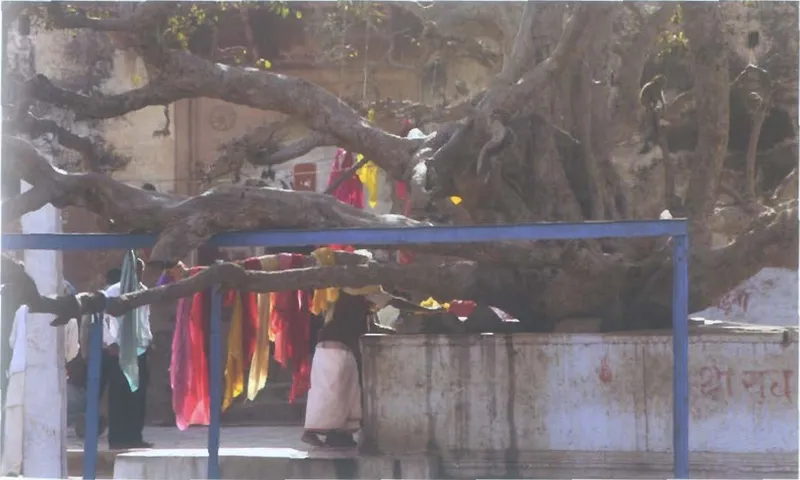
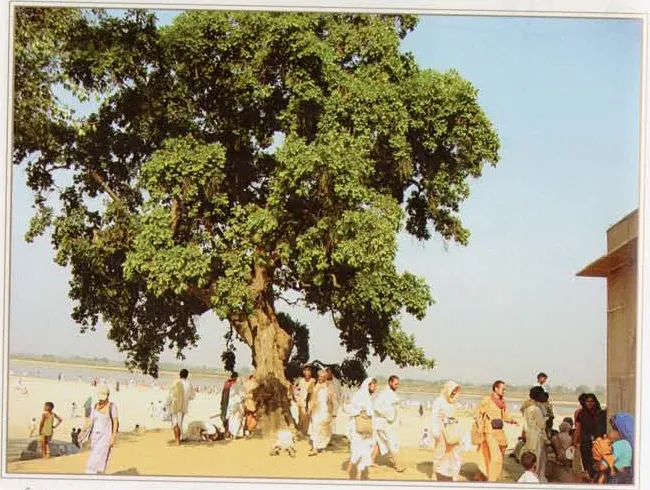
Vṛndāvana's Cīra-ghāṭa lies on the Yamunā close to Keśī-ghāṭa, with Bhramara-ghāṭa between them, according to the guidebooks.[9 +4] Read more: How Kṛṣṇa killed the horse demon Keśī → Śrī Vraja-maṇḍala Parikramā (2007) says that an old kadamba tree stands on the bank there, the tree of the pastime. Its photograph and that of Vṛndāvana, the Playground of God (2010) show a large old tree hung with cloths beside the river.[5 +3] The Bhakti-ratnākara tells a different pastime at this ghāṭa, of Rādhā, Kṛṣṇa and the sakhīs (Rādhā's friends) bathing after the rāsa, and it is only named here.[35, 36] The 2007 guidebook also lists a Cīra-kadamba on the bank near Dhīra-samīra, among three kadamba trees of Vṛndāvana.[26] The Prema-vilāsa says that Śrī Caitanya Mahāprabhu told Śrīla Lokanātha Gosvāmī to live in Vṛndāvana by Cīra-ghāṭa, the Rāsa-sthalī and a row of kadambas.[37, 38] Read more: How Śrīla Lokanātha Gosvāmī came to Vraja and stayed there →
Śrī Caitanya Mahāprabhu bathed at this ghāṭa during His visit to Vṛndāvana. In Śrīla Prabhupāda's translation:[39]
Names this place“The next morning Śrī Caitanya Mahāprabhu returned to Vṛndāvana and took His bath at Cīra-ghāṭa. He then went to Teṅtulī-talā, where He took rest.”
Śrīla Prabhupāda, Śrī Caitanya-caritāmṛta, Madhya-līlā 18.75, translation · vedabase.io
Śrīla Viśvanātha Cakravartī Ṭhākura's Vraja-rīti-cintāmaṇi names a Bhadrakālī, a form of the goddess, at the root of a kadamba in the north-west corner of Vṛndāvana. During her worship, it says, Kṛṣṇa stole the clothes and the hearts of the cowherd girls.[40] Śrīla Rūpa Gosvāmī's drama Vidagdha-mādhava recalls the pastime through the kadamba of a Bhadrakālī-tīrtha, without saying where it stood.[41]
How does the pilgrims' manual honour the kadamba?
Śrīla Nārāyaṇa Bhaṭṭa Gosvāmī's Vraja-bhakti-vilāsa gives the rites. At a Cīra-tīrtha, a holy place of the clothes, it says, the pilgrim worships the kadamba of the pastime. He ties ten cloths of different colours on it, with a mantra it ascribes to the Varāha Purāṇa, and bathes at Cīra-ghāṭa. Without this offering of cloth, it says, the pilgrimage is incomplete. The manual counts this Cīra-tīrtha among the tīrthas within Mathurā.[42] In its circuit of Vṛndāvana it adds a prayer for bathing at Cīra-ghāṭa. The prayer greets the beloved of the gopīs, adorned with cloths of many colours, and is said six times while bathing, sipping water and bowing, with an offering of cloth.[43]
Where the sources differ
The Bhāgavatam names no ghāṭa, and the later books give different places. Śrī Vraja-maṇḍala Parikramā (2007) accepts both Cīra-ghāṭas, saying that the same pastime takes place in different ages. Vṛndāvana, the Playground of God (2010) says that the place more generally accepted lies further up the Yamunā, where there is a Kātyāyanī Deity.[9 +5] The accounts are set side by side here:
Accounts differ Where Kṛṣṇa took the clothes of the girls after their Kātyāyanī vow (ŚB 10.22): at this Cīra-ghāṭa up the river, at the Cīra-ghāṭa of Vṛndāvana, or elsewhere.
- Śrīmad-Bhāgavatam 10.22.2-9On the bank of the Kālindī (Yamunā), at a nīpa (kadamba) tree; no ghāṭa is named.
- Śrīla Jīva Gosvāmī, Laghu-vaiṣṇava-toṣaṇī on 10.22.2At the ghāṭa of Vraja famous in his day by the name of the goddess Ghaṭṭa-vāsinī; no Cīra-ghāṭa, no distance.
- Padma Purāṇa, Pātāla 69.29-30In the fourth, north-eastern petal of the eight-petalled ring within Vṛndāraṇya; no ghāṭa named.
- Bhakti-ratnākara, Fifth Wave (printed p.269)At a Cīra-ghāṭa up the river, between Gopī-ghāṭa (Tapovana) and Nanda-ghāṭa.
The wording of these accounts is our summary of the sources, not a published translation.
Places in this article
Cīra-ghāṭa (Vṛndāvana)
चीर-घाट (वृन्दावन)Cīra-ghāṭa is a bathing place on the Yamunā in Vṛndāvana, close to Keśī-ghāṭa.
Cīra-ghāṭa (near Śergarh)
चीर-घाट (शेरगढ़ के पास)This Cīra-ghāṭa is a bathing place on the Yamunā up the river from Vṛndāvana, near Śergarh.
Cīra-ghāṭa (eight miles up-river)
चीर-घाट (नदी में आठ मील ऊपर)Kātyāyanī-devī Mandira (Cīra-ghāṭa near Śergarh)
कात्यायनी-देवी मन्दिर (चीर-घाट, शेरगढ़ के पास)This temple of the goddess Kātyāyanī stands at the Cīra-ghāṭa near Śergarh, on the bank of the Yamunā.
Kadamba tree (Cīra-ghāṭa, Vṛndāvana)
कदम्ब वृक्ष (चीर-घाट, वृन्दावन)Photographs in guidebooks of 2007 and 2010 show an old tree on the bank of the Yamunā at Cīra-ghāṭa in Vṛndāvana, hung with many cloths.
Cīra-kadamba
चीर-कदम्बKadamba tree (Cīra-ghāṭa near Śergarh)
कदम्ब वृक्ष (चीर-घाट, शेरगढ़ के पास)A kadamba tree stands at the Cīra-ghāṭa near Śergarh, the bathing place on the Yamunā up the river from Vṛndāvana.
Questions and answers
A month-long vow kept by the unmarried girls of Vraja in the first month of winter. Each day they bathed in the Yamunā at sunrise, worshipped a sand image of the goddess Kātyāyanī and prayed for Kṛṣṇa as their husband.[1–6]
The Bhāgavatam ends the pastime with Kṛṣṇa telling the girls that their desire was fulfilled, since that was the purpose of their vow. Śrīla Prabhupāda writes that He promised to meet them in the next autumn season.[6, 14]
He tells it in chapter 22 of his Kṛṣṇa book and connects it with the rāsa dance. In 1977 he said that the gopīs' vastra-haraṇa should not be presented to ordinary people as an ordinary thing.[10, 11]
Two places carry the name. One is a ghāṭa in Vṛndāvana, where the guidebooks show an old kadamba. The other is a Cīra-ghāṭa up the river near Śergarh, with a Kātyāyanī temple, which the Bhakti-ratnākara names as the place of the vow.[5 +8]
The Vraja-rīti-cintāmaṇi names a Bhadrakālī at a kadamba in Vṛndāvana, a guidebook lists a Cīra-kadamba near Dhīra-samīra, and the Vraja-bhakti-vilāsa counts a Cīra-tīrtha among the tīrthas of Mathurā.[26 +2]
The Bhāgavatam calls them the unmarried girls of Nanda's Vraja. The Garga-saṁhitā tells the pastime of the Mithilā women born in the homes of the nine Nandas, and the Brahma-vaivarta Purāṇa with Śrī Rādhā as the leader of the gopīs.[1 +7]
Sources
- Śrīmad-Bhāgavatam 10.22.1, GRETIL
- Śrīmad-Bhāgavatam 10.22.2–3, GRETIL
- Śrīmad-Bhāgavatam 10.22.7, GRETIL
- Śrīmad-Bhāgavatam 10.22.4, GRETIL
- Śrīmad-Bhāgavatam 10.22.9, GRETIL
- Śrīmad-Bhāgavatam 10.22.27, GRETIL
- Śrīla Prabhupāda, Kṛṣṇa, the Supreme Personality of Godhead, Chapter 33, 'Description of the Rāsa Dance' (last paragraph) · vedabase.io
- Śrī Vraja-maṇḍala Parikramā (2007), PDF p. 243
- Śrī Vraja-maṇḍala Parikramā (2007), PDF p. 312
- Śrīla Prabhupāda, Room Conversation with Film Producer about Kṛṣṇa Lila, Bhubaneswar, 22 January 1977 · vedabase.io
- Śrīla Prabhupāda, Kṛṣṇa, the Supreme Personality of Godhead (Kṛṣṇa book), Chapter 22, 'Stealing the Garments of the Unmarried Gopī Girls' · vedabase.io
- Bṛhad-vaiṣṇava-toṣaṇī (Śrīla Sanātana Gosvāmī): commentary on ŚB 10.22.6-7'; the passage comments on verse 6), Bhagavata Vidya Pith edition, ed. Bhagavata Rishi and Krishna Shankar Shastri, 1996
- Laghu-vaiṣṇava-toṣaṇī (Śrīla Jīva Gosvāmī): commentary on ŚB 10.22.6-7'; the passage comments on verse 6), Bhagavata Vidya Pith edition, ed. Bhagavata Rishi and Krishna Shankar Shastri, 1996
- Śrīla Prabhupāda, Kṛṣṇa, the Supreme Personality of Godhead (Kṛṣṇa book), Chapter 22, 'Stealing the Garments of the Unmarried Gopī Girls' (Kṛṣṇa's promise) · vedabase.io
- Śrīmad-Bhāgavatam 10.22.2, GRETIL
- Śrīmad-Bhāgavatam 10.22.6, GRETIL
- Laghu-vaiṣṇava-toṣaṇī (Śrīla Jīva Gosvāmī): commentary on ŚB 10.22.1-2 (Grantha Mandira canto 10 text, part 3, label 'v.10.22.1-2, jīva-gosvāmī (laghu-vaiṣṇava-toṣaṇī)'; the words comment on verse 2), Bhagavata Vidya Pith edition, ed. Bhagavata Rishi and Krishna Shankar Shastri, 1996
- Śrīla Viśvanātha Cakravartī Ṭhākura: commentary on ŚB 10.22.7, Bhagavata Vidya Pith edition, ed. Bhagavata Rishi and Krishna Shankar Shastri, 1996
- Vaṁśīdhara: commentary on ŚB 10.22.27, Bhagavata Vidya Pith edition, ed. Bhagavata Rishi and Krishna Shankar Shastri, 1996
- Garga-saṁhitā, Mādhurya-khaṇḍa (4) 3.6, Sanskrit Wikisource
Show all 43 references
- Brahma-vaivarta Purāṇa, Kṛṣṇa-janma-khaṇḍa (4) 27.88–89, Sanskrit Wikisource
- Padma Purāṇa, Pātāla-khaṇḍa (5) 69.29-30, Sanskrit Wikisource
- Śrīla Raghunātha dāsa Gosvāmī, Vraja-vilāsa-stava, verse 84
- Śrīla Jīva Gosvāmī: commentary on ŚB 10.22.2, Bhagavata Vidya Pith edition, ed. Bhagavata Rishi and Krishna Shankar Shastri, 1996
- Vṛndāvana, the Playground of God (2010), Bhakti Caitanya Svāmī, PDF p. 177
- Śrī Vraja-maṇḍala Parikramā (2007), PDF p. 346
- Śrīla Narahari Cakravartī, Bhakti-ratnākara, Fifth Wave (pañcama taraṅga), printed p. 269 (1912 edition), 2nd ed., 1912
- Śrīla Narahari Cakravartī, Bhakti-ratnākara, Thirteenth Wave (trayodaśa taraṅga), printed p. 1025 (1912 edition), 2nd ed., 1912
- the undated parikramā notes Cīra-ghāṭa, ¶5
- the undated parikramā notes Cīra-ghāṭa, ¶10
- the undated parikramā notes Tapovana, ¶12
- The Color Guide to Vṛndāvana (2000), Written and Photographed by Rājaśekhara dāsa Brahmacārī, PDF p. 102
- Śrī Vraja-maṇḍala Parikramā (2007), PDF p. 343
- Vṛndāvana, the Playground of God (2010), Bhakti Caitanya Svāmī, PDF p. 178
- Śrīla Narahari Cakravartī, Bhakti-ratnākara, Fifth Wave, printed p. 269 (1912 edition), 2nd ed., 1912
- Śrīla Narahari Cakravartī, Bhakti-ratnākara, Fifth Wave, printed p. 325 (1912 edition), 2nd ed., 1912
- Prema-vilāsa, seventh vilāsa, printed p. 45, left column, Kolkata, 1913
- Prema-vilāsa, seventh vilāsa, printed p. 47, right column, lines 3-8, Kolkata, 1913
- Śrīla Prabhupāda, Śrī Caitanya-caritāmṛta, Madhya-līlā 18.75, translation · vedabase.io
- Śrīla Viśvanātha Cakravartī, Vraja-rīti-cintāmaṇi, sarga 2 (dvitīyaḥ sargaḥ), v. 78
- Śrīla Rūpa Gosvāmī, Vidagdha-mādhava, Act 3 (tṛtīyo 'ṅkaḥ, 'rādhā-saṅgaḥ'), prose dialogue before v.30 veṇu-nāda-vilāsaḥ v.30')
- Śrīla Nārāyaṇa Bhaṭṭa Gosvāmī, Vraja-bhakti-vilāsa, printed p. 79 (Sanskrit text after section mark ॥ ८८ ॥), 1st ed., publ. Bābā Kṛṣṇadāsa, Kusuma-sarovara, Saṁvat 2008
- Śrīla Nārāyaṇa Bhaṭṭa Gosvāmī, Vraja-bhakti-vilāsa, printed p. 227, section 73 (circuit of Vṛndāvana in the vana-yātrā), 1st ed., publ. Bābā Kṛṣṇadāsa, Kusuma-sarovara, Saṁvat 2008
Further sources
- Śrīmad-Bhāgavatam 10.22, translation by the disciples of Śrīla Prabhupāda (BBT).
- Śrīla Prabhupāda, Kṛṣṇa, the Supreme Personality of Godhead, chapters 22 and 33; Śrī Caitanya-caritāmṛta, Madhya-līlā 18.75; conversation of 22 January 1977 (BBT).
- The Canto 10 commentaries of Śrīla Sanātana Gosvāmī, Śrīla Jīva Gosvāmī, Śrīla Viśvanātha Cakravartī Ṭhākura, Śrīla Baladeva Vidyābhūṣaṇa and Vaṁśīdhara (Sanskrit), summarised, not translated.
- Garga-saṁhitā, Brahma-vaivarta and Padma Purāṇas, Vraja-vilāsa-stava, Vraja-rīti-cintāmaṇi, Vidagdha-mādhava, Bhakti-ratnākara (1912 edition), Vraja-bhakti-vilāsa: summarised from the original languages.