Śāntanu-kuṇḍa (Satohā)
शान्तनु-कुण्ड (सतोहा) Hindi name proposed
Also called Śantanu-kuṇḍa, Satohā
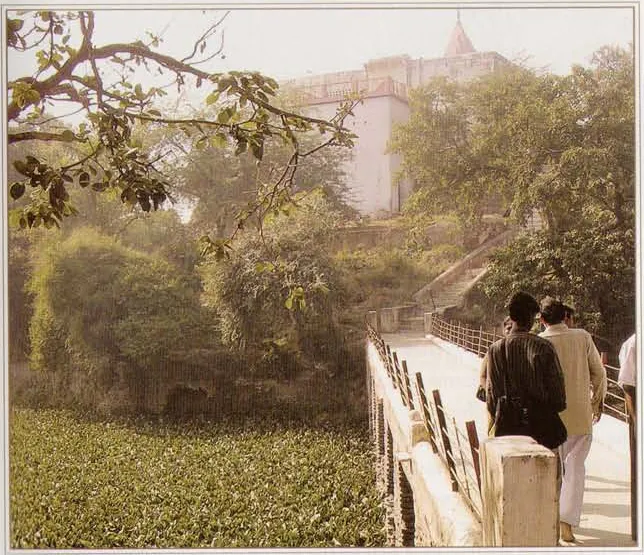
- What it is
- Śāntanu-kuṇḍa is a large kuṇḍa (sacred pond) beside the village of Satohā, on the Govardhana road about three miles from Mathurā.
- Visiting
- Śrī Vraja-maṇḍala Parikramā (2007) places Śāntanu-kuṇḍa on the Govardhana road about three miles from Mathurā, with Datihā two miles away and Khecarī-gaon one mile to the north-east.
- Places here
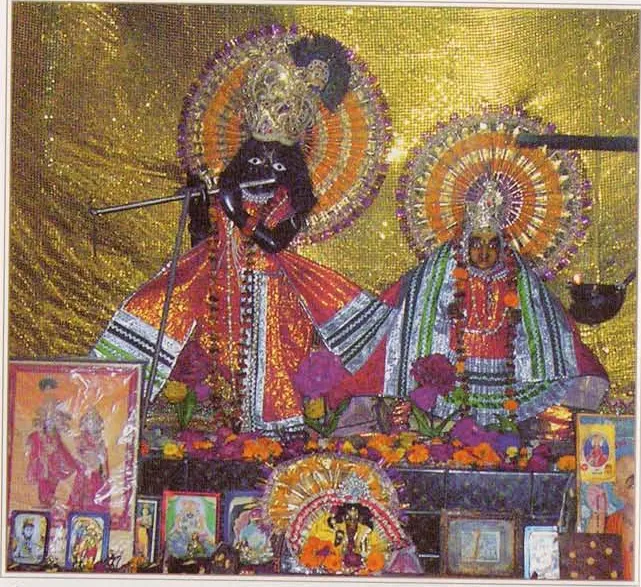
- Śāntanu-Bihārījī Mandira
In short
Śāntanu-kuṇḍa is a large kuṇḍa (sacred pond) beside the village of Satohā, on the Govardhana road about three miles from Mathurā.[1 +1] The guidebooks name it after King Śāntanu, the father of Bhīṣma, and in its middle, on a raised hill, stands the temple of Śrī Śāntanu-Bihārījī.[1 +6] According to the Bhakti-ratnākara, Śrīla Rāghava Paṇḍita Gosvāmī showed Śrīla Śrīnivāsa Ācārya and Śrīla Narottama dāsa Ṭhākura the very clear kuṇḍa of the village Sātoṅā as the place where Śāntanu Muni performed austerities.[5] The sources name different places for Śāntanu's austerities. Dated guidebooks (about 1986 and 2007) report that couples come here to pray for children and that women who wish for a child bathe in the kuṇḍa.[7 +1]
Key facts
| Kind | kuṇḍa |
|---|---|
| Region · area | Madhuvana · Satohā |
| Ācāryas | Śrīla Rāghava Paṇḍita Gosvāmī of Govardhana, Śrīla Śrīnivāsa Ācārya, Śrīla Narottama dāsa Ṭhākura, Śrīla Narahari Cakravartī Ṭhākura |
Traditional accounts
Śāntanu's austerities
According to the Bhakti-ratnākara of Śrīla Narahari Cakravartī Ṭhākura (Fifth Wave), Śrīla Rāghava Paṇḍita Gosvāmī, coming from Gandheśvarā-sthāna, pointed out the village Sātoṅā with its very clear kuṇḍa as the place of Śāntanu Muni's austerities, and then led Śrīla Śrīnivāsa Ācārya and Śrīla Narottama dāsa Ṭhākura on to Bahulāvana (summarised here, not translated). The book calls Śāntanu a muni, a sage, and mentions no son.[5] The same book names a second village printed with the same name in the Khadiravana area, where it says Śāntanu Muni worshipped Kṛṣṇa; that village and the accounts attached to the two are set out on the page of Sātoyā.[10 +2]
According to Pulinbihārī Datta's Bengali Vṛndāvana-kathā (1920), King Śāntanu performed austerities at this kuṇḍa, which people called Śā̃tihā, and obtained his son Bhīṣma (the book calls him Satyavrata) from Gaṅgā-devī. The book places the kuṇḍa near Āḍiṅ (Aḍīṅga).[6] The modern guidebooks say that Śāntanu performed austerities here for a worthy son; they differ from the scriptures on the place, as shown below.
The Varāha Purāṇa says that King Śāntanu once performed austerities at a kuṇḍa it calls Saṁpīṭhaka, west of Mathurā, setting the Sun before him; he obtained the mighty Bhīṣma and went home to Hastināpura. It does not use the names Śāntanu-kuṇḍa or Satohā, and no Vaiṣṇava or primary source found so far identifies Saṁpīṭhaka with this kuṇḍa.[13 +1] The Garga-saṁhitā says that Śāntanu obtained Bhīṣma after austerities in the forest of Madhu, in a passage that praises the land of Mathurā as a whole; it names no kuṇḍa or village (summarised here, not translated).[15]
Śāntanu, Gaṅgā and Satyavatī
Śrīmad-Bhāgavatam (Canto 9) tells that Śāntanu, a son of Pratīpa, became king, that Bhīṣma was born to him from Gaṅgā, and that Citrāṅgada was born to him from Satyavatī, the daughter of a fisherman. It mentions no austerity for a son and names no place.[16 +3]
śalaśca śāntanorāsīdgaṅgāyāṃ bhīṣma ātmavān / sarvadharmavidāṃ śreṣṭho mahābhāgavataḥ kaviḥ
From Śāntanu, through the womb of his wife named Gaṅgā, came Bhīṣma, the exalted, self-realized devotee and learned scholar.
Translation: Śrīla A.C. Bhaktivedanta Swami PrabhupādaAbout this place: The Bhāgavatam's account of Bhīṣma's birth: from Śāntanu through Gaṅgā. It mentions no austerity for a son and names no place, unlike the guidebooks and the Varāha Purāṇa.
According to Śrī Vraja-maṇḍala Parikramā (2007) and the undated parikramā notes Kumudavana, Satyavatī lived in a fisherman's house across the Yamunā, opposite Mathurā; the fisherman asked that her son should inherit the throne, and Prince Devavrata, later called Bhīṣma, went to the fisherman's house, vowed lifelong celibacy and promised the throne to her son.[7 +3] Śrīla Prabhupāda tells the vow in the same way, without naming a place (see below); where Satyavatī lived and where the vow was made could not be checked in any source.[7 +6]
Śrīla Prabhupāda
Śrīla Prabhupāda tells the story of Śāntanu, Satyavatī and Bhīṣma's vow in his lectures; he does not name this place …
Śrīla Prabhupāda tells the story of Śāntanu, Satyavatī and Bhīṣma's vow in his lectures; he does not name this place:[19 +3]
General teaching (does not name the place)Mahārāja Śantanu became attracted by Satyavatī, and he wanted to marry. But Mahārāja Śantanu had his son. So her father objected. … So Bhīṣmadeva immediately promised that "I shall never marry. Don't hesitate." So in this way he induced the fisherman to give his daughter to his father.
Śrīla Prabhupāda, Śrīmad-Bhāgavatam 1.3.21 lecture, Los Angeles, 26 September 1972 · vedabase.io
As a general teaching, not about this place, Śrīmad-Bhāgavatam says that whatever a person desires, he should worship the Supreme Personality of Godhead:[30]
General teaching (does not name the place)“A person who has broader intelligence, whether he be full of all material desire, without any material desire, or desiring liberation, must by all means worship the supreme whole, the Personality of Godhead.”
Śrīla Prabhupāda, Śrīmad-Bhāgavatam, 2.3.10, translation · vedabase.io
Visiting today
Śrī Vraja-maṇḍala Parikramā (2007) places Śāntanu-kuṇḍa on the Govardhana road about three miles from Mathurā, with Datihā two miles away and Khecarī-gaon one mile to the north-east.[1 +1] The kuṇḍa lies on the pilgrims' route from Kumudavana to Bahulāvana: the guidebook goes by way of the kuṇḍa and Gandheśvarī, and the Bhakti-ratnākara goes from Gandheśvarā-sthāna to the kuṇḍa and on to Bahulāvana.[2 +3]
According to Śrī Vraja-maṇḍala Parikramā (2007), women who wish for a child bathe in the kuṇḍa and, behind the temple, make a svastika of cow dung and perform pūjā; Vṛndāvana-Dhāma Ki Jaya! (c. 1986) says that many couples come to pray to the Deity for good children.[7 +1]
Location
| Where it is | On the Govardhana road about three miles from Mathurā[33] |
|---|
Places at Śāntanu-kuṇḍa (Satohā)
1 places
Nearby places
Mathurā · Kumudavana · Bahulāvana
Pictures
1 pictures
History
In 1883 the historian F. S. Growse described the large tank beside Satohā as faced all round with stone early in the eighteenth century by Savāī Jai Singh of Amber, much of the masonry by then in ruins. A high hill in its centre, joined to the land by a bridge, had a small temple on its summit, reached by fifty stone steps.[23] No inscription or other record of the work was found. In 1987 A. W. Entwistle reported that more than a hundred small sculptures had been recovered from the two ancient tanks at Satohā and nearby Ganeshra, among them three statuettes of Viṣṇu of the Kushana period and one of the Gupta period, and a Buddhist doorjamb from Satohā.[24]
The temple of Śrī Śāntanu-Bihārījī
The temple of Śrī Śāntanu-Bihārījī stands on the island hill in the middle of the kuṇḍa. Śrī Vraja-maṇḍala Parikramā (2007) calls its Deity Śāntanu's worshipful Lord, and Vṛndāvana-Dhāma Ki Jaya! (c. 1986) shows the Deities as Śrī Śrī Rādhā-Śantanvihārī.[1 +3] The Bhakti-ratnākara names only the kuṇḍa and mentions no temple.[25] The Deity's name differs in the dated books, as shown below.
In 1987 A. W. Entwistle saw around the base of the temple's outer wall a course of worn red sandstone with a leaf pattern, which he judged by its style to be medieval; no inscription is reported.[26] He reported, from a Hindi book of 1968 that could not be checked, that the temple was built by Mohandev, a mahant (head) of the Nāgājī branch of the Nimbārka sampradāya, and, from another book, that Ahalyā Bāī built the causeway; neither report gives a date, so both may need confirming.[26 +1]
Fairs and customs
Growse (1883) recorded that women wishing for children came to Satohā every Sunday, offered at the shrine and drew the svastika, and that a large fair was held on the sixth day of the bright fortnight of Bhādrapada; Prabhudayāl Mītal (1966) gives the same day for the fair.[23 +1] In 1920 the Vṛndāvana-kathā also reported childless women praying on Sundays before the Deity, whom it calls Santāna-bihārī.[6] Growse also describes the Pañca-tīrtha fair of Śrāvaṇa, whose pilgrims went from Viśrānti-ghāṭa to Madhuvana and on the next day to Śāntanu-kuṇḍa. The historians differ on whether this pilgrimage was still made in the twentieth century.[29]
Where the sources differ
Where Śāntanu performed his austerities: the guidebooks set them at this kuṇḍa, the Varāha Purāṇa at Saṁpīṭhaka, the …
Where Śāntanu performed his austerities: the guidebooks set them at this kuṇḍa, the Varāha Purāṇa at Saṁpīṭhaka, the Garga-saṁhitā in the forest of Madhu, and the Bhakti-ratnākara at the kuṇḍa of Sātoṅā.
Accounts differ Where Śāntanu performed his austerities: the sources name different places.
- Śrī Vraja-maṇḍala Parikramā (2007) p. 119; Vṛndāvana-Dhāma Ki Jaya! (c. 1986) p. 11; the undated parikramā notes Kumudavana; Vṛndāvana-kathā (1920) p. 121At Śāntanu-kuṇḍa, Satohā, on the Govardhana road three miles from Mathurā (the undated parikramā notes Kumudavana: on the small hill surrounded by the kuṇḍa). The Vṛndāvana-kathā puts the kuṇḍa right near Āḍiṅ (Aring) and gives its popular name as Śā̃tihā; that it is the kuṇḍa at Satohā is an editorial identification (the island temple and the Sunday visits it describes).
- Śrī Vraja-maṇḍala Parikramā (2007) p. 294 (Kāmyavana)'Nearby is Śāntanu-kuṇḍa, the place where Śāntanu performed austerities' — a kuṇḍa near Bhojana-thālī in Kāmyavana.
- Varāha Purāṇa 157.41, 48-49At Saṁpīṭhaka, a kuṇḍa listed right after Tālavana, west of Mathurā.
- Garga-saṁhitā 5.25.23Right here in the auspicious forest of Madhu, i.e. the land of Mathurā in Nārada's glorification.
The wording of these accounts is our summary of the sources, not a published translation.
Accounts differ What Śāntanu worshipped in his austerities for a son.
- Varāha Purāṇa 157.44-49He set Āditya, the Sun, in front of him ('ādityaṁ tu puraḥ sthāpya') and obtained Bhīṣma; the passage is about the Sun's presence and boons at Saṁpīṭhaka.
- Śrī Vraja-maṇḍala Parikramā (2007), pp. 119, 121'Mahārāja Śāntanu worshipped Bhagavān here with the desire to beget a son'; the temple in the kuṇḍa is of 'Śāntanu's worshipful deity, Śrī Śāntanu-Bihārījī'.
- Garga-saṁhitā 5.25.23; Vṛndāvana-Dhāma Ki Jaya! (c. 1986) p. 11-12; the undated parikramā notes KumudavanaAusterities only; no object of worship named.
Accounts differ Why Gaṅgā was no longer with Śāntanu when he sought to marry Satyavatī.
- Śrī Vraja-maṇḍala Parikramā (2007) p. 120; the undated parikramā notes Kumudavana'Bhīṣma's mother was Gaṅgā, however, for a particular reason she left Śāntanu.'
- Śrīla Prabhupāda, Bhagavad-gītā 2.10 lecture, London, 16 August 1973Gaṅgā had married him on condition that she could throw all their children into the Ganges; when he stopped her at Bhīṣma's birth she left ('Then I am going'), and he was 'wifeless'.
- Śrīla Prabhupāda, Caitanya-caritāmṛta Madhya 20.353-354 lecture, New York, 27 December 1966Śāntanu wanted to marry again 'after the death of his mother' (Bhīṣma's mother, Gaṅgā).
Accounts differ The name of the temple's deity in the dated sources (it bears on since when the deity has been called Śāntanu-Bihārī).
- F. S. Growse, Mathurá (1883), a historianGrowse describes a small temple on the summit of the island; he names no deity.
- Pulinbihārī Datta, Vṛndāvana-kathā (1920), printed p. 121barren women pray for children on Sundays before 'Santāna-bihārī Ṭhākura' (সন্তান-বিহারী ঠাকুর), whose temple stands on an island in the lake.
- P. Mītal (1966), a historianMītal names the temple on the high mound in the middle of Śāntanu-kuṇḍa as that of Śrī Śāntanu-vihārī.
- A. W. Entwistle (1987), a historianEntwistle calls it the temple of Śāntanu-Bihārī.
Accounts differ The day of the fair at Śāntanu-kuṇḍa (Satohā).
- F. S. Growse, Mathurá (1883), a historianGrowse says a large fair is held there on the sixth of the bright half of Bhādra.
- Mītal (1966), p. 102A fair is held on Bhādrapada śukla 6.
- A. W. Entwistle (1987), a historianEntwistle describes a vigil and an early-morning bath in the lake followed by a fair, on the day he calls Santan Saptami, in the bright half of Bhādra, not the dark half that the Varāha Purāṇa names.
- Varāha Purāṇa 157.45-47Bathing at Saṁpīṭhaka on the seventh of the dark fortnight (the month Bhādrapada is named in v.45) and on a Sunday that falls on a seventh; no fair is mentioned.
Accounts differ Whether the Pañca-tīrtha (pañcatīrthī) parikramā of Śrāvaṇa śukla 5, whose second day went to Satohā, continued in the 20th century.
- F. S. Growse, Mathurá (1883), a historianGrowse describes the custom of his day: the Pañca-tīrtha fair begins on the fifth of the bright half of Śrāvaṇa and goes to Madhuvana, then to Śāntanu-kuṇḍa at Satohā and the Jñāna-vāpī, then to Gokarṇeśvara, Garuḍa-Govinda and Brahma-kuṇḍa.
- Prabhudayāl Mītal (1966), a historianMītal describes the five-day parikramā of the fifth of the bright half of Śrāvaṇa as still performed, chiefly by women: Madhuvana, Satohā, Gokarṇa Mahādeva, Vṛndāvana and Garuḍa-Govinda.
- A. W. Entwistle (1987), a historianEntwistle says that even this custom was given up during the first half of the twentieth century.
References
33 references
- Śrī Vraja-maṇḍala Parikramā (2007), PDF p. 72
- Śrī Vraja-maṇḍala Parikramā (2007), PDF p. 71
- Vṛndāvana-Dhāma Ki Jaya! (c. 1986), by Dhruva Mahārāja dāsa, PDF p. 29
- the undated parikramā notes Kumudavana, ¶42
- Śrīla Narahari Cakravartī, Bhakti-ratnākara, Fifth Wave (pañcama taraṅga), 1912 ed. pp. 188-189, 2nd ed., 1912
- Pulinbihārī Datta, ch. 8 (aṣṭama paricheda), printed p. 121
- Śrī Vraja-maṇḍala Parikramā (2007), PDF p. 73
- the undated parikramā notes Kumudavana, ¶43
- Vṛndāvana-Dhāma Ki Jaya! (c. 1986), by Dhruva Mahārāja dāsa, PDF p. 30
- Śrīla Narahari Cakravartī, Bhakti-ratnākara, Fifth Wave (pañcama taraṅga), Khadiravana section, 1912 ed. p. 256, 2nd ed., 1912
- Śrī Vraja-maṇḍala Parikramā (2007), PDF p. 185
- Śrī Vraja-maṇḍala Parikramā (2007), PDF p. 186
- Varāha Purāṇa, adhyāya 157, verses 46-50, Sanskrit Wikisource
- Varāha Purāṇa, adhyāya 157, verses 41-45, Sanskrit Wikisource
- Garga-saṁhitā, Mathurā-khaṇḍa (5) 25.23 (chapter 'Śrī-Mathurā-māhātmya-varṇana'), Sanskrit Wikisource
- Śrīmad-Bhāgavatam ŚB 9.22.12-13, GRETIL
- Śrīmad-Bhāgavatam ŚB 9.22.19, GRETIL
- Śrīmad-Bhāgavatam ŚB 9.22.20, GRETIL
- Śrīla Prabhupāda, Śrīmad-Bhāgavatam, 9.22.20, purport · vedabase.io
- Śrīla Prabhupāda, Śrīmad-Bhāgavatam 1.3.21 lecture, Los Angeles, 26 September 1972 · vedabase.io
Show all 33 references
- Śrīla Prabhupāda, Bhagavad-gītā 2.10 lecture, London, 16 August 1973 · vedabase.io
- Śrīla Prabhupāda, Śrī Caitanya-caritāmṛta, Madhya-līlā 20.353–354 lecture, New York, 27 December 1966 · vedabase.io
- Mathurá (1883), F. S. Growse, B.C.S., M.A. Oxon., C.I.E. (as the title page gives him, p. 299
- A. W. Entwistle, section §14 'Sites west and north-west of Maholi', printed pp. 128-129, Egbert Forsten, Groningen, 1987
- Śrīla Narahari Cakravartī, Bhakti-ratnākara, Fifth Wave, printed pp. 188–189 (1912 ed.), 2nd ed., 1912
- A. W. Entwistle, §5 Shantanukund (Satoha), printed p. 334, Egbert Forsten, Groningen, 1987
- A. W. Entwistle, ch. 8, §5 'Shantanukund (Satoha)', printed p. 334, Egbert Forsten, Groningen, 1987
- Prabhudayāl Mītal, 'Braj-yātrā': '2—Satohā-Śāntanukuṇḍa (yātrā kā dūsrā mukām)', printed p. 102
- Mathurá (1883), F. S. Growse, B.C.S., M.A. Oxon., C.I.E. (as the title page gives him, p. 180
- Śrīla Prabhupāda, Śrīmad-Bhāgavatam, 2.3.10, translation · vedabase.io
- Śrī Vraja-maṇḍala Parikramā (2007), PDF p. 24
- the undated parikramā notes Kumudavana, ¶12
- Śrī Vraja-maṇḍala Parikramā (2007), p. 118-119